
A solid flow meter measures the mass flow of dry bulk material — cement, soybean meal, fly ash, plastic pellets, sugar, mined coal — moving through a pipe, chute, or on a belt. Unlike liquid flow, there is no single dominant technology: impact-plate, microwave Doppler, Coriolis, belt-weigher (LIW), and nucleonic meters all have their place, and picking the wrong one will cost you 20–30 % accuracy on a tonne-per-hour basis.
This guide is built around a six-technology comparison and a material-driven decision matrix. Use it to narrow down to one or two candidates before pricing — most procurement mistakes we see come from sizing a microwave meter for a slow gravity chute, or specifying an impact plate for an abrasive that destroys plates in three months.
Contents
- What Counts as a “Solid Flow”
- Six Technologies Compared
- Impact-Plate Solid Flow Meter
- Microwave Doppler Solid Flow Meter
- Belt-Weigher and Loss-in-Weight
- Decision Matrix by Material
- Installation and Calibration
- Featured Solid Flow Solutions
- FAQ
What Counts as a “Solid Flow”
A solid flow is a dry, particulate stream where the material is conveyed by gravity, mechanical (screw, belt, drag-chain), or pneumatic (dilute or dense phase) means. Particle size ranges from sub-µm fly ash up to 50 mm coal lumps, bulk densities from 50 kg/m³ for puffed rice to 2400 kg/m³ for iron ore, and flow rates from a few kg/h on a feeder weigher to 5000 t/h on a coal handling belt.
Two physical realities drive the technology choice:
- Velocity profile. Pneumatic-conveyed solids move at 15–25 m/s; gravity-fed solids in a chute fall at √(2gh)≈3–6 m/s; on a belt they move at 1–3 m/s. Each speed range favours different sensor physics.
- Density variability. Bulk density of the same material can vary ±10 % with moisture, packing, and aeration. Volumetric meters (microwave, ultrasonic) can not correct for this; mass-based meters (impact plate, Coriolis, belt scale) can.
Six Technologies Compared
Six measurement principles cover almost every solid flow application. Pick by conveying mode first, then by material abrasiveness, then by accuracy class.
| Technology | Principle | Conveying mode | Typical accuracy | Range | Sweet spot |
|---|---|---|---|---|---|
| Impact plate | Force on a deflector plate | Gravity chute | ±0.5–1 % FS | 1–500 t/h | Cement, grain, sugar |
| Microwave Doppler | Reflected frequency shift | Pneumatic / gravity | ±2–5 % FS | 0.05–200 t/h | Fly ash, dust, fine powder |
| Coriolis (mass) | Coriolis force on rotating measuring wheel | Free-falling stream | ±0.5 % FS | 0.1–600 t/h | Free-flowing granules, plastics |
| Belt weigher | Load cell × belt speed | Conveyor belt | ±0.5–2 % FS | 5–10000 t/h | Mining, ports, power plants |
| Loss-in-weight (LIW) | Differential of feed-hopper mass | Continuous batch | ±0.25 % FS | 0.01–50 t/h | Recipe dosing in plastics & food |
| Nucleonic (γ-attenuation) | Gamma absorption | Pipe / chute | ±2–4 % FS | 5–500 t/h | Hot, abrasive, sealed pipes |
For pneumatic dust collection lines and fly-ash transport from boilers, microwave is almost the only choice — the sensor is non-intrusive and survives the abrasive stream. For a gravity chute under a silo discharge, impact plate is the workhorse. The other four fill specific niches and are usually only justified by accuracy class or material constraints.
Impact-Plate Solid Flow Meter
An impact-plate meter measures the horizontal force exerted by a falling solid stream on an angled deflector plate. The plate is mounted at 30–45 ° from vertical inside the chute body; the deflection is sensed by a strain-gauge load cell or LVDT. Because force = mass × acceleration, and the falling velocity is fixed by the drop height (v=√(2gh)), the force is directly proportional to mass flow rate — no density correction needed.
For a 1.0 m drop, falling velocity is 4.43 m/s; a flow of 100 t/h (27.8 kg/s) generates 27.8 × 4.43 ≈ 123 N of horizontal impact force, well within typical 50–500 N load cell ranges. The meter works on cement, flour, fly ash, sand, soybean meal, polymer pellets, and any free-flowing granular material that doesn’t bridge.
- Strengths. Direct mass measurement, no density correction, ±0.5 % accuracy on a once-yearly cal, 1–500 t/h range, ATEX zone 21 dust available.
- Weaknesses. Plate wears on hard abrasives (silica sand, alumina, slag) — replace plate every 3–6 months. Sensitive to non-uniform feed: a plug or surge biases the reading. Doesn’t work on cohesive sticky materials that adhere to the plate.
Microwave Doppler Solid Flow Meter
Microwave solid flow meters fire a 24 GHz signal across the moving stream and read the frequency shift of the backscatter. The shift is proportional to particle velocity (Doppler effect), and the amplitude is proportional to the volumetric concentration of solids in the beam. Multiplying velocity × concentration × cross-sectional area gives volumetric flow; combined with a stored bulk density it becomes a mass-flow indication.
The killer use case is pneumatic transport of fine, abrasive, or hot powders where no instrument can sit inside the pipe. (For static silo level on the same powders, a powder level sensor is the right tool — flow meters measure motion, level sensors measure inventory.) A microwave head bolts to a 1½” half-coupling on the pipe wall — completely non-intrusive, no wear, no pressure drop. We see it on fly-ash extraction from ESPs, alumina pneumatic lines in smelters, cement raw-meal feeds, and granular catalyst dosing.
- Strengths. Zero wear, non-intrusive, handles 200 °C process pipes, works on streams from 5 to 25 m/s.
- Weaknesses. Requires a stable bulk density for mass-flow accuracy (±2–5 % FS typical). Beam path partially blocked by buildup on the antenna window — schedule cleaning.
For solids inside a slurry stream rather than a dry stream, see our slurry solids flow meter guide — the physics shifts to electromagnetic and Coriolis because the carrier is liquid.
Belt-Weigher and Loss-in-Weight
Belt-weigher (also called a “weightometer”) is the oldest and most accurate solid flow meter at high tonnages. A weighbridge frame sits under a section of the conveyor belt; load cells read the weight of material on the belt; a tachometer reads belt speed. Mass flow = belt loading × speed. With a multi-idler bridge and modern signal processing, ±0.25 % accuracy is achievable on coal, iron ore, limestone, and grain at 1000 t/h plus.
Loss-in-weight (LIW) feeders work the opposite way — the entire feed hopper sits on load cells, and the controller measures how fast the hopper is losing mass. Used for recipe dosing in plastics compounding, food blending, and pharma where ±0.25 % short-term accuracy on 0.01–50 t/h matters more than total throughput.
Both technologies are gravimetric (true mass), so they don’t drift with material density. Their weakness is mechanical: belt slip, load-cell zero drift, and hopper refill cycling all eat accuracy if not properly engineered.
Decision Matrix by Material
Once the conveying mode is fixed, the material itself usually narrows to one or two candidates. The matrix below reflects what we specify in real projects, not a textbook ideal.
| Material | Conveying | Recommended (1st) | Backup (2nd) | Avoid |
|---|---|---|---|---|
| Cement raw meal | Air slide / pneumatic | Microwave Doppler | Coriolis | Impact plate (abrasion) |
| Cement clinker | Belt | Belt weigher | Impact plate | Microwave (lump size) |
| Fly ash from ESP | Pneumatic | Microwave Doppler | Coriolis (drop section) | Belt weigher (n/a) |
| Coal at port handling | Belt | Belt weigher | Nucleonic (sealed bin) | Impact plate |
| Soybean / wheat / rice | Gravity chute | Impact plate | Coriolis | Microwave (low density) |
| Plastic pellets | Gravity / pneumatic | Coriolis | LIW | Impact (plate hammering) |
| Sugar | Gravity chute | Impact plate | LIW | Microwave (cohesion) |
| Alumina | Pneumatic dense phase | Microwave Doppler | Coriolis | Belt (n/a) |
| Calcium carbonate / limestone | Belt / chute | Belt weigher | Impact plate (HC plate) | Microwave (variable density) |
| Iron ore | Belt | Belt weigher | Nucleonic | Impact plate |
For sticky / cohesive materials (wet sand, hygroscopic salts, some pharmaceutical excipients) we usually recommend LIW — the dosing accuracy is independent of stream behaviour, and the feed screw can be tuned to the material instead of forced into a pre-engineered chute geometry.
Installation and Calibration
Solid flow meter accuracy is dominated by installation, not by the sensor brand. Three rules cover 80 % of the mistakes we see in the field:
- Free-fall stabilisation distance. Impact-plate and Coriolis solid meters need 0.8–1.2 m of vertical free fall above the sensor so the stream reaches a stable velocity. Less than 0.5 m and the reading bounces with the upstream feeder cycle.
- Pneumatic line straight run. Microwave heads need 5×D straight pipe upstream and 3×D downstream so the dust cloud is reasonably uniform across the cross-section. Mounting next to an elbow swings the reading ±15 %.
- Belt-weigher idler alignment. The weighbridge idlers must be coplanar with the upstream and downstream idlers within 0.5 mm. A dropped idler 5 m upstream introduces a slope effect that can shift the reading 1–2 %.
Calibration is by drop test or pre-weighed material run. For an impact plate or Coriolis: pass a known mass of material (e.g. 1 t out of a load cell silo) through the meter and compare the totaliser reading. For a belt weigher: a chain weight or test-weight run on a stopped belt sets the zero, and a material run sets the span. Repeat span checks every 6 months — gravity wear on liners and belt covers will drift the zero by 0.5–1 % per year.
For broader material handling context — feed control, dust suppression, and silo level monitoring around a solid flow loop — see our bulk solids powder level sensor guide and the radar level sensor for solids overview.
Featured Solid Flow Solutions
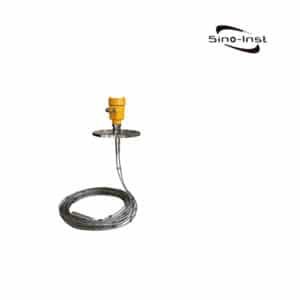
Bulk Solids Powder Level Sensor
SIRD-703 dust-tolerant 80 GHz radar pairs with solid flow meters in cement and fly-ash plants for upstream silo level. 30 m range, ATEX zone 20, 4–20 mA + Modbus.

SIRD-804 Radar Solid Level Sensor
120 GHz FMCW radar for tall silos with steep cone discharge. Narrow 4 ° beam clears chute geometry; ideal upstream of impact-plate flow meters in clinker and limestone bins.
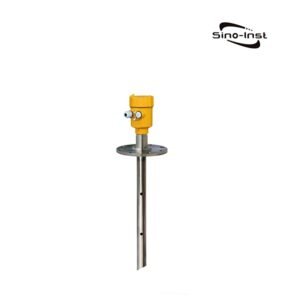
SIRD-805 Radar Slurry Level Sensor
When solids are conveyed in a liquid carrier (mining tailings, FGD slurry, paper stock), the upstream silo / tank level still needs supervision — SIRD-805 80 GHz radar handles slurry surfaces and dust together.
FAQ
How accurate is a solid flow meter?
Top-class belt weighers and LIW feeders reach ±0.25 % FS with proper installation. Impact-plate and Coriolis meters typically run ±0.5–1 % FS. Microwave Doppler is ±2–5 % FS — its strength is non-intrusion in pneumatic streams, not headline accuracy.
Can a solid flow meter measure pneumatic dense-phase transport?
Microwave Doppler is the practical choice. Coriolis works above ground in a bypass drop-section but adds 1–2 m of vertical real estate. Impact-plate is a non-starter — there is no free-fall stream.
What is the difference between an impact-plate and a Coriolis solid flow meter?
Impact-plate uses a static deflector and a load cell — measuring the impulse force. Coriolis solid flow meters use a powered, rotating measuring wheel; the deflection torque on the wheel scales with mass flow. Coriolis handles cohesive materials better and gives ±0.5 % accuracy at low rates; impact plate is cheaper and simpler at higher rates.
Do I need to recalibrate the meter when material changes?
Mass-based meters (impact plate, Coriolis, belt weigher) need only a span check after a material change because mass flow is independent of bulk density. Volumetric meters (microwave) need a new bulk-density entry and ideally a span run with the new material.
What’s the minimum flow rate that an impact-plate meter can detect?
Practical low-end is around 1 t/h on a 100 mm diameter chute with a 1 m drop. Below that the impact force falls under the load-cell signal-to-noise floor. For sub-1 t/h dosing, switch to LIW.
Is a microwave solid flow meter ATEX safe for cement / fly-ash dust?
Yes — most are certified for zone 21/22 dust-Ex. The 24 GHz emission is below the minimum ignition energy of typical organic and mineral dusts. Cement, fly ash, alumina, and silica flour are routinely measured with the antenna in direct contact with the pipe wall.
Request a Quote

Wu Peng, born in 1980, is a highly respected and accomplished male engineer with extensive experience in the field of automation. With over 20 years of industry experience, Wu has made significant contributions to both academia and engineering projects.
Throughout his career, Wu Peng has participated in numerous national and international engineering projects. Some of his most notable projects include the development of an intelligent control system for oil refineries, the design of a cutting-edge distributed control system for petrochemical plants, and the optimization of control algorithms for natural gas pipelines.