
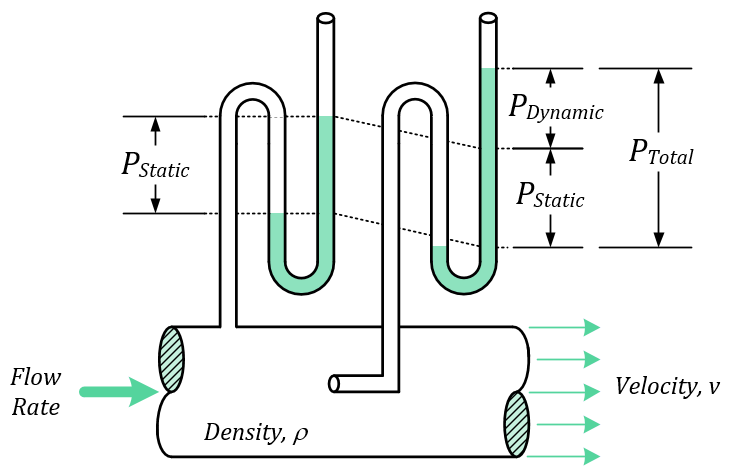
Static, dynamic, and total pressure are three flavours of the same scalar — but they appear at different ports of a Pitot-static probe, drive different process instruments, and trip up new HVAC and fluid-mechanics engineers because the textbook prose hides the practical mapping. This page leads with a three-way comparison table, then walks the formulas, the Pitot anatomy, an HVAC duct traverse example, and what pressure gauges actually read.
Static vs Dynamic vs Total Pressure: Comparison Table
The fastest answer, before any equations. Use this table to decide which port, sensor, and equation matches the engineering problem in front of you.
| Quantity | Symbol | What it Measures | Typical Sensor / Port | Where it Shows Up |
|---|---|---|---|---|
| Static pressure | ps | Pressure exerted by a fluid at rest on the pipe or duct wall, normal to flow | Wall tap, gauge transmitter, manometer static leg | Process gauges, HVAC duct readings, tank pressures |
| Dynamic pressure | q or pd | Kinetic energy density of the moving fluid, ½ρv² | Pitot-static probe — difference between impact and static ports | Flow meters (DP-type), aircraft airspeed, fan curves |
| Total pressure | p0 or pt | Static + dynamic, the energy if the fluid were brought to rest isentropically | Forward-facing impact port (Pitot tube) | Aerodynamics, compressor inlet, turbine stages |
The defining identity (incompressible, low-Mach): p0 = ps + ½ρv². Knowing any two of the three, you can solve for the third. A Pitot-style averaging probe measures both p0 and ps in the same body and outputs the difference (the dynamic head) to a DP transmitter.
Contents
- Comparison table (above)
- Static pressure: force at rest on pipe and tank walls
- Dynamic pressure: kinetic energy and its formula
- Total pressure and Bernoulli’s equation
- Pitot-static tube anatomy
- Static pressure in HVAC fans and ducts
- What pressure gauges actually measure
- HVAC duct velocity from a Pitot traverse
- Three misconceptions engineers still get wrong
- FAQ
- Featured pressure & flow instruments
Static Pressure: Force at Rest on Pipe and Tank Walls
Static pressure is the pressure a fluid exerts perpendicular to a surface that is not moving with the flow — the pipe wall, the duct wall, the diaphragm of a wall-mounted gauge. It exists whether the fluid is moving or stationary. For a fluid at rest under gravity, ps = ρgh; for a closed pressurized tank, it is whatever the regulator allows.
Static pressure is what process gauges, transmitters, and most safety devices read by default. The port faces sideways into the flow, so kinetic energy contributes nothing to the signal. The static port on a Pitot-static probe — those small holes on the side of the probe body — does the same job inside a moving stream.
- Units: Pa, kPa, bar, psi, “in WC” (inches of water column in HVAC), mm Hg (vacuum and medical).
- Sensor: gauge pressure transmitter, absolute pressure transmitter, or the static side of a differential transmitter.
- Process examples: tank head pressure, pump suction/discharge static, distillation column pressure, HVAC duct static.
Dynamic Pressure: Kinetic Energy and Its Formula
Dynamic pressure is the kinetic energy of the moving fluid expressed as a pressure. For an incompressible flow at low Mach number:
q = ½ ρ v²
- ρ = fluid density (kg/m³)
- v = local fluid velocity (m/s)
- q = dynamic pressure (Pa)
Dynamic pressure is zero when the fluid is at rest, and rises with v². Doubling velocity quadruples the dynamic head — which is why orifice plate, Venturi, and Pitot-style DP flow meters are intrinsically square-root devices, not linear ones. The 4–20 mA output that drives the loop has to be linearised in the transmitter or the DCS; see our linear-to-sqrt converter tool for the math.
For air at standard density (1.20 kg/m³) and 10 m/s in a duct, q = 0.5 × 1.20 × 100 = 60 Pa. For water at 1000 kg/m³ and 2 m/s in a pipe, q = 2000 Pa = 2 kPa. The factor of 800× between gas and liquid dynamic head explains why air-velocity Pitot tubes need very sensitive DP cells while water-velocity Pitots can use standard-range transmitters.
Total Pressure and Bernoulli’s Equation
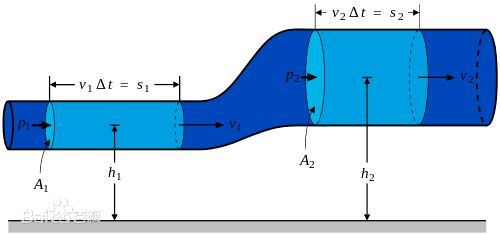
Total pressure is the static + dynamic sum at a point. It is also the pressure you would read if you could decelerate the fluid to zero velocity isentropically — no friction, no heat exchange. Bernoulli’s equation says total pressure is conserved along a streamline of a steady, incompressible, frictionless flow:
ps + ½ρv² + ρgz = constant
The ρgz term is the elevation head; in a horizontal pipe or HVAC duct it drops out and the equation simplifies to p0 = ps + q. In real pipes, friction and turbulence make total pressure decrease in the flow direction — that decrease is the line’s friction head, which is what pumps and fans actually have to provide. The relationship between line static pressure and the resulting flow is covered in detail in our flow rate and pressure reference.
For compressible flows above Mach 0.3, the simple formula understates total pressure. Aerodynamicists use the isentropic relation p0/ps = (1 + (γ−1)/2 × M²)γ/(γ−1). For most HVAC and process work, Mach is well under 0.1 and the incompressible form is fine.
Pitot-Static Tube Anatomy: Which Port Reads Which
A Pitot-static probe is two tubes in one body. The forward-facing impact port stagnates the flow at the tip and reads total pressure p0. The flush side holes — typically a ring of 4 to 8 — read the wall static ps. A DP transmitter across the two ports outputs the dynamic head q directly. From q you back out velocity by v = √(2q/ρ).
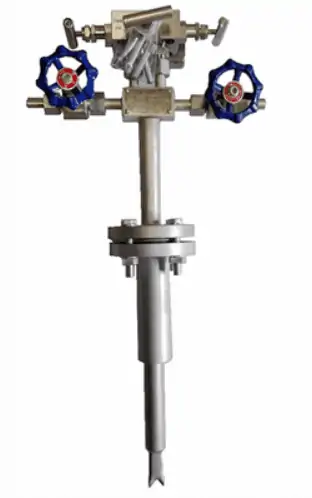
Misalignment costs accuracy fast. A ±5° yaw on a single-port Pitot is roughly 1% error on velocity; ±15° is closer to 8–10%. Averaging Pitot tubes (Verabar, Annubar, V-cone variants) place multiple impact ports across a chord to reduce both alignment sensitivity and the impact of non-uniform velocity profiles. For straight-pipe rules see our flow-meter straight-pipe requirements note, and our V-Cone flow meter page for the contraction-based variant.
Static Pressure in HVAC Fans and Ducts
In HVAC, “static pressure” is almost always referenced to the duct wall, and the design target is the pressure the fan has to supply to overcome the system resistance. Typical numbers:
- Residential furnace / AC: 0.5 in WC (125 Pa) is a common rated external static pressure.
- Light commercial RTU: 0.8–1.5 in WC (200–375 Pa).
- VAV systems at the fan: 2–4 in WC (500–1000 Pa).
- High-pressure plenum or dust collection: 6–10 in WC (1.5–2.5 kPa).
“Total” external static pressure on a fan curve is supply-side static plus return-side static, both measured to the duct wall — not the velocity pressure. Velocity pressure (the dynamic head from the fan outlet) is separate, and fan-total pressure rise is the sum of the two. Confusing the two is the most common HVAC commissioning mistake. For chilled-water side energy accounting, see how flow and ΔT combine in our BTU meter for chilled water note.
What Pressure Gauges Actually Measure
A standard process gauge, gauge transmitter, or absolute transmitter mounted on a wall tap reads static pressure. The diaphragm sees fluid normal to its face from a side port, so the kinetic component has no projection onto the sensing surface.
To read dynamic or total pressure you need a probe that intentionally faces the flow:
- An impact port alone (a forward-facing tube) reads total pressure.
- A static wall tap reads static pressure.
- The DP between an impact port and a static port reads dynamic pressure directly.
- A differential pressure flow calculation across an orifice, Venturi, or V-cone is the same physics — Bernoulli applied across an area contraction.
HVAC Duct Velocity From a Pitot Traverse
Round duct, 400 mm ID, supply air at 25 °C. Pitot-static traverse shows an average dynamic head of 38 Pa across the standard log-Chebyshev points. What is the air velocity and volumetric flow?
- Air density at 25 °C ≈ 1.184 kg/m³.
- v = √(2q/ρ) = √(2 × 38 / 1.184) = √(64.2) = 8.01 m/s.
- Cross-section A = π(0.4/2)² = 0.1257 m².
- Q = v × A = 8.01 × 0.1257 = 1.007 m³/s = 3623 m³/h = 2133 CFM.
If the air is hotter or cooler than 25 °C, correct ρ before computing v. Around 80 °C supply air the density is ~12% lower, which gives a ~6% higher velocity for the same measured dynamic head — small but enough to matter for VAV setpoints.
Three Misconceptions Engineers Still Get Wrong
- “Dynamic pressure is what a gauge reads when the fluid is moving.” No — a wall-mounted gauge reads static pressure whether the fluid moves or not. Dynamic head only shows when a forward-facing impact probe is involved.
- “Total pressure equals static pressure plus the pump pressure.” No — total pressure is the energy per unit volume at a point, not a pump-curve quantity. The pump curve specifies the pressure rise (Δp0) it adds between suction and discharge.
- “At higher velocity the static pressure goes up.” The opposite. By Bernoulli, where v rises (e.g. at an orifice throat or in a Venturi neck) static pressure falls so that total pressure stays constant. That fall is exactly what DP flow meters measure.
FAQ
What is the difference between static and dynamic pressure?
Static pressure is the force the fluid exerts on a surface that is not moving with the flow. Dynamic pressure is the kinetic-energy contribution from the fluid’s motion, ½ρv². The two add to give total pressure: p0 = ps + ½ρv².
What is the difference between static pressure and dynamic pressure in a fan?
Fan static pressure is the wall-referenced pressure the fan must supply to push air through the ductwork against system resistance. Fan dynamic pressure (also called velocity pressure) is the kinetic head at the fan outlet, ½ρv² evaluated at outlet velocity. Fan-total pressure rise is the sum — and is what the fan curve plots against flow.
Do pressure gauges measure static or dynamic pressure?
Standard wall-mounted process gauges and transmitters read static pressure. To read dynamic pressure you need a Pitot-style probe wired through a DP transmitter across the impact and static ports. To read total pressure alone you need a forward-facing impact port without a paired static port.
What is total pressure used for?
Total pressure is used in aerodynamics (airspeed via Pitot tube), turbomachinery (compressor and turbine inlet/outlet states), and as the reference for Bernoulli energy balances. In incompressible HVAC and water systems, total pressure equals static + dynamic and is the quantity conserved between two points on a frictionless streamline.
Why do flow meters need dynamic pressure?
DP-type flow meters (orifice plate, Venturi, V-cone, Pitot, averaging Pitot) infer velocity from the dynamic head created by an area change or a stagnation point. Q = K √(ΔP/ρ), so the meter is intrinsically square-root and needs accurate density correction for compressible fluids.
Featured Pressure & Flow Instruments

SMT3151 Gauge Pressure Transmitter
±0.075% FS | 4–20 mA HART | Reads static pipe/tank pressure to atmosphere, configurable range from kPa to MPa.
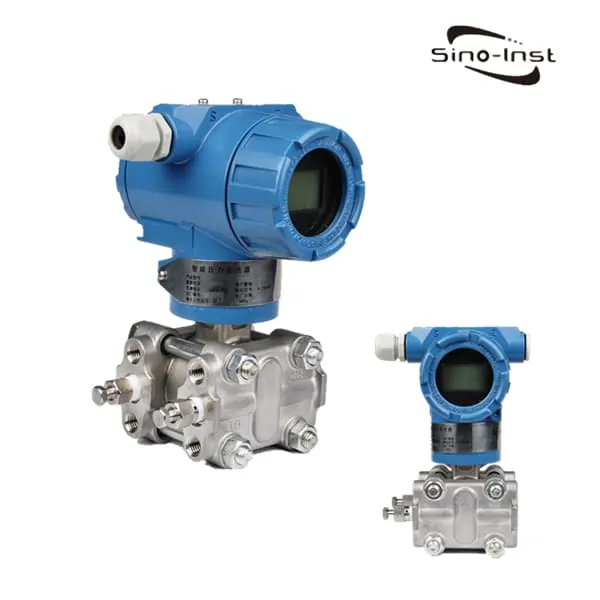
SMT3151DP DP Transmitter
±0.075% FS | 4–20 mA HART | Pairs with Pitot or orifice ports to deliver dynamic head; spans from 0–0.5 kPa up to 0–40 MPa.
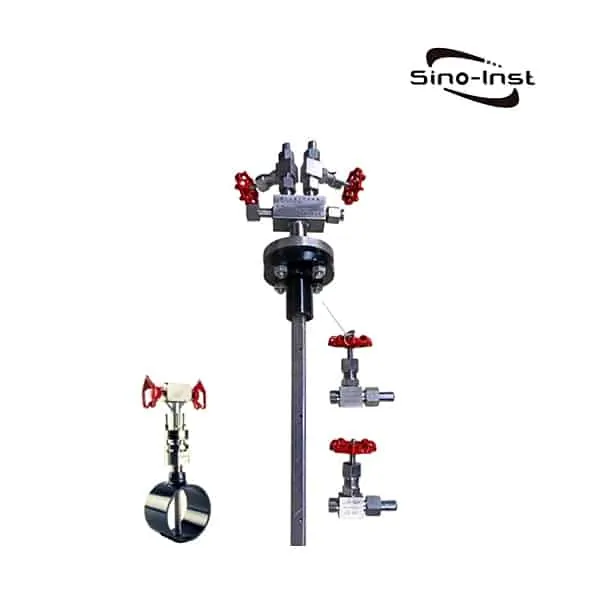
Verabar Averaging Pitot
DN50–DN3000 | Multi-port impact + static | Built-in DP output for direct dynamic-head reading on liquid, gas, and steam.
Need a Pressure or Pitot Tube Sized for Your Process?
Whether you need a static gauge transmitter, a DP cell for a Pitot or orifice, or an averaging Pitot probe in carbon-steel or 316L, send the line size, fluid, and design velocity to our engineers — we’ll quote ranges, accuracy class, and process connection together.
For loop-side issues when your pressure transmitter reads wrong, see the pressure transmitter troubleshooting checklist — multimeter loop test plus a 5-fault decision tree.
Request a Quote

Wu Peng, born in 1980, is a highly respected and accomplished male engineer with extensive experience in the field of automation. With over 20 years of industry experience, Wu has made significant contributions to both academia and engineering projects.
Throughout his career, Wu Peng has participated in numerous national and international engineering projects. Some of his most notable projects include the development of an intelligent control system for oil refineries, the design of a cutting-edge distributed control system for petrochemical plants, and the optimization of control algorithms for natural gas pipelines.