
Updated Apr 17, 2026 — Differential pressure (DP) flow measurement relies on a flow element — a restriction in the pipe that creates a pressure drop proportional to flow rate. But not all flow elements perform equally. Each type trades off accuracy, pressure loss, and cost differently. This guide compares all six major types of flow elements with real specs and a decision framework so you can pick the right one for your application.
Contents
- What Is a Flow Element?
- What Are the 6 Main Types of Flow Elements?
- How Do You Compare Flow Elements?
- What Is the Difference Between an Orifice Plate and a Venturi Tube?
- How Do You Select the Right Flow Element?
- FAQ
What Is a Flow Element?
A flow element is a restriction placed inside a pipe that creates a measurable pressure drop proportional to the flow rate. The DP transmitter reads that pressure difference, and the flow rate is calculated using Bernoulli’s equation: Q is proportional to the square root of the differential pressure.
All DP flow elements share this same operating principle. What separates them is the geometry of the restriction — and that geometry determines accuracy, permanent pressure loss, turndown ratio, and how they handle dirty or multiphase fluids. The discharge coefficient (Cd) captures these geometric differences in a single number.
What Are the 6 Main Types of Flow Elements?
The six main types of DP flow elements are: orifice plate, Venturi tube, flow nozzle, wedge meter, V-cone, and averaging pitot tube. Each uses a different restriction geometry to generate differential pressure.
Orifice Plate
The orifice plate is a thin plate with a concentric bore mounted between flanges. It is the most widely installed flow element globally, covering roughly 40% of all industrial flow measurements. Cd is approximately 0.6, accuracy is typically +/-0.5% to +/-2% of rate depending on installation, and turndown ratio is limited to about 3:1 due to the square-root relationship. Permanent pressure loss runs 40-80% of the generated DP.
Venturi Tube
A Venturi tube uses a converging inlet cone, a cylindrical throat, and a diverging recovery cone to gradually accelerate and decelerate flow. This smooth geometry recovers 80-90% of the generated pressure drop. Cd is around 0.98. Accuracy reaches +/-0.5% of rate. The Venturi handles dirty and slurry fluids well because there are no sharp edges to erode, but the unit cost is roughly 5-10x that of an orifice plate.
Flow Nozzle
The flow nozzle sits between an orifice plate and a Venturi in both cost and performance. It features a smooth elliptical inlet converging to a cylindrical throat, but lacks the Venturi’s recovery cone. Pressure recovery is about 40-60%. Cd is approximately 0.99. Flow nozzles are common in steam and high-velocity gas applications where erosion would damage a sharp-edged orifice plate.
Wedge Meter
The wedge meter uses a V-shaped restriction welded into the top of the pipe. It excels with slurries, viscous liquids, and dirty fluids because there are no cavities or stagnation points where solids can accumulate. Accuracy is typically +/-0.5% to +/-1.5%. Turndown reaches 5:1 to 8:1. The wedge geometry works reliably at low Reynolds numbers (below 10,000), where orifice plates become unreliable.
V-Cone
The V-cone positions a cone-shaped element in the center of the pipe, forcing flow to the annular space along the pipe wall. This design conditions the flow profile internally, reducing straight-run requirements to 0-3 diameters upstream. Accuracy is +/-0.5%, turndown reaches 10:1, and pressure recovery is 50-70%. The V-cone is a strong choice for tight installations where long straight runs are unavailable.
Averaging Pitot Tube
An averaging pitot tube (such as an Annubar) inserts a multi-port sensor across the pipe diameter, measuring both total and static pressure at multiple points across the flow profile. Permanent pressure loss is the lowest of any DP element — typically below 5% of the generated DP. Accuracy is +/-0.8% to +/-1.5%. Installation cost is low since the sensor can be hot-tapped into existing pipe without shutdown. Best suited for large pipes (DN200+) in HVAC, utility water, and stack gas.
How Do You Compare Flow Elements?
You compare flow elements across five performance dimensions: accuracy, permanent pressure loss, turndown ratio, relative cost, and application fit (see our companion guide on K-factor calibration). The table below puts all six elements side by side.
| Flow Element | Accuracy (% of rate) | Pressure Loss (% of DP) | Turndown | Relative Cost | Best Application |
|---|---|---|---|---|---|
| Orifice Plate | +/-0.5 to +/-2.0 | 40-80% | 3:1 | 1x (baseline) | Clean gas/liquid, budget projects |
| Venturi Tube | +/-0.5 | 10-20% | 4:1 | 5-10x | High-value fluids, slurries, large pipes |
| Flow Nozzle | +/-0.5 to +/-1.0 | 40-60% | 4:1 | 2-4x | High-velocity steam and gas |
| Wedge Meter | +/-0.5 to +/-1.5 | 40-60% | 5:1 to 8:1 | 3-5x | Slurries, viscous fluids, low Re |
| V-Cone | +/-0.5 | 30-50% | 10:1 | 4-7x | Short straight runs, wet gas |
| Averaging Pitot Tube | +/-0.8 to +/-1.5 | <5% | 4:1 | 1-2x | Large pipes, HVAC, retrofit |
The key takeaway: orifice plates dominate on cost, but they pay for that savings with the highest pressure loss. For high-value fluids — natural gas, refined chemicals, steam — the Venturi’s 85% pressure recovery translates directly into pumping or compression energy savings that often offset the higher purchase price within 1-3 years.
What Is the Difference Between an Orifice Plate and a Venturi Tube?
The core difference is pressure recovery. An orifice plate recovers only 15-20% of the generated DP, while a Venturi tube recovers 80-90%. This single difference cascades into cost, maintenance, and application decisions.
| Parameter | Orifice Plate | Venturi Tube |
|---|---|---|
| Pressure Recovery | 15-20% | 80-90% |
| Cd | ~0.6 | ~0.98 |
| Purchase Cost (DN100) | $200-$600 | $2,000-$6,000 |
| Maintenance | Plate replacement every 2-5 yrs (erosion) | Minimal — no wearing edges |
| Straight Run Upstream | 15-40D | 5-10D |
| Dirty Fluid Tolerance | Low (edge buildup) | High (smooth bore) |
| Pipe Sizes | DN15 to DN1000+ | DN50 to DN3000+ |
Consider a 10-inch natural gas pipeline running at 500 SCFM. An orifice plate creates roughly 50 kPa of permanent loss, while a Venturi on the same line loses about 8 kPa. That 42 kPa difference, multiplied across 8,760 hours/year of compressor runtime, can cost thousands in electricity annually. For steam flow measurement, where every kPa of wasted pressure translates to lost thermal energy, the argument for a Venturi or flow nozzle strengthens further.
So when should you stick with an orifice plate? When the fluid is low-value (cooling water, ambient air), the line pressure is high enough that losses don’t matter, or the project budget is tight. Orifice plates are also easiest to re-range — just swap the plate for a different bore.
How Do You Select the Right Flow Element?
Follow a three-step decision process to narrow down six options to one or two candidates.
Step 1: Check Fluid Properties
Is the fluid clean, dirty, or a slurry? For clean gas or liquid, all six elements work. For dirty or viscous fluids, eliminate the orifice plate and averaging pitot tube — solids will foul the pressure taps or erode the sharp orifice edge. Wedge meters and Venturi tubes handle dirty service best.
Step 2: Check Your Pressure Budget
Can the process afford permanent pressure loss? If the system is gravity-fed or the pump is already near its limit, you need a low-loss element: Venturi tube or averaging pitot tube. If line pressure is 20 bar or higher and the loss is negligible relative to system pressure, an orifice plate is perfectly acceptable.
Step 3: Check Accuracy and Turndown Requirements
Do you need +/-0.5% accuracy with custody-transfer traceability? Venturi or V-cone. Is +/-2% enough for process monitoring? An orifice plate saves money. Need turndown beyond 4:1? The V-cone reaches 10:1. Understanding flow meter K-factor behavior across the range helps confirm whether your candidate element stays within spec at both low and high flows.
Frequently Asked Questions
What is the most common flow element?
The orifice plate. It accounts for approximately 40% of all industrial flow measurements worldwide, primarily because of its low cost, simplicity, and the extensive empirical data (ISO 5167) supporting its calibration.
Which flow element has the lowest pressure loss?
The averaging pitot tube produces the lowest permanent pressure loss — typically less than 5% of the generated DP. The Venturi tube comes second, recovering 80-90% of the DP through its diverging cone.
Can I use an orifice plate for steam?
Yes, but flow nozzles are preferred for high-velocity superheated steam. The sharp orifice edge erodes faster in wet or high-velocity steam. If budget requires an orifice plate, use stainless steel 316 or Monel and plan for more frequent inspections.
What turndown ratio can a DP flow element achieve?
Standard orifice plates and pitot tubes achieve 3:1 to 4:1 turndown. V-cone meters reach 10:1. Using stacked DP transmitters or multi-range transmitters can extend turndown to 8:1 or beyond for most element types.
Do flow elements need calibration?
Orifice plates, Venturi tubes, and flow nozzles manufactured to ISO 5167 can be installed without wet calibration — their Cd values are predicted from geometry and Reynolds number. V-cones, wedge meters, and pitot tubes typically require factory calibration against a reference standard.
Featured Flow Elements from Sino-Inst
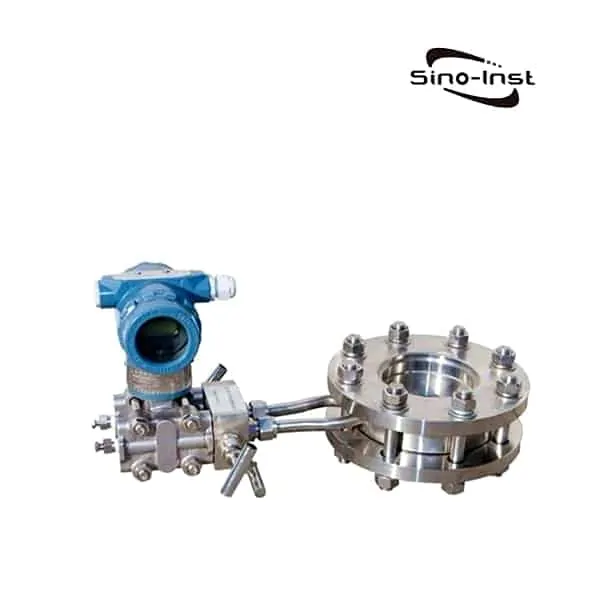
Orifice Plate Flow Meter
SI-LG orifice plate flow meter — the standard DP primary element for steam, gas and clean liquids. Supports concentric, segmental and eccentric plates, pairs with any smart DP transmitter.

Venturi Tube
Classical venturi flow meter with low permanent pressure loss and high repeatability. Long service life on dirty liquids, gas and steam where orifice plates wear out fast.

V-Cone Flow Meter
V-cone flow meter (inner-cone / integrated cone type) for DP flow measurement in water, steam, natural gas and dirty process fluids. Rated to 450 °C and 40 MPa with high turndown and low pressure recovery.
nNeed help selecting a flow element for your application? Send us your pipe size, fluid type, operating pressure and temperature, and required accuracy. Our engineers will recommend the right element and provide a quotation — typically within 24 hours.
Request a Quote

Wu Peng, born in 1980, is a highly respected and accomplished male engineer with extensive experience in the field of automation. With over 20 years of industry experience, Wu has made significant contributions to both academia and engineering projects.
Throughout his career, Wu Peng has participated in numerous national and international engineering projects. Some of his most notable projects include the development of an intelligent control system for oil refineries, the design of a cutting-edge distributed control system for petrochemical plants, and the optimization of control algorithms for natural gas pipelines.