
Updated: April 11, 2026
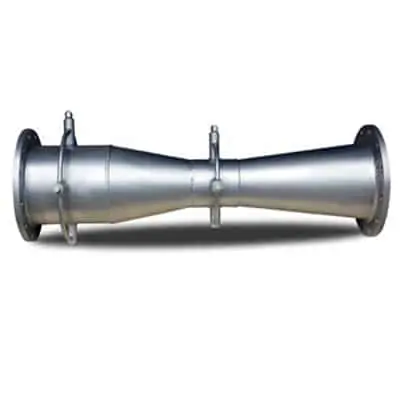
A venturi tube is a differential pressure device used to measure the flow rate of fluids in a pipe. It works on a simple principle: force fluid through a constriction, measure the pressure drop, and calculate the flow rate from that drop. The design has no moving parts, which means it lasts for decades with almost zero maintenance. Engineers have been using venturi tubes in water systems, steam lines, and gas pipelines since the late 1800s.
Contents
- What Is a Venturi Tube?
- The Venturi Effect and Bernoulli’s Equation
- Venturi Tube Working Principle
- Venturi Tube Design Types
- How to Measure Flow with a Venturi Tube
- Venturi Tube vs Orifice Plate vs Flow Nozzle
- Venturi Flow Meters from Sino-Inst
- FAQ
What Is a Venturi Tube?
A venturi tube is a shaped pipe section with three main parts: a converging cone at the inlet, a narrow throat in the middle, and a diverging cone (diffuser) at the outlet. When fluid enters the converging section, it speeds up. At the throat, the velocity reaches its maximum and the pressure drops to its lowest point. The diffuser then gradually slows the fluid back down, recovering most of the pressure.

Two pressure taps—one at the upstream inlet and one at the throat—connect to a differential pressure transmitter. The pressure difference between these two points is directly related to the flow rate. A higher flow produces a larger pressure drop across the throat.
Compared to other differential pressure flow elements, the venturi tube has the lowest permanent pressure loss—typically only 10–15% of the measured differential pressure. That makes it the preferred choice when pumping costs matter or when you need to minimize energy loss in a pipeline.
The Venturi Effect and Bernoulli’s Equation
The venturi effect is the drop in fluid pressure that occurs when a fluid flows through a constricted section of pipe. Italian physicist Giovanni Battista Venturi first described this phenomenon in 1797. The underlying physics comes from Bernoulli’s principle: in a steady, incompressible flow with negligible friction, the total energy along a streamline stays constant.
Bernoulli’s equation states:
P + ½ρv² + ρgh = constant
Where P is static pressure, ρ is fluid density, v is velocity, g is gravitational acceleration, and h is elevation. For a horizontal pipe (h₁ = h₂), the equation simplifies: when velocity increases at the throat, pressure must decrease. This pressure drop is what we measure.

The venturi effect is not limited to pipe flow measurement. It appears in aircraft wing design (lift generation), carburetor fuel mixing, medical aspirators, and building ventilation systems. But in industrial process instrumentation, it is primarily used to determine flow rates in closed conduits.
Venturi Tube Working Principle
The measurement relies on two equations working together: the continuity equation and Bernoulli’s equation.
The continuity equation for incompressible flow says:
A₁ × v₁ = A₂ × v₂
Where A₁ and v₁ are the cross-sectional area and velocity at the inlet, and A₂ and v₂ are at the throat. Since A₂ is smaller than A₁, v₂ must be larger than v₁.
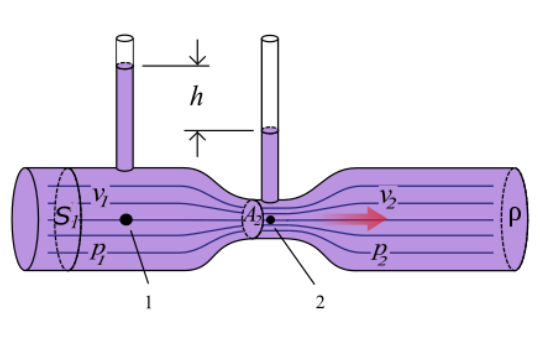
Combining both equations gives the volumetric flow rate formula:
Q = C × A₂ × √(2ΔP / (ρ × (1 − β⁴)))
Where C is the discharge coefficient (typically 0.95–0.99 for a properly manufactured venturi), ΔP is the measured differential pressure, ρ is fluid density, and β is the diameter ratio (d/D, throat diameter divided by pipe diameter). Understanding the relationship between flow rate and pressure is fundamental to applying this formula correctly.
A practical note: the discharge coefficient for a standard venturi tube per ISO 5167 is well-characterized and stable. That stability is why venturi tubes can achieve ±0.5% measurement accuracy when manufactured to standard dimensions.
Venturi Tube Design Types
ISO 5167-4 defines three main venturi tube construction types, each suited to different applications and pipe sizes.
Classic (Machined) Venturi
The classic venturi has a 21°±1° converging cone, a cylindrical throat with length equal to its diameter, and a diverging cone with a 7°–15° angle. The inlet cylinder length equals the pipe diameter D. This is the most accurate type, with a well-documented discharge coefficient. Suitable for pipe sizes DN 50 to DN 1200.

Welded (Fabricated) Venturi
Made from rolled sheet metal and welded together, the fabricated venturi is used for large-diameter pipes (DN 200 to DN 3000 and above). The convergent angle can vary from 10.5°±0.5° to 21°±1°. Manufacturing cost is lower than the machined type, making it practical for large water mains and industrial gas ducts.
Venturi Nozzle (ISA 1932 Nozzle + Diffuser)
A venturi nozzle combines an ISA 1932 nozzle entrance with a diverging diffuser section. It offers a shorter overall length than the classic venturi while maintaining low pressure loss. Pipe sizes range from DN 50 to DN 500. Often chosen where installation space is limited but you still need the pressure recovery benefit.
| Feature | Classic Venturi | Welded Venturi | Venturi Nozzle |
|---|---|---|---|
| Converging angle | 21°±1° | 10.5°–21° | ISA 1932 profile |
| Pipe size range | DN 50–1200 | DN 200–3000+ | DN 50–500 |
| Permanent pressure loss | 10–15% | 10–15% | 5–20% |
| Accuracy (per ISO 5167) | ±1% | ±1.5% | ±1.2% |
| Best for | Standard industrial | Large pipes, water mains | Space-constrained installs |
How to Measure Flow with a Venturi Tube
Setting up a venturi tube for flow measurement involves these steps:
1. Install the venturi tube. Mount it inline with the correct upstream and downstream straight pipe lengths. A typical requirement is 5D–10D upstream and 4D downstream, though the venturi is more forgiving than an orifice plate.
2. Connect the differential pressure transmitter. Run impulse tubing from the upstream pressure tap and the throat pressure tap to a DP transmitter. Slope the tubing properly to avoid air pockets (for liquid service) or condensate traps (for gas/steam). For more on how DP transmitters work, see our guide on pressure transmitter working principles.
3. Configure the transmitter. Enter the pipe diameter, throat diameter, fluid density (or configure temperature/pressure compensation for gas), and the transmitter will calculate the flow rate using the square-root relationship between ΔP and flow.
4. Verify with a reference. After installation, compare readings against a known flow rate if possible. The K-factor method can help verify accuracy during commissioning.
A common field mistake: installing the venturi tube backwards. The converging section must face the flow direction. If installed in reverse, the pressure recovery won’t work and the measurement will be unreliable. Always check the flow arrow marked on the body.
Venturi Tube vs Orifice Plate vs Flow Nozzle
All three are differential pressure flow elements defined in ISO 5167. Each has trade-offs.
| Parameter | Venturi Tube | Orifice Plate | Flow Nozzle |
|---|---|---|---|
| Permanent pressure loss | 10–15% of ΔP | 40–80% of ΔP | 30–50% of ΔP |
| Accuracy | ±0.5–1% | ±0.5–2% | ±1–1.5% |
| Straight pipe requirement | 5–10D upstream | 10–40D upstream | 10–30D upstream |
| Dirty fluid tolerance | Good (smooth profile) | Poor (edge buildup) | Moderate |
| Cost | High | Low | Medium |
| Maintenance | Very low | Periodic plate inspection | Low |
| Installation length | Long | Short (flange-mounted) | Medium |
Choose a venturi tube when permanent pressure loss must be minimized—for instance, in gravity-fed water systems or high-volume gas pipelines where compressor costs are significant. Choose an orifice plate when budget is tight and you can accept the energy penalty. A flow nozzle sits between the two in both cost and performance.
Venturi Flow Meters from Sino-Inst
Sino-Inst manufactures venturi tubes and complete venturi flow meter assemblies (venturi + DP transmitter + valve manifold) for water, steam, gas, and chemical applications. All units are manufactured per ISO 5167-4 and supplied with calibration certificates.
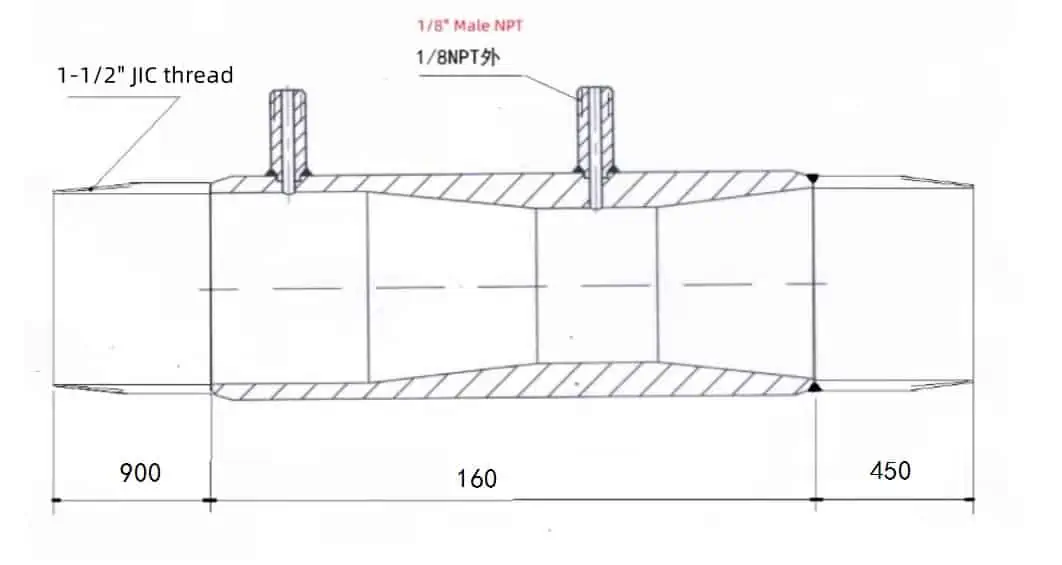
Standard Venturi Tube
DN50–DN1200 | ±1% Accuracy | Low Pressure Loss
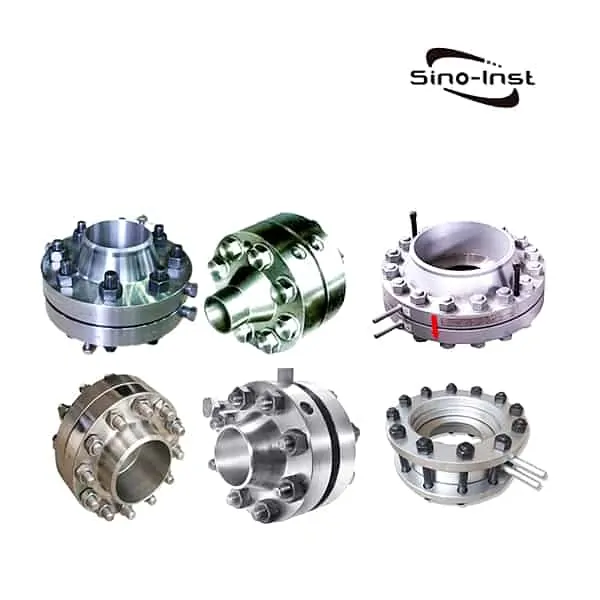
Orifice Plate Flow Meter
DN15–DN1200 | 4-20mA/HART | Gas, Liquid, Steam

Flow Nozzle
DN50–DN500 | High-Temp Steam | ISO 5167
FAQ
What is the typical accuracy of a venturi tube?
A standard venturi tube manufactured per ISO 5167-4 achieves ±1% accuracy on the discharge coefficient. With a properly calibrated DP transmitter, overall system accuracy of ±0.5–1.5% of actual flow is achievable. Accuracy depends on the beta ratio, Reynolds number, and manufacturing tolerances.
What is the difference between a venturi tube and a venturi meter?
A venturi tube is just the physical pipe element with its converging-throat-diverging geometry. A venturi meter (or venturi flow meter) is the complete measurement system: venturi tube + differential pressure transmitter + connecting impulse tubing + signal processing. The tube creates the pressure drop; the meter gives you the flow reading.
Can a venturi tube measure gas flow?
Yes. Venturi tubes measure gas, liquid, and steam. For gas applications, you need temperature and pressure compensation because gas density changes with operating conditions. The DP transmitter or flow computer applies the gas expansion factor defined in ISO 5167 to correct the reading.
Why does a venturi tube have lower pressure loss than an orifice plate?
The diverging diffuser section gradually decelerates the fluid after the throat, converting kinetic energy back into pressure. An orifice plate has no diffuser—the fluid exits the orifice into a sudden expansion, which creates turbulence and wastes energy. The venturi tube typically recovers 85–90% of the differential pressure, while an orifice plate recovers only 20–60%.
What beta ratio should I use for a venturi tube?
The beta ratio (d/D) for standard venturi tubes per ISO 5167 ranges from 0.3 to 0.75. A beta of 0.4–0.6 is most common. Lower beta means higher differential pressure and better signal-to-noise ratio but also higher permanent pressure loss. Higher beta means lower differential pressure and less energy loss but requires a more sensitive DP transmitter.
How long does a venturi tube last?
With no moving parts and a smooth internal profile, a venturi tube in clean service can last 20–30 years or more without recalibration. In corrosive or abrasive service, material selection (316SS, Hastelloy, ceramic-lined) determines lifespan. Periodic throat diameter measurement confirms that erosion has not shifted the calibration.
Need help selecting the right venturi tube or DP flow meter for your application? Our engineering team can review your process data—pipe size, fluid type, flow range, pressure, and temperature—and recommend the optimal solution. Contact us for a technical consultation or quotation.
Request a Quote

Wu Peng, born in 1980, is a highly respected and accomplished male engineer with extensive experience in the field of automation. With over 20 years of industry experience, Wu has made significant contributions to both academia and engineering projects.
Throughout his career, Wu Peng has participated in numerous national and international engineering projects. Some of his most notable projects include the development of an intelligent control system for oil refineries, the design of a cutting-edge distributed control system for petrochemical plants, and the optimization of control algorithms for natural gas pipelines.