
Updated 2026-05-09 by the Sino-Inst engineering team.
A flow transmitter is the field instrument that turns a flow measurement into a 4-20 mA, HART, Modbus, or pulse signal that a PLC or DCS can read — and that a SCADA historian then trends across the plant. It sits between a primary element (an orifice plate, a magmeter coil, a vortex bluff body, a Coriolis tube) and the control room. This guide explains what is inside a flow transmitter, how each signal output works, how the device differs from a plain flow meter, and the five spec-sheet numbers that decide whether a transmitter actually fits the loop.
Contents
- The Role of a Flow Transmitter in a Process Loop
- Inside a Flow Transmitter: Primary Element, Sensor, Transducer, and Output Stage
- Signal Output Options: 4-20 mA, HART, Modbus, and Pulse
- How a Flow Transmitter Differs from a Flow Meter
- Reading a Flow Transmitter Spec Sheet — Five Numbers That Matter
- Featured Sino-Inst Flow Transmitters
- Flow Transmitter FAQ
The Role of a Flow Transmitter in a Process Loop
Picture a typical 4-20 mA loop in a chemical plant. A primary element — say, an orifice plate — sits in the line and produces a measurable physical effect (a pressure drop). A flow transmitter reads that effect, applies the calibration curve, and outputs a single proportional signal: 4 mA at zero flow, 20 mA at full scale. The control room receives that one wire pair and treats it as the flow value.
That is the practical definition. A flow transmitter is the part that does three jobs: it senses, it conditions, and it transmits. A bare flow sensor cannot drive a 1500-foot cable run to a marshalling cabinet. A 4-20 mA transmitter can, because the signal is a current, not a voltage, and is immune to wiring resistance up to the loop budget.
For a deeper view of how the loop carries the signal, see our guide on upstream and downstream straight pipe requirements, which covers the install conditions that decide whether the reading you transmit is even valid.
Inside a Flow Transmitter: Primary Element, Sensor, Transducer, and Output Stage
A complete flow-measurement chain has four stages. Each stage has a job, and changing one without considering the others is the most common reason a “calibrated” loop reads the wrong number.
- Primary element — the device in the pipe that creates a measurable effect. Orifice plate, venturi tube, magmeter electrodes, vortex bluff body, Coriolis tube, ultrasonic transducers. Each has its own physics.
- Sensor — the part that reads the effect. A differential-pressure cell across an orifice. Two electrodes across a magmeter. A piezoelectric crystal behind a vortex bluff body. The sensor outputs a small electrical quantity (millivolts, microamps, picocoulombs).
- Transducer / signal conditioner — the analog and digital electronics that linearise, temperature-compensate, and scale the sensor signal into engineering units. This is where the calibration curve lives.
- Output stage — the transmitter proper. Drives 4-20 mA, encodes HART on top, talks Modbus RTU/TCP, or generates a scaled pulse output.
Take a magnetic flow transmitter as a worked example. The coils generate field B inside the meter body. Conductive liquid passing through cuts the field at velocity v, and Faraday’s law gives an induced EMF: V = k · B · D · v, where D is the bore diameter. That induced voltage is in the millivolt range. The transducer amplifies it, removes 50/60 Hz noise, applies the calibration K-factor, and the output stage scales the result to a 4-20 mA current loop.
Signal Output Options: 4-20 mA, HART, Modbus, and Pulse
The output you pick is dictated by what the receiving system speaks. Most modern transmitters offer two or more options on the same hardware, but mixing them is non-trivial.
| Output | Typical use | Wiring | Practical limit |
|---|---|---|---|
| 4-20 mA analog | Continuous flow rate to PLC/DCS analog input | Twin shielded, up to ~1500 m at 24 V loop | One value per pair; ~0.05% reading resolution at ADC |
| HART (over 4-20 mA) | Diagnostics + secondary variables on existing 4-20 mA wiring | Same twin shielded; HART superimposes 1200 baud FSK | Slow data rate; needs HART-aware host |
| Modbus RTU/TCP | Multivariable digital data — flow + totalizer + diagnostics | RS-485 multidrop (RTU) or Ethernet (TCP) | Up to 247 nodes per RS-485 segment |
| Pulse / frequency | Totalizing into a counter (custody transfer, batching) | Open collector or scaled frequency | One pulse = one volume unit; needs care for low flow rates |
For batch control or custody transfer, pulse output is still the most defensible because the count is unambiguous. For instrumentation under modern asset-management software, HART is the path of least resistance — every modern handheld speaks it. See our note on converting a 4-20 mA loop to 0-10 V when the receiver is a legacy voltage input.
How a Flow Transmitter Differs from a Flow Meter
The two terms get used loosely. Strictly, a flow meter is a device that indicates flow rate locally — a rotameter with a glass tube and a float, a paddlewheel with a mechanical totalizer, a magmeter with a field LCD. A flow transmitter is the version that also outputs a remote signal. Many modern devices integrate both: a magmeter body with a digital display on the converter, plus 4-20 mA / HART / Modbus to the control room. The same hardware sells under either name depending on whether the brochure is aimed at a maintenance engineer or a control engineer.
The practical decision is not about the names. It is about whether the value needs to leave the field, and over which protocol. If you only need a local read for plant rounds, a basic flow meter is enough. If a PLC or DCS must log the value, alarm on it, or use it in a control loop, a transmitter is required. See flow totalizer vs flow meter for the related distinction between rate-only and totalising units.
Reading a Flow Transmitter Spec Sheet — Five Numbers That Matter
A spec sheet is a contract. Five numbers do most of the work; the rest is decoration.
- Calibrated range and turndown — the ratio between the highest and lowest flow the device measures within accuracy. A magmeter at 100:1 turndown is honest from 0.3 m/s to 30 m/s. A DP transmitter at 10:1 is fine in a steady-state line, painful in a varying batch process.
- Accuracy class — read whether it is “% of reading” or “% of span”. 0.5% of reading at 10% of span is 5x worse than 0.5% of full scale near zero. Vendors quote whichever number looks better.
- Process and ambient temperature — separate ratings. The wetted body sees process fluid temperature; the electronics housing sees ambient. The lower of the two limits is the one that bites.
- Output and protocols — confirm 4-20 mA loop voltage budget (typically 12-42 V), HART revision, and Modbus addressing. Do not assume; ask.
- Hazardous-area certification — ATEX, IECEx, FM/CSA, and the gas/dust group. A transmitter rated Zone 2 will not be accepted by the safety case for a Zone 0 vessel headspace.
For installation context that affects what numbers you actually achieve in the field, see our differential pressure flow meter calculation guide and the flow units cheat sheet when reading a US-units brochure.
Featured Sino-Inst Flow Transmitters
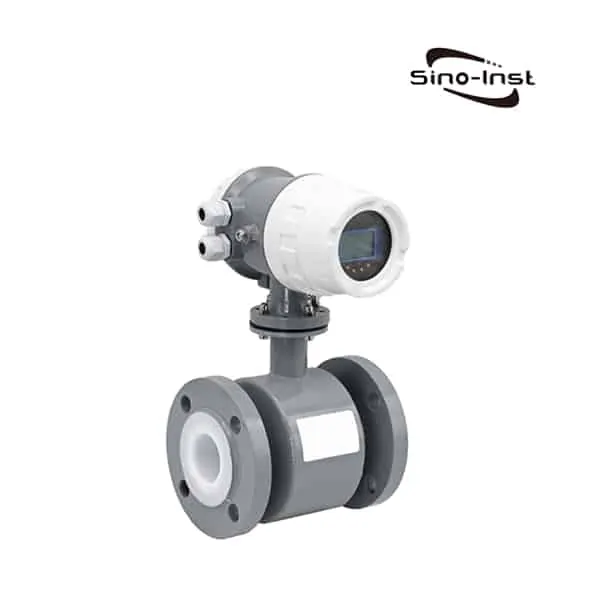
Industrial Magmeter Flow Meters
Conductive liquids, DN10–DN3000. 4-20 mA + HART, accuracy ±0.5% of reading, IP68 sub-DN200.
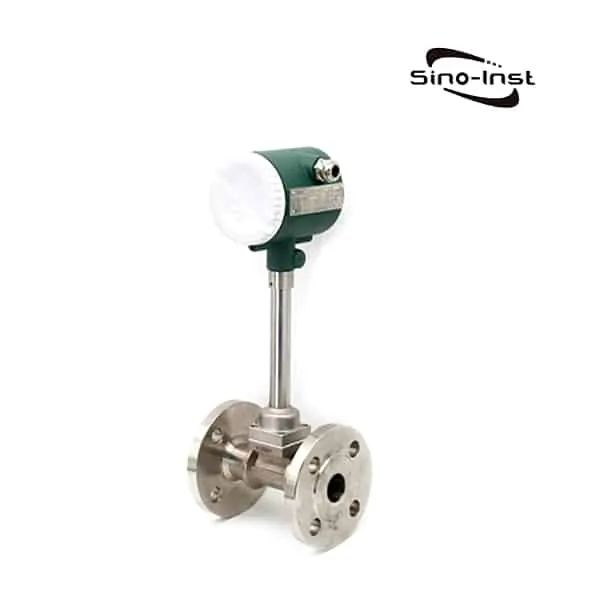
Vortex Shedding Flow Meter
Steam, gas, low-viscosity liquid. 4-20 mA / HART / pulse. Up to 426 °C process temp, no moving parts.
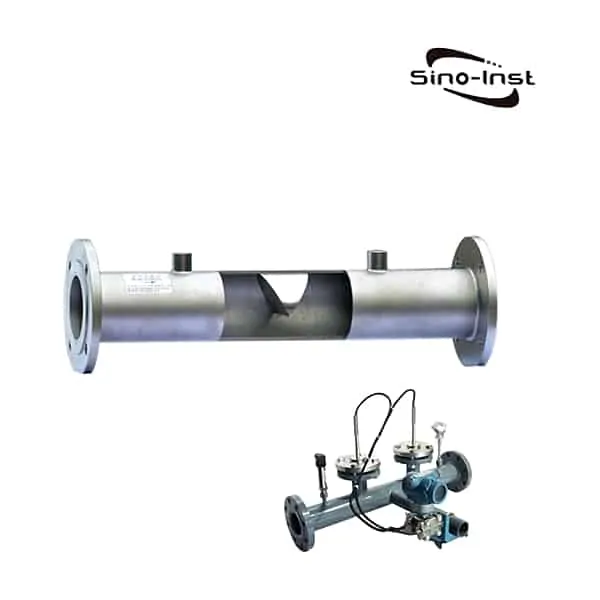
Wedge Flow Meter
Slurries, dirty / abrasive fluids. DP-based, 4-20 mA / HART, recoverable signal at low Reynolds number.
Flow Transmitter FAQ
How does a flow transmitter work?
A flow transmitter reads a primary element (orifice, magmeter, vortex, Coriolis) through a sensor, applies the calibration in a transducer, and outputs a 4-20 mA, HART, Modbus, or pulse signal proportional to flow rate.
What is the difference between a pressure transmitter and a flow transmitter?
A pressure transmitter outputs a signal proportional to gauge, absolute, or differential pressure. For fast dynamic events such as engine in-cylinder combustion or hydraulic pulsations, a piezoelectric pressure sensor is used instead. A flow transmitter outputs a signal proportional to flow rate. A DP-based flow transmitter combines a DP cell with a primary element and a square-root extraction stage.
What are the three types of transmitters used in flow measurement?
Differential-pressure (orifice, venturi, wedge), velocity (magmeter, vortex, ultrasonic, turbine), and mass-flow (Coriolis, thermal).
What is the purpose of a flow transmitter in a process loop?
To convert a measured flow into a control-room-readable signal that can be logged, alarmed, used in a PID loop, or fed into custody transfer at any distance from the field.
Get a Quote from Our Flow Engineering Team
Tell us your line size, fluid, expected flow range, and required output protocol. Our engineers will respond within one business day with a recommended transmitter, datasheet, and lead time.
Request a Quote
Related: flow rate unit conversions.

Wu Peng, born in 1980, is a highly respected and accomplished male engineer with extensive experience in the field of automation. With over 20 years of industry experience, Wu has made significant contributions to both academia and engineering projects.
Throughout his career, Wu Peng has participated in numerous national and international engineering projects. Some of his most notable projects include the development of an intelligent control system for oil refineries, the design of a cutting-edge distributed control system for petrochemical plants, and the optimization of control algorithms for natural gas pipelines.