
Updated: April 15, 2026
A capacitive liquid level sensor detects level by measuring the capacitance change between a probe and the tank wall (or a second probe) as the liquid rises or falls. The liquid acts as the dielectric — its dielectric constant determines how much capacitance changes per centimeter of level. That’s the whole working principle in one sentence.
What matters in the field is knowing when this technology works well (oils, water, most chemicals, slurries) and when it doesn’t (varying dielectric, heavy coating, high-purity water). This guide walks through the physics, sensor types, calibration, and the dielectric-constant numbers you actually need to size a probe.
Contents
- How Does a Capacitive Liquid Level Sensor Work?
- What Are the Main Types of Capacitive Level Sensors?
- What Dielectric Constants Work with Capacitive Sensing?
- What Are the Advantages and Disadvantages?
- How Do You Calibrate a Capacitive Liquid Level Sensor?
- Capacitive vs Float vs Ultrasonic: Which to Pick?
- Featured Capacitive Level Sensors
- FAQ
How Does a Capacitive Liquid Level Sensor Work?
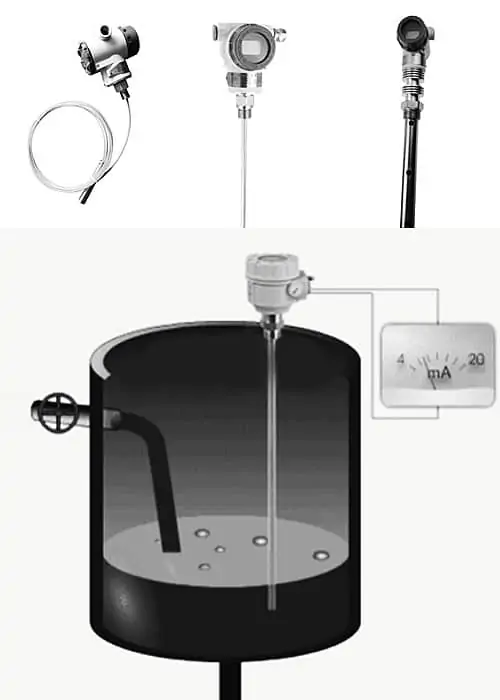
The sensor acts as one plate of a capacitor; the tank wall or a second rod acts as the other plate. Liquid between them is the dielectric material. When level rises, more of the probe is submerged, dielectric material replaces air (εr of water is 80 vs air’s 1), and capacitance jumps.
The transmitter converts that capacitance change into a 4–20 mA or digital signal proportional to level. The equation:
C = (ε0 × εr × A) / d
Where ε0 is the vacuum permittivity, εr is the relative dielectric constant of the liquid, A is the submerged electrode area, and d is the gap. Because εr is the only variable that depends on the medium, the sensor must be calibrated to the specific liquid.
What Are the Main Types of Capacitive Level Sensors?
Four probe configurations cover almost every tank scenario.
- Bare rod (single probe, metal tank). The rod and the conductive tank form the capacitor. Simplest and cheapest. For conductive liquids like water, the rod must be insulated.
- Insulated rod. PTFE or PFA jacket prevents shorting in conductive media. Standard for water, acids, and alkalis.
- Dual-rod (coaxial). A second rod replaces the tank wall — used in plastic or fiberglass tanks where there’s no grounded reference.
- RF admittance. Adds a driven guard to cancel out coating effects on the probe. Used on sticky liquids like slurries, glue, and chocolate. See our RF admittance level sensor guide.
What Dielectric Constants Work with Capacitive Sensing?
Capacitive sensors work reliably when the liquid’s dielectric constant is ≥1.8 and stable. Below that, capacitance change per cm is too small to measure reliably. If εr varies with temperature or composition, calibration drifts.
| Liquid | εr (approx.) | Capacitive sensing |
|---|---|---|
| Air / vapor | 1.0 | Reference |
| Gasoline, kerosene | 2.0 | Marginal — needs sensitive electronics |
| Diesel, fuel oil | 2.1–2.3 | Good |
| Lubricating oil | 2.2–2.8 | Good |
| Vegetable oil | 3.0 | Good |
| Alcohols (ethanol) | 24 | Excellent |
| Water (tap) | 80 | Excellent — requires insulated probe |
| Aqueous acids/bases | 40–80 | Excellent — requires insulated probe |
Do not use capacitive sensing on liquids with unpredictable εr — examples include variable oil–water emulsions and slurries of changing solids content. Use guided wave radar or float-based measurement instead.
What Are the Advantages and Disadvantages?
Short answer: capacitive is a low-cost, rugged workhorse, but it’s sensitive to medium properties and probe coating.
| Advantages | Disadvantages |
|---|---|
| No moving parts — long service life | Needs stable dielectric constant |
| Works in pressurized and high-temp tanks (to 200 °C, 40 bar) | Coating on probe shifts calibration |
| Compact — fits small tanks where radar doesn’t | Metal tank required for single-rod types |
| Low cost: $150–$600 per sensor | Must be recalibrated if liquid changes |
| Accuracy ±1% of full scale | Foam and vapor can affect top of range |
How Do You Calibrate a Capacitive Liquid Level Sensor?
Two-point calibration handles most capacitive sensors. Do it with the actual process liquid, not water. For general calibration procedures across flow and level instruments, see our calibration procedures guide.
- Empty the tank. Set the low (4 mA / 0%) point. This captures probe-to-tank baseline capacitance.
- Fill to 100% of measuring range. Set the high (20 mA / 100%) point.
- Verify at midpoint. Fill to 50% and check reading is 12 mA ±1%. If off, check for probe coating or partial air gap.
- Log ambient temperature. εr of many oils changes 0.1% per °C. For wide temperature swings, use a transmitter with temperature compensation.
A common field mistake is to calibrate with water when the tank will hold oil. The dielectric constants differ by a factor of 30, and the sensor reads nonsense until you recalibrate.
Capacitive vs Float vs Ultrasonic: Which to Pick?
Capacitive wins on cost and durability in small-to-medium tanks with stable liquids. Float meters win where power or electronics aren’t available. Ultrasonic wins on non-contact measurement in open tanks.
| Criterion | Capacitive | Float | Ultrasonic |
|---|---|---|---|
| Contact with liquid | Yes | Yes | No |
| Moving parts | No | Yes | No |
| Handles foam / vapor | Fair | Fair | Poor |
| Handles sticky / coating liquids | Poor (RF admittance: Good) | Poor | Good |
| Accuracy | ±1% FS | ±3–5% FS | ±0.5% FS |
| Typical cost (1 m range) | $150–$600 | $50–$300 | $300–$800 |
Featured Capacitive Level Sensors
Capacitance Level Transmitter
SI700 RF capacitance level transmitter for continuous and point level detection in liquids and solids. Resists coating, condensation and vapour layers — reliable where radar struggles.
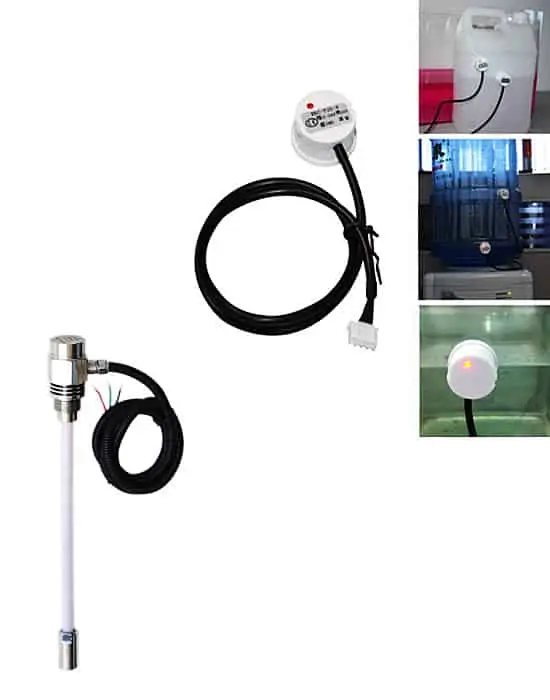
Capacitive Water Level Sensor
Contact and non-contact capacitive water level sensor for storage tanks, wells and corrosive liquids. Resists temperature, humidity and conductivity drift for reliable readings where floats fail.
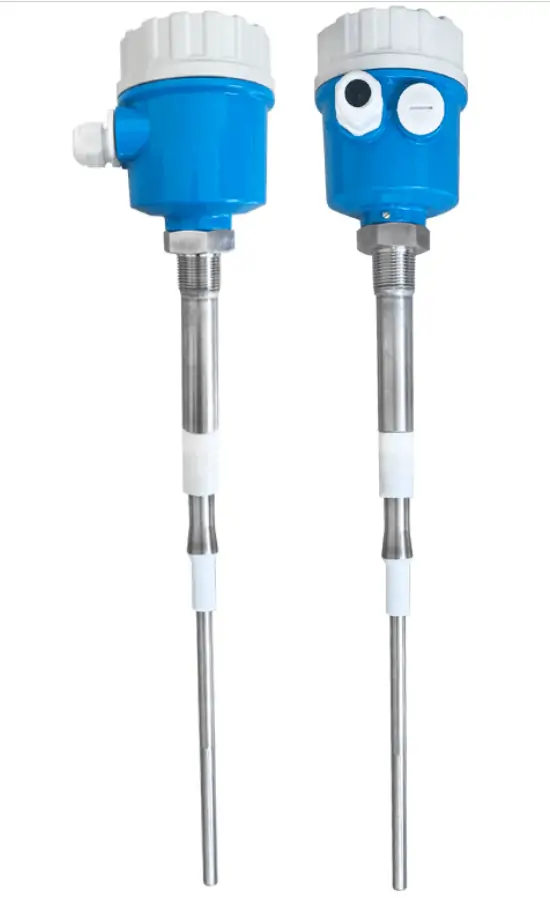
Capacitive Level Switch
Capacitive (RF) level sensor for liquid, solid and interface measurement. Handles high-temp, corrosive and easy-to-crystallise media with anti-clogging probes and 4-20mA output.
FAQ
Can a capacitive level sensor measure both liquids and solids?
Yes, for solids with dielectric constant ≥1.8 — grain, plastic pellets, cement powder all work. The accuracy is lower (±3%) because dielectric varies with bulk density.
Does probe length affect accuracy?
Longer probes give higher capacitance change per unit level, which improves resolution. Up to a point — probes over 4 m may need a high-sensitivity transmitter. Never cut a factory probe in the field; it changes the calibration curve.
What makes RF admittance different from standard capacitive?
RF admittance uses a driven guard electrode that cancels out capacitance caused by coating on the probe. Standard capacitive sensors drift when a residue builds up; RF admittance ignores it. Use RF admittance on sticky liquids and heated oils.
Does a capacitive sensor work with pure deionized water?
Yes, but with reduced accuracy. DI water’s dielectric constant is the same (80), but its low conductivity causes response instability. For ultra-pure water service, conductivity-based or ultrasonic water level sensors are more reliable.
Is capacitive level sensing safe for hazardous areas?
Yes. Intrinsically safe and explosion-proof versions are available with ATEX and IECEx certifications. Specify Ex ia for flammable liquid tanks and Ex d for vapor spaces.
How long does a capacitive level sensor last?
With no moving parts, expected life is 10–15 years in normal service. PTFE-jacketed probes in aggressive chemicals last 5–10 years before coating degradation forces replacement.
Need to confirm whether capacitive is the right fit for your tank? Send us the liquid, probe length, and tank material. Our engineers will recommend the right probe type and output, plus a quote — usually within 24 hours.
Request a Quote

Wu Peng, born in 1980, is a highly respected and accomplished male engineer with extensive experience in the field of automation. With over 20 years of industry experience, Wu has made significant contributions to both academia and engineering projects.
Throughout his career, Wu Peng has participated in numerous national and international engineering projects. Some of his most notable projects include the development of an intelligent control system for oil refineries, the design of a cutting-edge distributed control system for petrochemical plants, and the optimization of control algorithms for natural gas pipelines.