
Flow rate and pressure are linked by Bernoulli’s equation, by friction losses, and by the geometry of whatever the fluid passes through. A pump that delivers 200 kPa across a 50 mm pipe will not push the same volume per minute as one delivering 200 kPa across a 25 mm pipe. Pressure alone is not flow — and flow alone is not pressure. The rest of this page walks through the formulas you actually use in the field, two worked examples, and the corrections every engineer needs to apply when reading a flow meter spec from a vendor.
Contents
- How Flow Rate and Pressure Relate
- The Five Core Formulas
- Worked Example — Calculating Flow from Pressure
- Pressure Drop in Real Piping
- Why the Pressure-Flow Curve Matters for Pump Selection
- Quick Reference Table — Pressure to Flow
- Common Mistakes Calculating Flow from Pressure
- Frequently Asked Questions
How Flow Rate and Pressure Relate
Pressure is the energy per unit volume that drives a fluid; flow rate is how much volume crosses a section in a given time. They are tied by three physical realities:
- Energy conservation. Bernoulli’s equation says total head — pressure + velocity + elevation — is conserved along a streamline (ideal case). Drop the pressure across an orifice and the velocity (hence flow) rises.
- Friction loss. Real pipes consume pressure to push the fluid against wall shear. Doubling the flow roughly quadruples the friction loss in turbulent flow.
- Geometry. Pipe diameter, roughness, fittings, and the restriction itself (orifice, valve, nozzle) determine how much flow a given pressure differential produces.
The Five Core Formulas
Keep these five formulas on a card next to your desk. They cover 90% of plant calculations.
| Use case | Formula | Note |
|---|---|---|
| Bernoulli (ideal) | P + ½ρv² + ρgh = constant | Conservation along a streamline, no friction |
| Orifice / Venturi (incompressible) | Q = Cd · A · √(2ΔP / ρ) | The workhorse for DP-based flow measurement |
| Darcy-Weisbach (pipe friction) | ΔP = f · (L/D) · (ρv²/2) | Friction factor f from Moody chart |
| Hagen-Poiseuille (laminar flow) | Q = (Π · ΔP · D⁴) / (128 · μ · L) | Valid for Re < 2300; very small pipes/oils |
| Valve / restriction (Cv coefficient) | Q = Cv · √(ΔP / SG) | Flow in GPM, ΔP in psi, SG specific gravity |
Two practical notes. The orifice formula uses ΔP (pressure differential), not absolute line pressure — a transmitter reporting 5 bar of line pressure tells you nothing about flow unless you also know the upstream-to-downstream drop. And the Cv formula is unit-bound: psi and GPM are required as input, not bar and m³/h. Convert before using or read our differential-pressure flow calculator walkthrough for a SI-unit version.
Worked Example — Calculating Flow from Pressure
An orifice plate sits in a 100 mm horizontal water line. Bore diameter is 60 mm. The DP transmitter reads 25 kPa. Find the flow rate.
If your pump curve is in LPM but the procurement spec is in US gallons per minute, run a sanity check on the conversion before sizing — our LPM to GPM conversion guide covers the US/UK gallon gap and the spec-sheet decoder.
- Beta ratio β = d/D = 60/100 = 0.6.
- For β = 0.6 in turbulent water flow, discharge coefficient Cd ≈ 0.62 (ISO 5167 table).
- Orifice area A = π · (0.06/2)² = 2.827 × 10⁻³ m².
- Water density ρ = 1000 kg/m³. ΔP = 25,000 Pa.
- Q = 0.62 · 2.827e-3 · √(2 · 25000 / 1000) = 0.62 · 2.827e-3 · 7.07 = 0.01239 m³/s.
- Convert to working units: 0.01239 m³/s × 3600 = 44.6 m³/h, or about 196 GPM.
The same 25 kPa drop across a different bore would give a different flow. That dependence on geometry is why DP flow meters need a calibration certificate that matches the installed bore and pipe, not just the spec sheet’s claimed accuracy. See straight-run pipe requirements for the installation rules that keep the calibration valid.
Pressure Drop in Real Piping
The total pressure loss in a real pipe run is the sum of friction in straight pipe plus losses at every fitting. A simplified working form:
- Straight pipe loss: Darcy-Weisbach (above). Friction factor f rises with roughness and falls with Reynolds number.
- Fitting losses: ΔPfitting = K · (ρv²/2). K values from tables — 90° elbow K ≈ 0.75, gate valve fully open K ≈ 0.15, sudden contraction K ≈ 0.5.
- Elevation: ρgh — 1 m of water adds 9.81 kPa to the static head requirement.
The friction line on a pump curve is the sum of these terms. When the pump’s pressure output equals the system’s friction demand at a given flow, the system stabilises at that operating point. Most underperforming pump installations trace back to a friction estimate that ignored elbows, valves, or the eventual fouling-up of strainers and heat exchangers.
Why the Pressure-Flow Curve Matters for Pump Selection
A centrifugal pump produces more flow at lower pressure and less flow at higher pressure. Plot the pump’s pressure-vs-flow curve on the same axes as the system’s friction curve. The intersection is the operating point.
- If the system curve drifts left of the pump’s best efficiency point (BEP), you waste energy and risk recirculation damage.
- If the system curve sits right of BEP, the motor may overload during low-resistance conditions (filter clean, valve open).
- Aim to size pumps so the design point sits within ±10% of BEP, then verify with a flow meter K-factor calibration after commissioning.
Quick Reference Table — Pressure to Flow
Approximate flow through a 1″ (25 mm) clean steel pipe, water at 20 °C, no fittings, fully developed turbulent flow. Use as a sanity check, not a design value.
| Line pressure (psi) | Approx. flow (GPM) | Approx. flow (m³/h) |
|---|---|---|
| 10 | 14 | 3.2 |
| 20 | 20 | 4.5 |
| 40 | 28 | 6.4 |
| 60 | 34 | 7.7 |
| 80 | 40 | 9.1 |
| 100 | 44 | 10.0 |
Note the non-linearity. Doubling pressure does not double flow because friction losses scale with v² — about 40% more pressure is needed to move twice the volume. Engineers used to volumetric scaling are often surprised by how badly bigger pumps underperform expectations.
Common Mistakes Calculating Flow from Pressure
- Confusing absolute pressure with differential pressure. Line pressure tells you nothing on its own — flow follows the DP across a known restriction.
- Ignoring fluid properties. Hot water has a different viscosity and density from cold water. A static vs dynamic pressure check matters before reaching for Bernoulli.
- Assuming the orifice Cd is 1.0. Real coefficients run 0.6 to 0.8 depending on beta ratio and Reynolds number. ISO 5167 lists actual values.
- Mixing units. The Cv formula needs psi and GPM. The orifice formula needs SI units. Convert before substituting.
- Forgetting upstream straight-run. An orifice that meets ISO 5167 in the lab but sits 1 D downstream of a 90° elbow on site will read 5-10% off true flow. Read the magnetic flow meter installation guide for similar straight-pipe rules across meter families.
Featured DP Flow Meters and Pressure Transmitters from Sino-Inst
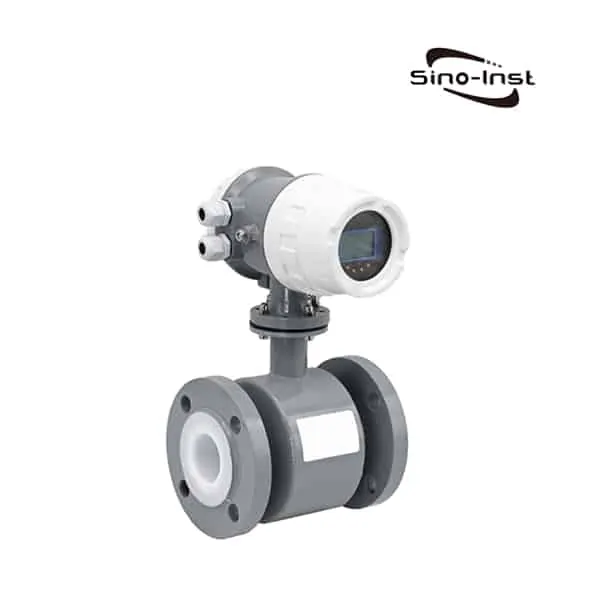
Industrial Magmeter Flow Meters
DN6-DN3000 | 4-20 mA, pulse, Modbus | conductive liquids — measures flow directly, no DP calculation needed.
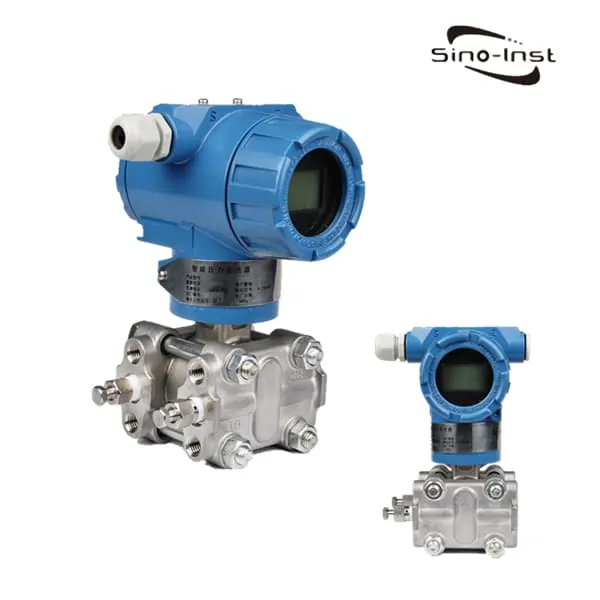
SMT3151DP Differential Pressure Transmitter
100:1 turndown | 0.075% accuracy | HART + 4-20 mA — pair with an orifice plate to compute Q from ΔP.
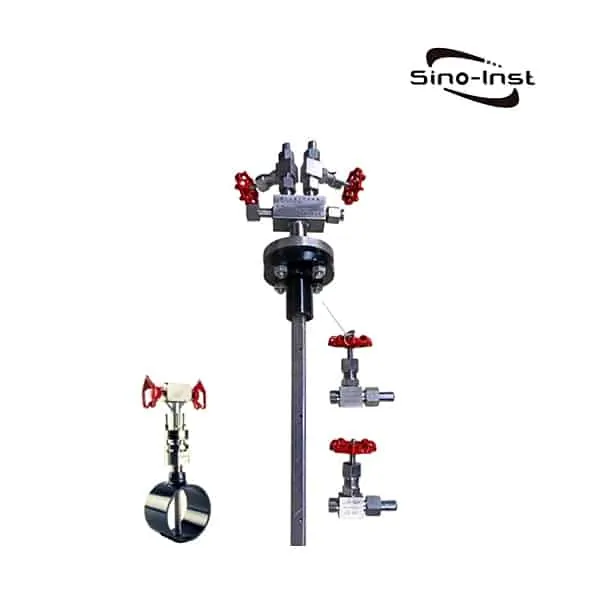
Verabar Averaging Pitot Tube
Insertion design | low permanent pressure loss | DP output for air, gas, steam, water — minimal installation cost.
Frequently Asked Questions
What is the formula for flow rate from pressure?
For a fluid passing through a restriction: Q = Cd · A · √(2ΔP / ρ). ΔP is the pressure drop across the restriction, A is the restriction area, ρ is the fluid density, and Cd is the discharge coefficient (typically 0.6 to 0.8 for orifices).
Does higher pressure always mean higher flow?
No. Higher line pressure does not by itself produce more flow. Flow rises when the pressure differential across the system increases, while the system geometry stays constant. A sealed pipe at 10 bar has zero flow despite high pressure.
How do I convert pressure to flow rate in GPM?
The simplest practical conversion uses the valve coefficient: Q (GPM) = Cv · √(ΔP / SG), where ΔP is in psi and SG is specific gravity. For pipes without a defined restriction, you need pipe length, diameter, roughness, and fluid properties — there is no single-number conversion.
What is Bernoulli’s equation used for?
Bernoulli’s equation conserves total energy (pressure + kinetic + potential) along a streamline for an ideal fluid. In instrumentation, it underpins the orifice, venturi, and pitot-tube flow-measurement formulas. Real-world calculations correct Bernoulli with a discharge coefficient or friction term.
Why does my flow meter read low at high pressure?
Several causes. A DP meter on an orifice reads correctly only within its calibrated turndown — extreme pressure drops outside that range introduce nonlinearity. Or the pressure is compressing a gas, so volumetric flow shrinks even though mass flow is steady. Check the meter’s calibration certificate and whether the reading is volumetric or mass-based.
Sino-Inst engineers have specified flow elements, DP transmitters, and magnetic and ultrasonic flow meters for refineries, water utilities, and chemical sites across more than 50 countries. Send the line size, fluid properties, and the pressure range — the team will return a sized configuration. Learn more about the Sino-Inst engineering team and request a quote below.
Request a Quote

Wu Peng, born in 1980, is a highly respected and accomplished male engineer with extensive experience in the field of automation. With over 20 years of industry experience, Wu has made significant contributions to both academia and engineering projects.
Throughout his career, Wu Peng has participated in numerous national and international engineering projects. Some of his most notable projects include the development of an intelligent control system for oil refineries, the design of a cutting-edge distributed control system for petrochemical plants, and the optimization of control algorithms for natural gas pipelines.