
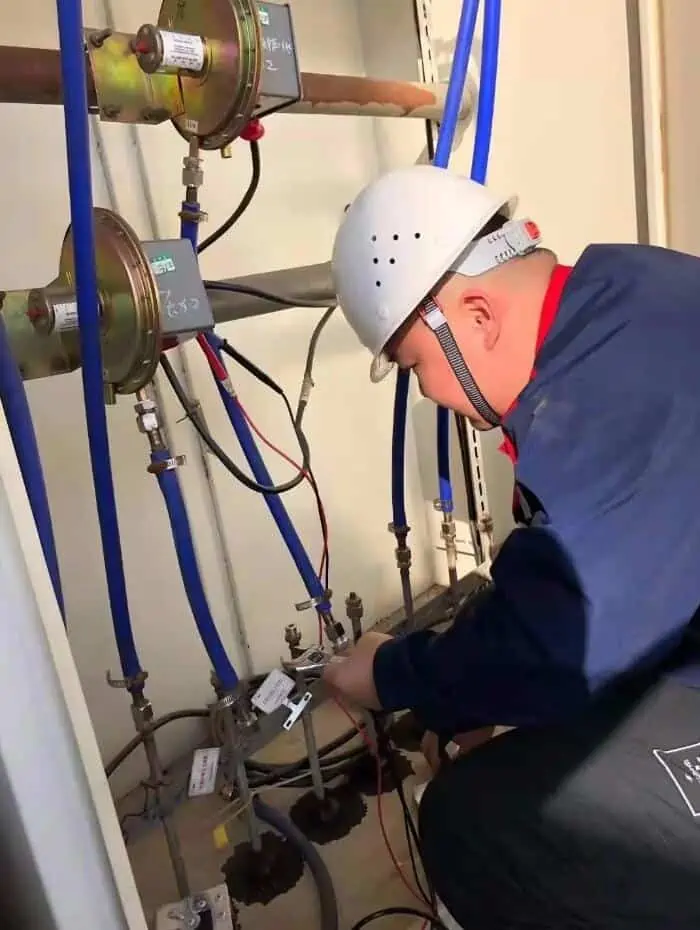
Updated May 26, 2026 | Sino-Inst Engineering Team
Most pressure transmitter troubleshooting calls trace to one of five things. A 4–20 mA transmitter with “no output” looks like a dead sensor, but it almost never is. In our field records, 80% of no-output reports come down to wrong wiring polarity, low supply voltage, an open loop, a clogged impulse line, or a damaged diaphragm. Work down this list in order and you will find the fault before opening the transmitter housing.
Contents
- First 60 seconds: what to check before touching anything
- The basic loop test — multimeter in series
- Fault 1: Wiring reversed or open
- Fault 2: Low supply voltage at the transmitter
- Fault 3: Blocked impulse line or closed isolation valve
- Fault 4: Damaged or saturated diaphragm
- Fault 5: Drifted zero, failed electronics
- Replacement options
- FAQ
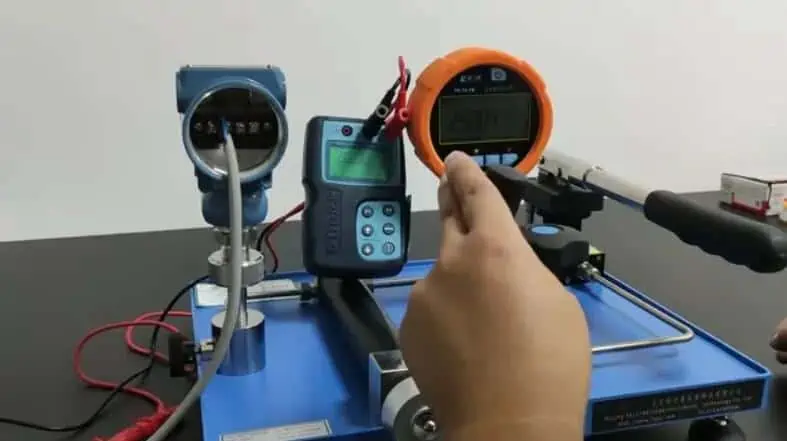
First 60 seconds: what to check before touching anything
Before any multimeter goes on the loop, rule out a control-system cause. 30% of reported transmitter failures are actually DCS tag problems or PLC analog card faults. Confirm scaling first — our pressure transmitter working principle page has the URL/LRL math used in tag setup.
- Check the DCS tag: is the scale correct? A transmitter reading 50% shown as 0% is a tag fault, not a transmitter fault.
- Check the analog input card: pull a second channel from the same card. If it also reads 0, the card is dead.
- Check the 24 V power supply: measure DC at the marshalling panel, not at the PSU. Long cable runs drop 2–4 V at 20 mA loop current.
- Look at the transmitter display: a local LCD showing pressure but the DCS showing zero means the loop is broken somewhere between the transmitter and the DCS input card.
Pull recent maintenance records. If another technician just swapped wiring, changed a fuse, or opened an isolation valve, that is your most likely cause.
The basic loop test — multimeter in series
Loop current tells you what the transmitter is actually putting out. A multimeter set to mA, wired in series, is the single most diagnostic tool you have.
- Set multimeter to DC mA, 200 mA range.
- Disconnect the positive loop wire from the transmitter + terminal.
- Put the multimeter red lead on the transmitter + terminal, black lead on the disconnected wire. Loop must stay unbroken.
- Read the current.
| Reading | What it means | Next step |
|---|---|---|
| 4.00 mA ±0.05 | Transmitter healthy, pressure at zero | Check if that is plausible. If not, look at impulse line and diaphragm. |
| 3.8–5 mA, unstable | Loose terminal, moisture, or bad ground | Tighten terminals. Check for water in conduit. Verify shield grounded at one end only. |
| < 3.6 mA | Failed low alarm — transmitter detects internal fault | Check local display for error code. Diaphragm, electronics, or calibration fault likely. |
| > 21 mA | Failed high alarm — out-of-range or sensor short | Check process pressure vs URL. Diaphragm may be over-ranged. |
| 0 mA | No loop — open circuit or no supply | Go to Fault 1 and Fault 2. |
A working 2-wire transmitter must draw at least 4 mA to run its own electronics. If you see 0 mA, the transmitter itself is not even booted — the loop is open or the supply is too low. If the loop has to drive a 0–10 V PLC input downstream of the sense resistor, refer to our 4-20 mA to 0-10 V conversion guide for the matching resistor math.
Fault 1: Wiring reversed or open
Reversed polarity is the #1 cause of a just-installed transmitter reading zero. The transmitter has reverse-polarity protection on most models, so it does not blow — it just sits there drawing nothing.
- Confirm + goes to transmitter +, — goes to transmitter −. Labels on the terminal block are authoritative, not the cable color.
- Check conductor continuity end-to-end. Marshalling cabinet to field junction box to transmitter.
- For 2-wire transmitters, there are only two terminals. For 4-wire units (powered separately), signal and power are on different pairs — do not confuse them.
- For installation best practice, see our pressure transmitter installation guide.
Fault 2: Low supply voltage at the transmitter
Most 4–20 mA transmitters need a minimum of 10–16 V DC at the terminals to operate. The nominal 24 V supply at the control room can drop below that by the time it reaches a field transmitter at the end of a 400 m cable loop with a 250 Ω sense resistor.
Calculate minimum supply voltage:
V_supply_min = V_transmitter_min + (0.020 A × (R_sense + R_cable + R_barrier))
For a 250 Ω sense resistor, 25 Ω cable loop, IS barrier at 300 Ω, and a transmitter needing 12 V:
V_supply_min = 12 + 0.020 × (250 + 25 + 300) = 12 + 11.5 = 23.5 V
A 22 V supply on that loop will leave the transmitter cold. Swap to a 24 V or 28 V supply, or move the sense resistor closer to the transmitter. For HART communication, keep at least 250 Ω in the loop — see our HART pressure transmitter guide for the full loop math.
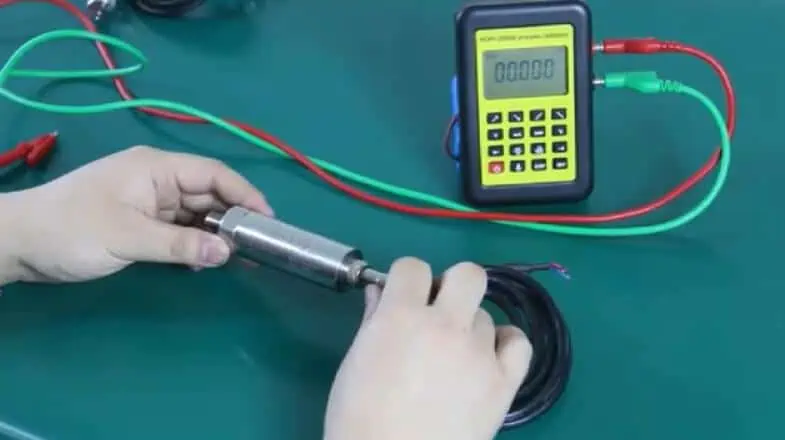
Fault 3: Blocked impulse line or closed isolation valve
A perfectly healthy transmitter will read 4 mA if the process pressure never reaches the diaphragm. Blocked impulse lines are the #1 process-side cause of flat output.
- Is the manifold isolation valve open? Walk the line from the process tap to the transmitter and touch every valve.
- Is the impulse line plugged? Crystallization, scale, and wax plug lines over time. A hot-water flush through the tap usually clears it.
- Is there trapped gas in a wet leg or trapped liquid in a dry leg? Both sides of a DP transmitter must be the phase the installer intended. Our DP transmitter installation guide covers impulse-line filling procedures.
- On a diaphragm seal transmitter, is the capillary oil leaked out? Touch the face of the remote seal: a sunken diaphragm means fill fluid is gone and the transmitter needs factory service.
Fault 4: Damaged or saturated diaphragm
An over-ranged diaphragm reads a constant upper limit (20 mA or higher) regardless of real pressure. A cracked or stretched diaphragm reads constant low or drifts with temperature.
- Bench test: remove the transmitter, apply a known pressure with a hand pump, and watch output. A linear 4–20 mA response across 0–100% means the sensor is good.
- Stuck at 20+ mA: diaphragm over-ranged, or electronics stuck in failed-high state. Most transmitters recover after a pressure release and a power cycle.
- Stuck at 4 mA, no response to pressure: diaphragm mechanically damaged or the pressure sensing element is shorted internally. Replace the transmitter or send for repair.
- Reading drifts with ambient temperature: fill fluid has migrated or the sensing diaphragm has permanent deformation. Replace.
Fault 5: Drifted zero, failed electronics
A transmitter that reads a steady 6–8 mA with no process pressure applied is usually alive but with drifted zero. This is fixable in the field with a HART communicator or via the local zero push-button.
- Isolate the transmitter from process pressure.
- Vent both sides of a DP transmitter to atmosphere (open the equalizer valve on the manifold).
- Trigger a zero-trim — via HART, the local button, or the DCS asset management software.
- Check that output is now 4.00 mA ± 0.02.
- If zero-trim does not hold, the electronics are drifting. Replace.
Do not confuse zero drift with span drift. Zero drift is a constant offset at zero pressure. Span drift shifts the 20 mA endpoint. Both are trimmable through the transmitter menu, but persistent drift after trimming means the sensor is degrading and the unit is near end-of-life. For a full calibration procedure with deadweight tester or hand pump, see our pressure transmitter calibration walkthrough.
Replacement options
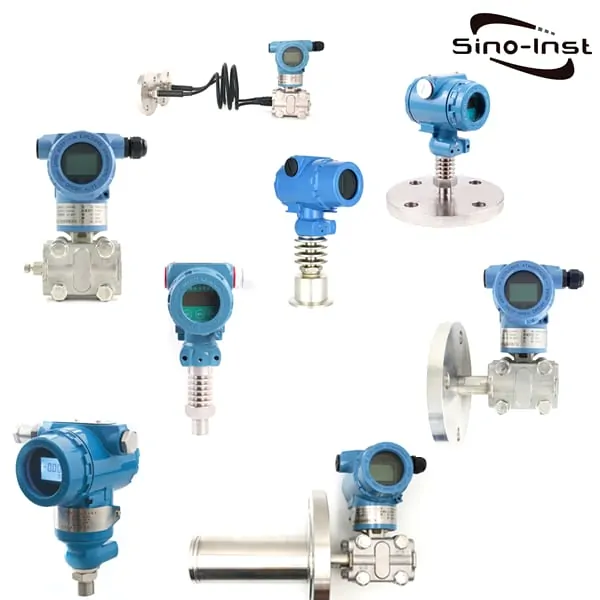
Process Industrial Pressure Transmitter
General-purpose 4–20 mA with HART. ±0.075% accuracy, 10-year stability. Direct drop-in replacement for legacy Rosemount 3051 and Yokogawa EJA loops.

SMT3151 TGP Gauge Pressure Transmitter
Compact 2-wire gauge pressure unit for utilities and OEM use. ±0.1% accuracy, 0.4 kPa to 42 MPa range, IP67 housing. Fast zero-trim via magnetic button.
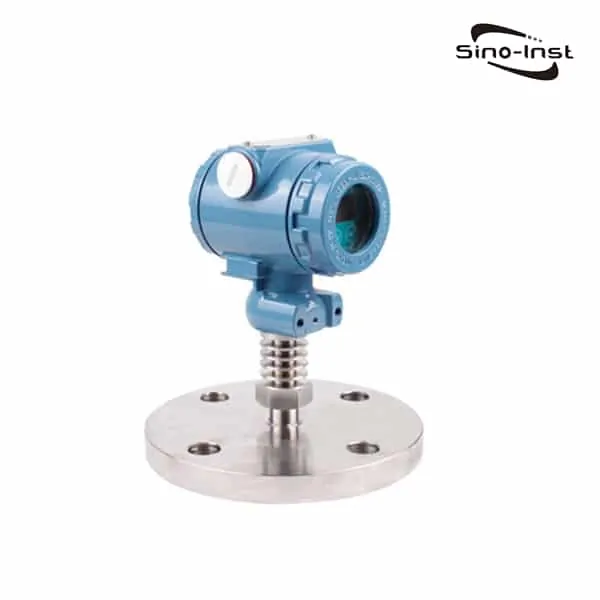
Diaphragm Seal Pressure Transmitter
Flush-flanged remote seal for viscous, slurry, or high-temperature service. Eliminates impulse-line blockage. 316L wetted parts, PTFE option, capillary lengths to 10 m.
FAQ
How do you troubleshoot a faulty pressure transmitter?
Start with the loop, not the transmitter. Put a multimeter in series and read the mA: 0 mA means open circuit or no power; 4 mA at zero process pressure means the transmitter is healthy but the impulse line may be blocked; >21 mA means a failed-high alarm. Walk the 5-fault sequence above (wiring, voltage, impulse line, diaphragm, drift) before opening the transmitter housing.
What does a 20 mA output mean when there is no pressure?
The transmitter has entered a failed-high alarm state. This happens when the sensor detects an internal fault — over-ranged diaphragm, failed ADC, or memory corruption. Cycle power to clear transient faults. If 20 mA persists at zero pressure, replace the transmitter.
How do I test a 4-20mA pressure transmitter with a multimeter?
Set the multimeter to DC mA (200 mA range), break the loop at the + terminal, and insert the meter in series. The multimeter becomes part of the current path. You should read 4 mA at zero pressure and 20 mA at full scale. Never put a multimeter in parallel with a 4–20 mA loop — it will short the signal to ground.
Can low voltage damage a 4-20mA transmitter?
Low supply voltage does not damage the transmitter, but it prevents normal operation. Below the minimum operating voltage (typically 10–12 V at the terminals), the transmitter either does not boot or outputs an unstable current. Fix the supply; the transmitter will resume normal service.
How often should a pressure transmitter be recalibrated?
Annual recalibration is standard for custody transfer and safety-critical loops. For general process control, 3–5 years is typical if the transmitter has not been exposed to over-range events, temperature cycling beyond spec, or corrosive service. Trend the zero drift year over year — if it is accelerating, shorten the interval.
Still stuck on a 4–20 mA loop that reads wrong? Send us the transmitter tag, loop wiring diagram, and the current DCS reading. Our engineers will walk through the fault tree with you and recommend a replacement unit if yours is end-of-life. If you also need a refresher on instrument units, our common units of pressure page covers psi/bar/kPa cross-reference.
Request a Quote

Wu Peng, born in 1980, is a highly respected and accomplished male engineer with extensive experience in the field of automation. With over 20 years of industry experience, Wu has made significant contributions to both academia and engineering projects.
Throughout his career, Wu Peng has participated in numerous national and international engineering projects. Some of his most notable projects include the development of an intelligent control system for oil refineries, the design of a cutting-edge distributed control system for petrochemical plants, and the optimization of control algorithms for natural gas pipelines.