
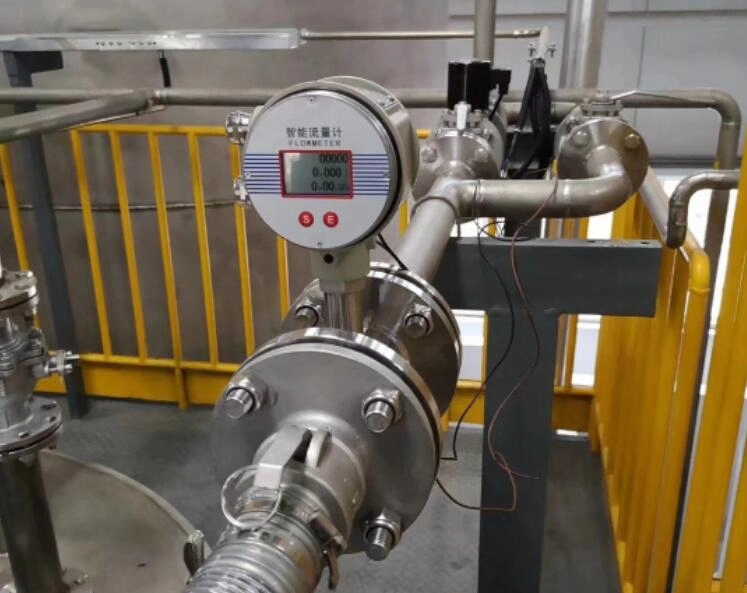
Updated May 21, 2026 — A condensate flow meter sits on the return side of a steam loop and measures the hot, sub-cooled water flowing back to the boiler feed tank. Pick the wrong technology and you will see negative flow, missing pulses, or a meter that fouls in six months. This guide covers technology selection, sizing, installation, and BTU recovery for steam condensate metering.
Vortex meters on steam lines have a K-factor set by the bluff body geometry, largely independent of density above Re ≈ 20,000.
Contents
- How Steam Condensate Flow Differs from Liquid Water
- Pumped vs Gravity Condensate Lines
- Six Technologies for Condensate Flow Measurement
- Sizing the Meter for the Return Loop
- Installation: Slope, Vent, and Strainer Rules
- BTU Recovery and Condensate Energy Accounting
- Six Errors That Wreck Condensate Readings
- Frequently Asked Questions
How Steam Condensate Flow Differs from Liquid Water
Condensate looks like water but does not act like it. Three properties matter for metering:
- Temperature. Saturation condensate sits at 90 to 180 °C depending on system pressure. Above 120 °C, common turbine bearings shorten life and elastomer seals fail within months.
- Flash steam. Pressure drops across the trap create flash — a two-phase mix of condensate and steam. Most meters cannot resolve the steam fraction and will under-report flow by 5-15%.
- Conductivity drift. Pure condensate has very low conductivity (often <1 µS/cm), which kills electromagnetic flow meters that need >5 µS/cm to operate.
The right meter handles all three. Plain rotameters and inexpensive turbine wheels generally do not. If you also need to measure live steam upstream, see our BTU and heat-meter guide for sensor pairing.
Pumped vs Gravity Condensate Lines
Condensate returns by gravity from the trap to a receiver, then a pump moves it back to the boiler. Each side needs a different meter.
| Section | Typical pressure | Flow profile | Recommended meter |
|---|---|---|---|
| Gravity (trap to receiver) | 0 to 2 barg | Slug, intermittent, often two-phase | Open-channel or vortex with degassing baffle |
| Pumped (receiver to boiler) | 3 to 10 barg | Steady, full pipe, single-phase | Turbine, vortex, ultrasonic, or DP orifice |
Never put a magnetic flow meter on a pure-condensate gravity line. Low conductivity kills the signal. Put it on the pumped side only if the boiler feed has >5 µS/cm makeup water blended in.
Six Technologies for Condensate Flow Measurement
- Vortex shedding. Shedding frequency tracks flow; survives 200 °C and two-phase mix better than turbine. ±1% accuracy on clean pumped condensate. Best general-purpose pick.
- Turbine. Mechanical wheel pulses per unit volume. Cheap and accurate (±0.5%) but bearings die fast in hot condensate; budget for replacement every 1-2 years.
- DP orifice + smart transmitter. Plate or wedge restriction with a DP transmitter. Robust to temperature, handles flash if condensate pots are fitted. Inline with our DP hookup guide.
- Ultrasonic clamp-on. Non-intrusive, no pressure drop, easy retrofit. Limited above 150 °C without high-temperature transducers. See the insertion ultrasonic flow meter for high-temp jobs.
- Coriolis mass. Measures mass directly, immune to density variation. Expensive, but ideal when you must close an energy balance on the steam loop.
- Averaging pitot (Verabar). Inserted probe with multiple ports averages velocity profile. Low pressure drop, tolerant of two-phase flow at modest accuracy (±1.5%). See our Verabar averaging pitot for specs.
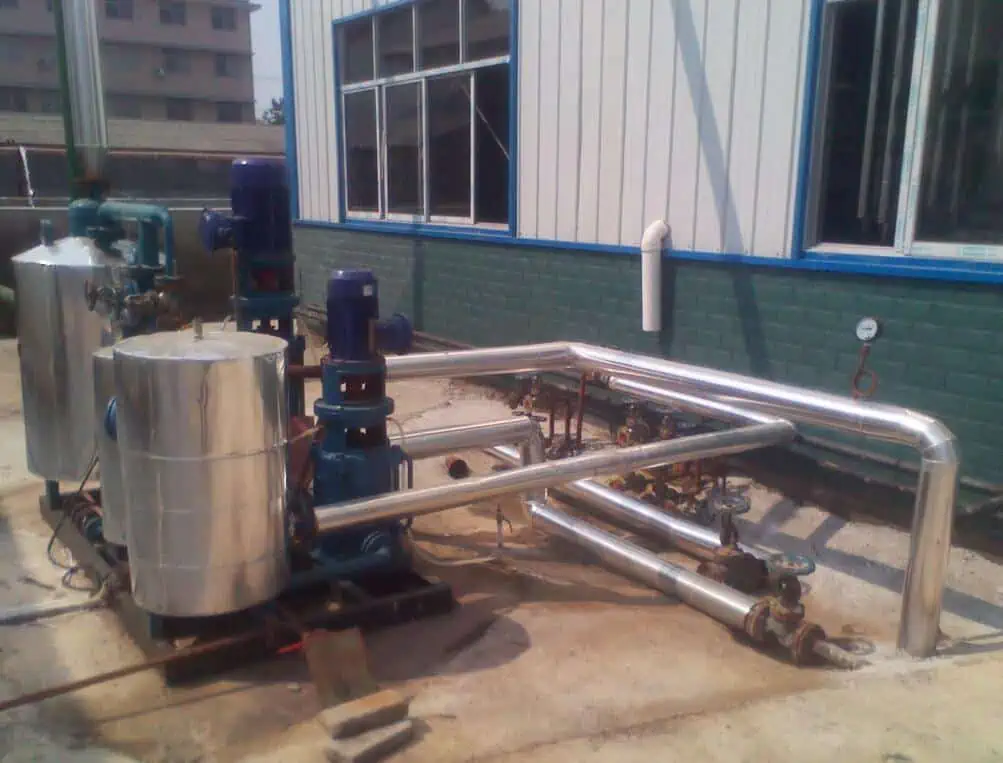
Sizing the Meter for the Return Loop
Condensate flow rate is roughly 90 to 98% of the steam mass flow upstream, depending on losses. Size for the maximum boiler steam load, then de-rate by losses and apply a 1.3x safety margin.
- Velocity target: 1 to 3 m/s in the pumped return. Below 1 m/s, vortex meters fall below the low-flow cutoff.
- For boilers under 5 t/h steam, DN25 to DN50 vortex is standard. For 10-30 t/h boilers, DN65 to DN100.
- Always check the meter rangeability against the condensate flow profile during start-up and shutdown — turn-down ratios of 10:1 are not unusual.
Installation: Slope, Vent, and Strainer Rules
Most condensate metering errors trace back to bad installation, not meter selection.
- Mount the meter on a vertical riser with upward flow. This keeps the pipe full and prevents flash steam from collecting at the meter throat.
- Leave 10 pipe diameters upstream and 5 downstream — the same 10D/5D rule that applies to most inline flow meters.
- Add a strainer 5D upstream. Trap scale, valve packing, and rust flakes upstream of the meter; debris pits the inner wall and breaks small turbine wheels in days.
- Install an air vent at the high point. Trapped air after maintenance produces a phantom flow signal until purged.
- Insulate the meter body on outdoor service to prevent night-time recondensation in the sensing cavity.
- Allow a calibration loop. Block valves before and after make field calibration possible without draining the line.
BTU Recovery and Condensate Energy Accounting
Plants serious about heat recovery pair the condensate flow meter with two temperature probes — one upstream, one downstream of a heat exchanger — and a BTU calculator. The calculator multiplies mass flow by the enthalpy difference to give recovered energy in kWh or BTU.
Typical recoverable energy on a 10 t/h boiler with 80% condensate return is 600 to 900 kW — large enough to justify a Coriolis meter on the high-value side, even if the gravity side stays on vortex. Use a smart DP transmitter if the boiler is also fed via orifice metering.
Six Errors That Wreck Condensate Readings
- Magnetic meter on a low-conductivity line. Pure condensate is below the >5 µS/cm threshold — you will see noise but no signal.
- Horizontal mount with gas pocket. The pipe is partially full and the meter under-reports.
- No strainer. Bearings and small ports clog within months.
- Trap downstream of meter. The trap pressure pulse hits the meter face and creates false counts.
- Wrong density compensation. A vortex meter at 180 °C reads volumetric; you must multiply by density to get mass — many sites forget.
- Calibration done cold. Bench calibration at 20 °C does not represent 150 °C service. Always specify field calibration at process conditions.
Featured Steam & Condensate Flow Meters
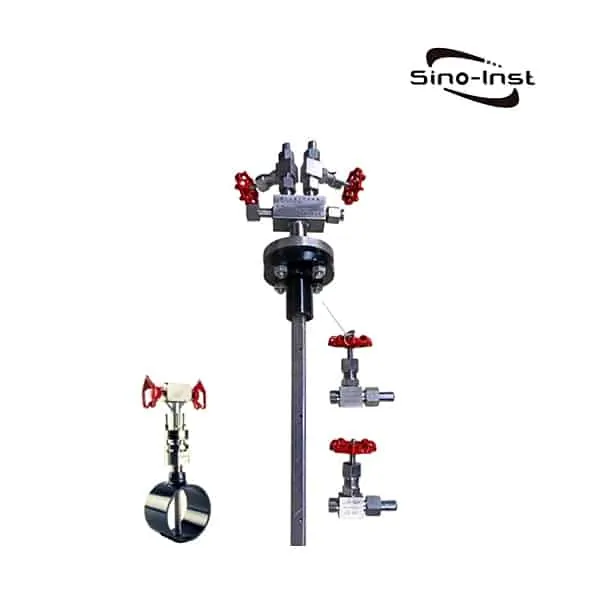
Verabar Averaging Pitot Flow Meter
Insertable averaging pitot | ±1.5% accuracy | DN25-DN2000 — survives 400 °C steam and two-phase condensate at very low pressure drop.
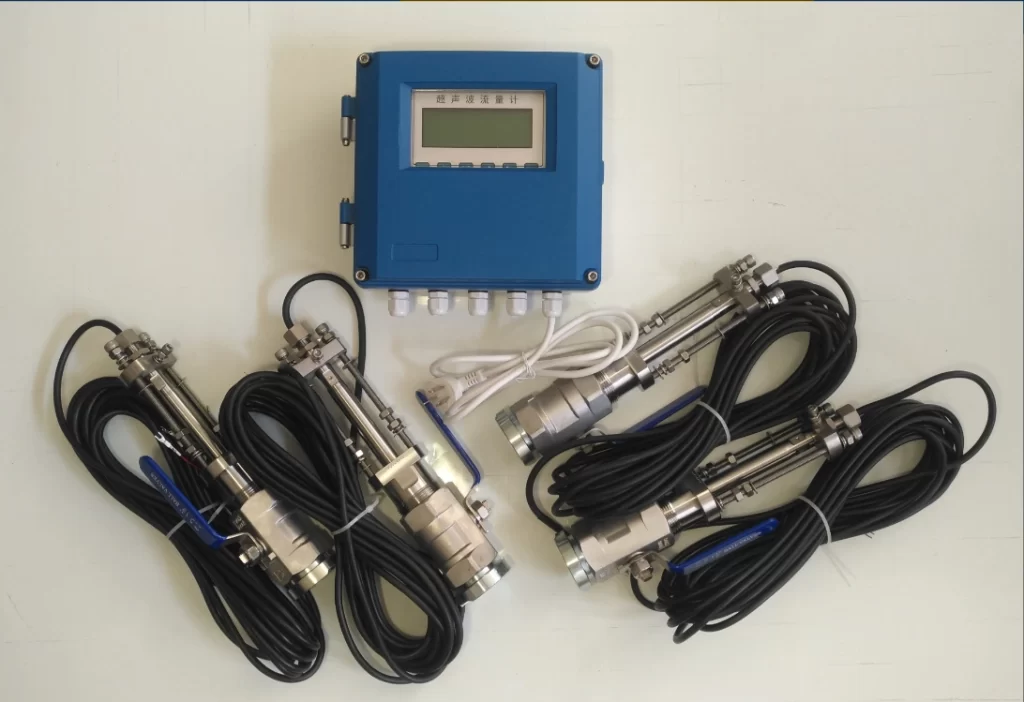
Insertion Ultrasonic Heat Meter
Insertion ultrasonic + RTD pair | DN50-DN2000 | hot-tap retrofit — pairs flow + supply/return temperature to compute BTU on the fly.
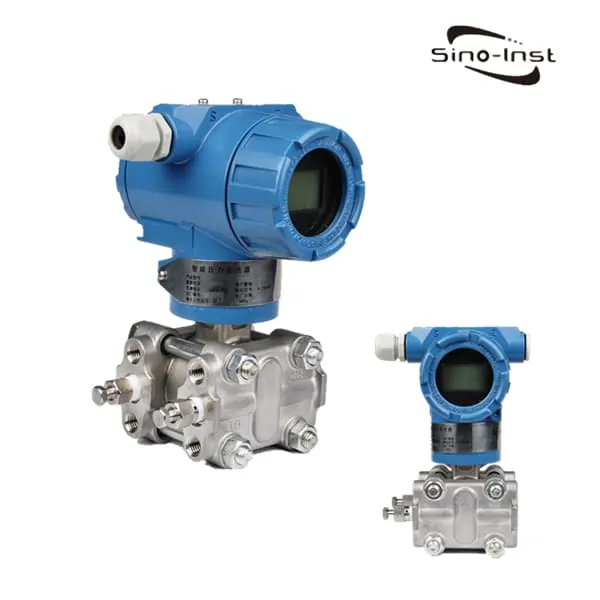
SMT3151DP Smart DP Transmitter
0-40 MPa span | ±0.05% accuracy | HART output — pairs with orifice or wedge primary element for high-pressure pumped condensate metering.
Frequently Asked Questions
What is a condensate flow meter?
A condensate flow meter measures the hot water flowing back from steam-using equipment to the boiler feed tank after the steam has given up its latent heat. It is sized in mass or volume per hour and is essential for energy accounting, leak detection, and recovery-loop efficiency tracking.
How does a condensate meter work?
Most condensate meters work on the same principles as cold water meters — vortex shedding, turbine rotation, differential pressure, or ultrasonic transit-time — but they use high-temperature components rated to 200 °C, and they are mounted to avoid two-phase flash steam at the sensing element.
Can a magnetic flow meter measure steam condensate?
Not on pure condensate. Magnetic meters need fluid conductivity above ~5 µS/cm; condensate from clean boiler feed is typically below 1 µS/cm. Use vortex, turbine, ultrasonic, or DP technology instead.
What is a steam BTU meter?
A steam BTU meter combines a steam mass flow meter, supply temperature, and condensate return temperature, and computes the heat actually delivered. Energy is mass flow times the enthalpy difference between supply and return.
Where should a condensate meter be installed?
On a vertical riser with upward flow, downstream of a strainer, at least 10 pipe diameters from any elbow or valve, and with an air vent at the high point. Insulate the body on outdoor service.
Need help selecting a condensate flow meter for your steam loop? Send the line size, condensate temperature, expected mass flow, and meter location and our engineers will quote a complete recovery package within one business day.
Request a Quote

Wu Peng, born in 1980, is a highly respected and accomplished male engineer with extensive experience in the field of automation. With over 20 years of industry experience, Wu has made significant contributions to both academia and engineering projects.
Throughout his career, Wu Peng has participated in numerous national and international engineering projects. Some of his most notable projects include the development of an intelligent control system for oil refineries, the design of a cutting-edge distributed control system for petrochemical plants, and the optimization of control algorithms for natural gas pipelines.