
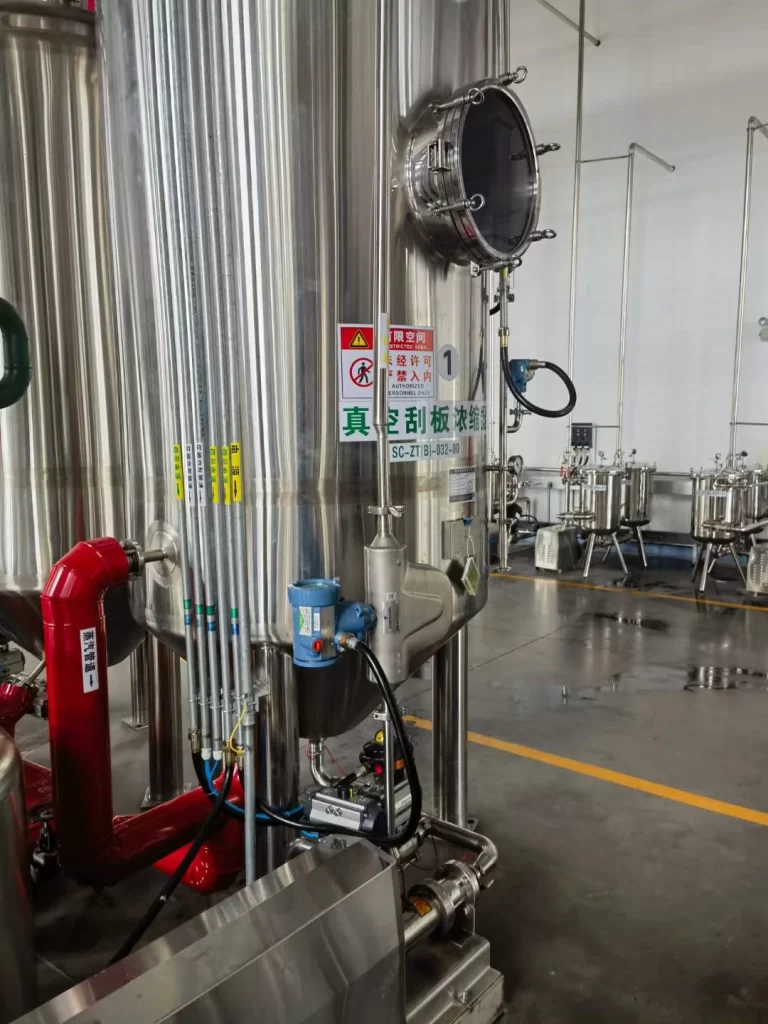
A Coriolis meter is famous for mass flow, but the same vibrating tubes also give a direct, real-time density reading — and that density comes from a completely different signal than the flow. Once you see which signal does what, it is obvious when the density number is trustworthy and when temperature or entrained gas will quietly pull it off.
Contents
- How does a Coriolis flow meter measure density?
- Why density and mass flow come from two different signals
- How accurate is Coriolis density measurement?
- Why temperature compensation matters
- Coriolis density vs tuning-fork and DP density meters
- Field calibration and common density errors
- Featured Coriolis and density meters
- Frequently asked questions
How does a Coriolis flow meter measure density?
A Coriolis flow meter measures density from the resonant (natural) frequency at which its tubes vibrate. A drive coil holds the tubes oscillating at their natural frequency; that frequency falls as the mass of fluid inside the fixed-volume tubes rises. Because volume is fixed, more mass means more density, so the meter converts the measured vibration period τ into density with a calibrated relation of the form ρ = K₀·τ² − K₁, where K₀ and K₁ are tube constants set at the factory. A heavier fluid literally slows the tubes down.
Why density and mass flow come from two different signals
Mass flow and density are two independent measurements on the same tubes. Mass flow is read from the Coriolis-induced phase shift — the slight twist between the inlet and outlet legs as moving fluid resists the tube’s rotation. Density is read from the vibration frequency, which does not need any flow at all. That is why a Coriolis meter still reports density at zero flow, and why you can use one instrument to derive concentration or °Brix as well as mass and volume flow.
How accurate is Coriolis density measurement?
A good Coriolis meter measures density to roughly ±0.0005–0.002 g/cm³ (±0.5–2 kg/m³), while its mass flow accuracy is typically ±0.1% of rate. That density spec is excellent for concentration, interface detection and net-oil calculations, though it is not quite a laboratory densitometer. The big caveat is two-phase flow: entrained gas or cavitation makes the tubes vibrate erratically and degrades both the density and the mass-flow reading, so the fluid must stay single-phase and the tubes full.
Why temperature compensation matters
Temperature is the error source people forget. The Young’s modulus of the tube metal softens as it warms, which lowers the resonant frequency independently of any density change — left uncorrected this can look like several kg/m³ of false density shift. Quality meters carry one or two built-in Pt100 RTDs and apply a tube-stiffness compensation, and they also report process temperature so you can correct fluid density to a reference temperature. If your meter’s density wanders with ambient or process temperature swings, suspect the temperature compensation first.
Coriolis density vs tuning-fork and DP density meters
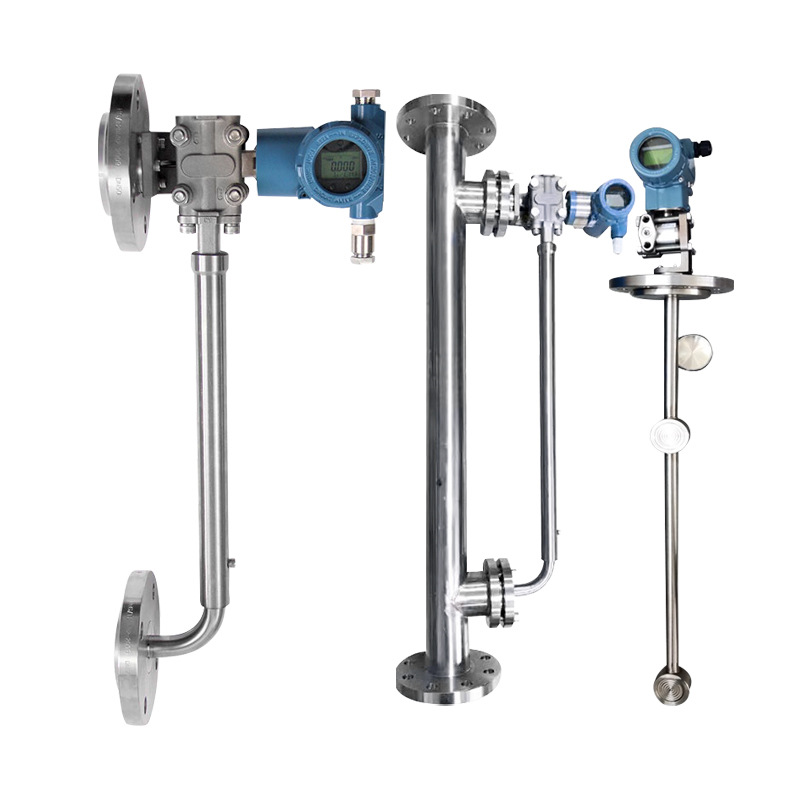
Choose Coriolis density when you already need mass flow and density from one point — concentration control, blending, or custody net-oil. If you only need density in a tank or line and not flow, a tuning-fork density meter is a cheaper, simpler fit. For large tanks, a differential-pressure (hydrostatic) density method measures density from the pressure of a known liquid column. Coriolis wins on combined accuracy and a single process penetration; tuning-fork and DP win on cost and on tolerance of difficult or gassy service.
Field calibration and common density errors
Verify density in the field against a known fluid: degassed water at a measured temperature has a density of 998.2 kg/m³ at 20 °C, which makes a clean single-point check, and an air/water pair gives a two-point span. The usual culprits behind a bad density reading are entrained gas, partially full tubes, coating or erosion that changes tube mass, mounting strain, and — most often — temperature compensation that has not been set up for the actual service. Document the verification so drift is visible over time. For very high accuracy, send the meter for periodic factory density calibration.
Featured Coriolis and density meters
Three Sino-Inst instruments for combined mass-flow-and-density and for dedicated density service:
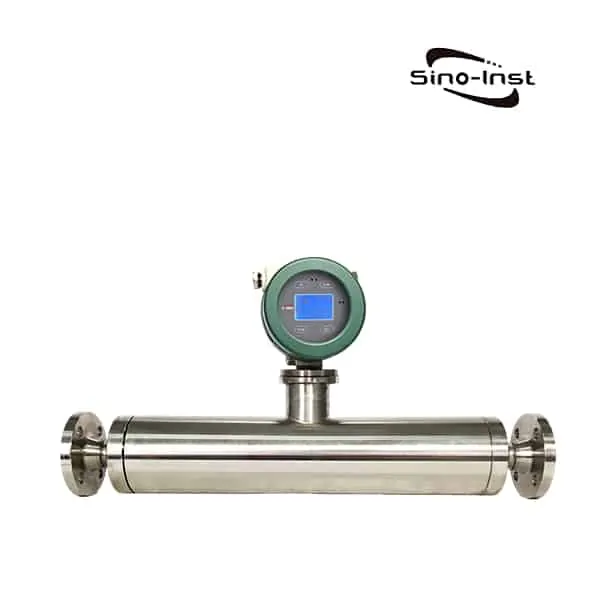
Z-Series Straight-Tube Coriolis
Single straight-tube Coriolis meter for simultaneous mass flow and density, easy to drain and clean for hygienic and viscous fluids.
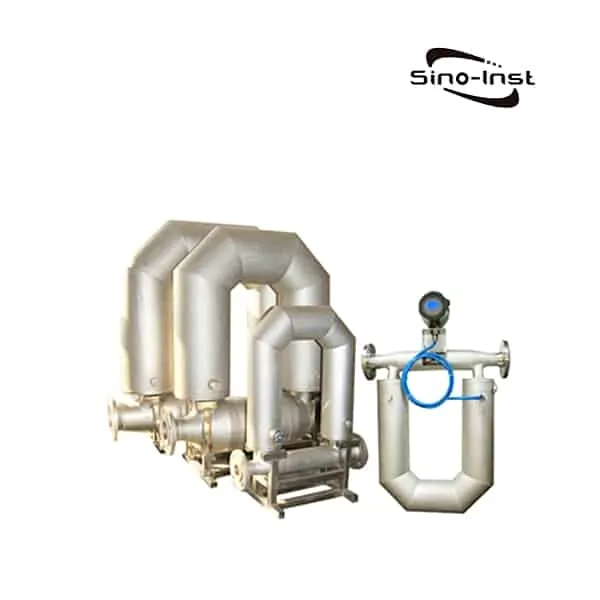
U-Series Coriolis Mass Flow Meter
Bent-tube Coriolis meter delivering ±0.1% mass flow plus real-time density for blending, dosing and concentration measurement.
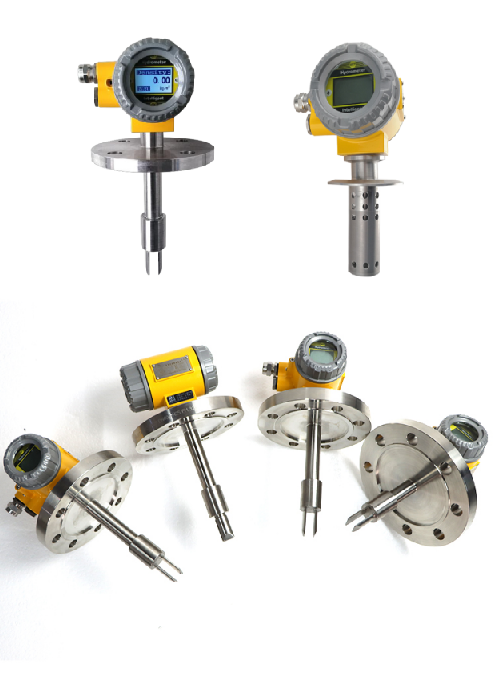
Tuning Fork Density Meter
Dedicated vibrating-fork density meter for tanks and lines when you need density and concentration but not flow — lower cost, simple install.
Frequently asked questions
How does a Coriolis meter measure density?
It measures the resonant frequency of its vibrating tubes. The tubes oscillate at their natural frequency, which decreases as the mass — and therefore density — of the fixed-volume fluid inside increases. The meter converts the vibration period into density using factory tube constants.
Is Coriolis density as accurate as a dedicated density meter?
Coriolis density is typically ±0.5–2 kg/m³, which is excellent for process concentration and net-oil work but slightly below a laboratory densitometer. For combined mass flow plus density from one point it is usually the best overall choice.
Does temperature affect Coriolis density measurement?
Yes. Warming softens the tube metal (Young’s modulus), lowering the resonant frequency and faking a density change. Quality meters use built-in RTDs and tube-stiffness compensation to correct it, and report temperature so you can reference density to a standard temperature.
Can a Coriolis meter measure density at zero flow?
Yes. Density comes from the tube vibration frequency, which is present whether or not fluid is moving, so the meter reports density even at no flow as long as the tubes are full of single-phase fluid.
Why is my Coriolis density reading unstable?
The most common cause is entrained gas or a partially full tube, which disrupts the vibration. Other causes are coating or erosion changing tube mass, mounting strain, and temperature compensation not configured for the actual service.
About this article
Written and technically reviewed by the Sino-Inst engineering team — last reviewed 2026-06-02 (AI-assisted drafting). Based on the vibrating-tube resonant-frequency density principle and field calibration practice for Coriolis and density meters. Questions? reach our application engineers.
Request a Quote

Wu Peng, born in 1980, is a highly respected and accomplished male engineer with extensive experience in the field of automation. With over 20 years of industry experience, Wu has made significant contributions to both academia and engineering projects.
Throughout his career, Wu Peng has participated in numerous national and international engineering projects. Some of his most notable projects include the development of an intelligent control system for oil refineries, the design of a cutting-edge distributed control system for petrochemical plants, and the optimization of control algorithms for natural gas pipelines.