
An RTD (resistance temperature detector) measures temperature by tracking how the resistance of a platinum element rises with temperature. A thermocouple measures temperature by reading the millivolt signal produced when two dissimilar metal wires join at a hot end. Same goal, very different physics — and that difference is what makes one right for your tank, oven, or pipeline and the other a poor fit.
This guide gives you a 5-application decision matrix, the wiring rules that trip up most installers, and a 5-year cost comparison so you can make a defensible choice the next time procurement asks why you specified one over the other.
Contents
- RTD and Thermocouple: Core Difference in One Sentence
- Working Principle: Resistance vs Voltage
- Accuracy and Stability Over Temperature
- Temperature Range and Sensor Limits
- Response Time and Self-Heating
- Wiring: 2/3/4-Wire RTD vs Type K/J/T Thermocouple
- 5-Year Cost of Ownership
- Decision Matrix: 5 Common Industrial Applications
- Common Selection Mistakes
- Featured Sensors from Sino-Inst
- FAQ
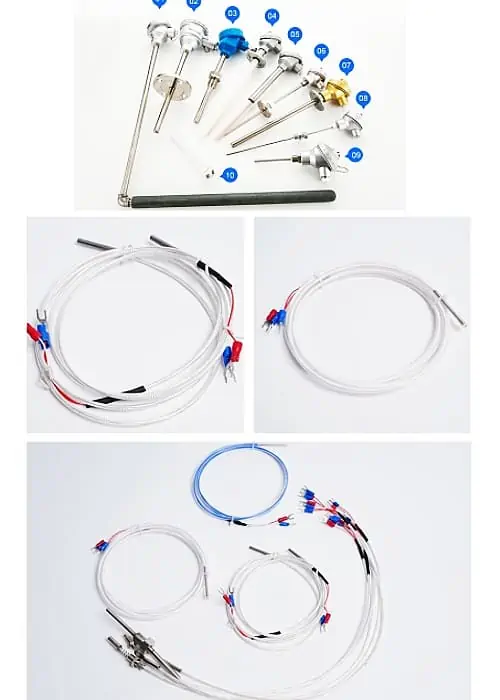
RTD and Thermocouple: Core Difference in One Sentence
An RTD changes its electrical resistance with temperature; a thermocouple generates a small voltage when its hot junction sees a different temperature than its cold junction. That single sentence drives every spec-sheet number that follows — accuracy, range, wiring complexity, drift, and cost.
The reference standards are IEC 60751 for platinum RTDs (Pt100 at 0 °C resistance of 100 Ω, α = 0.00385 Ω/Ω/°C) and IEC 60584 for thermocouples (covering Types K, J, T, N, S, R, B). Anyone selling you a sensor outside those standards is selling you trouble.
Working Principle: Resistance vs Voltage
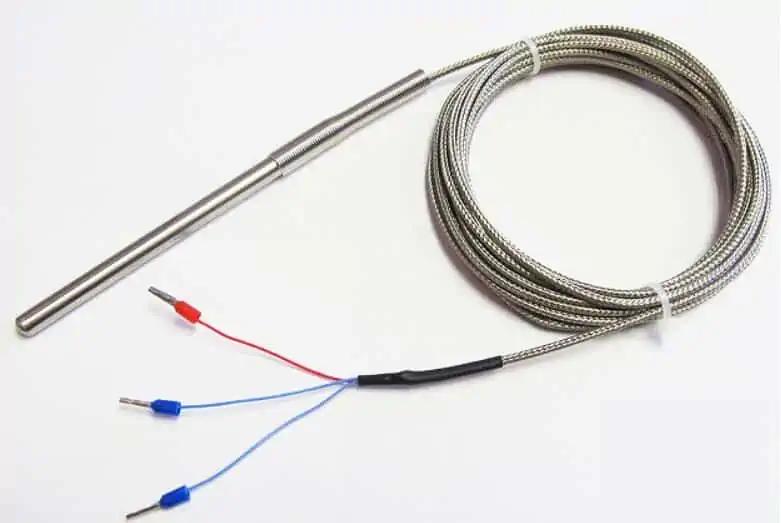
A Pt100 RTD is a small platinum film or wire-wound coil whose resistance follows the Callendar−Van Dusen equation. Above 0 °C: R(T) = R₀[1 + AT + BT²], where R₀ = 100 Ω, A = 3.9083 × 10⁻³, B = −5.775 × 10⁻⁷. Drive a small constant current (typically 1 mA) through the platinum and you measure the resulting voltage; resistance follows by Ohm’s law.
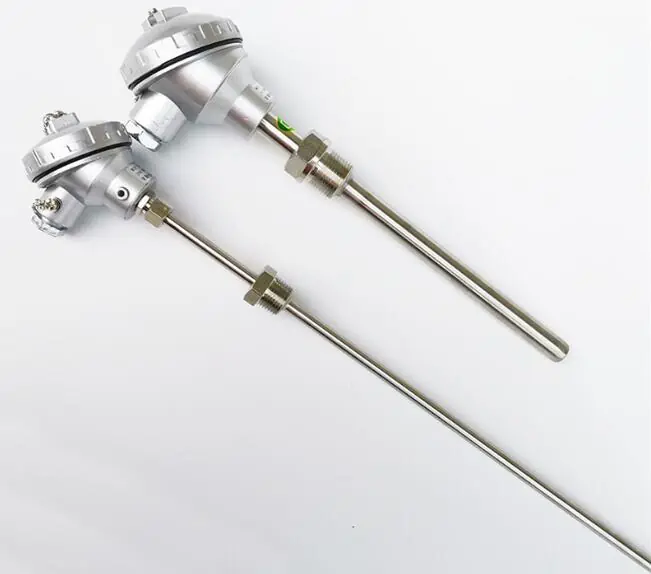
A thermocouple is built from two dissimilar metal wires welded at one end (the measuring junction). When that junction is at a different temperature than the open end (cold junction), a millivolt-level Seebeck voltage appears. The relationship is non-linear, so the converter or transmitter uses a polynomial reference table from NIST ITS-90 to translate millivolts into temperature.
Accuracy and Stability Over Temperature
An IEC 60751 Class A Pt100 is rated to ±(0.15 + 0.002·|T|) °C. At 100 °C, that’s ±0.35 °C. A Class B Pt100 is ±(0.30 + 0.005·|T|) °C — about three times looser. RTDs drift by less than 0.05 °C per year if treated gently.
A Class 1 Type K thermocouple is rated to ±1.5 °C below 375 °C, then ±0.4% of reading above. At 1000 °C, that’s ±4 °C. Type T is the most accurate thermocouple, ±0.5 °C below 125 °C, but it only goes to 400 °C. Type S (platinum/platinum-rhodium) is more stable than K above 1000 °C but ten times the price.
Bottom line: below 600 °C, RTDs win on accuracy by a factor of five to ten. Above 600 °C, thermocouples are the only practical choice — RTDs cannot survive there long.
Temperature Range and Sensor Limits
| Sensor | Operating Range | Continuous Use Limit |
|---|---|---|
| Pt100 RTD (thin film) | −50 to +500 °C | +400 °C |
| Pt100 RTD (wire-wound) | −200 to +650 °C | +600 °C |
| Type T thermocouple | −200 to +400 °C | +350 °C |
| Type J thermocouple | −40 to +750 °C | +700 °C |
| Type K thermocouple | −200 to +1260 °C | +1100 °C |
| Type N thermocouple | −270 to +1300 °C | +1200 °C |
| Type S / R / B | 0 to +1700 °C | +1600 °C |
Beyond the continuous limit, the platinum migrates in an RTD and the thermocouple wire alloys degrade. A K-type pushed past 1100 °C in air drifts at roughly 1–2 °C per 100 hours of operation. We’ve seen factory floors blame “controller drift” when the real problem was an exhausted K-type that nobody documented.
Response Time and Self-Heating
Thermocouples are faster. A 1.5 mm sheathed Type K reaches 63% of a step change in about 0.5 second in water, 5–7 seconds in air. A 6 mm sheathed Pt100 takes 3–4 seconds in water, 30+ seconds in still air. If you’re tuning a fast loop or chasing a transient, that gap matters.
RTDs also suffer self-heating: the 1 mA excitation current dissipates I²R in the element. A typical 100 Ω element with 1 mA gives 0.1 mW. In still air that’s enough to raise the reading by 0.05–0.1 °C, which is more than the Class A error budget. Thermocouples have no excitation current and no self-heating.
Wiring: 2/3/4-Wire RTD vs Type K/J/T Thermocouple
An RTD reading is just a resistance, so lead wire resistance adds directly to the measurement. A 2-wire RTD adds the full lead resistance — about 0.4 Ω per 10 m of 22 AWG copper, which is roughly 1 °C error. A 3-wire RTD subtracts one lead from the resistance bridge and cuts the lead error by about 90%. A 4-wire RTD passes current through two leads and measures voltage on the other two; lead resistance disappears from the math entirely. Use 4-wire for laboratory accuracy, 3-wire for everything else.
Thermocouples use extension wire of the same alloy as the thermocouple itself — never plain copper. Substituting copper extension on a Type K creates a second junction at the head, and that junction reads room temperature into your loop as a 4–6 °C offset. Color codes are international (IEC 60584): Type K is green positive / white negative; Type J is black/white; Type T is brown/white. For background on extension wiring conventions and shielded cables, see our note on shielded twisted-pair cables for industrial instrumentation.
For full Type K reference values, see the Type K thermocouple chart with mV reference and tolerance bands. For Pt100 element construction, see our WZP Pt100 series assembled thermal resistance page.
5-Year Cost of Ownership
| Cost Item | Pt100 RTD (Class A, 3-wire) | Type K Thermocouple (Class 1) |
|---|---|---|
| Initial sensor + thermowell | $140 | $70 |
| Transmitter (4-20 mA) | $110 | $95 |
| 3-wire cable (50 m) | $95 | $210 (Type K extension) |
| Annual calibration (5 yrs) | $60 × 5 = $300 | $40 × 5 = $200 |
| Replacement during 5 yrs | 0 (typical) | 1 (high-temp service) |
| 5-yr total | $645 | $645 + $70 = $715 |
RTD wins on TCO in service below 600 °C even though the sensor itself costs twice as much. Two reasons: copper cable is much cheaper than Type K extension cable, and RTDs rarely need mid-service replacement. The math flips above 800 °C — RTDs cannot survive there, so the comparison ends.
Decision Matrix: 5 Common Industrial Applications
| Application | Typical Range | Recommended Sensor | Why |
|---|---|---|---|
| HVAC chiller water | 4 to 12 °C | Pt100 Class A | Tight accuracy needed for BTU calc |
| Boiler feedwater | 80 to 150 °C | Pt100 Class B | Stable, easy 3-wire run to PLC |
| Plastic injection mold | 180 to 280 °C | Type J or Pt100 wire-wound | Either works; J is cheaper if many sensors |
| Heat-treat furnace | 700 to 1100 °C | Type K Class 1 | RTD cannot survive |
| Glass / kiln / cement | 1200 to 1600 °C | Type S or B | Only platinum-alloy TCs handle this |
Common Selection Mistakes
- Specifying Pt100 for a 1200 °C kiln. The platinum will diffuse into the sheath in weeks. Use Type S.
- Running 2-wire RTD for a 30 m cable run. Lead-wire error swamps Class A accuracy. Use 3-wire minimum, 4-wire for lab work.
- Reusing copper cable as Type K extension. You just put a 4–6 °C junction error at the head.
- Mixing Type K and Type J how a pressure transmitter works. A Type J transmitter reading a Type K sensor under-reads by 30–40 °C at 500 °C.
- Ignoring sheath material. Inconel 600 is fine in oxidizing air; in sulfur-bearing flue gas it pits in months. Spec Hastelloy or ceramic.
Featured Sensors from Sino-Inst
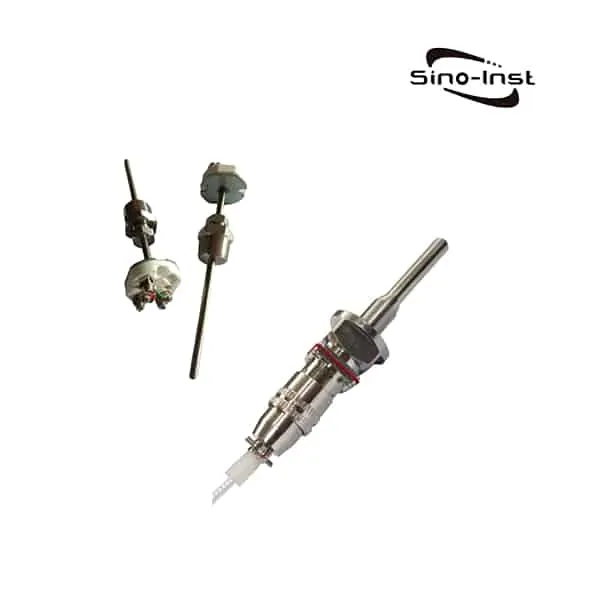
Pt100 Thermal Resistance RTD
IEC 60751 Class A | −200 to +650 °C | 2/3/4-wire — Pt100 element for HVAC, process, and lab measurement.

Industrial Thermocouple (K/J/N/T/S)
IEC 60584 Class 1 | Up to +1700 °C | Inconel / ceramic sheath — furnaces, kilns, and high-temperature process.
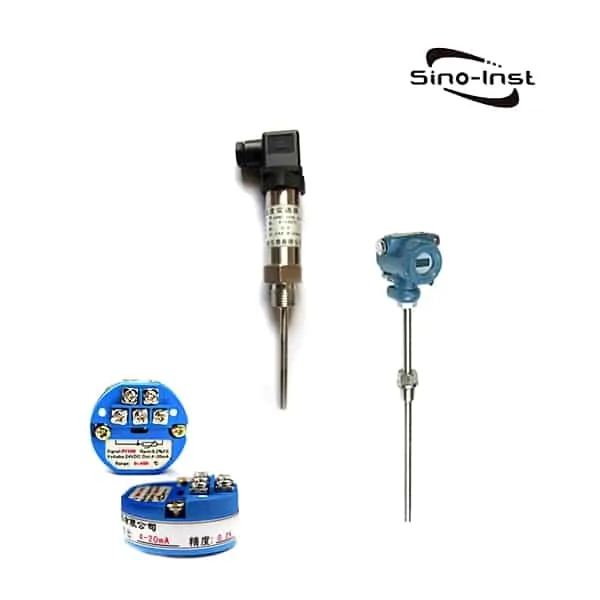
Universal-Input Temperature Transmitter
RTD or TC input | 4-20 mA / HART output | DIN-rail or head-mount — pairs with any sensor on this page.
Need help picking? Send your service conditions (medium, temperature range, pipe size, connection) to our engineers using the form below — we typically reply within one working day with a sized quote.
FAQ
Which is more accurate, RTD or thermocouple?
Below 600 °C, an IEC Class A Pt100 RTD beats any thermocouple by a factor of 5 to 10. Above 600 °C, RTDs degrade and thermocouples become the only practical choice.
Can I replace a thermocouple with an RTD?
Only if the service temperature stays under the RTD’s continuous limit (typically 600 °C wire-wound or 400 °C thin-film) and the transmitter accepts RTD input. You’ll also need to swap from thermocouple extension wire to plain copper.
What is the difference between Pt100 and Pt1000?
Both are platinum RTDs following IEC 60751. Pt100 has 100 Ω at 0 °C and is the industrial standard. Pt1000 has 1000 Ω at 0 °C; the higher base resistance makes lead-wire error 10x less important, so it’s popular in HVAC and 2-wire installations.
What is RTD full form?
RTD stands for Resistance Temperature Detector. It is a temperature sensor whose electrical resistance changes predictably with temperature. The most common type is the platinum Pt100 defined by IEC 60751.
Which thermocouple type should I use for general industrial work?
Type K is the default workhorse for 0–1100 °C — wide range, cheap, readily available. Use Type T if you need accuracy below 200 °C, Type J for older European installations, Type N for long-term stability above 800 °C, and Type S/R/B above 1100 °C.
How long does an RTD last in service?
Properly specified Pt100 RTDs in non-cycling service routinely last 10+ years with drift under 0.05 °C/year. Thermal cycling, vibration, and sheath corrosion shorten that life. We recommend a 12-month calibration check for any sensor in custody-transfer or food/pharma service.
Request a Quote

Wu Peng, born in 1980, is a highly respected and accomplished male engineer with extensive experience in the field of automation. With over 20 years of industry experience, Wu has made significant contributions to both academia and engineering projects.
Throughout his career, Wu Peng has participated in numerous national and international engineering projects. Some of his most notable projects include the development of an intelligent control system for oil refineries, the design of a cutting-edge distributed control system for petrochemical plants, and the optimization of control algorithms for natural gas pipelines.