
Updated: April 23, 2026
A pressure gauge gives you a number on a dial. A how a pressure transmitter works sends a 4-20 mA signal to a control system. That single sentence drives 90% of the selection decision. The remaining 10% is where most plants get it wrong — picking a transmitter when a gauge would have done the job, or trying to skip the gauge on an installation that legally needs one. This article walks through the real differences, when each one is the right call, and why most well-designed plants install both side by side.
A pressure gauge reads static line pressure to the atmosphere; for the distinction with dynamic and total pressure (which need a Pitot port) see our static vs dynamic pressure reference.
Contents
- What Is the Difference Between a Pressure Transmitter and a Pressure Gauge?
- Pressure Transmitter vs Pressure Gauge: Parameter Comparison
- When to Use a Pressure Gauge
- When to Use a Pressure Transmitter
- Why You Often Install Both
- Cost Comparison and Total Lifecycle
- Pressure Transmitters and Gauges from Sino-Inst
- FAQ
What Is the Difference Between a Pressure Transmitter and a Pressure Gauge?
A pressure gauge displays the reading locally on a mechanical or digital dial. A pressure transmitter converts the same pressure into a 4-20 mA, HART, or digital signal so a PLC, DCS, or SCADA system can use it. The gauge is for human eyes at the equipment. The transmitter is for the control system in another building.
For background on the control algorithm that drives pressure regulation valves, see our explainer on PID controller principle, tuning, and applications.
The internal sensing element can be the same — a Bourdon tube, diaphragm, or piezoresistive cell. For fast dynamic events the choice flips to a piezoelectric pressure sensor instead, since neither a gauge nor a typical 4-20 mA transmitter can follow microsecond transients. What changes is the back end. A gauge ends in a mechanical linkage to a pointer. A transmitter ends in electronics that produce a calibrated current loop. That single architectural difference drives everything else: power requirement, accuracy, signal length, and price.
Pressure Transmitter vs Pressure Gauge: Parameter Comparison
Compare the two on the parameters that matter for plant specification, not the marketing brochure.
| Parameter | Pressure Gauge | Pressure Transmitter |
|---|---|---|
| Output | Visual dial reading | 4-20 mA, HART, Modbus, Profibus |
| Power | None (mechanical) or 24 VDC (digital) | 24 VDC, 2-wire loop |
| Typical accuracy | ±1.6% to ±0.5% of full scale | ±0.075% to ±0.5% of span |
| Signal range | Local only | Up to 1 km on 4-20 mA |
| Calibration interval | Annual visual check | 1-3 years, depending on service |
| Hazardous area approval | Mechanical: passive safe | Ex ia / Ex d certified versions |
| Connection | 1/4" NPT or G1/2 thread | Same process connection plus M20 or 1/2" NPT cable entry |
| Indicative price | $15-$200 | $200-$1500 |
| Failure mode | Pointer stuck or burst element | Loop breaks, signal drift, or saturates 22 mA |
Two numbers in this table are easy to misread. Accuracy on a gauge is quoted as percent of full scale, but on a transmitter it is percent of span. A 0-100 bar gauge at ±1% means ±1 bar regardless of where the pointer sits. A 0-100 bar transmitter ranged for 20-80 bar at ±0.1% of span means ±0.06 bar — close to ten times more accurate when you need to read mid-range pressures. This rangeability is the second hidden advantage of transmitters.
When to Use a Pressure Gauge
Pick a gauge when a person walks past the equipment and needs to read pressure on the spot. Compressed air manifolds, lubrication oil pressure, hydraulic test stands, and small package skids all qualify. The control system either does not exist or does not care about that pressure point.
Specific scenarios where a gauge is the right call:
- Local indication on isolated equipment. A standalone air compressor in a workshop. No DCS, no HMI, just a maintenance technician.
- Verification of a transmitter reading. An on-site gauge lets a field operator confirm what the control room is seeing — useful during loop checks and instrument troubleshooting.
- Code-required pressure indication. ASME B31.3 and PED-certified pressure vessels often require a local gauge regardless of what the control system measures. Specifying a transmitter does not exempt you from the gauge.
- Low-budget package skids. If the OEM ships a unit with a $40 gauge, replacing it with a $400 transmitter for inventory standardization rarely pays back.
- No power available. Mechanical gauges work in remote pits, vault stations, and locked-out maintenance scenarios where 24 VDC is not present.
The classic mistake here is over-specifying transmitters on small skid packages because the engineer is uncomfortable with mechanical instruments. A $1200 HART transmitter on a 20 hp compressor adds nothing the operator can use. The gauge is fine.
When to Use a Pressure Transmitter
Pick a transmitter whenever the pressure value has to leave the equipment. Control loops, alarms, data historians, custody transfer, and remote monitoring all require an electronic signal. A transmitter is also the right call when the measurement is in a hazardous area, on a moving asset, or in a location no one walks past during a normal shift.
Specific scenarios where a transmitter is the right call:
- Closed-loop control. The pressure feeds a PID controller that adjusts a valve or pump. A gauge cannot do this.
- Process alarms and trips. Safety integrity functions need a signal the SIS can read. ANSI/ISA 84 / IEC 61511 systems specifically rule out reading a gauge as the safety input.
- Tank inventory and DP-based level. The control system needs continuous level, calculated from differential pressure. See our extended diaphragm seal DP level transmitter page for that specific application.
- Remote or unmanned sites. A telemetry RTU at a wellhead or pump station needs a 4-20 mA input. No one is reading a gauge there.
- High-accuracy custody transfer. Fiscal flow measurement and pipeline metering require ±0.075% to ±0.04% accuracy, which is transmitter territory.
- Long signal runs. The control room is 800 m away. A 4-20 mA loop carries the signal that distance with no degradation.
The opposite mistake is also common — relying on the control system’s transmitter as the only pressure indication and forgetting that field crews still need a local readout during commissioning, maintenance, or DCS outages.
Why You Often Install Both
On most regulated process equipment, gauges and transmitters are not competitors. They sit on the same nozzle. The transmitter feeds the control system. The gauge gives the field operator a backup reading without having to call the control room.
The standard install pattern looks like this: a tee or pressure manifold on the process line, a gauge on one branch with an isolation valve, a transmitter on the other branch with its own isolation. Both can be replaced under hot-line conditions without shutting down the process. The gauge often acts as the bypass during transmitter calibration. This dual install costs roughly 10-15% more than a transmitter alone, and the maintenance team will thank you every year for it.
For installation hardware and impulse line layout, our pressure transmitter installation guide covers the manifold, valve, and orientation rules.
Cost Comparison and Total Lifecycle
Capital cost is only part of the story. Calibration, replacement, and downstream integration are where transmitters spend more.
| Cost Item | Mechanical Gauge | Smart Transmitter |
|---|---|---|
| Initial unit cost | $15-200 | $200-1500 |
| Wiring and termination | None | $50-200 per loop |
| Annual calibration labor | 15 min visual check | 30-60 min loop calibration |
| Documentation per device | Tag plate | HART config sheet, calibration certificate |
| Typical service life | 5-10 years | 10-15 years |
| Spares strategy | Like-for-like swap | Configured spare with hot-cut procedure |
The gauge wins on raw price. The transmitter wins on data value — the question is whether the data is actually used. If the 4-20 mA signal feeds a recorded historian and a control loop that runs the plant, the transmitter pays for itself many times over. If the signal goes nowhere except a screen no one watches, you bought an expensive gauge.
Pressure Transmitters and Gauges from Sino-Inst
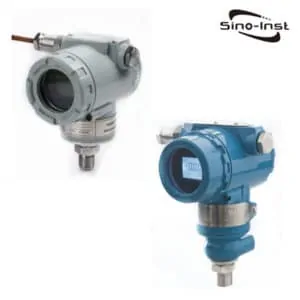
SMT3151 Smart Gauge Pressure Transmitter
4-20 mA + HART, ±0.075% accuracy, 316L wetted parts. The standard process transmitter for control loops and tank measurement.
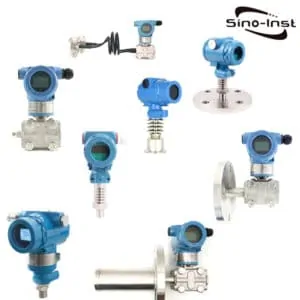
Industrial Pressure Transmitters
Full process range with HART, Modbus, or Profibus output. Hazardous-area Ex ia certified. Use when the loop has to talk to the DCS.
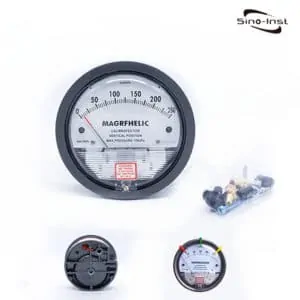
SI-2000 Differential Pressure Gauge
Local mechanical gauge for filter ΔP, blower discharge, and clean-room HVAC. Magnetic-coupled diaphragm, no power required.
FAQ
Is a pressure transmitter more accurate than a pressure gauge?
Usually yes. A standard process gauge is ±1% of full scale. A smart transmitter is ±0.075% of span and can be reranged to a smaller window for higher resolution. The accuracy gap is roughly 10-13× in favor of the transmitter when measuring partial-range pressures.
Can a pressure transmitter replace a pressure gauge?
Functionally yes if the transmitter has an integrated LCD or HART HMI. Practically, most plants keep both because a mechanical gauge gives a reading during power loss and DCS outages. Code-required local indication still needs a gauge in many jurisdictions.
What output does a pressure transmitter use?
The 4-20 mA two-wire loop is the global standard, with HART superimposed for diagnostics and configuration. Newer plants also use Modbus RTU, Profibus PA, and Foundation Fieldbus. Wireless HART exists but is rare on primary process points.
Do pressure transmitters need calibration?
Yes — typically every 1-3 years depending on service. Calibration involves applying a known reference pressure and trimming the sensor zero, span, and 4-20 mA loop output. Smart transmitters store the calibration history in HART memory.
When should I use a digital pressure gauge instead of a mechanical gauge?
Use a digital gauge when you need ±0.25% accuracy with a local readout but no signal output. Test benches, calibration carts, and pump test rigs are typical. Digital gauges run on batteries or 24 VDC and offer min/max recall.
What is the difference between a pressure transmitter and a pressure transducer?
A transducer outputs a low-level signal — millivolt or 0-5 V — that needs further amplification. A transmitter has a built-in amplifier and outputs a standardized 4-20 mA or HART signal that runs straight into a DCS. In modern process plants, the term "transmitter" is the default; transducers live in OEM equipment and lab instrumentation.
Get a Pressure Transmitter or Gauge Quote
Tell us the process pressure range, fluid, hazardous-area zone, and signal output you need. We’ll come back with a model number, accuracy class, and process connection drawing — usually within one business day.
Request a Quote

Wu Peng, born in 1980, is a highly respected and accomplished male engineer with extensive experience in the field of automation. With over 20 years of industry experience, Wu has made significant contributions to both academia and engineering projects.
Throughout his career, Wu Peng has participated in numerous national and international engineering projects. Some of his most notable projects include the development of an intelligent control system for oil refineries, the design of a cutting-edge distributed control system for petrochemical plants, and the optimization of control algorithms for natural gas pipelines.