
A capacitive fuel level sensor measures diesel, petrol, kerosene, or jet fuel by treating the tank as a parallel-plate capacitor and reading the change in capacitance as fuel rises and falls. It is non-mechanical, has no moving parts inside the probe, and resolves level to about ±1 mm in clean fuel — which is why it has displaced reed-switch float chains in most over-the-road tankers and standby gensets built since 2015.
This guide explains how the capacitance reading is converted to a fuel volume, what the probe actually looks like inside, where capacitive technology beats float / ultrasonic / magnetostrictive alternatives, and where it does not. Worked numbers use Pa, mm, and pF so you can repeat the math against your own datasheet.
Contents
- How a Capacitive Fuel Level Sensor Works
- Inside the Probe: Coaxial Electrode Design
- Dielectric Constant and Why Diesel ≠ Petrol
- Capacitive vs Float, Ultrasonic, and Magnetostrictive
- Where Capacitive Wins — and Where It Doesn’t
- Calibration and Field Diagnostics
- Where We See It Installed
- Featured Capacitive Level Products
- FAQ
How a Capacitive Fuel Level Sensor Works
A capacitive fuel level sensor uses a vertical metal rod (or rod-and-tube) inserted into the tank as one capacitor plate, and the tank wall — or a concentric outer tube — as the second plate. Fuel acts as the dielectric between them. As fuel level rises, the dielectric in the gap changes from air (relative permittivity εr≈1.0) to fuel (εr≈2.0–2.2 for diesel, 1.9–2.1 for petrol). Capacitance rises in direct proportion to the wetted length.
For a coaxial probe the relationship is C = 2π·ε0·εr·L / ln(b/a), where a and b are the inner and outer electrode radii, L is the wetted length in metres, and ε0 is the vacuum permittivity (8.854×10⁻¹² F/m). A 600 mm probe with a=2 mm, b=8 mm reads roughly 60 pF empty and 120 pF full of diesel — a 60 pF span the transmitter electronics resolve to 12-bit (≈0.015 pF), which is why ±1 mm resolution over 600 mm is realistic.
The transmitter applies a 1–10 kHz AC excitation across the electrodes and measures the resulting current. AC is mandatory: a DC reading would be swamped by the leakage resistance of fuel additives and water contamination, and would also polarise the electrodes over time. Modern transmitters use synchronous demodulation to reject 50/60 Hz pickup from nearby alternators and switching gear.
Inside the Probe: Coaxial Electrode Design
Two electrode geometries dominate fuel applications. Coaxial probes use an inner rod inside an outer perforated tube — the outer tube fixes the gap, so the reading is independent of tank wall material and the probe can be installed in plastic, fibreglass, or rubber-lined steel tanks. Rod-to-wall probes use the metal tank itself as the second plate; they are cheaper and shorter but only work in conductive metal tanks and are sensitive to off-axis mounting.
The inner rod is usually 316L stainless steel for diesel and biodiesel-blend service. PTFE or PFA insulation on the outer surface of the rod is non-negotiable — it stops the probe from short-circuiting if conductive water settles to the bottom of the tank. The PTFE jacket is also what gives capacitive probes their tolerance for ethanol-blend gasoline; bare metal probes corrode in E10/E15 fuel within months.
Probe lengths up to 4 m are standard. Above 2 m we recommend a centring spider every 600 mm to keep the rod parallel to the outer tube — vibration during transport will otherwise let the rod swing 1–2 mm off-axis, which moves the apparent capacitance enough to produce a 30–50 mm level error.
Dielectric Constant and Why Diesel ≠ Petrol
Different fuels have different dielectric constants, so the same probe gives a different full-scale capacitance for each. A transmitter calibrated for diesel and then filled with petrol will read about 7 % low. The values below are typical at 20 °C — they drift roughly −0.001 εr/°C with rising temperature.
| Fuel | Dielectric constant εr | Notes that affect calibration |
|---|---|---|
| Diesel (No.2 / EN 590) | 2.0 – 2.2 | Reference fuel for most factory calibrations |
| Biodiesel B100 | 3.1 – 3.2 | Reads ~50 % high if not recalibrated |
| Petrol / gasoline (RON 95) | 1.9 – 2.1 | Reads ~5–7 % low on a diesel calibration |
| E10 (10 % ethanol) | 4.5 – 5.5 | Recalibration mandatory; ethanol is polar |
| Jet A-1 / kerosene | 1.7 – 2.0 | Lowest end of the range |
| Hydraulic oil | 2.1 – 2.8 | Varies with additive package |
If the tank serves multiple fuels, look for a transmitter with a wet-cal procedure — fill the tank to a known level, push a button, and the firmware re-derives εr from the measured capacitance. Two-point wet calibration (empty and full) handles εr drift caused by additives, water emulsion, and seasonal temperature swings without manual datasheet lookup.
Capacitive vs Float, Ultrasonic, and Magnetostrictive
For diesel and petrol tanks under 4 m, four technologies dominate. The decision usually comes down to accuracy required, tank cleanliness, and whether the tank is on a vehicle that vibrates and slosh-loads the sensor.
| Tech | Typical accuracy | Moving parts | Best for | Watch out for |
|---|---|---|---|---|
| Capacitive rod | ±0.5–1 % FS | None | Vehicle / genset / IBC | Mixed-fuel tanks; conductive sludge |
| Reed-switch float | ±5–10 mm steps | Magnetic float | Cheap aftermarket; small tanks | Float sticks on biofilm; resolution = magnet pitch |
| Ultrasonic (top) | ±0.25 % FS | None | Above-ground bulk diesel | Foam / vapour / dome echoes |
| Magnetostrictive | ±0.01 % FS | External float ring | Custody-transfer fuel terminal | Cost: 4–8× capacitive |
For most fleet-fuel and standby-power applications, capacitive hits the sweet spot — better accuracy than a reed-switch float, immune to the tank-dome echoes that plague ultrasonic in mobile applications, and a fraction of the cost of a magnetostrictive setup. We cover the magnetostrictive trade-offs in our magnetostrictive tank level measurement guide.
Where Capacitive Wins — and Where It Doesn’t
Capacitive fuel sensors are the default for vehicle tanks, gensets, day tanks, and IBCs because they have no moving parts to seize, no top-of-tank vapour cone to degrade the signal, and they handle the −40 °C to +85 °C ambient range that reed-switch floats cannot.
- Wins: no moving parts, ATEX-able for petrol vapour, immune to slosh and roll on vehicles, ±1 mm resolution, life expectancy 10+ years.
- Loses: requires recalibration per fuel type, sensitive to thick sludge or wax buildup on the rod, accuracy degrades if free water sits at the bottom, longer probes need careful centring.
For tanks where free water and biological sludge are unavoidable — old underground storage, marine bilge — we usually recommend a non-contact alternative. See how to check level in underground tanks for the comparison.
Calibration and Field Diagnostics
Two-point wet calibration is the reliable method. Drain the tank, record the empty-pF reading, fill to a known volume against a calibrated dipstick, record the full-pF reading. The transmitter linearises between the two endpoints. A two-point cal beats a single-point dry-cal by 3–5 % in real fuel because it captures the actual εr of the fuel batch.
Common field faults and how we diagnose them in 5 minutes:
- Reading drifts upward over weeks. Sludge / biofilm on the rod increases the apparent εr. Pull the probe, wipe with a lint-free cloth.
- Reading suddenly jumps to 100 %. Short between rod and outer tube. Check the PTFE jacket for cracks at the bottom.
- Reading reads zero with fuel in the tank. Open circuit on the rod cable, or a failed AC excitation oscillator on the transmitter board.
- Reading is 7 % off after a fuel change. εr mismatch. Re-run the wet calibration.
- Reading bounces ±20 mm at idle. Vehicle vibration moving the rod inside the outer tube. Add a centring spider.
Where We See It Installed
In our field installations, capacitive fuel level sensors show up most often in five settings. Each has its own probe length, output format, and certification requirement, and the transmitter SKU usually changes between them.
- Truck and bus diesel tanks — 800–1500 mm coaxial probe, CAN J1939 output, ATEX zone 2 if any vapour space.
- Standby diesel genset day tanks — 600–1000 mm rod-to-wall probe, 4–20 mA into the genset controller, with a high-high alarm at 95 %.
- Construction equipment fuel tanks — short 400 mm probes, 0–5 V output for telematics displays.
- Marine fuel polishing systems — 1–2 m PTFE-jacketed probe, 4–20 mA, IP68 head.
- Petrol forecourt UST monitoring — 3–4 m probe, intrinsically safe barrier, RS-485 to the SIR / SIRA controller. For new-build USTs we now recommend pairing capacitive with an independent diesel fuel tank level gauge for redundancy.
If your application is closer to truck-mounted oil level sensing rather than diesel — for example hydraulic reservoirs or lubricant day tanks — the rod material and gland rating change, and the calibration shifts to εr≈2.5.
Featured Capacitive Level Products
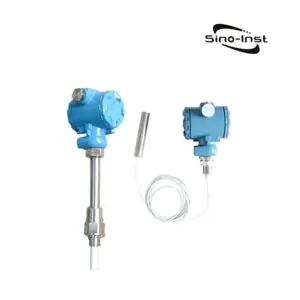
Capacitive Level Sensors
PTFE-jacketed coaxial rod probes for diesel, petrol, and biodiesel. 0.4–4 m lengths, ±0.5 % FS, 4–20 mA / RS-485, ATEX zone 1 option for vapour-space service.
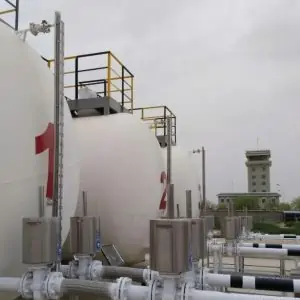
Fuel Tank Diesel Level Sensors
Capacitive and float-style sensors purpose-built for vehicle and genset diesel tanks. CAN J1939 / 4–20 mA / 0–5 V outputs, vibration-rated to 10 g, biodiesel B20-compatible.
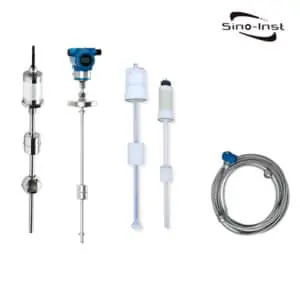
Magnetostrictive Level Transmitters
When ±0.01 % custody-transfer accuracy is required and budget allows, magnetostrictive transmitters replace capacitive in fuel-terminal and bulk storage service. SI-100 / LD / LP series, ATEX/IECEx Ex ia.
FAQ
Can a capacitive fuel level sensor work in a plastic tank?
Yes — but only with a coaxial probe. The outer tube provides the second electrode and fixes the gap, so the tank wall material does not enter the measurement. A rod-to-wall probe needs a conductive metal tank to work.
Will it read correctly with water at the bottom of the tank?
Free water (εr≈80) on top of the wetted length will read as 100 % full because water has 40× the dielectric of diesel. A capacitive probe cannot tell water from fuel — pair it with a water-bottom sensor or drain the tank periodically.
How often does a capacitive fuel level sensor need recalibration?
For a single-fuel tank, once at commissioning and once after the first 500 hours of service. After that, recalibrate only when fuel grade changes or when the reading drifts more than 2 % against a manual dipstick check.
Is capacitive sensing safe for petrol vapour?
Yes, with the appropriate certification. The probe itself is passive; the transmitter electronics need to be ATEX/IECEx Ex ia or housed in an Ex d enclosure with an intrinsically safe barrier on the cable. Excitation voltages are kept below 5 V to stay under the ignition energy threshold.
What is the highest temperature a capacitive fuel sensor can handle?
Standard PTFE-jacketed probes are rated to +85 °C process. High-temperature versions with PFA jacket and a remote-mounted electronics head extend that to +200 °C, suitable for heated heavy-fuel-oil tanks on marine bunkers.
Capacitive vs ultrasonic for a diesel day tank — which one?
For a sealed indoor genset day tank under 1.5 m, capacitive is the safer pick — ultrasonic struggles with vapour cones and the small dome geometry creates spurious echoes. Above 2 m or in an open-vented bulk diesel tank, top-mounted ultrasonic catches up on accuracy.
Request a Quote

Wu Peng, born in 1980, is a highly respected and accomplished male engineer with extensive experience in the field of automation. With over 20 years of industry experience, Wu has made significant contributions to both academia and engineering projects.
Throughout his career, Wu Peng has participated in numerous national and international engineering projects. Some of his most notable projects include the development of an intelligent control system for oil refineries, the design of a cutting-edge distributed control system for petrochemical plants, and the optimization of control algorithms for natural gas pipelines.