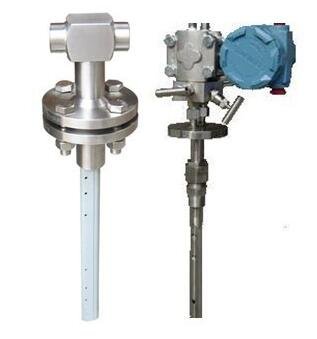
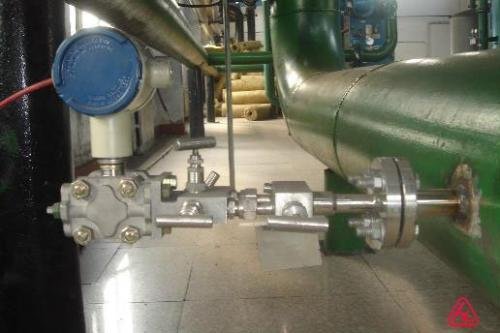
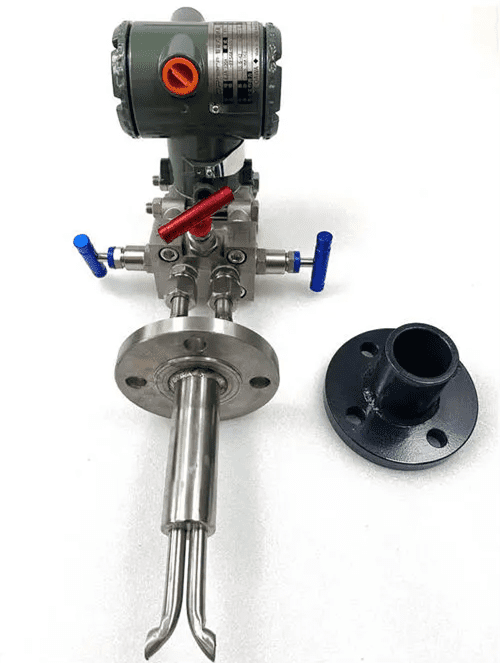
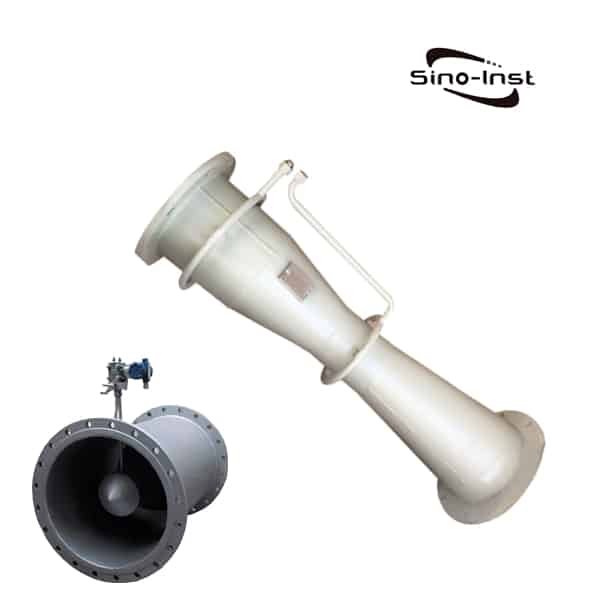
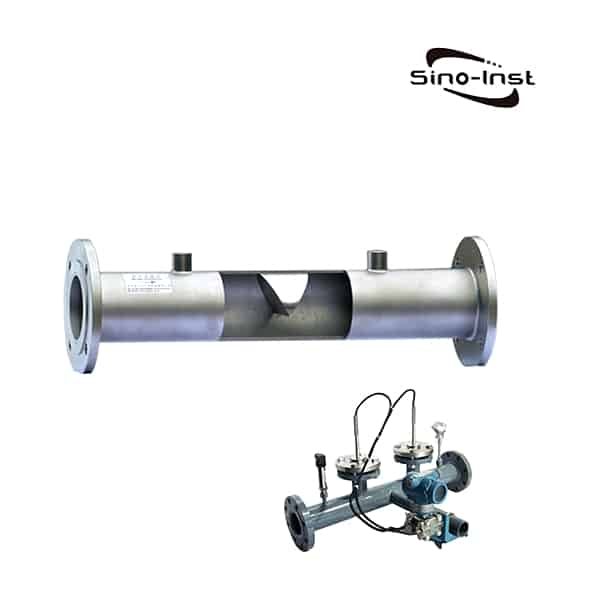
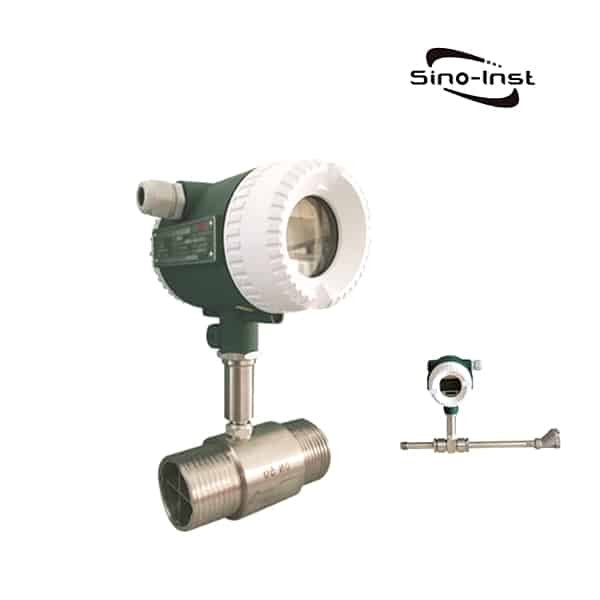
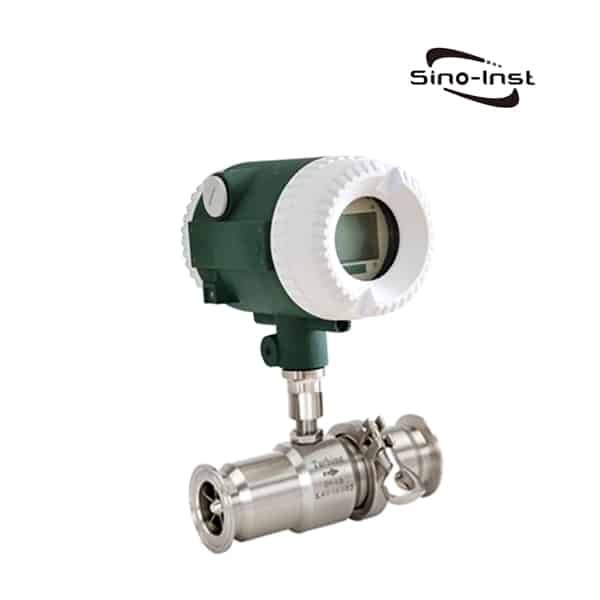
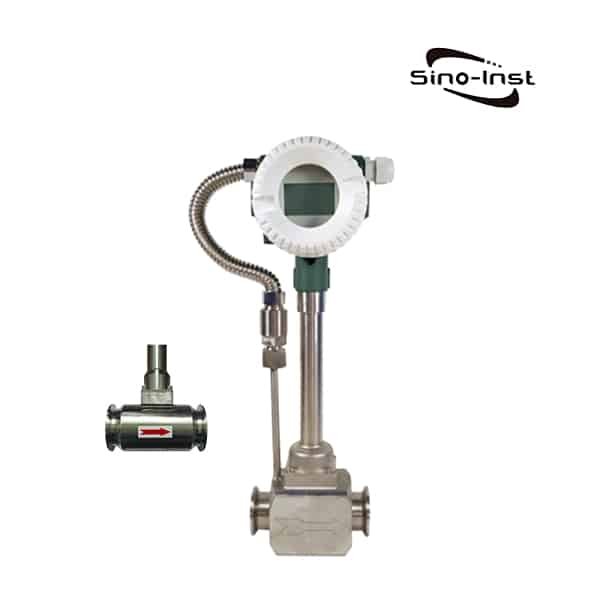
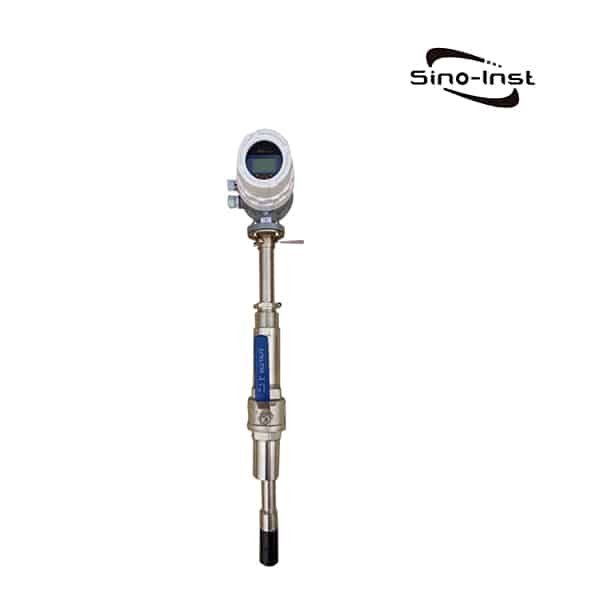
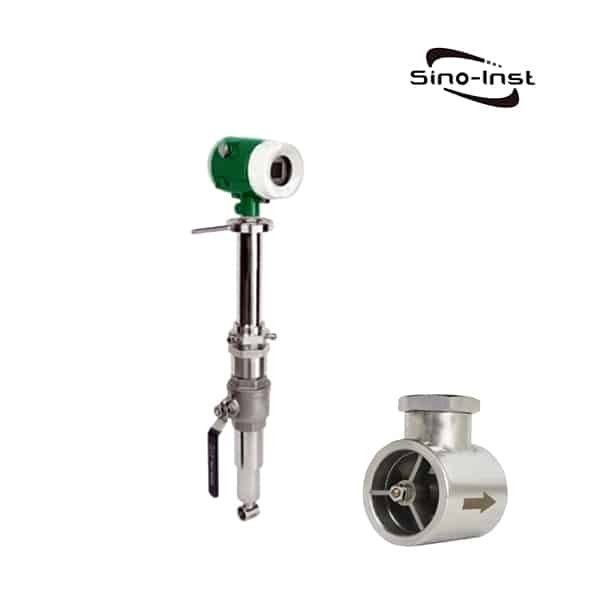
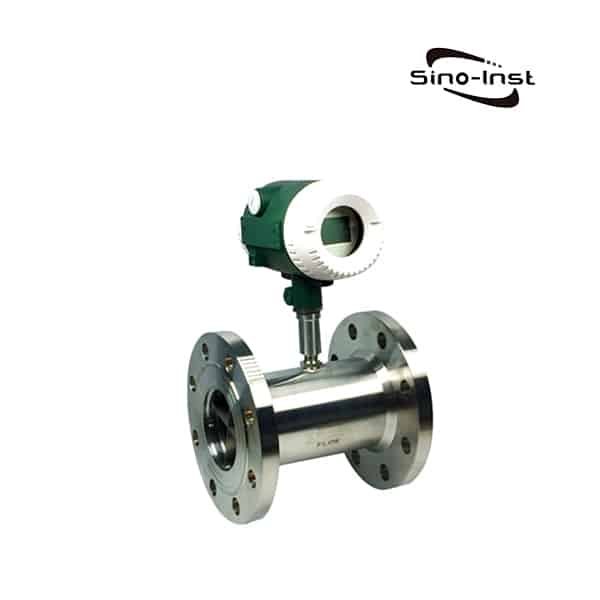
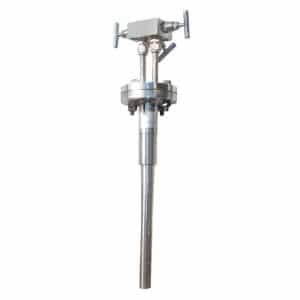
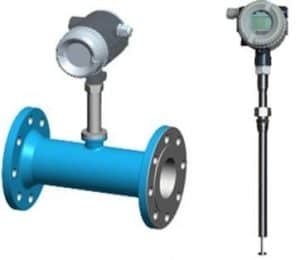
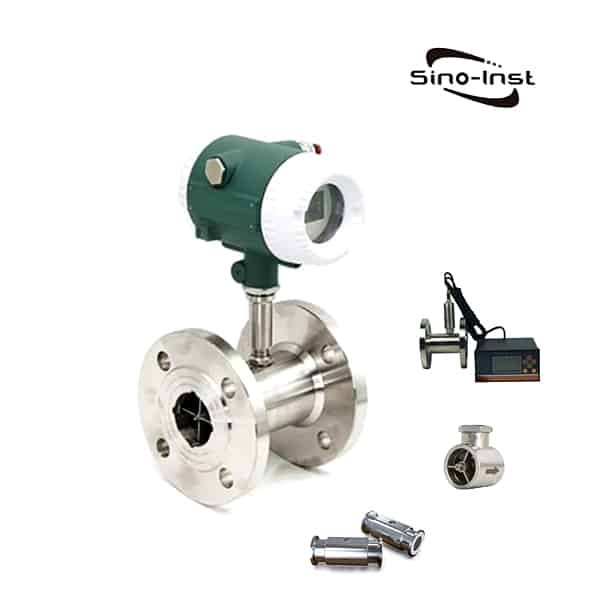
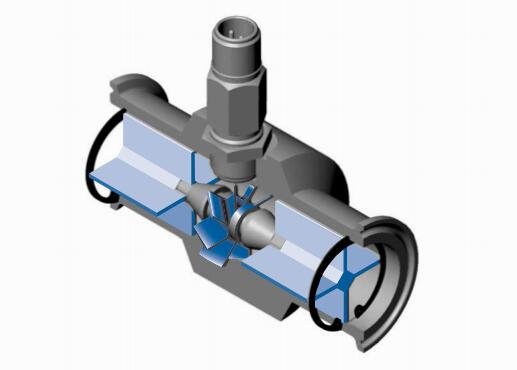
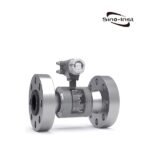
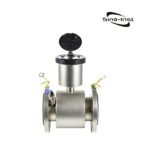
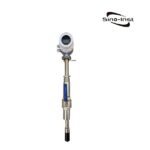
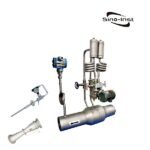
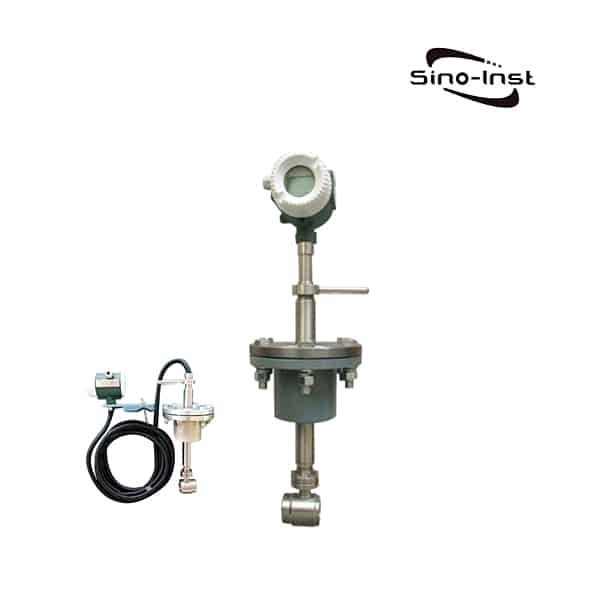
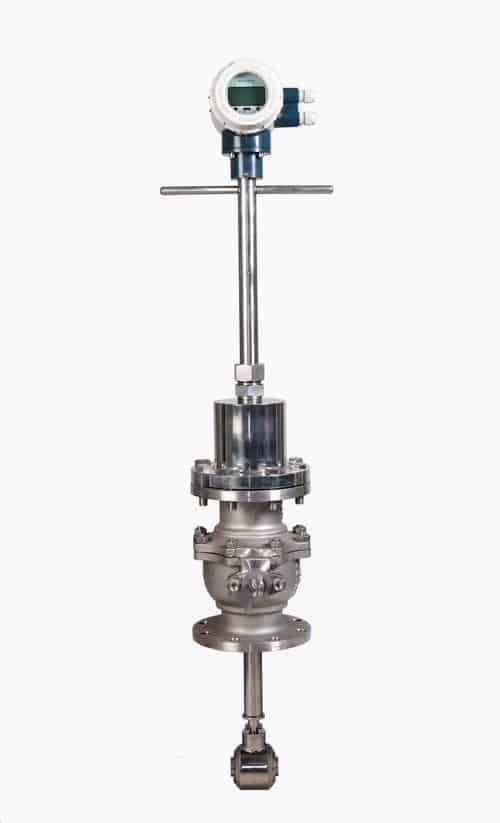
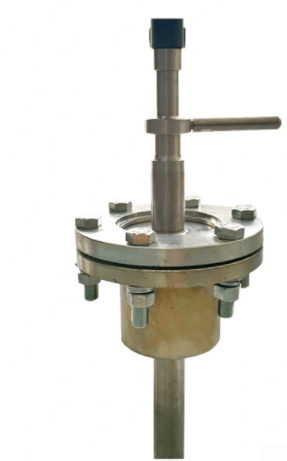
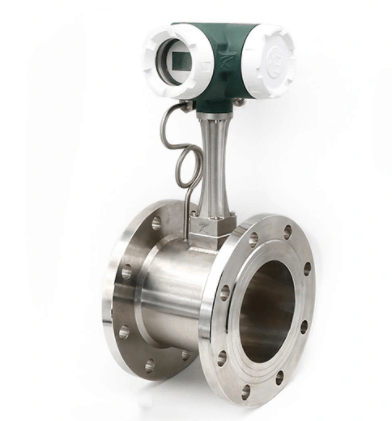
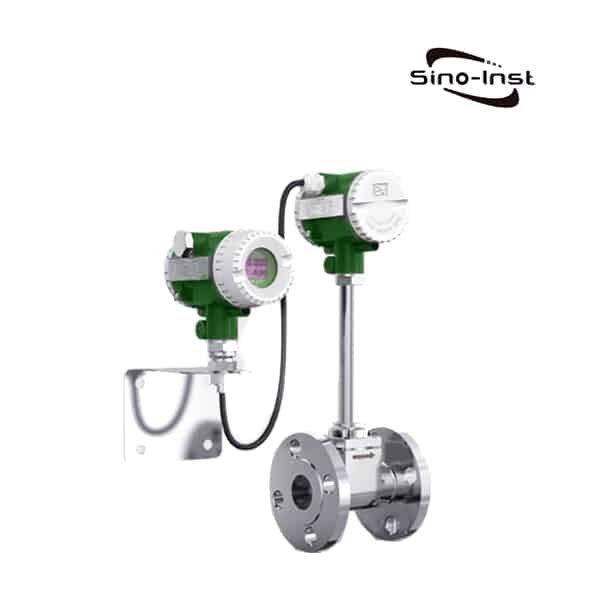
SI 3051ANB Annubar Flow Meter

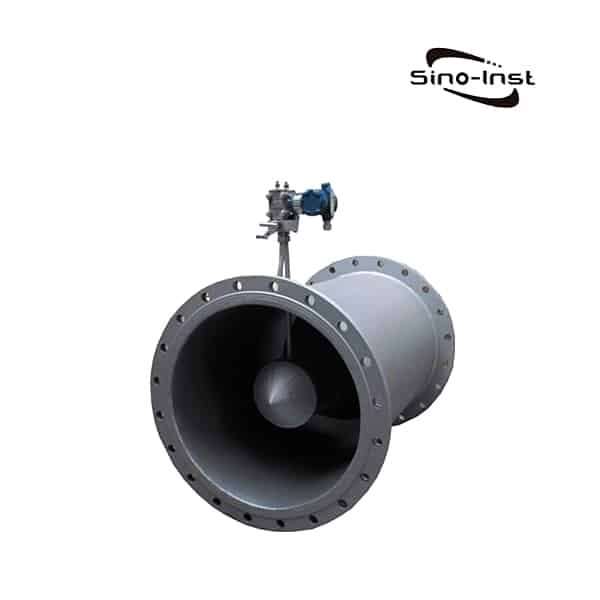
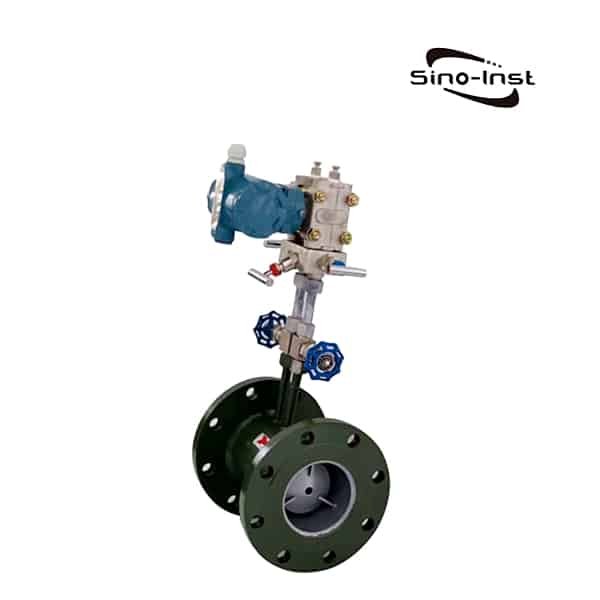
Annubar flow meter also known as flute-shaped constant velocity tube flow meter and Toba tube flow meter. Annubar flow meter is a differential pressure flow meter.

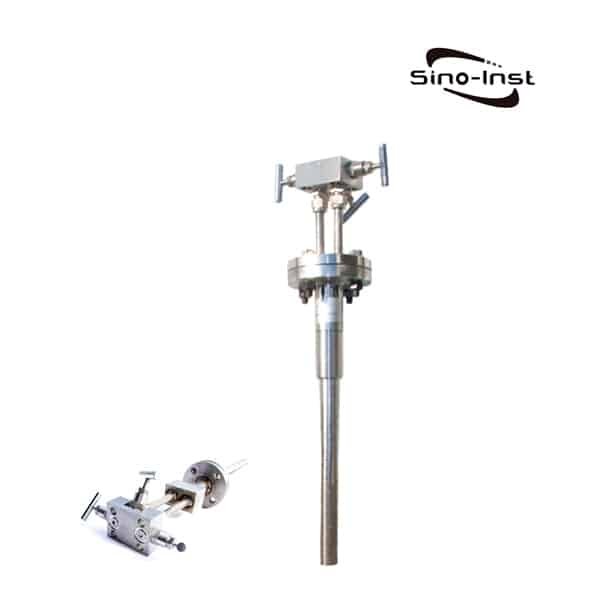
Annubar Flow Meter

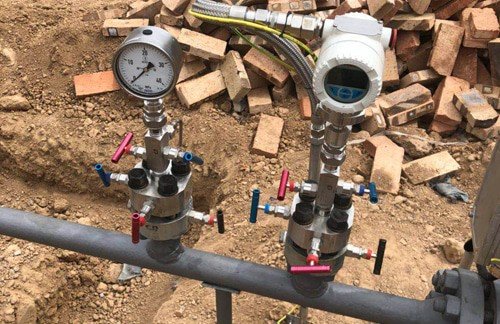
Annubar Flow Meter is a no-equal solution with a patented, averaging pitot tube that delivers superior measurement accuracy over a wide flow range. This flow meter can measure multiple variables and is engineered with an integrated thermowell for temperature measurement. Its patented T-shaped sensor is capable of obtaining measurements via a single pipe penetration while maintaining a small profile in the pipe to reduce permanent pressure loss and increase energy savings.

Sino-Inst, Manufacturer for differential pressure flow meters. Including the Orifice plate, Venturi, Annubar, etc. Suitable for liquid, gas, and steam flow measurement. Please contact our sales engineers for technical support!

Features of SI 3051ANB Annubar Flow Meter

  1. Honeycomb hexagonal stable structure,increasing the range ratio.
  2. Suitable for square or rectangular pipes.
  3. For the unavoidable clogging problem of similar products in measuring dirty media, achieve non-stop production maintenance.
  4. Average speed tube + three valve group + temperature pressure compensation + transmitter, form an integrated structure, easy to use.
  5. No flow coefficient drift, long-term stability.
  6. Exclusively provide intuitive resonance check to ensure long-term stable operation.
  7. Low pressure loss, low energy consumption, significant energy saving effect.
  8. Easy to install and save labor, low price and fast delivery (1 week)

Annubar Flow Meters’ technical parameters

  • Suitable for measuring the flow of liquids, gases, and steam.
  • The maximum working temperature of 1300 ° C (with appropriate materials and mounting parts).
  • The highest working pressure up to 400Bar (40MPa)
  • The highest viscosity is 500 cp
  • The length of the upstream and downstream straight pipe sections is required to be short.
  • Standard stainless steel grade.
  • Long-term accuracy is not affected by wear and tear.
  • Specifications: DN50-DN5000 (mm); insert: DN500-DN5000 (mm);
  • Measurement accuracy: ±6.0%; repeatability: ±0.1%;
  • Range:
    • volume flow: 10:1;
    • mass flow: 8:1;4,
    • working pressure: the average speed tube does not propose a functional type: ≤ 20MPa;
    • the average speed tube can be proposed type: ≤ 10MPa;
  • Fluid temperature: ≤ 450 ° C; Medium viscosity: ≤ 30CP (equivalent to heavy oil);
  • Material:
    • Average speed tube, three valve group: various grades of stainless steel (optional);
    • Main pipe, flange: stainless steel or carbon steel (optional);

Application of the Annubar flow meter

The output of the Annubar flowmeter is a differential pressure signal.

It can be used with instruments that measure differential pressure to accurately measure a variety of liquids, gases and vapors (superheated steam and saturated steam) in the He-shaped pipe and rectangular pipe.

The size of the pipe to be tested ranges from 20MM to 5000MM. Annubar has been successfully used in the chemical industry, (including the nuclear industry) chemical industry, petrochemical industry and metal smelting industry.

It is suitable for:

  1. Gas delivery and liquid delivery
  2. Energy research, steam boiler heat rate, pump efficiency.
  3. Gas compressor efficiency and fuel consumption
  4. Process control: input and output, ratio, balance; cooling water or air, steam heating.
  5. Feeding in the chemical industry

The Use and Characteristics of the Annubar flowmeter

The Annubar flowmeter is an ideal substitute for differential pressure fow measurement. Because of its simple installation, low-pressure loss, high strength, no wear and no leakage.

It can be widely used in industrial and mining enterprises to measure the flow of blast furnace gas, compressed air, steam and other liquids and gases.

1. The unique internal secondary average structure provides high precision (±1% reading), and high repeatability (±0.1%).

2. The outer impact tube of the Annubar flowmeter, is processed by a single piece of material without welding.

It has the highest strength, compared with similar products welded by the double-body structure. And it is also convenient to use high-temperature resistance and corrosion resistant material.

Working principle of Annubar flow meter

Annubar flow meter working principle

When the fluid flows through the probe, a high-pressure distribution zone is created at the front. And the pressure in the high-pressure distribution zone is slightly higher than the static pressure of the pipeline.

According to the Bernoulli equation, the velocity of the fluid flowing through the probe is increased. And a low pressure distribution zone is generated at the rear of the probe.

The pressure in the low-pressure distribution zone is slightly lower, than the static pressure of the pipeline.

The fluid flows from the probe and creates a partial vacuum, at the back of the probe with vortices on either side of the probe.

The cross-sectional shape of the constant velocity flow probe, the rough surface condition and the position of the low-pressure tapping orifice are key factors, in determining probe performance.

The stability and accuracy of the low voltage signal, is decisive for the accuracy and performance of the uniform velocity probe.

The Annubar average velocity probe detects the average differential pressure, produced by the average velocity of the fluid.

The Annubar average velocity probe has multiple pairs of pressure tapping holes, arranged in a certain standard in the high and low-pressure zones, making it possible to accurately measure the average flow rate.

Annubar Flow Meter Calculation

The flow calculation formula of the uniform velocity tube flowmeter is derived from the Bernoulli equation and the continuity equation:

Qv=α﹒ ε﹒ (π/4)﹒ D2﹒ (2P/ρ1)0.5
Qm=α﹒ ε﹒ (π/4)﹒ D2﹒ (2?P﹒ρ1)0.5
Among them: Qv: volume flow
Qm: mass flow
α: Sensor structure coefficient
△P: Differential pressure value
ε: fluid expansion coefficient
ρ: Density under fluid conditions
ε: fluid expansion coefficient
For incompressible fluid ε=1, for compressible body ε<1. If D, △P, and ρ1 in the formula all use SI units, the unit of QV is M3∕S. The unit of Qm is ㎏∕S.

How Averaging Pitot Tubes Work-Annubar Technology

Video source: https://www.youtube.com/embed/ofiQPZkGPJM?rel=0

Advantages and Disadvantages of the Annubar flowmeter:

Advantages:

  • Can be inserted through a small opening.
  • Can be used to sample the velocity at several points.
  • Reasonable design, easy installation, and economy
  • Low-pressure drop, minimal obstruction.
  • High accuracy and good stability

Disadvantages:

  • Single point measurement.
  • The pitot tube is fragile
  • DP signal is low.

Annubar flow meter calibration

The annubar flowmeter is a commonly used type of flowmeter. It is a new type of differential pressure flow detection component, developed based on the principle of pitot tube velocity measurement.

It has the advantages of stable performance, flexible use and high reliability.

1. Connect the signal cable and power cable;

2, open the import and export valves, the inlet and outlet valves must be consistent

3. Open the stainless steel three-valve balance valve, slowly open the high-low pressure end of the orifice plate, and close the stainless steel three-valve balance valve, after the fluid passes through the flowmeter.

Annubar flowmeter installation pipeline conditions:

(1) The straight pipe sections before and after the throttle piece must be straight, and must not be visible to the naked eye.

(2) The straight pipe section used for installing the throttle piece should be smooth. If it is not smooth, the flow coefficient should be multiplied by the roughness correction sparse.

(3) In order to ensure the flow of the fluid, a fully developed turbulent velocity distribution is formed in the 1D before the throttle. And the distribution is made into a uniform axisymmetric shape, so:

1). The straight pipe section must be round. And the roundness of the 2D range of the throttle is very strict and has a certain roundness index.

Specific measurement method:

(A) On the OD, D/2, D, 2D 4 vertical pipe sections of the throttle, measure the inner diameter of the four pipes, at least equal to each other with an equal angular distance, and take the average value D.

The difference between the measured value of internal diameter, and the average value shall not exceed ±0.3%.

(B) After the throttle element, 8 inner diameter single measured values ​​are measured, by the above method at the OD and 2D positions. And any single measured value is compared with D. And the large deviation of zui must not exceed ±2%.

2). Before and after the throttle element, a straight pipe section of sufficient length is required.

The length of the straight pipe section which is long enough. And the form of the local resistance part. Before the throttle element are related to the diameter ratio β.

(4) The length of the straight pipe section between the upstream side of the throttle member, the resistance member and the second resistance member may be 1/2 of the listed value. According to the form of the second resistance member, and β = 0.7 (regardless of the actual β value)

(5) When the upstream side of the throttle member is an open space, or a large container with a diameter ≥ 2D, the open space or the straight pipe length, between the large container and the throttle member shall not be less than 30D (15D).

If there are other local resistance members, between the throttle member and the open space or the large container. The open space is from the open space to the length of the small straight pipe section 1 provided, between the throttle member and the local resistance member.

The total length of the straight pipe section between the throttle pieces shall not be less than 30D (15D).

You may like:
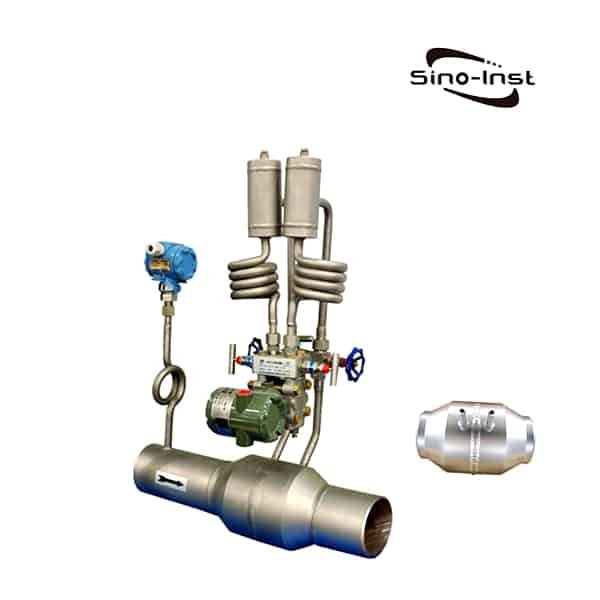
Frequently
Asked
Questions

Annubar flow meter is sometimes referred to as Averaging pilots and contains multiple pressure tappings to ‘average’ the flow; this is to try to compensate for a non-ideal flow profile.
The averaging pitot tube is inserted across the pipe as shown below. One side of the bar has pressure taps facing the flowing fluid that are coupled into an “averaging” chamber that measures the total (i.e. static + dynamic) pressure of the fluid.

There are numerous types of flow meters depending upon the application, the specific fluid, and the construction, including materials, of the flow meter. The 5 basic classifications of flow meters include:
1. Differential Pressure Flow Meters
Differential pressure flow meters measure the differential pressure across an orifice where flow is directly related to the square root of the differential pressure produced. There are also primary and secondary elements in differential flow meters. The primary element produces a change in kinetic energy using either flow nozzle, pitot tube, orifice plate, or venturi flow meters. The secondary element measures the differential pressure and provides the signal.
Differential pressure meters represent around 1/5 of all flowmeters around the world. They are commonly used in the oil & gas industry, along with HVAC, beverage, water, pharma, mining, paper, and chemical applications.

Extended reading: What Is A Venturi Flow Meter?
2. Positive Displacement Flow Meters
Positive displacement (PD) flow meters measure the volume filled with fluid, deliver it ahead and fill it again, which calculates the amount of fluid transferred. It measures the actual flow of any fluid while all other types of flow meters measure some other parameter and convert the values into flowrate. In PD flow meters, the output is directly related to the volume passing through the flow meter. PD flowmeters include piston meters, oval-gear meters, nutating disk meters, rotary vane type meters, etc.
Positive displacement flow meters are known for their accuracy. They are commonly used in the transfer of oils and fluids, like gasoline, hydraulic fluids as well as in-home use for water and gas applications.
3. Velocity Flow Meters
Velocity meters measure the velocity of the stream to calculate the volumetric flow rate. These are less sensitive when the Reynolds number of fluid is higher than 10000. Velocity flow meters include turbine, paddlewheel, vortex shedding, electromagnetic, and sonic/ultrasonic flow meters.
4. Mass Flow Meters
Mass flow meters are more effective in mass-related processes as they measure the force that results from the acceleration of the mass. More specifically, the force is measured as the mass moving per unit of time, instead of the volume per unit of time. Mass flow meters include Coriolis mass meters and thermal dispersion meters.
Typical applications for mass flow meters are tied to chemical processes. In addition to the chemical and gas industries, typical industries using mass meters include pharma, power, mining, and wastewater.
5. Open Channel Flow Meters
Measurement of liquid in open channels includes v-notch, weirs, and flumes. These dam-like structures, or overflows, allow for a limited or concentrated free-flow of liquids based on the unique shape and size of the structure. This type of flow meter allows for a reading of the flow rate to be calculated.
Common applications of open channel meters include free-flowing liquids like streams, rivers, irrigation channels, and sewer/wastewater systems.

From Wikipedia:

The biggest difference between an annubar and a pitot tube is that an annubar takes multiple samples across a section of a pipe or duct. In this way, the annubar averages the differential pressures encountered accounting for variations in flow across the section. A pitot tube will give a similar reading if the tip is located at a point in the pipe cross section where the flowing velocity is close to the average velocity.

Sino-Inst offers over 10 Annubar Flow Meter products. These are differential pressure flow meters, 40% are water meters (like the Insertion Turbine Flow Meter), and 40% are water treatment (like the Annubar flow meter ).

A wide variety of Annubar Flow Meter options are available to you, such as free samples, paid samples.

Sino-Inst is a globally recognized supplier and manufacturer of Annubar Flow Meter, located in China. The top supplying country is China (Mainland), which supply 100% of the Annubar Flow Meter respectively.

Sino-Inst sells through a mature distribution network that reaches all 50 states and 30 countries worldwide. Annubar Flow Meter products are most popular in Domestic Market, Southeast Asia, and Mid East.

You can ensure product safety by selecting from certified suppliers, with ISO9001, ISO14001 certification.

Request a Quote

Handheld Ultrasonic Flow Meter

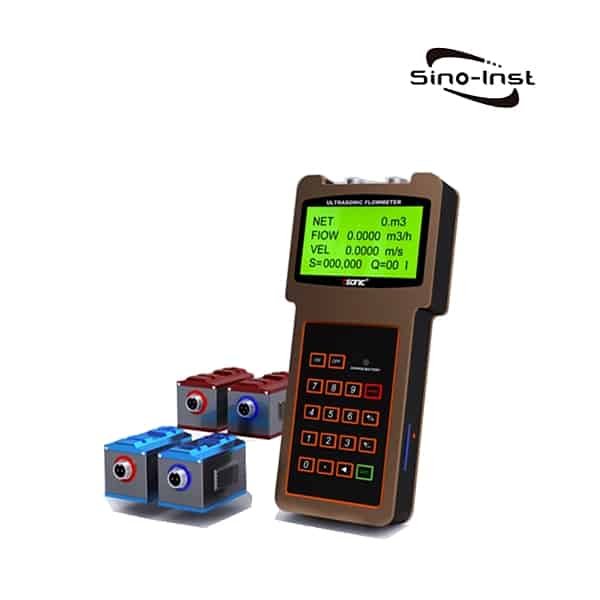
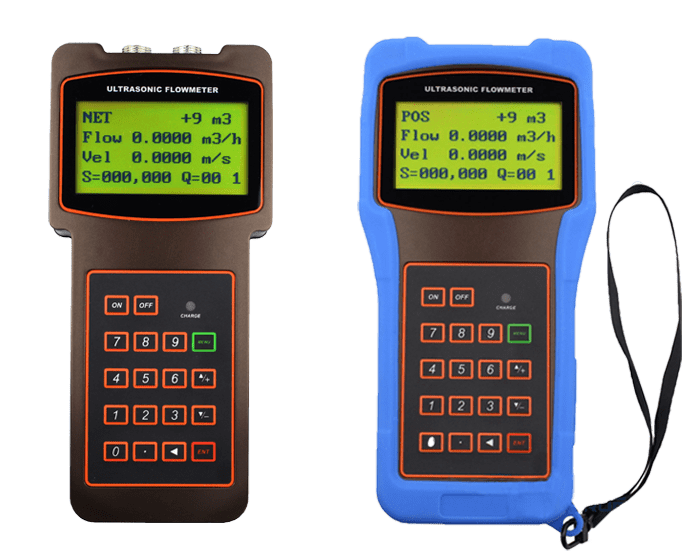
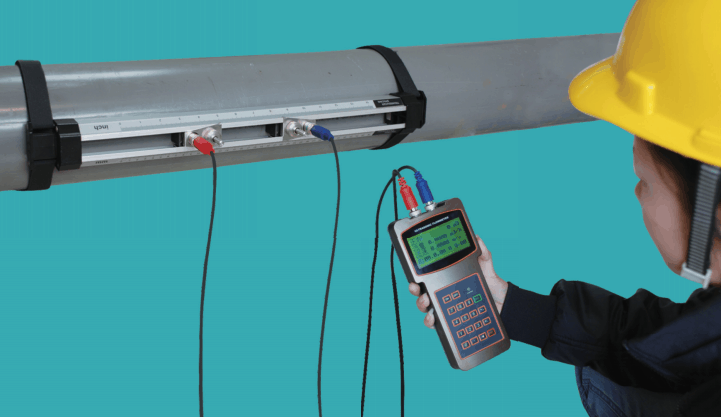
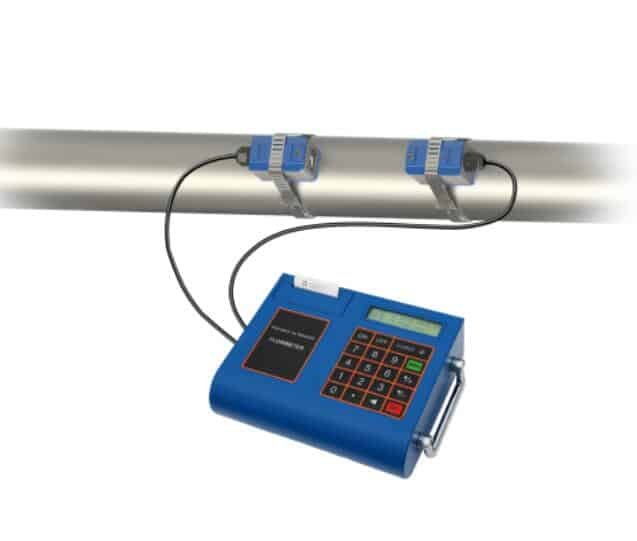
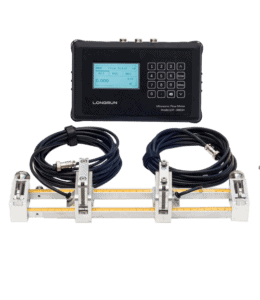
Handheld ultrasonic flow meter realizes the non-contact measurement of liquid flow. Also often referred to as Portable Clamp-On Ultrasonic Flow Meter for Liquids.

Handheld Ultrasonic Flow Meter ( Model:2000H) has been successfully applied to measurement work in various industries. The measuring range is 20-6000mm (0.5-20 inches). A non-contact measurement method is adopted. Flexible operation and easy to carry. Conductive or non-conductive, corrosive or non-corrosive liquids can be measured. Various fluids: water, pure water, sewage, sea water, chemical fluids, river water, fuel Oil etc. can be measured.

Handheld Ultrasonic Flow Meter Reference price: USD 470.00/pc

Sino-Inst offers a variety of  Ultrasonic flow meters for flow measurement. If you have any questions, please contact our sales engineers.

Features of Handheld Ultrasonic Flow Meter

  • High precision measurement
    • Measurement accuracy is better than ±1%, linearity is 0.5%, repeatability is 0.2%
  • Small size and light weight
    • Volume: 210 × 90 × 30mm, the host weight is only 0.5kg
  • Non-contact measurement 
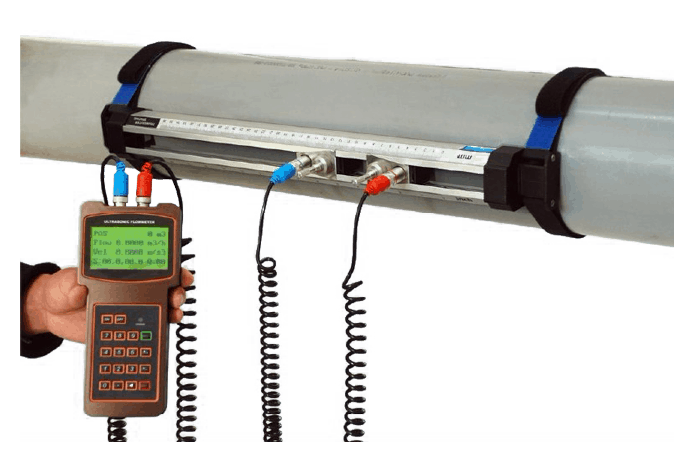
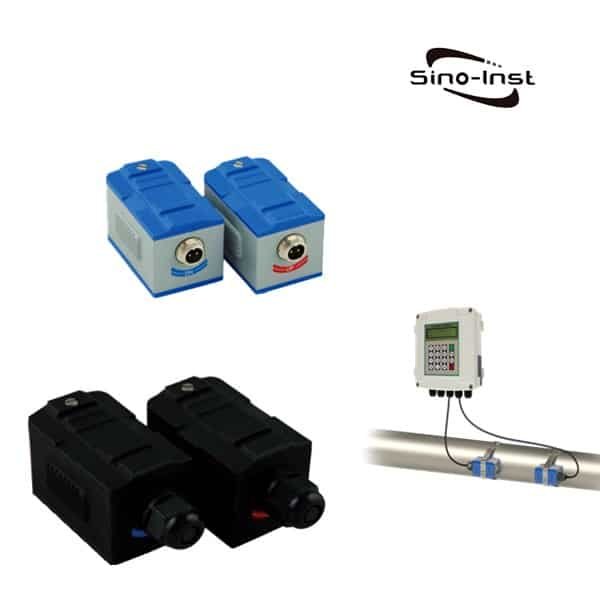
    • The magnetic flow ultrasonic sensor is adsorbed on the outer wall of the pipe to complete the flow measurement.
  • Large measuring range
    • Measurement of pipe flow from DN20 to DN2000 with different types of sensors
  • Charger
    • Built-in large-capacity nickel-metal hydride rechargeable battery to support continuous operation of the flowmeter for more than 12 hoursLarge screen
  • LCD display
    • It can display cumulative flow, instantaneous flow, flow rate, working status, etc. at the same time.
  • Built-in data logger
    • Built-in data logger with a space of 24K bytes and can store 2000 lines of measurement data.

Specifications of Handheld Ultrasonic Flow Meter

Items Performance and Parameter
Main Unit Principle transit-time ultrasonic flowmeter
Accuracy Accuracy :over 1%-2%; 
Repeatability: over 0.2%
Display 4 line x 16 character LCD with backlight
Dimension 200*93*33cm:  
 390g
Operation Support 16 key light touch keyboard 
and the Simulation keyboard software
Data interface Insulate RS232 serial interface, 
upgrade the flew meter software by computer, 
support the MODBUS, etc. 
Signal Output 1 way OCT output
Special Cable Twisted-pair cable ;
Select the RS232 communication.;
Generally, the standard is 5m*2, 
optional 10m*2 
Pipe Condition Pipe Material Steel, Stainless steel, Cast iron, Copper, 
Cement pipe, PVC, Aluminum, 
Glass, steel product, liner is allowed.
Pipe Diameter DN 15—6000mm
Straight length pipe Transducer installation should be satisfied: 
upstream10D, downstream 5D, 
30D from the pump.
Measuring Medium Type of Liquid Water ; Ultra-pure liquids; 
Solvents and other liquids 
Temperature Standard Transducer: -30–90; 
High-temperature transducer: -40–160
Turbidity under 10000ppm and less bubble 
Flow rate 0–±10m/s
Flow Direction Measuring two (plus-minis)
direction of flow rate 
Working Environment Temperature Main Unit: -20–60
Flow transducer: -40–160
;  
Temperature transducer: according to the customer’s demands.
Humidity Main Unit: 85% RH
Power Supply AC  110V-240V  

Optional Transducer

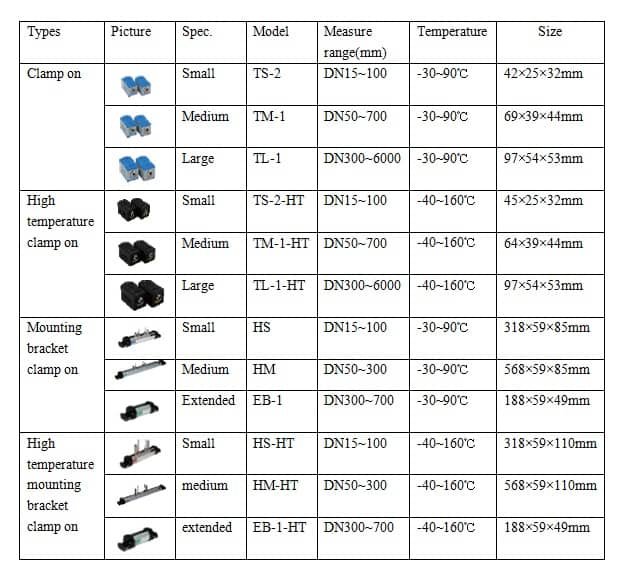
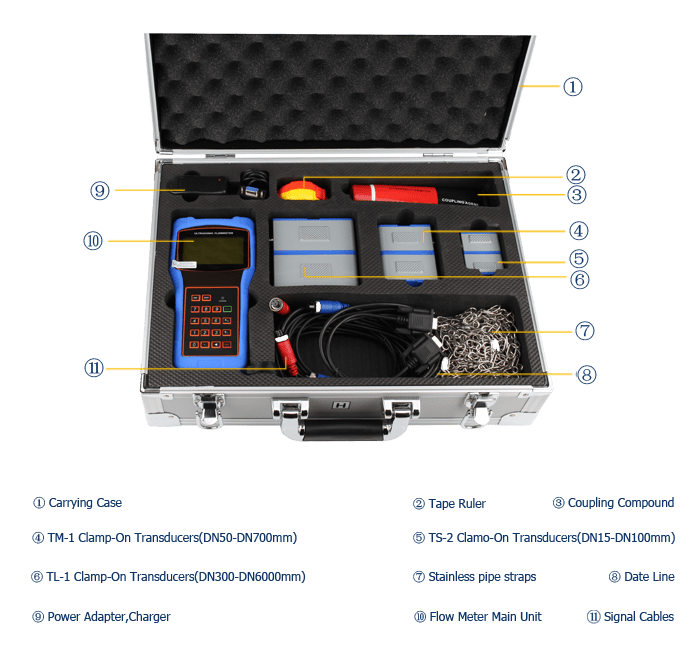
Handheld Ultrasonic Flow Meter packaging 3.png

Guess You’ll Like: Ultrasonic flow meters types & technical guide

Featured Clamp-on ultrasonic flow meters

Handheld Ultrasonic Flow Meter is a commonly used clamp-on ultrasonic flow meter.

Clamp-on ultrasonic flow meter mainly refers to the installation form of the ultrasonic sensor. The sensor clamp is fixed outside the pipe.

Clamp-on ultrasonic flow meters can be handheld, wall-mounted, and portable with printing functions depending on the host. You can select different hosts according to your measurement needs.

Typical Applications of Handheld Ultrasonic Flow Meter

The handheld ultrasonic flow meter is mainly used for flow measurement of industrial pipeline fluids, and is widely used in environmental protection, petrochemical, metallurgy, paper-making, food, pharmaceutical and other industries.

The SI-2000H ultrasonic flow meter is ideal for flow testing during test and balance.

It is also useful for temporary flow monitoring, in existing systems to establish baseline demand data.

  • Water (hot water, cooling water, potable water, seawater, etc.)
  • Petroleum products
  • Chemicals, including alcohol, acids, etc
  • Beverage, food, and pharmaceutical processors
  • Secondary sewage, waste treatment, etc.
  • Power plants, Metallurgy, and miming applications
  • Pipeline leak detection, inspection, tracking, and collection

Of course, if you are allowed to install a pipe segment flowmeter in your measurement pipeline, you may consider the use of an electromagnetic flowmeter. Electromagnetic flowmeters will provide more accurate measurements.

For example, if you need to measure the wastewater flow of a 2-inch pipe, then you can refer to: Magnetic Flow Meters Guides.

Handheld Ultrasonic Flow Meter Installation

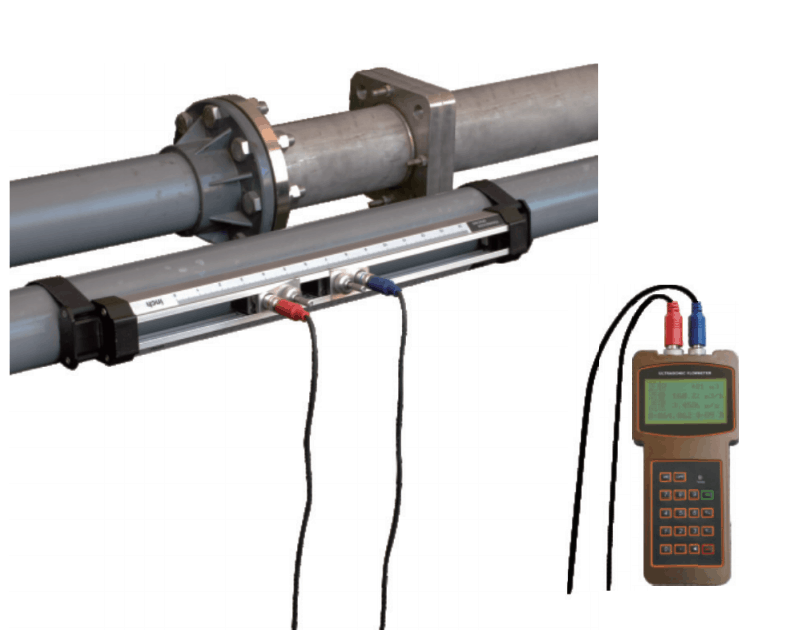
Handheld Clamp on Transducers

  • Install the clamp on transducer (with magnet) on the pipe, can finish the flow measurement. No pressure drop, no need cut off pipe.
  • Several types transducers for selection, measuring pipe size from DN25-DN6000mm.
  • Several types transducers for selection.

Clamp on Mounting Bracket Transducers

  • Bracket transdcuer can simplify the ultrasonic flow meter installation process. Shorten installation time and improve installation accuracy.
  • Install the clamp on bracket transducer (with magnet) on the pipe. Can finish the flow measurement. No pressure drop, no need cut off pipe.
  • Several types bracket transducers for selection, measuring pipe sizing from DN25-DN700mm.
  • Several types bracket transducers for selection, measuring temperature range -30℃ to 160℃.

Check more Choosing The Right 1 Inch Flow Meter.

Portable ultrasonic flow meter for water

Ultrasonic flowmeter is especially suitable for measuring large-diameter liquid pipelines because of its measuring principle. It has a large number of applications in urban water supply and sewage treatment industries. And the measurement results are very good.

Water is often used as circulating water in industrial production. That is, the water that can be recycled as the carrier of heat in the production process of the enterprise. The beginning is a circulating pool with a cooling system, and the end is the heat exchange equipment of the production workshop.

There are many types and quantities of heat exchange equipment in biochemical companies, so the circulating water pipelines are complicated. If a flow meter is installed on each circulating water pipeline, it will be a considerable expense.

Therefore, most production companies do not install flow meters for circulating water pipes in the initial stage of design to reduce investment costs. However, in order to grasp the operating efficiency of all heat exchange equipment in the production process, it is necessary to detect the flow rate of the circulation in the pipeline. .

An ultrasonic flowmeter can be used as a standard meter to transmit the value. It not only protects water resources rationally and scientifically, but also quantifies the paid use of water resources to a great extent. At the same time, it also protects the interests of both parties who use the water and reduces the cost of enterprise inspection. This makes periodic verification of large-caliber water flow meters a reality.

Handheld ultrasonic flow meter manual:

The measurement accuracy of the ultrasonic flowmeter is very high. Almost no interference from various parameters of the measured medium. In particular, it can solve the flow measurement problems of strong corrosive, non-conductive, radioactive and flammable and explosive media that other instruments cannot.
So what causes the inaccurate measurement of the ultrasonic flowmeter? The following are the reasons for the inaccurate measurement:
The influence of pipeline parameter equipment on the accuracy of ultrasonic flowmeter measurement.
The influence of upstream and downstream straight pipes on the accuracy of ultrasonic flowmeter measurement.
The influence of couplant on measurement accuracy.
The influence of the installation position of the ultrasonic flowmeter transducer on the measurement accuracy.

Read More about: Choose the most suitable Inline flow meter

Common types of ultrasonic flow meters
①According to the measurement principle. Ultrasonic flowmeters are now the most commonly used methods for measuring flow rates are the propagation velocity difference method ultrasonic flowmeter and the Doppler frequency shift method ultrasonic flowmeter. The propagation velocity difference method can be divided into three types: time difference method, phase difference method and acoustic cycle frequency difference.
②According to the installation method of the transducer. There are two types of ultrasonic flowmeters: fixed ultrasonic flowmeter and portable ultrasonic flowmeter.
The transducer installation methods of the fixed ultrasonic flowmeter can be divided into:
A tube-segment ultrasonic flowmeter integrating transducer and measuring tube;
The external clamp ultrasonic flowmeter with the transducer clamped on the outer wall of the measuring tube;
Plug-in ultrasonic flowmeter in which the transducer passes through the outer wall of the pipe and directly contacts the medium;
The transducer is attached to the inner wall of the large pipeline ultrasonic flowmeter.
③According to the channel of propagation. Ultrasonic flow meters can be divided into single-channel ultrasonic flow meters and multi-channel ultrasonic flow meters. Among them, multi-channel can be divided into two-channel ultrasonic flowmeter, ultrasonic flowmeter, four-channel and eight-channel ultrasonic flowmeter.
Extended Reading: Inline Ultrasonic Flow Meter

Ultrasonic flowmeters use sound waves to determine the velocity of a fluid flowing in a pipe.
At no flow conditions, the frequencies of an ultrasonic wave transmitted into a pipe, and its reflections from the fluid are the same.
Under flowing conditions, the frequency of the reflected wave is different, due to the Doppler effect.
When the fluid moves faster, the frequency shift increases linearly.
The transmitter processes signals from the transmitted wave, and its reflections to determine the flow rate.
Extended reading: Ultrasonic flow detectors types

More Featured Liquid Flow Meters

Frequently
Asked
Questions

Portable Ultrasonic Flow Meter is a handheld ultrasonic flow meter. The clamp-on sensor is used to measure liquid flow in industrial pipelines.

The portable ultrasonic flowmeter uses a non-invasive sensor to measure liquid flow. The installation process is extremely simple. There is no need to destroy the pipeline during the measurement process and no need to stop production. The sensor is not in contact with the measured medium. Battery powered, small size, light weight and easy to carry. Realize the real sense of mobile flow measurement, online detection, is a real sense of portable ultrasonic flowmeter.

Generally speaking, mass flow meters are relatively accurate.
Of course, the accuracy of the flowmeter still depends on the site conditions.
If the measurement of temperature and pressure is not very difficult, the accuracy of the flowmeter must be relatively high.
In addition, to ensure the accuracy of the flowmeter, correct installation and use are also very important.

Lorem ipsum dolor sit amet, consectetur adipiscing elit. Nunc ullamcorper condimentum ultrices. Cras euismod ornare laoreet. Quisque vel efficitur quam, eu molestie odio.

Lorem ipsum dolor sit amet, consectetur adipiscing elit. Nunc ullamcorper condimentum ultrices. Cras euismod ornare laoreet. Quisque vel efficitur quam, eu molestie odio.

Lorem ipsum dolor sit amet, consectetur adipiscing elit. Nunc ullamcorper condimentum ultrices. Cras euismod ornare laoreet. Quisque vel efficitur quam, eu molestie odio.

Related Blogs

  • Clamp on Water Flow Meter

    What is Clamp on Water Flow Meter? Clamp on Water Flow Meter is also known as the clamp-on ultrasonic flowmeter. Using an ultrasonic flowmeter to measure water flow rate is…
  • BTU Meter for Chilled Water

    What is BTU Meter for Chilled Water? The BTU Meter for Chilled Water accurately measures the thermal energy consumed by chilled water in British Thermal Units (BTU). This is a…
  • Water Flow Measurement for Pipes and Open Channels

    Water flow measurement is common in both industry and life. You may often hear about the use of electromagnetic flowmeters to measure wastewater. The clamp-on ultrasonic flowmeter measures large water…
  • Mechanical Water Flow Meters

    Mechanical water flow meters refer to a type of flow meter suitable for clean water processes or applications. The working principle of a mechanical water flow meter is to measure…
  • Irrigation Flow Meters for Agriculture Water System

    What is an irrigation flow meter? The irrigation flow meter is a flow meter designed for agricultural irrigation water counting. Agriculture, horticulture, etc. require water for irrigation. And water is…
  • How does a residential water meter work?

    What does a residential water meter look like? A residential water meter is a legal meter for measuring water consumption in residential communities, residential buildings, bungalows, and other places. What…
  • Chilled Water Flow Meter

    Application What is a Chilled Water Flow Meter? A chilled water flow meter refers to a flow meter that can be used to measure low-temperature water. Common chilled water flow…
  • 2 inch Water Flow Meter

    2 inch water flow meter is also written as 2″ flow meter. If you are planning to buy a 2 inch water flow meter, please be sure to read this…
  • Inline water flow meters

    Featured inline water flow meters Strap on flow meter X3  External clamp-on flow sensor. Easy to install. Suitable for measuring pipe diameter Φ9.53~Φ90. Ultrasonic Water Meter for Residential Water DN15-DN40,…
  • Hot Water Flow Meters

    Hot Water Flow Meters Improve Heating-Boiler System Hot water flow meters refer to flow meters that can measure and indicate the flow of high temperature water. Hot water is widely…
  • Slurry Flow Meter

    Flow Meter for Slurry Application Slurry is a product of domestic sewage and industrial wastewater treatment. Slurry consists of solid impurities, a slurry of suspended substances. The main characteristic of…

Sino-Inst, Manufacuturer for Handheld Ultrasonic Flow Meters. It can measure a single sound-conducting liquid medium of DN 15—6000mm. It can measure even liquids such as water, sea water, oil, and slurry.

Sino-Inst’s Handheld Ultrasonic Flow Meters, made in China, Having good Quality, With better price. Our flow measurement instruments are widely used in China, India, Pakistan, US, and other countries.

Request a Quote

Please enable JavaScript in your browser to submit the form

Portable Ultrasonic Flow Meter

Portable Ultrasonic Flow Meter is a handheld ultrasonic flow meter. The clamp-on sensor is used to measure liquid flow in industrial pipelines.

The portable ultrasonic flowmeter ( Model: 3000H) uses a non-invasive sensor to measure liquid flow. The installation process is extremely simple. There is no need to destroy the pipeline during the measurement process and no need to stop production. The sensor is not in contact with the measured medium. Battery powered, small size, light weight and easy to carry. Realize the real sense of mobile flow measurement, online detection, is a real sense of portable ultrasonic flowmeter.

Portable Ultrasonic Flow Meter Reference price: USD 870.00/pc

Sino-Inst offers a variety of  Ultrasonic flow meters for flow measurement. If you have any questions, please contact our sales engineers.

Features Of Portable Ultrasonic Flow Meter

  1. Equipped with a magnetic mounting rail, which can be adsorbed on the outside of the pipe wall. Easy to install, saving time and cost of installation.
  2. The measurement range is large, and a set of sensors can be used to measure pipe diameters in all ranges.
  3. Newly added energy meter/cold (hot) meter function. It can be expanded to portable energy meter/cold (hot) meter.

Specifications of Portable Ultrasonic Flow Meter

Performance description
Measuring range±0.03ft/s~±40ft/s(±0.01m/s~±12m/s)
Precision±1%
Pipe diameter range1 “~ 48” (25mm~1200mm)
Measuring mediumSingle acoustic liquid medium
Testable pipeCarbon steel, stainless steel, PVC pipe or other dense and sound conducting pipe
Function
OutputAnalog output: 4~20mA, maximum load 750Ω
Modbus:RS485
SD card storage16G
Storage interval setting1~99999 seconds
keyboardDigital film buttons
Display screen240*128 LCD display (backlight)
power supplyRechargeable lithium battery with a battery capacity of 3000mAh. Under normal use, a full charge can be used for 16 hours
Operating temperatureTransmitter: -40℃~60℃
Sensor: -40℃~80℃, standard type; -40℃~1300℃ is optional
Measuring the relative humidity of the environment0-99%
Physical index
Protection levelTransmitter IP65, sensor IP68
cableTwisted-pair shielded cable, the standard length is 5 meters

Extended Reading: Guide and Selection for Diesel Fuel Flow Meters

Portable Ultrasonic Flow Meter Common Applications: 

  • Cooling and heating fluid measurements
  • Water and wastewater measurements
  • Leak detection in piping systems
  • Monitoring and controlling of HVAC systems
  • Fuel and oil consumption measurements
  • Checking other flow meters
  • Flow and usage audits
  • Interface detection
  • Offshore applications
  • Automated process control

Extended reading: Hot Water Flow Meters Improve Heating-Boiler System

Other forms of application of ultrasonic flowmeter:

  1. The externally clamped ultrasonic flowmeter can realize non-contact flow measurement. Even if it is a plug-in or internally attached ultrasonic flowmeter, the pressure loss is almost very low, and it is convenient and economical to measure flow.
  2. The ultrasonic flowmeter can measure water, gas, oil and various media, and it has a wide range of applications.
  3. The manufacturing cost of ultrasonic flowmeter has almost nothing to do with the caliber. The price is reasonable on the large diameter flow measuring stone. Comprehensive competitive advantage with easy installation and use
  4. Portable ultrasonic flow meters can be used to measure flow in pipelines with different pipe diameters and different materials. Used as a standard table for online calibration, comparison or period verification.
  5. Ultrasonic flowmeter has the convenience of inverse source based on two basic physical quantities of length and time. It can be expected that flow meters that surpass other principles will become flow standards or carriers of flow standards.
  6. Ultrasonic flowmeter has extremely low power consumption and long battery power supply time. Advanced intelligent host is easy to carry out network wireless communication, and its application prospects are broader.

Extended reading: Typical Applications of Handheld Ultrasonic Flow Meter

Transmitter wiring:

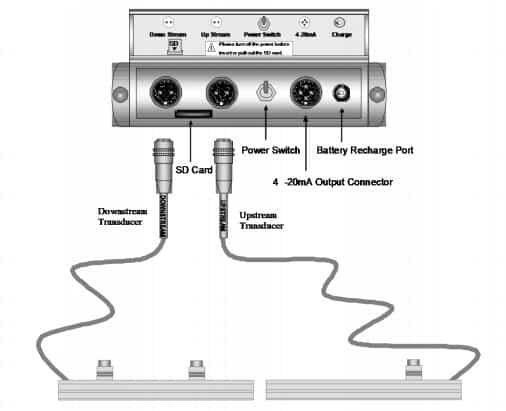
Open the top cover of the transmitter and you can see the wiring ports on the power board, from left to right, in order:

Downstream sensor interface (Down Stream), upstream sensor interface (Up Stream), power switch, 4-20mA output interface, charger port, specific wiring, please refer to the following figure:

Portable ultrasonic flowmeter Transmitter wiring

Guess You’ll Like: Ultrasonic flow meters types & technical guide

Common faults and treatment in the use of ultrasonic flowmeter

Ultrasonic flowmeter is a non-contact instrument. It can not only measure the medium flow of large pipe diameter, but also measure the medium that is difficult to contact and observe. The measurement accuracy is very high, and it is rarely affected by various parameters of the test medium. In particular, it can solve the flow measurement problems of strong corrosive, vision, radioactivity and flammable and explosive media that other instruments cannot do.

Common faults and treatment in the use of ultrasonic flowmeter

  1. Failure phenomenon: The instantaneous flowmeter fluctuates greatly.
    ⑴ Cause of failure: large fluctuations in signal strength; large fluctuations in the measured fluid itself.
    ⑵Processing method: adjust the probe position and increase the signal strength (maintain above 3%). Ensure the signal strength is stable. If the fluid fluctuates greatly, the position is not good. Re-select the points to ensure the working conditions of the first 10D and the 5D.
  2. Failure phenomenon: Low signal of external clamp ultrasonic flowmeter.
    ⑴Cause of failure: The pipe diameter is too large or the pipe fouls seriously or the installation method is wrong.
    ⑵ Treatment method: Use plug-in probes for those with too large pipe diameter and serious scaling. Re-select the installation method.
  3. Failure phenomenon: The signal of the plug-in probe decreases after a period of use.
    ⑴Cause of failure: The probe may be offset or the scale on the probe surface may be thick.
    ⑵ Treatment method: readjust the probe position. Clear the emitting surface of the probe.
  4. Trouble phenomenon: No display when booting.
    ⑴Cause of failure: The power supply attribute does not correspond to the rated value of the instrument or the fuse is blown.
    ⑵ Treatment method: Check whether the power supply attribute corresponds to the rated value of the instrument. Whether the fuse is blown. If the above problems are not found, notify the factory professionals to deal with.
  5. Trouble phenomenon: The instrument has only backlight and no character display after power on.
    ⑴Cause of failure: Generally, the program chip is missing.
    ⑵ Treatment method: notify the factory professionals to deal with.
  6. Failure phenomenon: Ultrasonic flow meter cannot be used under strong interference on site.
    ⑴ The cause of the fault: The power supply has a large fluctuation range, or there are frequency converters or strong magnetic field interference or the grounding wire is incorrect.
    ⑵ Treatment method: Provide stable power supply to the instrument. Or install the meter away from the inverter and strong magnetic field interference. Or set the grounding wire standardly.

Extended Reading: Inline Ultrasonic Flow Meter

More Featured Liquid Flow Meters:

Read more about: Non-invasive Ultrasonic Tank Level Sensor Working Principle

Sino-Inst, Manufacuturer for Portable Ultrasonic Flow Meters. It can measure a single sound-conducting liquid medium of 1″~48″(25mm~1200mm). It can measure even liquids such as water, sea water, oil, and slurry.

Sino-Inst’s Portable Ultrasonic Flow Meters, made in China, Having good Quality, With better price. Our flow measurement instruments are widely used in China, India, Pakistan, US, and other countries.

Request a Quote

Please enable JavaScript in your browser to submit the form

Turbine Insertion Flow Meter

Insertion Flow Meter is widely used for flow measurement of large diameter pipes. Insertion Turbine Flow Meter is also called insertion type turbine flow meter.

Insertion Turbine Flow Meter is designed for accurate, cost-effective flow measurement of large pipes. Insertion Turbine Flow Meter utilizes an electronic turbine rotation sensing system and unique low-quality turbine design. It provides process flow measurement for steam, gas, and high-temperature liquid Reliable solution. Of course, according to different application environments, different versions of plug-in flow meters can be provided, such as fixed, adjustable, bidirectional, and high pressure.

Insertion Turbine Flow Meter reference price: USD 350-900/pc.

Sino-Inst offers a variety of  Turbine flow meters for flow measurement. If you have any questions, please contact our sales engineers.

Features of Turbine Insertion Flow Meter

SI- LWCB/Q SERIES Insertion Turbine Flowmeters for Liquids and Gas 4”-72” Pipe Diameters

LWCQ featuresLWCB features
Strong anti-impurity ability. The tangential impeller can release suspended debris in the fluid at any time when it is rotating so that it will not be wound on the blades of the tangential impeller;The structure and principle of the sensor and display instrument are very simple and intuitive. It is especially easy for users to master its use and maintenance technology;
Strong anti-electromagnetic interference and anti-vibration ability;Strong anti-electromagnetic interference and anti-vibration ability;
The structure and principle of the sensor and display instrument are very simple and intuitive. It is especially easy for users to master its use and maintenance technology;The sensor can be installed in the open air. The entire sensor can be submerged in water for a long time;
After replacing the impeller and bearing, the meter coefficient remains unchanged;The flow range is wide and the lower limit flow rate is low.
Wide flow range. Low lower limit flow rate;The metering error of the complete set of flowmeters to the total fluid is small.
The measurement error of the complete set of the flowmeter to the total fluid is small;Almost no pressure loss. Save power and power consumption.
Almost no pressure loss. Save power and power consumption;After replacing the impeller and bearing, the meter coefficient remains unchanged;
The sensor can be installed in the open air. The entire sensor can be submerged in water for a long time;Sensors with shut-off valves. There is no need to cut off the flow during installation and removal;
Sensors with shut-off valves. There is no need to cut off the flow during installation and removal;Horizontal, vertical, and inclined pipes can be used;
Horizontal, vertical, and inclined pipes can be used;The purchase, installation, and maintenance costs of complete flowmeters are low.
The purchase of complete sets of flowmeters. Low installation and maintenance costs;

Specifications Of Turbine Insertion Flow Meter

Accuracy±5% 、±2.5%
Insertion depthWhen the inner diameter (DN) of the tested pipe is ≤1050mm, the insertion depth is:
LWCQ: 0.5×DN-20mm
LWCB: 0.5×DN
Nominal pressure1.0 MPa
Measured liquid temperature-20℃~120℃
Ambient temperature-20 ℃~70 ℃
Distance from the sensor to display meterUp to 1000m or more
Requirements on the length of straight pipeThe length of the upstream straight pipe section of the sensor should not be less than 20DN, and the length of the downstream straight pipe section should not be less than 7DN to ensure measurement accuracy.
If the length of the straight pipe section cannot meet this requirement, the on-site calibration instrument coefficient K can be used after on-site calibration is carried out under the condition of on-site calibration.

Flow Range

Model Measured inner diameter of pipe  mm Insert rod length mm The flow range corresponding to the nominal diameter DN m3/h
Full flow range Accuracy is ±2.5% of the flow range of the displayed value Accuracy is the flow range of ±5% of the displayed value
LWCQ-100* 100   6-150 10-150 <10-6
LWCQ-150 150 13-200 20-200 <20-13
LWCQ-200 200 23-300 40-300 <40-23
LWCQ≤400* 100 906 6-150 10-150 <10-6
150 13-200 20-200 <20-13
200 23-300 40-300 <40-23
250 36-450 62-450 <62-36
300 52-650 90-650 <90-52
350 70-900 120-900 <120-70
400 92-1100 160-1100 <160-92
LWCQ≤800 500 1106 150-1800 250-1800 <250-150
600 220-2500 360-2500 <360-220
700 280-3500 450-3500 <450-280
800 380-4500 640-4500 <640-380
LWCQ>800* 900 1306 460-5800 800-5800 <800-460
1000 600-7000 990-7000 <990-600
1100 700-8500 1200-8500 <1200-700
Model Measured inner diameter of pipe  mm Insert rod length mm The flow range corresponding to the nominal diameter DN m3/h
Full flow range Accuracy is ±2.5% of the flow range of the displayed value Accuracy is the flow range of ±5% of the displayed value
LWCB-100* 100   3-150 5-150 <5-3
LWCB-150 150 7-200 10-200 <10-7
LWCB-200 200 12-300 20-300 <20-12
LWCB≤400* 100 900 3-150 5-150 <5-3
150 7-200 10-200 <10-7
200 12-300 20-300 <20-12
250 18-450 31-450 <31-18
300 26-650 45-650 <45-26
350 35-900 60-900 <60-35
400 46-1100 80-1100 <80-46
LWCB≤800 500 1100 75-1800 125-1800 <125-75
600 110-2500 180-2500 <180-110
700 140-3500 225-3500 <225-140
800 190-4500 320-4500 <320-190
LWCB>800* 900 1300 230-5800 400-5800 <400-230
1000 300-7000 495-7000 <495-300
1100 350-8500 600-8500 <600-350
Model Description
LWC—
Impeller Q     Tangential
B Axial
Structure  ≤or> Indicates a shut-off valve
Indicates no shut-off valve
Diameter (mm) User pipe diameter

Model example
Example 1: LWCQ-100, which means no stop valve, nominal diameter DN100mm
Example 2: ≤400, it means there is a stop valve, the nominal diameter DN≤400mm
Example 3: LWCQ>800, it means there is a stop valve, the nominal diameter DN>800mm

Read More about: What is the difference between rotameter and flowmeter?

Turbine Insertion Flow Meter Working Principle

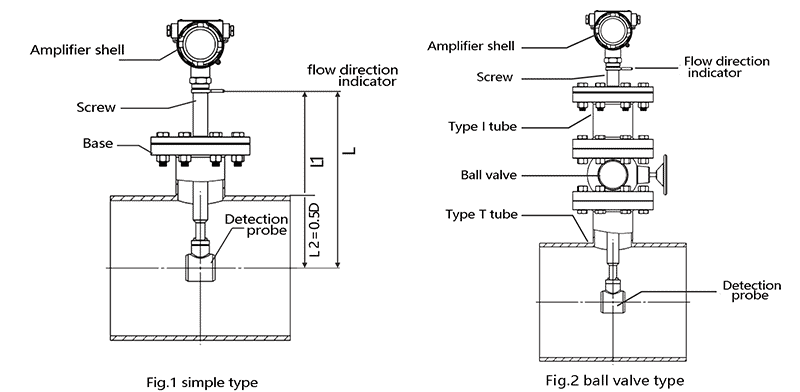
The plug-in turbine flowmeter is a new domestic velocity flowmeter. The turbine head, detection coil, etc. are designed as a combined plug-in. Because of its small size, the installation hole is also small. Therefore, a ball valve can be used to solve the problem of closing the installation hole.

More ingeniously, the insertion rod is made into a trapezoidal screw. When you need to remove it, you don’t need to stop the water. You can first rotate the trapezoidal screw to gradually raise the turbine head. After passing the upper ball valve, rotate the handle of the ball valve to close the pipeline. You can continue to spin up the turbine until it is removed. After installation and reset, proceed in reverse order. The same can be achieved without stopping the water.

The impeller inserted into the detection head of the plug-in turbine flowmeter is rotated by the fluid. The magnetic resistance of the magnetic circuit of the detection coil is periodically changed. The magnetic flux in the detection coil is periodically changed. Therefore, electric pulses are induced in the detection coil. Flow signal. The frequency f (times/second) of this signal is proportional to the volumetric flow Q (m3l second) flowing through the pipeline. The proportional coefficient is the meter coefficient K of the sensor, so f=K”Q.

The electrical pulse signal is amplified by the preamplifier and sent to the secondary instrument. Its waveform is rectangular pulse. After further enlargement and shaping, it is divided into two ways.

Send coefficient conversion circuit all the way. Then the power amplifier is sent to the totalizer. Obtain the cumulative volume flow. The other way sends the frequency dividing circuit. Then output 0~10mA (or 4~20mA) current signal through frequency/current conversion. At the same time, the instantaneous flow rate is displayed on the secondary meter.

Extended Reading: What is difference between rotameter and flow meter

Each SI- LWCB/Q Flow Meter is provided with a 4-20mA analog output for flow rate,

pulse output for totalization and a built-in user interface and display.

The standard loop-powered meter also includes HART.

Know more about: Turbine type Flow Meter

Applications of Turbine Insertion Flow Meter

Precision flow measurement of liquid and gas applications in large diameter pipes at a lower cost than using an in-line flow meter.

SI- LWCB/Q Series Insertion Flow Meters are designed to work in pipe sizes, ranging from ¾” to 72″ in diameter (1″ for copper).

Insertion Turbine Flow Meter application

Uses for the turbine flow meters include:

  • Chilled Water
  • Hot Water
  • Condenser Water
  • Domestic Water
  • Process Cooling
  • Steam Condensate and Brine.

Extended reading: 2 inch Water Flow Meter

Guess you like: Insertion Magnetic Flow Meter-Large diameter online install

Steam Insertion flow meter

SI- LWCB/Q Series Insertion Turbine Flow Meters, can measure the steam.

And, Sino-Inst also offers:

Steam Vortex Flow Meters are designed for accurate, cost-effective mass flow measurement of saturated steam.

The standard loop-powered version of the vortex flowmeter is equipped with the internal temperature compensation required for direct mass flow measurement. Steam Vortex Flow Meter is provided with a 4-20mA analog output for flow rate, pulse output for totalization, and a built-in user interface and display. The standard loop-powered meter also includes HART.

Read more about: Steam pressure transmitter-Pressure measure on steam pipeline 

Natural gas flow meters

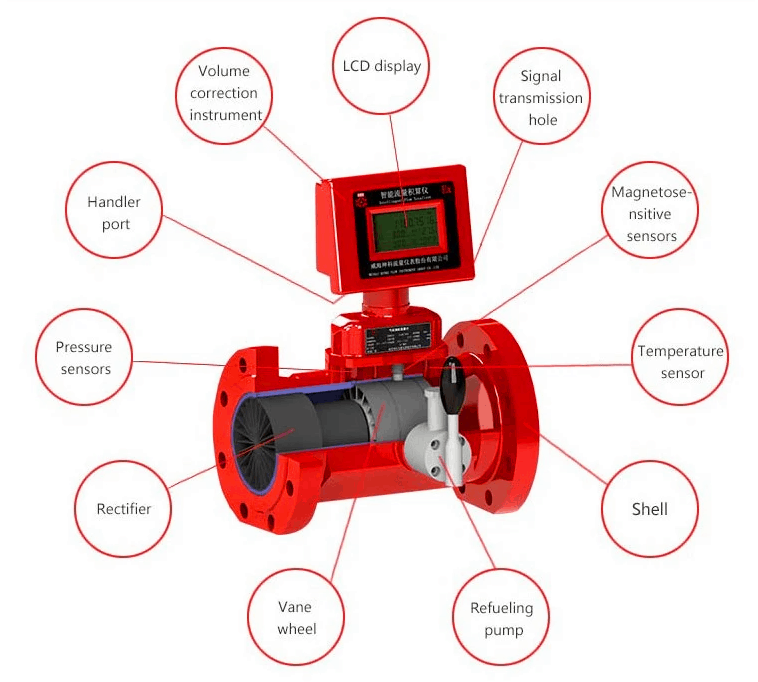
The gas turbine flowmeter integrates temperature, pressure, flow sensors and intelligent flow totalizers. The gas turbine flowmeter has high accuracy and good repeatability, so it is suitable for trade measurement and industrial process detection. It is widely used in many kinds of gas in petroleum, chemical, metallurgy, aviation, scientific research and other sectors and industrial fields. Such as natural gas, city gas, propane, butane, air, nitrogen and other gases measurement.

More Featured Insertion Flow Meter

Frequently
Asked
Questions

Turbine flow meters are velocity flow meters, also called impeller flow meters. Can be used to measure the instantaneous flow and cumulative flow of liquids and gases.

Turbine flowmeters are widely used in flow measurement: petroleum, organic liquids, inorganic liquids, liquefied gas, natural gas, coal gas and cryogenic fluids. Turbine flowmeter signals can be divided into pulse signals or current signals (4-20mA). It is suitable for use with secondary display, PLC, DCS and other computer control systems.

Extended reading: Turbine Flow Meter Advantages and Disadvantages

Simply put. The turbine flow meter has a turbine. It needs to be installed in the fluid pipeline when in use, and both ends are supported by bearings.

When the fluid passes through the turbine. The fluid hits the turbine blades. Drive the rotation of the turbine blades. The flow rate is measured indirectly through the angular velocity of the turbine blades. The method used is that the angular velocity of the blades is proportional to the fluid velocity.

Extended reading: Liquid Turbine Flow Meter Working Principle

At present, there are many kinds of Insertion flowmeters in use. According to the working principle of the Insertion flowmeter detection head, it can be divided into Insertion turbine, Insertion vortex, Insertion electromagnetic, Insertion ultrasonic, and Insertion target flowmeter.

More Featured Insertion flowmeters

Insertion flow meter is a type of flow meter divided by structure, which includes various flow meters with different working principles.

Insertion flow meter has a great development. Insertion flow meter has been promoted and used in many forms.

According to the working principle of the Insertion flow meter detection head, it can be divided into plug-in turbine, plug-in vortex, plug-in electromagnetic, uniform velocity tube and thermal flow meter.

According to the number of measurement points of the Insertion flow meter, it can be divided into two categories: point flow type and runoff type.

Extended reading: Metal Tube Flow Meter-Variable Area Flow Meters Principle

Water flow meters are flow meters that can diaplay the flow rate of industrial water pipe.

A water flow meter measures the amount of water flowing through a pipe. We have several kinds to choose from, depending on the application, maintenance needs, and budget.

Read more about Water flow meter types.

Extended reading: Featured Cheap flow meters for Sale

Sino-Inst’s insertion turbine flow meters provide significant cost, savings for line sizes from 2 to 80′ without compromising performance.

With high accuracy, wide turndown, and a unique low-mass rotor design without welded joints, the insertion turbine flow meter gives you the benefit, of more than 10 years of practical experience.

Request a Quote

Please enable JavaScript in your browser to submit the form

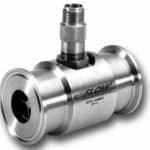
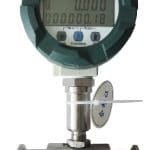
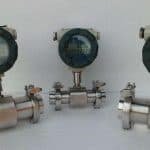
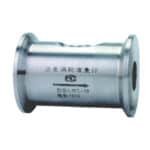
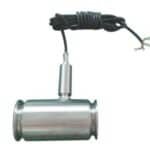
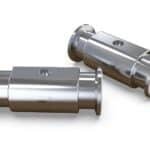
Turbine Sanitary flow meter

Sanitary Flow Meter, also called sanitary turbine flow meter or Hygienic turbine flowmeter. Ensure Accurate Flow Measurement in Sanitary food-processing and bio-technology industries.

Sanitary turbine flow meters have stainless steel bodies and come standard with Tri-Clover fittings. Sanitary flow meter is suitable for measuring liquid without impurities. It can output pulse frequency signal. It is used to detect instantaneous flow and total integrated flow. Sanitary flow meter can be used in food, sport drink, liquor and other beverage industries, in preprocess applications.

Sanitary Turbine Flow Meter reference price: DN100USD 300-700/pc.

Sino-Inst offers a variety of  Turbine flow meters for flow measurement. If you have any questions, please contact our sales engineers.

Features of Turbine Sanitary flow meter

  • Meets the requirements of 3-A Sanitary Standard number 28-04
  • 316L stainless steel body and internal wetted parts
  • Consistent, reliable gas flow measurement
  • Wafer mounting configuration for limited space requirements
  • Anti-corrosion and anti-rust materials, suitable for the health industry;
  • Quick-load structure, easy to install and maintain;
  • High precision and good repeatability;
  • High-quality turbine, beyond the conventional range;

Benefits of sanitary turbine flow meter

The lightweight, balanced rotor provides instantaneous response to changes in the flow;

No mating flange design allows for quick and easy install;

Superior material of construction for high performance in aggressive environments.

The SI-LWGY Series Sanitary Turbine Flowmeters feature 316 stainless steel construction. And have a smooth finish. Which is designed to eliminate cracks and crevices where bacteria breed.

Standard flowmeters are available in sizes from 1/2″ to 2″ with sanitary clamps.

Flow rates range from 0.1 to 250 gallons per minute (0.38 to 946 LPM).

Extended reading: Food grade flow meters for Food & Beverage industry

Specifications of Hygienic turbine flowmeter.

Measuring range0.04-40m³/h
Applicable mediumClean liquid without impurities (water, water solution, beer beverage, glycerin, glycol)
Nominal pipe diameterDN4-50mm
Accuracy level±0.2%FS, ±0.5%FS, ±1.0%FS, ±1.5%FS
Repeatability error±0.5% of measured value; ±1.0%
Linearity1%
displayWide screen LCD display, parameters and variables can be set through the buttons on the panel
Instantaneous flow display, cumulative total display, percentage display, frequency display
l/min, m³/h, Hz
Resolution0.1 l/min, 0.005 m³/h
Operating temperature-35-60℃ (standard type)
-20-180℃ (high temperature type)
-40-80℃ (explosion-proof type)
Allowable viscosity0.8-30cm²/s
Work pressure1.6MPa, 2.5MPa, 4.0MPa, special can be customized
shell materialStainless steel 316L
Turbine materialStainless steel 316L
Head materialAluminum alloy
BearingTungsten carbide bearings, ruby bearings are optional
Entrance: 10*DN
Exit: 5*DN
Signal output4~20mA, pulse, RS485, MODBUS protocol, HART output
Power supply 220V AC, 24V DC
Electrical connectionsIntelligent type: M20*1.5 terminal wiring,
Digital display type: aviation plug wiring
Ordinary type: direct outlet
Connection methodChuck
Protection levelIP65 (optional IP68)
Ambient temperature-20℃…80℃
Relative humidity 5%~95%
Explosion-proof markIntrinsically safe ExiaIICT6
Power consumption<20W
Diameter(mm)Normal flow range(m3/h)Extended flow range(m3/h)Regular pressure(MPa)
DN 40.04~0.250.04~0.41
DN 60.1~0.60.06~0.61
DN 100.2~1.20.15~1.51
DN 150.6~60.4~81
DN 200.8~80.45~91
DN 251~100.5~101
DN 321.5~150.8~151
DN 402~201~201
DN 504~402~401

Extended reading: Vortex Hygienic Flow Meter

SI-LWGY Sanitary flow meter applications

Typical applications include measuring or batch controlling water, WFI, USP water, deionized water, vaccines, clean pharmaceuticals, milk, cream, vegetable oil, wine, beer, spirits, soft drinks, juices (without pulp)and any other clean, consumable liquid.

Application Examples:

  • Sanitary
  • Food Processing
  • Pharmaceutical
  • Industries Process or Industrial
  • Pharmaceutical industry:
    • filling and metering of infusion products such as saline and glucose water;
  • Food and beverage industry:
    • filling and metering of liquid foods such as vegetable juice, juice, beer, and refined oil.

Extended reading: Turbine Insertion Flow Meter for Large Diameter Pipeline

Magnetic Sanitary Flow Meter

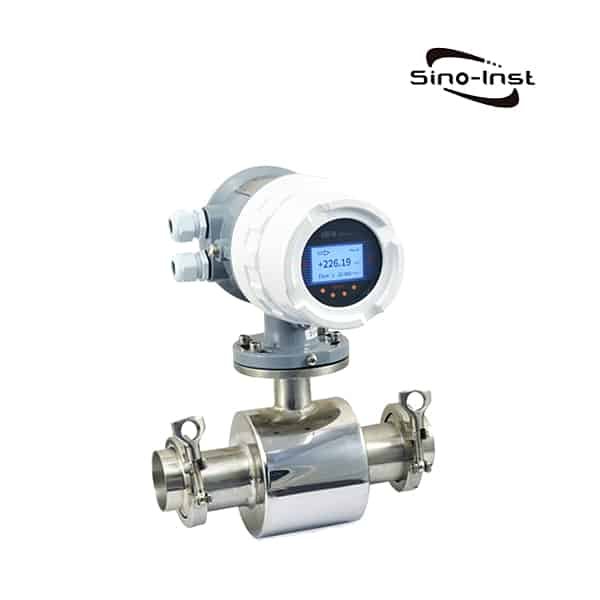
Magnetic Sanitary Flow Meter measures the flow of conductive liquids.

Sanitary Flow Meter uses a new type of sanitary lining material and lining technology, which meets the sanitary requirements of the food industry. It uses a stainless steel shell and stainless steel clamp connection. It is convenient for the quick disassembly and cleaning of the electromagnetic flow meter. Magnetic flow meter in a sanitary version which meets the strict requirements of the food-processing and bio-technology/ pharmaceutical industries.

Clamp on ultrasonic flow meter is also a good choice for the health industry. Because the external clamp sensor does not need to destroy the pipe.

Read more about: Sanitary Flow Meters-316SS,Tri clamp-Pulse- for Brewery

More about Turbine Flow Meters

What is a turbine flow meter?

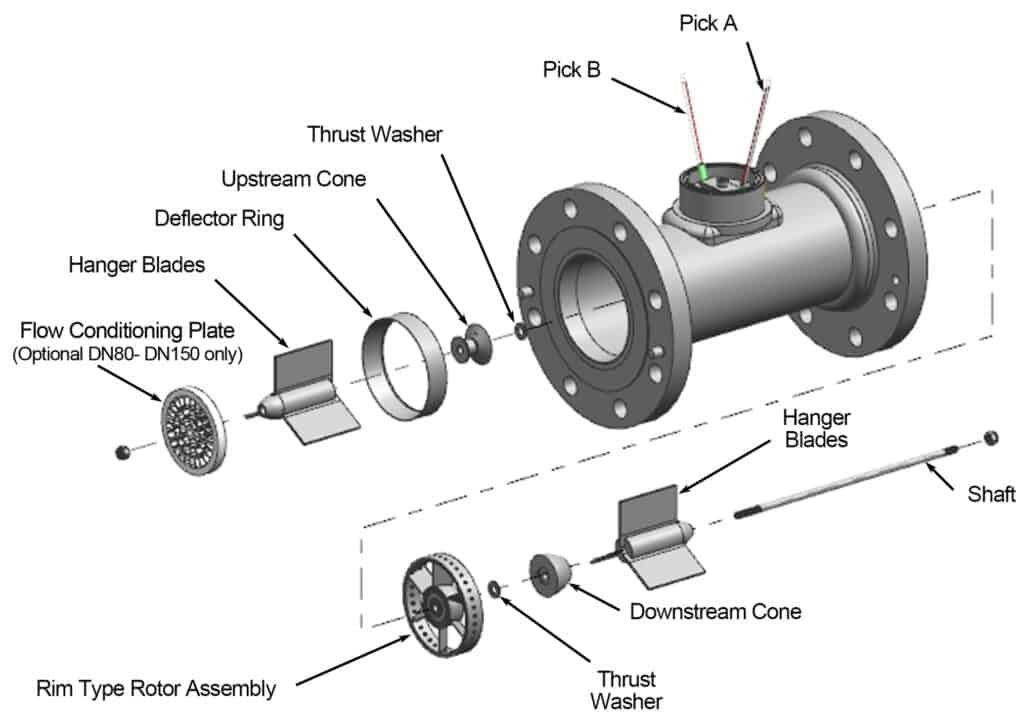
A turbine flow meter is a volume sensing device. As liquid or gas passes through the turbine housing, it causes the freely suspended turbine blades to rotate. The velocity of the turbine rotor is directly proportional to the velocity of the fluid passing through the flow meter.

The external pickoff mounted on the body of the flow meter, senses each rotor blade passing, causing the sensor to generate a frequency output. The frequency is directly proportional to the volume of the liquid or gas.

Extended reading: Quantitative control with turbine flowmeter

What is the principle of turbine flow meter?

Gas turbine flow meter working principle

The gas turbine flowmeter uses a turbine for measurement. It first converts the flow rate into the rotational speed of the turbine, and then converts the rotational speed into an electrical signal proportional to the flow rate.

Gas turbine flowmeter is used to detect instantaneous flow and total integrated flow. Its output signal is frequency, which is easy to digitize.

The induction coil and the permanent magnet are fixed on the housing together. When the ferromagnetic turbine blade passes the magnet, the reluctance of the magnetic circuit changes, thereby generating an induction signal.

The signal is amplified and reshaped by the amplifier and sent to the counter or frequency meter. The total accumulated flow is displayed. At the same time, the pulse frequency undergoes frequency-voltage conversion to indicate instantaneous flow.

The speed of the impeller is proportional to the flow, and the number of revolutions of the impeller is proportional to the total amount of flow. The output of the turbine flowmeter is a frequency modulated signal. It not only improves the anti-interference of the detection circuit, but also simplifies the flow detection system.

The gas turbine flowmeter has a turndown ratio of up to 10:1, and the accuracy is within ±0.2%. The time constant of the turbine flowmeter with small inertia and small size can reach 0.01 second.

Liquid Turbine Flow Meter Working Principle

Liquid Turbine Flow Meter is a speed type flow meter based on the principle of torque balance.

The fluid flows through the sensor housing. Because the blades of the impeller have a certain angle with the flow direction. The impulse of the fluid makes the blades have a rotational torque. After the friction torque and fluid resistance are overcome, the blades rotate. The speed is stable after the torque is balanced.

Under certain conditions, the speed is proportional to the flow rate.

Due to the magnetic permeability of the blade, it is in the magnetic field of the signal detector (composed of permanent magnets and coils). The rotating blade cuts the magnetic lines of force. The magnetic flux of the coil is periodically changed. Electrical pulse signals are induced at both ends of the coil.

This signal is amplified and reshaped by an amplifier. A continuous rectangular pulse wave with a certain amplitude is formed. It can be transmitted to the display instrument remotely. The instantaneous flow or total amount of the fluid is displayed.

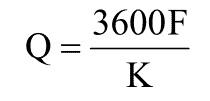
Within a certain flow range, the pulse frequency f is proportional to the instantaneous flow Q of the fluid flowing through the sensor. The flow equation is:

Where:
f——Pulse frequency [Hz]
k——The meter coefficient of the sensor [1/m3], which is given by the calibration sheet.
Q——The instantaneous flow of fluid (under working condition) [m3/h]
3600-conversion factor in seconds

The meter coefficient of each sensor is filled in the verification certificate by the manufacturer. The k value is set in the matching display instrument. The instantaneous flow and cumulative total can be displayed.

Turbine flow meter advantages and disadvantages

Turbine Meter Advantages

  • The cost is moderate.
  • Very good at clean, low viscosity fluids of moderate velocity and a steady rate.
  • Turndown is very good as it can read very low compared to the greatest flow.
  • They are reliable if put in a clean fluid especially if it has some lubricity.
  • AGA and API approved for custody transfers.
  • They do cause some pressure drop where that may be a factor such as gravity flows.
  • High accuracy. Among all flowmeters, it is the most accurate flowmeter.
  • No zero drift, good anti-interference ability.
  • High accuracy. Among all flowmeters, it is the most accurate flowmeter.
  • No zero drift, good anti-interference ability.

Turbine Meter Disadvantages

  • Not reliable for steam.
  • Bearings wear out.
  • Requires constant backpressure to prevent cavitation.
  • Accuracy adversely affected by bubbles in liquids.
  • Turbine meters can be used with clean liquids and gases only (may need to install a strainer upstream to prevent damage from particulates).
  • Not applicable for measuring corrosive fluids.
  • May not function properly with high viscosity fluids where the flow profile is laminar.
  • Cannot maintain calibration characteristics for a long time.

Types of turbine flow meter

Generally speaking, according to the measuring medium, we can divide the turbine flowmeter into liquid turbine flowmeter and gas flowmeter.

Of course, according to the function of the turbine flowmeter, we can divide the turbine flowmeter into a basic turbine flowmeter and an intelligent turbine flowmeter.

  1. Basic turbine flowmeter

The turbine sensor itself does not have the on-site display function, and only transmits the flow signal remotely.
The flow signal can be divided into pulse signal or current signal.
Low price, high integration, small size, especially suitable for use with secondary display, PLC, DCS and other computer control systems.

  1. Intelligent turbine flowmeter

Intelligent turbine flowmeter, a display integrated instrument developed by combining turbine flow sensor and advanced ultra-low power single-chip microcomputer technology.
It has the advantages of compact structure, high reliability, resistance to external power supply interference, lightning protection, and low cost.
Three-point correction of instrument coefficients can be carried out on site, and nonlinearity of instrument coefficients can be intelligently compensated.
Simultaneously display instantaneous flow, cumulative flow, temperature, pressure and other measurement parameters.
It has real-time data storage function and explosion-proof function.
Especially suitable for use with PLC, DCS and other computer control systems.

What is k factor in turbine flow meter?

K-factor (K value) is a factor calculated by calibrating and comparing the meter with other measuring devices that meet the accuracy requirements before putting it into use.
This coefficient is a fixed value, which is the actual coefficient obtained by the flowmeter manufacturer for each meter after verification, and has nothing to do with the initial design.

There are two kinds of different manufacturers k:
One is k=f/Q, which is the number of vortices generated by du unit flow;
The other k=Q/f, that is, each vortex corresponds to the flow rate of Zhuan.
The k value is calibrated with factory water. The sensor measures the vortex number of the instrument and compares it with the volume flow measured by the calibration device to obtain the k value.

The k value is actually related to the internal mechanical structure of the flow meter measuring tube.

Sino-Inst, Manufacuturer for Turbine Sanitary flow meterrs, like: gas turbine flow meter, liquid turbine flow meter, sanitary turbine flow meter, insertion turbine flow meter, steam turbine flow meter, and natural gas turbine flow meter.

Sino-Inst’s Turbine Sanitary flow meters, made in China, Having good Quality, With better price. Our flow measurement instruments are widely used in China, India, Pakistan, US, and other countries.

Request a Quote

Please enable JavaScript in your browser to submit the form

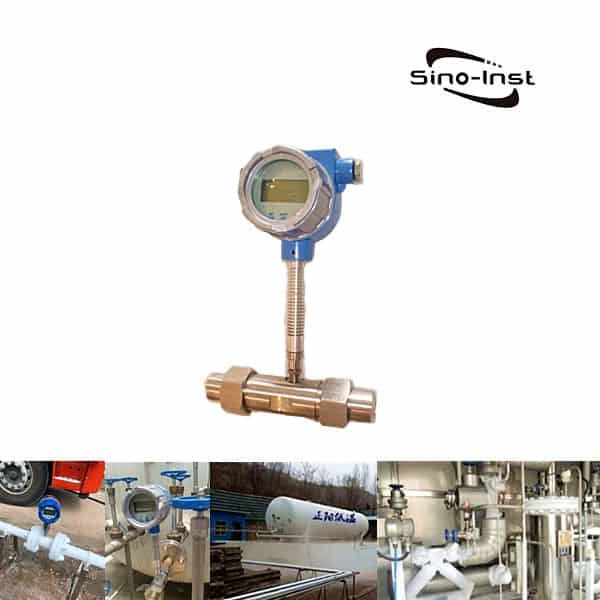
Liquid Turbine Flow Meter

Liquid turbine flow meter is the main type of impeller flow meter. Turbine flow meter sensor uses a multi-blade rotor to sense the average flow rate of the fluid. Belongs to speed flow meter.

Liquid turbine flow meter is the main type of impeller type flow (velocity) meter. It is composed of sensors and conversion display. The sensor uses a multi-blade rotor to sense the average flow rate of the fluid, thereby deriving the flow or total amount. Liquid turbine flow meter is suitable for measuring liquids that are not corrosive to stainless steel 1Cr18Ni9Ti, 2Cr13 and corundum Al2O3 in closed pipelines and are free of impurities. For milk, soybean oil, edible oil, diesel, purified water.

Liquid Turbine Flow Meter reference price: DN100. USD 400-500/pc.

Sino-Inst offers a variety of  Turbine flow meters for flow measurement. If you have any questions, please contact our sales engineers.

Features of Liquid Turbine Flow Meter

  1. The repeatability is good, and the short-term repeatability can reach 0.05%~0.2%. It is precisely because of the good repeatability, such as frequent calibration or online calibration can get extremely high accuracy. It is the preferred flow meter in trade settlement;
  2. High precision, generally up to ±1%R, ±0.5%R, high-precision type up to ±0.2%R;
  3. Output pulse frequency signal. No zero drift, strong anti-interference ability;
  4. Can get very high frequency signal (3~4kHz). Strong signal resolution;
  5. Wide range. Medium and large diameters can reach 1:20, and small diameters are 1:10;
  6. The structure is compact and light. It is convenient to install and maintain, and has a large circulation capacity;
  7. Suitable for high-pressure measurement. No holes are required on the meter body, and it is easy to make a high-pressure meter;
  8. It can be made into an insert type, suitable for large-caliber measurement. The pressure loss is small, the price is low. It can be taken out continuously, and the installation and maintenance are convenient.

Turbine Flow Meter Advantages and Disadvantages

Advantages:
(1) High precision, among all flowmeters, it is the most accurate flowmeter;
(2) Good repeatability;
(3) Element zero drift, good anti-interference ability;
(4) The range is wide;
(5) The structure is compact.

Disadvantages:
(1) The calibration characteristics cannot be maintained for a long time;
(2) The physical properties of the fluid have a great influence on the flow characteristics.

Liquid Turbine Flow Meter Datasheet

Instrument caliber and connection methodDN4, 6, 10, 15, 20, 25, 32, 40 use threaded connection;
(DN15, 20, 25, 32, 40) DN50, 65, 80, 100, 125, 150, 200 use flange connection
Executive standardTurbine flow sensor (JB/T9246-1999)
Accuracy class±1%R, ±0.5%R, ±0.2%R (specially required)
Range ratio1:10; 1:15; 1:20
Instrument material304 stainless steel, 316 (L) stainless steel, etc.
Measured medium temperature (℃)-20~+80℃;-20~+120℃; -20~+150℃;
Environmental conditionsTemperature -10~+55℃, relative humidity 5%~90%, atmospheric pressure 86~106kPa
output signalSensor: pulse frequency signal, low level≤0.8V, high level≥8V
Transmitter: two-wire 4~20mADC current signal
Power supplyA. External power supply: +24VDC±15%, ripple ≤±5% for 4-20mA, pulse output, R485, etc.
B. Internal power supply: 1 set of 3.0V10AH lithium battery, the battery voltage is normal when the battery voltage is 2.0-3.0V
Signal transmission lineSTVPV3×0.3 (three-wire system), 2×0.3 (two-wire system)
Transmission distance≤1000m
Signal line interfaceBasic type: Hausmann connector, explosion-proof type: internal thread M20×1.5
Explosion-proof gradeExiaIICT4 or ExdIIBT6
Protection levelIP65
Diameter (mm)Normal flow range (m3/h)Extended flow range(m3/h)Routine stress tolerance (MPa)Special pressure rating (MPa) (MPa)
DN 40.04-0.250.04-0.46.312、16、25
DN 60.1-0.60.06-0.66.312、16、25
DN 100.2-1.20.15-1.56.312、16、25
DN 150.6-60.4-86.3、2.5(Flange)4.0、6.3、12、16、25
DN 200.8-80.45-96.3、2.5(Flange)4.0、6.3、12、16、25
DN 251-100.5-16.3、2.5(Flange)4.0、6.3、12、16、25
DN 321.5-150.8-156.3、2.5(Flange)4.0、6.3、12、16、25
DN 402-20 1-206.3、2.5(Flange)4.0、6.3、12、16、25
DN 504-402-402.54.0、6.3、12、16、25
DN 657-704-702.54.0、6.3、12、16、25
DN 8010-1005-1002.54.0、6.3、12、16、25
DN 10020-20010-2001.64.0、6.3、12、16、25
DN 12525-25013-2501.62.5、4.0、6.3、12、16
DN 15030-30015-3001.62.5、4.0、6.3、12、16
DN 20080-80040-8001.62.5、4.0、6.3、12、16

Know more about: Turbine type Flow Meter for Liquid & Gas technology

Turbine Flow Meter PDF

Liquid Turbine Flow Meter Order Guide

LWGY Explain
Classify LWGY         Basic model,+5-24DCV power supply
LWGYA         Two-wire system current output,
remote transmission
LWGYB         Battery powered field display
LWGYC         field display/Two-wire system current output
LWGYD         RS485 communication output
Inside nominal
 diameter
4       4mm,general turbine flow range 0.04~0.25m3/h
6       6mm,general turbine flow range 0.1~0.6m3/h
10       10mm,general turbine flow range 0.2~1.2m3/h
12       12mm,general turbine flow range 0.2~2m3/h
15       15mm,general turbine flow range 0.6~6m3/h
20       20mm,general turbine flow range 0.7~7m3/h
25       25mm,general turbine flow range 1~10m3/h
32       32mm,general turbine flow range 1.5~15m3/h
40       40mm,general turbine flow range 2~20m3/h
50       50mm,general turbine flow range 4~40m3/h
65       65mm,general turbine flow range 7~70m3/h
80       80mm,general turbine flow range 10~100m3/h
100       100mm,general turbine flow range 20~200m3/h
125       125mm,general turbine flow range 25~250m3/h
150       150mm,general turbine flow range 30~300m3/h
200       200mm,general turbine flow range 80~800m3/h
Anti-explosion A     No mark, non – explosive type
B     Anti-explosion
Accuracy class A   Accuracy 0.5 grade
B   Accuracy 1 grade
Turbine type A Wide range turbine
B  Ordinary turbine
  • DN4-DN40 caliber sensor is a threaded connection, the maximum working pressure is 6.3Mpa;
  • DN50-DN200 caliber sensor is a flanged connection, the maximum working pressure is 2.5Mpa;
  • The DN4-DN10 caliber sensor has straight pipe sections and filters.
  • Sensors with a diameter above DN15 can be supplied with straight pipe sections.
  • Sensors with DN25-DN40 caliber can also be made as flanged connections, but this must be stated when ordering.

Liquid Turbine Flow Meter Applications

Turbine flowmeter is a kind of speed meter. It has the advantages of high precision, good repeatability, simple structure, few moving parts, high pressure resistance, wide measurement range, small volume, light weight, small pressure loss, and convenient maintenance.

Applications for turbine flowmeters can be found in the water, petroleum and chemical industries. Water applications include distribution systems within and between water bodies. Petroleum applications include custody transfer of hydrocarbons. Other applications can be found in the food and beverage and chemical industries.

When measuring diesel oil, a liquid turbine flowmeter can generally be selected for measurement.

Why is the liquid turbine flowmeter suitable for measuring diesel? Liquid turbine flowmeter has high anti-electromagnetic interference and anti-vibration ability. In addition, it has a wide range. Not only can measure medium and small calibers, but also large calibers can be measured.

Liquid turbine flowmeters can be divided into flange connection, threaded connection, plug-in type and clamp type sanitary type according to the installation method. The specific installation method needs to be selected according to the on-site selection.

Read more about: Diesel Fuel Flow Meters

Turbine flowmeters are also a good choice when you need to measure water flow.

Perhaps, you would say, an electromagnetic flowmeter is a better choice. Yes, in most cases, we will choose electromagnetic flowmeter to measure water flow. However, if the electromagnetic flowmeter cannot measure it. For example, raw water, non-conductive aqueous solution, etc. Then, we can consider using a turbine flowmeter.

Read more about: 10 Ways to Water Flow Measurement

Read more Turbine Flow Meter Application Case: Demineralized Water.

Turbine Flow Meter for Gas

Gas turbine flow meter is a velocity flow meter that measures gas flow. For natural gas, nitrogen, and gas trade measurement.

The gas turbine flowmeter integrates temperature, pressure, flow sensors and intelligent flow totalizers. The gas turbine flowmeter has high accuracy and good repeatability, so it is suitable for trade measurement and industrial process detection. It is widely used in many kinds of gas in petroleum, chemical, metallurgy, aviation, scientific research and other sectors and industrial fields. Such as natural gas, city gas, propane, butane, air, nitrogen and other gases measurement.

Gas Turbine Flow Meter reference price: USD900-2500/pc

Gas turbine flowmeters are widely used in petroleum, chemical, metallurgy, aviation, scientific research and other departments and various gases in industrial fields, such as natural gas, city gas, propane, butane, air, nitrogen and other gases. The instrument has high accuracy and good repeatability, and is suitable for trade measurement and industrial process detection.

Extended reading: Quantitative control with turbine flowmeter

Turbine Flow Meter Technology

Sino-Instrument standard piping liquid turbine flowmeter, indicate the flow rate and measure total throughput of a liquid line.

As liquid flows through the meter and over the rotor, the rotor turns at a speed that is directly proportional to the flow rate.

A magnetic pickup senses the rotor blades, as they pass and generates an electrical (sine wave) signal.

These electrical pulses are then transmitted to the flow measurement readout equipment.

Extended reading: Turbine Insertion Flow Meter for Large Diameter Pipeline

Liquid Turbine Flow Meter Working Principle

Liquid Turbine Flow Meter is a speed type flow meter based on the principle of torque balance.

The fluid flows through the sensor housing. Because the blades of the impeller have a certain angle with the flow direction. The impulse of the fluid makes the blades have a rotational torque. After the friction torque and fluid resistance are overcome, the blades rotate. The speed is stable after the torque is balanced.

Under certain conditions, the speed is proportional to the flow rate.

Due to the magnetic permeability of the blade, it is in the magnetic field of the signal detector (composed of permanent magnets and coils). The rotating blade cuts the magnetic lines of force. The magnetic flux of the coil is periodically changed. Electrical pulse signals are induced at both ends of the coil.

This signal is amplified and reshaped by an amplifier. A continuous rectangular pulse wave with a certain amplitude is formed. It can be transmitted to the display instrument remotely. The instantaneous flow or total amount of the fluid is displayed.

Within a certain flow range, the pulse frequency f is proportional to the instantaneous flow Q of the fluid flowing through the sensor. The flow equation is:

Where:
f——Pulse frequency [Hz]
k——The meter coefficient of the sensor [1/m3], which is given by the calibration sheet.
Q——The instantaneous flow of fluid (under working condition) [m3/h]
3600-conversion factor in seconds

The meter coefficient of each sensor is filled in the verification certificate by the manufacturer. The k value is set in the matching display instrument. The instantaneous flow and cumulative total can be displayed.

Extended reading: water meter installation details

Common Liquid Turbine Flow Meter Applications

The liquid turbine flowmeter is a precision flow measuring instrument. The liquid turbine flowmeter and the corresponding flow totalizer can be used to measure the flow and total amount of liquid.

Liquid turbine flowmeters are widely used in metering and control systems in the fields of petroleum, chemical industry, metallurgy, scientific research, etc.

Liquid turbine flow meters equipped with sanitary joints can be used in the pharmaceutical industry.

Filling measurement of pure water produced by reverse osmosis desalination method

In the application of reverse osmosis equipment, it can be used to supply process pure water in the pharmaceutical, chemical, electronic, electroplating and other industries. It can also be used as a production line for drinking bottled and bottled water, as well as food and beverage.

Field Application of Flowmeter in Thermal Power Plant System

The instruments and meters used in thermal power plants mainly include temperature, pressure, liquid level, and flow. There are many types of flowmeter instruments in this system. Depending on the nature of the medium, different flow rates have different effects.

Boiler water supply process

The treatment of boiler make-up water plays a vital role in the overall operation of the boiler. The application of liquid turbine flow meters directly affects the health and smooth operation of the process.

Extended reading: Turbine Flow meter Vs Gear Flow meter

More Featured Liquid Flow Meters

Extended reading: Vortex Hygienic Flow Meter

Sino-Inst, Manufacuturer for liquid turbine flow meters. Like: gas turbine flow meter, gpi turbine flow meter. liquid turbine flow meter. Sanitary turbine flow meter. Insertion turbine flow meter, steam turbine flow meter. And natural gas turbine flow meter.

Sino-Inst’s turbine flow meters, made in China. Having good Quality, With better price. Our flow measurement instruments are widely used in China, India, Pakistan, US, and other countries.

Request a Quote

Please enable JavaScript in your browser to submit the form

Gas Turbine Flow Meter

Gas turbine flow meter is a velocity flow meter that measures gas flow. For natural gas, nitrogen, and gas trade measurement.

The gas turbine flowmeter integrates temperature, pressure, flow sensors and intelligent flow totalizers. The gas turbine flowmeter has high accuracy and good repeatability, so it is suitable for trade measurement and industrial process detection. It is widely used in many kinds of gas in petroleum, chemical, metallurgy, aviation, scientific research and other sectors and industrial fields. Such as natural gas, city gas, propane, butane, air, nitrogen and other gases measurement.

Gas Turbine Flow Meter reference price: USD900-2500/pc

Sino-Inst offers a variety of  Turbine flow meters for flow measurement. If you have any questions, please contact our sales engineers.

Industrial Propane Tank Level Indicators for Industrial Tank Level Measurement

Features of Gas Turbine Flow Meter

  1. High accuracy, good repeatability. Small pressure loss, good vibration resistance;
  2. Using high-quality bearings, low friction resistance, good sealing performance and long life;
  3. It integrates microprocessor, flow sensor, high-precision temperature and pressure sensor. Directly measure the flow, temperature and pressure of the measured gas. And automatically perform flow tracking compensation and compression factor correction operations;
  4. The meter has pulse signal and analog signal output. It can directly realize the centralized collection and real-time management of computer data through the RS485 communication interface or the GPRS system;
  5. Low power consumption, can be powered by internal battery or external power supply;
  6. With real-time data storage function, it can prevent data loss when the battery is replaced or the power is suddenly lost. In the case of power failure, internal data can be stored permanently;
  7. It can be used in conjunction with IC card prepayment system to facilitate trade settlement;

Specifications Of Gas Turbine Flow Meter

Mediun :No impurity, no corrosive gas, natural gas, etc.
Precision:±1.5%, ±1.0%, ±0.5%,
Repetition:Better than 0.1%
Traffic Range:6.5~6500m³/h
Display content:instantaneous working conditions, volume, standard volume, temperature, pressure, battery capacity, etc.
Calibre measurement:DN50-DN300
Connection mode:Flange connection
Power supply:Battery or external power supply operation
Output:Pulse signal output, 4-20mA current output, RS485 communication GPRS remote communication
Inside nominal diameter DN (mm) Made Flow
specification
Startup
flow rate
(m3/h)
Range of
flow
(m3/h)
Pressure
 rating
(Mpa)
Sell material Accuracy 
50(2”) KLWQD-501 G40 ≤0.8 6.5~65 1.6
2.5
Aluminum alloy

Accuracy 1.0:

The allowable error is
 Qmin~0.2Qmax:±2%;
0.2Qmax~Qmax;±1%

KLWQD-502 G65 ≤0.9 10~100
KLWQD-503 G100 ≤1.7 16~160
80(3”) KLWQD-801 G100 ≤2.0 10~200 1.6 
2.5
Aluminum alloy
KLWQD-802 G160 ≤2.5 18~360
KLWQD-803 G250 ≤3.0 20~400
100(4”) KLWQD-1001 G160 ≤2.5 13~250 1.6 Aluminum alloy
KLWQD-1002 G250 ≤3.0 20~400
KLWQD-1003 G400 ≤4.5 32~650
150(6”) KLWQD-1501 G400 ≤7.5 32~650 1.6 Aluminum alloy
KLWQD-1502 G650 ≤8.5 50~1000
KLWQD-1503 G1000 ≤10.0 80~1600
200(6”) KLWQD-2001 G650 ≤12.0 50~1000 1.6 carbon steel  Accuracy 1.5:The
 allowable error is
Qmin~0.2Qmax:±3.0%;
0.2Qmax~Qmax;±1.5%
KLWQD-2002 G1000 ≤16.0 80~1600
KLWQD-2003 G1600 ≤20.0 130~2500
250(10”) KLWQD-2501 G1000 ≤20.0 80~1600 1.6 carbon steel 
KLWQD-2502 G1600 ≤22.0 130~2500
KLWQD-2503 G2500 ≤25.0 200~4000
300(12”) KLWQD-3001 G1600 ≤22.0 130~2500 1.6 carbon steel 
KLWQD-3002 G2500 ≤35.0 200~4000
KLWQD-3003 G4000 ≤45.0 320~6500

What Are Gas Turbine Flow Meter?

When the fluid flows into the Gas Turbine Flow Meter, it is rectified and accelerated under the action of a dedicated integrated rectifier for the air inlet. Since the turbine blades are at a certain angle to the fluid flow direction, the angular velocity of the turbine is proportional to the fluid volume flow at this time.

According to the principle of electromagnetic induction, a magnetic sensor is used to induce a pulse signal proportional to the volume flow of the fluid from the coaxial rotating signal wheel. The signal is amplified, filtered, and reshaped and enters the intelligent flow totalizer together with the temperature and pressure sensor signals. The micro-processing unit of the instrument performs arithmetic processing. The volume flow and total flow of the gas are directly displayed on the LCD screen.

Please see the structure diagram below for the structure principle of Gas Turbine Flow Meter.

Gas turbine flow meter working principle

The gas turbine flowmeter uses a turbine for measurement. It first converts the flow rate into the rotational speed of the turbine, and then converts the rotational speed into an electrical signal proportional to the flow rate.

Gas turbine flowmeter is used to detect instantaneous flow and total integrated flow. Its output signal is frequency, which is easy to digitize.

The induction coil and the permanent magnet are fixed on the housing together. When the ferromagnetic turbine blade passes the magnet, the reluctance of the magnetic circuit changes, thereby generating an induction signal.

The signal is amplified and reshaped by the amplifier and sent to the counter or frequency meter. The total accumulated flow is displayed. At the same time, the pulse frequency undergoes frequency-voltage conversion to indicate instantaneous flow.

Extended reading: Quantitative control with turbine flowmeter

The speed of the impeller is proportional to the flow, and the number of revolutions of the impeller is proportional to the total amount of flow. The output of the turbine flowmeter is a frequency modulated signal. It not only improves the anti-interference of the detection circuit, but also simplifies the flow detection system.

The gas turbine flowmeter has a turndown ratio of up to 10:1, and the accuracy is within ±0.2%. The time constant of the turbine flowmeter with small inertia and small size can reach 0.01 second.

Extended reading: Threaded Vortex Nitrogen Gas Flow Meter

Gas turbine flow meters Applications

Gas turbine flowmeters are mainly used for gas flow measurement in industrial pipelines.
Flow measurement of air, nitrogen, oxygen, hydrogen and other media fluids.

When measuring the volume flow under working conditions, it is hardly affected by the fluid density, pressure, temperature, viscosity and other parameters.

Further reading: Nitrogen(N2) Flow Meter Types

Natural gas turbine flow meter

The gas turbine flowmeter has the characteristics of high sensitivity, good repeatability, large range ratio and high precision. Therefore, it is widely used in natural gas flow measurement.

When the flow rate changes greatly, the gas turbine flowmeter is more suitable than the differential pressure flowmeter.
The gas turbine flowmeter has a wide range ratio, medium and large diameters can reach 40:1 to 10:1, and small diameters are 6:1 or 5:1.

With the development of natural gas measurement technology and the increasing requirements for natural gas trade and transfer measurement, gas turbine flowmeters can not only meet the requirements of trade measurement, but also meet a wide measurement range.

In addition, its equipment cost is lower than orifice flow meters and gas ultrasonic flow meters.
Therefore, gas turbine flow meters are being used more and more widely. Especially China’s natural gas market usage has increased significantly. However, it is common in the downstream market that the initial consumption of natural gas pipelines is low. Large supply. Turbine flowmeter can reduce the diameter of the measuring tube due to its wider range ratio, thereby reducing investment.

The gas turbine flowmeter has high accuracy. The accuracy of ordinary flowmeters is (±1~±1.5)%, and the special type is (±0.5~±0.2)%. However, the higher the accuracy, the more demanding on-site conditions. harsh. Turbine flowmeter has good repeatability. Short-term repeatability can reach (0.05~0.2)%. If you calibrate regularly, you can get high accuracy.

The gas turbine flowmeter has a compact and light structure, convenient installation and maintenance, and large flow capacity. It is suitable for high pressure measurement.

There is no need to open holes on the meter body, and it is easy to make a high-pressure meter, which can meet the pressure increase requirements of the pipeline. Because of the above advantages, it is one of the preferred flow meters in natural gas trade settlement.

Extended reading: Turbine Insertion Flow Meter for Large Diameter Pipeline

Extended reading: Turbine Flow meter Vs Gear Flow meter

Sino-Inst’s Turbine Gas Meter offer reliable and accurate volume flow measurement in a large range of sizes and pressure rating while being fully compliant with international standards.

Sino-Inst is the risk-free choice for your gas flow measurement applications.

Sino-Inst supplies turbine flow meters, like: gas turbine flow meter. gpi turbine flow meter. liquid turbine flow meter. sanitary turbine flow meter. insertion turbine flow meter. steam turbine flow meter. and natural gas turbine flow meter.

Sino-Inst’s turbine flow meters, made in China, Having good Quality, With better price. Our flow measurement instruments are widely used in China, India, Pakistan, US, and other countries.

Request a Quote

Please enable JavaScript in your browser to submit the form

Insertion Vortex Flow Meter

Insertion Vortex Flow Meter is mainly used for flow measurement of gas, liquid, and steam fluid in large-diameter pipelines.

Insertion Vortex Flow Meter is used on large-size pipes. Reduce piping installation to save costs. The insertion vortex flowmeter is mainly used for large-caliber gas, liquid and vapor medium fluids. When measuring volume flow, it is hardly affected by fluid density, pressure, temperature and viscosity. With plug-in structure, there is no need to cut pipes and drill welded flanges. Just plug it in, easy to install. Greatly save labor costs and product costs.
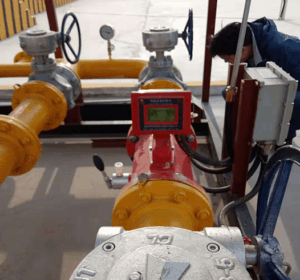
Insertion Vortex flow meter reference price: USD 500-1500/pc.

Sino-Inst offers a variety of  Vortex flow meters for flow measurement. If you have any questions, please contact our sales engineers.

Features of Insertion Vortex Flow Meter

  1. It is suitable for the measurement of large-diameter pipelines (DN150~DN2000), and is used in occasions that require less precision;
  2. Easy installation, no need to cut pipes. Greatly save labor costs and product costs;
  3. It has a very unique medium versatility. It can be used for flow measurement and control of most steam, gas and liquid;
  4. Simple structure, no holes and gaps design. No wear, dirt, no moving parts, low failure rate. Has high stability and reliability;
  5. The vortex flowmeter uses the latest signal processing technology, and the entire system analyzes the measured signal. Then eliminate external interference and medium disturbance. Therefore, stable measurement can be achieved even in harsh process conditions;
  6. The piezoelectric element of the vortex flowmeter is embedded in the probe body. No contact with the medium, no filler inside. Low pressure loss and long service life;
  7. The vortex flowmeter originally forms a signal. Its output frequency has a linear relationship with flow rate. There is no zero drift problem;
  8. Adopt advanced digital signal processing technology. Low lower limit and excellent vibration resistance.

Specifications of Insertion Vortex Flow Meter

Measuring mediumSuperheated/saturated steam, liquid and gas
Measuring rangeSee the flow range table of the plug-in vortex flowmeter for details
DiameterPlug-in: DN150~DN2000
Connection methodPipe opening with connecting flange
Flange standard GB9119-2000 1.6, 2.0, 2.5, 4.0 (MPa)
structureIntegrated type, split type, diving type
Probe body insertion rod304 (standard supply), 316L (other material supply agreement)
Medium temperature (℃)(-40~80)℃, (-40~250)℃, (-40~350)℃
Environment temperature (℃)(-30~+65)℃ Atmospheric pressure: 86kPa~106kPa
Nominal pressureLiquid 1.6MPa, 2.0MPa, 2.5MPa, 4.0MPa
Gas and steam 1.6MPa, 2.5MPa
Accuracy2.50%
Velocity range (m/s)Liquid: 0.5~5, Gas: 6~500, Steam: 7~60
Output signal1: No local display frequency signal: high level ≥5V low level 1V, square wave, pulse duty ratio: 1:1
2: Standard current signal; (4-20) mA standard current signal proportional to the flow
3: Local display instantaneous flow, cumulative flowmeter. Simultaneously output the proportional (4-20) mA standard current signal and pulse frequency signal or (4-20) mA+HART
Power supplyVoltage pulse type: DC12V or DC24V
Standard current output, local display: DC24V
Battery powered local display lithium battery: 3.6V
Ambient temperatureAmbient temperature (-40~+55) ℃,
relative humidity 5~90 ​​(%),
atmospheric pressure: 86kPa~106kPa
Protection levelIP65 is used for indoor and outdoor installation,
IP68 can be used for diving installation
Explosion-proof gradeIntrinsically safe Ex ia ⅡC T6 Ga
displayLCD display instantaneous flow, cumulative flow, vortex frequency
Cable interfaceM20×1.5 (internal thread, recommended); 1/2NPT (internal thread)

What is Vortex Flow?

When a fluid moves through a stationary object (“bluff body”) with a high Reynolds number, the fluid becomes a vortex on either side of the object.
Each vortex will form, then separate from the object and continue to move with the flowing gas or liquid, once twisted in an alternating manner.
This phenomenon is called vortex rotation, and the pattern of moving vortices carried downstream of a stationary object is called vortex street.

How does a vortex flow meter work?

Vortex Flow Meter Working Principle

Vortex flowmeter is a speed-type flowmeter produced according to karman’s vortex principle,
which can be used for the measurement and measurement of conventional gas, steam and
liquid.

Vortex flow sensor has high precision and wide range ratio, no moving parts in use, which can
improve mechanical stability and reduce maintenance.Vortex flowmeter is almost not affected by the temperature, pressure and composition of medium when measuring the volume of working condition.

Therefore, it is convenient to calibrate the instrument, so vortex street flow sensor is widely used in production and life.

When a trigonal column vortex generator is set in the fluid, regular vortices are generated alternately on both sides of the vortex generator, which is called Carmen vortex.

The vortex columns are arranged asymmetrically downstream of the vortex generator. Vortex flowmeter is produced according to this principle.

Vortexes are generated by generating bodies and the number of vortexes is detected by high-sensitivity sensors. In a certain range, the number of vortexes generated is proportional to the flow rate.

In vortex flowmeter, the relationship between flow rate and the number of vortexes generated
can be expressed by the following formula:

Q:Operating volume flow of the measured medium. The unit is m3/h。
F:Frequency of the number of vortices produced by the generating body. The unit is Hz.
K:Refers to the calculated or calibrated flow coefficient. It represents how many frequency signals per cube. the coefficient is usually obtained by calibration.

The formula of standard table method calibration coefficient K:

The formula can also be used for flow correction.

More about vortex flow meter working principle wikipedia.

OMEGA Engineering has a great explanation video about vortex flow meter working principle. Let’s take a look!

Video source: https://www.youtube.com/watch?v=QxCeVVXF2ng&feature=emb_logo

Types of vortex flow meter

Depending on the mounting style, the types of vortex flow meters include:

  1. Insertion flow meter
    Each insertion type of vortex flow meter consists of a built-in bluff body and three sensors, namely one sensor to record the vortex shedding frequency, an RTD temperature sensor, and a solid-state pressure sensor. These components are located in close proximity to each other in a short tube and together they form an assembly called an insertion sensor head. The sensor probe is inserted carefully into a hole made into the pipeline using flanged or male NPT process connections.

This flow meter is also provided an LCD display and keypad to program and monitor the system settings. The insertion flow meter used in pipes which are 2 inches or larger. Since it is a retractable meter, there is no need to shut down the system to take the required measurements.

  1. Inline flow meter
    An Inline flow meter is similar to the insertion flow meter in terms of its components. It also has a bluff body and three sensors to register the vortex shedding frequency, temperature, and pressure. It differs from an insertion flow meter in that it replaces a part of the pipeline and not inserted through it.

Classified by connection method

The connection mode of vortex flowmeter and pipeline can be divided into flange connection type and flange clamping type. These two connection types have their own advantages.

The flange connection type connects the vortex street meter body and the flange into a whole, which is easy to install. But it increases the machining cost for the manufacturer. For different pressure levels, flanges with different pressure levels need to be cast and smelted. The user needs to install the matching anti-flange on the pipe during installation.

However, the flange-mounted flowmeter has no bulky flanges at both ends, which is relatively light. On the premise of ensuring the sealing surface and mechanical strength requirements, it is enough to only manufacture the flangeless surface.

When users use it, they can choose flanges with different pressure levels according to different working pressures. Connect it with bolts, and then directly weld to the pipe.

Where are vortex flow meters used?

The vortex flowmeter is mainly used in the flow measurement of industrial pipeline medium fluid. The medium can be gas, liquid, steam, etc. The main scope of action includes:

  • During industrial production, such as metallurgy, coal, electric power, chemical, pharmaceutical, environmental protection and other manufacturing;
  • Energy measurement. Including the scientific measurement of primary and secondary energy. Such as coal, petroleum gas, natural gas, etc., to achieve energy saving and reduce consumption;
  • Environmental protection engineering. Including flow measurement of flue gas, sewage, etc.;
  • Transportation. Including pipeline transportation for control, distribution and scheduling, and better economic accounting through measurement results.

Vortex flow meter advantages and disadvantages

1.Advantages of vortex flowmeter

(1) The vortex flowmeter has no moving parts, and the measuring element has a simple structure, reliable performance and long service life.

(2) The vortex flowmeter has a wide measuring range. The turndown ratio can generally reach 1:10.

(3) The volume flow of the vortex flowmeter is not affected by thermal parameters such as the temperature, pressure, density or viscosity of the fluid being measured. Generally, no separate calibration is required. It can measure the flow of liquid, gas or steam.

(4) The pressure loss it causes is small.

(5) The accuracy is high, the repeatability is 0.5%, and the maintenance is small.

2.Disadvantages of vortex flowmeter

(1) The volume flow of the vortex flowmeter is not affected by the temperature, pressure, density and other thermal parameters of the measured fluid. But the final measurement result of liquid or steam should be mass flow, and for gas, the final measurement result should be standard volume flow. Both mass flow or standard volume flow must be converted by fluid density. The changes in fluid density caused by changes in fluid operating conditions must be considered.

(2) The main factors that cause flow measurement errors are: measurement errors caused by uneven pipeline flow rates; it is impossible to accurately determine the medium density when the fluid working condition changes. The wet saturated steam is assumed to be dry saturated steam for measurement. If these errors are not limited or eliminated, the total measurement error of the vortex flowmeter will be very large.

(3) Poor vibration resistance. External vibration can cause measurement errors of the vortex flowmeter, or even fail to work normally. The high-velocity impact of the channel fluid will cause additional vibrations to the cantilever of the vortex generator, which reduces the measurement accuracy. The influence of large pipe diameter is more obvious.

(4) Poor adaptability to measuring dirty media. The generating body of the vortex flowmeter is very easy to be dirty by the medium or entangled by the dirt, and the change of the geometric body size has a great influence on the measurement accuracy.

(5) High requirements for straight pipe sections. Experts pointed out that the straight pipe section of the vortex flowmeter must ensure the front 40D and the 20D to meet the measurement requirements.

(6) Poor temperature resistance. Vortex flowmeters generally can only measure the fluid flow of media below 300°C.

Insertion vortex flow meter installation

1.Continuous flow dismountable sensor

①The mounting seat is welded well. First install the ball valve on the mounting seat, tighten and seal with bolts;

②Open the ball valve. Insert the vortex probe into the ball valve. Then tighten the lifting mechanism and the ball valve with bolts. Pay attention to sealing;

③Before leaving the factory. The insertion depth of the measuring head has been adjusted. Do not adjust or disassemble the measuring head at will. Otherwise, it may cause leakage or affect measurement accuracy.

2. Dismountable sensor after the current is cut off

Because the insertion depth of the sensor is designed according to the user’s measuring pipe diameter. So only pay attention to the installation direction when installing. Fasten it with bolts.

Guess you like: Insertion Magnetic Flow Meter-Large diameter online install

Vortex Steam Flow Meter

The vortex steam flow meter concentrates temperature and pressure compensation in the vortex flowmeter. Automatically detect the temperature and pressure of the medium in the pipeline, and the density automatically participates in the calculation. It can display the instantaneous mass flow and cumulative mass flow of the medium. It can also display the temperature and pressure of the medium. It can measure liquid, general gas, saturated steam, superheated steam, etc.

Vortex steam flow meter reference price: USD 200-1500/pc.

You may like:

Sino-Instt offer over 10 Insertion Vortex Shedding flow meters, with Best Price.

A wide variety of industrial Vortex shedding flow meters options are available to you, such as free samples, paid samples. All of our flow meters can wokrk with the AMS NEW TREX.

About 13% of these are magnetic flow meter, 14% are Insertion Magnetic Flow Meter, 25% are Venturi flow meter, 13% are Handheld ultrasonic flow meter, and others are Liquid Turbine Flow Meters.

Sino-Inst is Insertion Vortex shedding flow meter suppliers, located in China. Vortex shedding flow meter products are most popular in North America, Mid East, and Eastern Europe.

Request a Quote

Vortex Steam Flow Meter

Steam flow meter is mainly used for the steam flow measurement. The vortex flow meter concentrates temperature and pressure compensation. Can measure superheated/saturated steam, liquid and gas.

The vortex steam flow meter concentrates temperature and pressure compensation in the vortex flowmeter. Automatically detect the temperature and pressure of the medium in the pipeline, and the density automatically participates in the calculation. It can display the instantaneous mass flow and cumulative mass flow of the medium. It can also display the temperature and pressure of the medium. It can measure liquid, general gas, saturated steam, superheated steam, etc.

Vortex steam flow meter reference price: USD 200-1500/pc.

Sino-Inst offers a variety of  Vortex flow meters for flow measurement. If you have any questions, please contact our sales engineers.

Features of Steam Flow Meter

  1. Easy to install. It is suitable for the measurement of steam, compressed air and other gases;
  2. Integrated temperature and pressure dual compensation. The instantaneous flow and accumulated flow, temperature, pressure and other data after compensation can be directly read on the meter head;
  3. It has a very unique medium versatility. It can be used for flow measurement and control of most steam, gas and liquid;
  4. Simple structure, no holes and gaps design. No wear, dirt resistance, no moving parts, low failure rate. It has high stability and reliability;
  5. The vortex flowmeter uses the latest signal processing technology, and the entire system analyzes the measured signal. Then eliminates external interference and media disturbance. Therefore, stable measurement can be achieved even in harsh process conditions;
  6. The piezoelectric element of the vortex flowmeter is embedded in the probe body. It does not touch the medium. There is no filling material inside. The pressure loss is small and the service life is long;
  7. The original signal formed by the vortex flowmeter. Its output frequency has a linear relationship with the flow rate. There is no zero drift problem;
  8. Adopt advanced digital signal processing technology. Low lower limit. Excellent anti-vibration performance.

Read more about: Steam pressure transmitter-Pressure measure on steam pipeline 

Vortex Steam Flow Meter Specification

Measuring mediumSuperheated/saturated steam, liquid and gas
Measuring rangeSee flow range table for details
caliberWafer type/flange type: DN15~DN400~DN1000
Medium temperature (℃)(-40~80)℃, (-40~150)℃, (-40~300)℃, (-40~400)℃
Environment temperature (℃)(-20~+70)°C atmospheric pressure: 86kPa~106kPa
Nominal pressureLiquid 1.6MPa, 2.0MPa, 2.5MPa, 4.0MPa, 5.0MPa, 6.3MPa, 10.0MPa, 25MPa
Gas and steam 1.6MPa, 2.0MPa, 2.5MPa, 4.0MPa, 5.0MPa
Accuracy±1.0%, ±1.5%
Flow rate range (m/s)Liquid: 0.15~7 Gas: 1.5~60 Steam: 2~70
output signalThree-wire voltage pulse: high level≥5V low level<1V
Standard current signal: (4-20) mA standard current signal proportional to the flow rate, local display flow, cumulative flow.
And output proportional to the flow rate (4-20) mA standard current signal and pulse frequency signal
Communication method: RS-485 communication
Power supplyThree-wire voltage pulse: DC12V, DC24V
Standard current output, local display: DC24V
Battery power supply (lithium battery): 3.6V
Ambient temperature(-20~+70)°C atmospheric pressure: 86kPa~106kPa
Protection levelIP65
Explosion-proof gradeIntrinsically safe Ex ia ⅡC T6 Ga
displayLCD displays instantaneous flow, cumulative flow, vortex frequency,
temperature and pressure (integrated temperature and pressure)
Cable interfaceM20×1.5 (internal thread, recommended);
1/2NPT (internal thread)
Installation formIntegrated installation;
split installation
(the measuring tube and the indicator are connected by a 10-core special shielded cable)
Diameter (DN)Liquid flow range (m3/h)Output frequency range (Hz)Gas flow range (m3/h)Output frequency range (Hz)
151.2~6.290~9005~25265~2640
201.5~1040~3968~50218~1982
251.6~1632~32510~70172~1420
322~2020~25015~150130~1350
402.5~2513~13022~220115~1147
503.5~359~9336~32096~854
656~608~8250~48061~583
8010~1006~6570~64045~417
10015~1505~50130~110043~367
12525~2505~47200~170033~290
15040~4004~40280~224027~221
20080~8003~33580~496024~207
250140~14003~26970~800020~171
300200~20002~221380~1100017~136

Extended reading: Flow Totalizer F3000X for Data collection and calculation

Vortex Steam Flow Meter Applicaitons

  1. And saturated steam flow measurement
  2. Steam boiler monitoring
  3. Compressor air monitoring
  4. Measure the consumption of compressed air system
  5. Measure industrial gas consumption
  6. SIP and CIP processing in the food, beverage and pharmaceutical industries

Extended reading: Measuring Flow With Pressure Sensors

What is the principle of vortex Steam flow meter?

Or, How steam flow is measured?
How is the steam flow rate calculated?

The basic principle of the intelligent vortex flowmeter, is the Karman vortex principle. That is “the vortex separation frequency is proportional to the flow velocity”.

The diameter of the flowmeter body is basically the same as the nominal diameter of the meter. The axis of the cylinder is perpendicular to the flow direction of the measured medium, and the bottom surface greets the fluid.

When the measured medium flows through the cylinder, Vortex is alternately generated on both sides of the column, and the vortex is continuously generated and separated.

In the downstream of the column, two rows of vortices, namely “vortex street”, are formed. Theoretical analysis and experiments have shown, that the frequency of vortex separation is proportional to the flow rate of the column side medium.

f=(sr*V)/d

In the formula:

F── the frequency of the vortex separation of the column side (Hz);

V── column side flow rate (m/s);

D── the width of the cylinder facing surface (m);

Sr ─ Strauhal number.

It is a constant that is substantially independent of fluid properties, and flow rate depending on the shape of the cross-section of the cylinder.

Extended reading: Liquid Bitumen/Asphalt Flow Meter

Temperature and pressure compensation of vortex steam flowmeter

Gases are compressed fluids. If its volume state has changed. It is mainly caused by changes in temperature and pressure indicators.

In the process of measuring the gas flow, on the one hand, the flowmeter must be able to accurately output the standard volume flow. On the other hand, the output of mass flow is also required.

And the vortex flowmeter is used to measure the volume flow. It is necessary to ensure that the measurement is carried out in the environment of the working condition. Therefore, the vortex flowmeter is used in the measurement process of general gas and steam. The temperature and pressure compensation function should be fully considered. And make a reasonable instrument selection.

After temperature and pressure compensation, the volume flow of the working condition can be converted into a mass flow. Or it is converted into other volume flow, that is, the standard volume flow.

For general gases during measurement. The compensation principle is to calculate according to the formula, which belongs to the standard gas state equation:

P0V0/T0= P1V1/T1.

where:
The absolute pressure (Pa) in the standard state represented by P0;
The absolute pressure (Pa) in the working state represented by P1;
T0 represents the thermodynamic temperature (K) in the standard environment;
T1 represents the thermodynamic temperature (K) under working conditions;
V0 represents the gas volume in the standard environment;
V1 is the gas volume in the operating state.

Extended reading: How to realize the flow accumulation function in PLC?

During the steam measurement. The work that needs to be done is the compensation of saturated steam. There are two methods of application, one is pressure compensation and the other is temperature compensation.

There are usually two specific compensation modes.

That is, if the vortex flowmeter sensor does not have a temperature detection element and built-in pressure. Static compensation can only be implemented inside the instrument. That is to say, the compensation is realized by inputting the fixed pressure value and temperature value. This mode is more suitable for occasions without large temperature and pressure changes.

If the vortex flowmeter sensor has a temperature detection element and built-in pressure. The meter takes into account the results of the measured temperature and pressure. Master the state of steam. Determine which type of steam is superheated steam or saturated steam.

For mass flow, the calculation method needs to obtain the steam database index stored in the instrument and implement intelligent calculation. The other is to use the steam flow totalizer. in the steam flow totalizer. The volume flow and temperature of the working conditions measured by the transmission vortex flowmeter. And to transmit the signal measured by the pressure transmitter.

The steam flow totalizer has built-in superheated steam and saturated steam compensation algorithms. Can accurately output mass flow and standard volume flow. Moreover, the heat and specific enthalpy can be output correctly.

Extended reading: How to Calibrate DP Level Transmitter

Steam Flow Meter Types

Commonly used flow meters for steam flow measurement include: differential pressure flow meters, vortex flow meters, rotary wing steam flow meters, V cone flow meters, elbow flow meters, and flute-shaped uniform velocity tube flow meters. These steam flow meters work principles and The usage requirements are different.

Sino-Inst shares the knowledge of these steam flow meters with you.

Extended reading: metal tube flow meter

In the measurement of steam flow, the differential pressure flowmeter still ranks first. It is based on authoritative standards and has test pieces that are easy to copy. The structure is simple, firm, reliable, and has a long service life. The usable temperature and pressure range is wide. Low price, no need for real flow calibration and other advantages.

Extended Reading: Advantages and disadvantages of differential pressure flow meter

The complete set of differential pressure flow meters is composed of standard throttling devices, differential pressure transmitters and flow totalizers from different manufacturers, so it is flexible and convenient to use.

The differential pressure flowmeter is especially suitable for measuring high temperature, high pressure saturated steam and superheated steam.

Differential pressure flow meters also have shortcomings. Such as: installation is more complicated, easy to leak, maintenance and disassembly labor intensive. The turndown ratio is only 3:1, and the pressure loss is large. Due to changes in the measurement conditions during use, the process parameters deviate from the design values, which will cause larger measurement errors.

Extended reading: Integral DP Flow Meter|Gas, liquid, steam|Compact structure

The vortex flowmeter has a simple structure and does not need a pressure guiding tube. The measurement range is large, and the turndown ratio can reach 10:1. The advantages of small pressure loss, etc., account for an increasing proportion of saturated steam flow measurement. The installation difficulty is similar to the orifice plate, and it has certain requirements for straight pipe sections.

Vortex flowmeters also have disadvantages. For example, regular verification cannot be done by general users and needs to be removed for inspection. Its stability is affected by the flow rate, and the stress-type vortex flowmeter is more sensitive to vibration and is susceptible to measurement errors due to the impact of pipeline or equipment vibration. Vortex flowmeters are also limited by temperature. Generally, it cannot exceed 500°C. The vortex flowmeter cannot be used to measure multiphase flow.

Read more about: Vortex Shedding Flow Meter Working Principle

Rotary wing steam flowmeter has a wide range of applications in the measurement of saturated steam in small and medium-sized enterprises. It is a measuring instrument based on pure mechanical principles. It has simple structure, firmness and low maintenance. Only the inner orifice plate needs to be replaced to adjust the range. It also has the advantages of manual adjustment of pressure compensation, and no power supply.
But there are also shortcomings. Such as: straight pipe section has certain requirements. The adaptable range of pipe diameter is limited and can only be installed horizontally. The accuracy is not high, and manual meter reading is not convenient for measurement management.

Features of thermal gas mass flow meter:

  • The range of fluid media has been expanded: gas, gas and liquid, and liquid. Proprietary humidity algorithm software makes fluid flow measurement more accurate.
  • The replacement of the sensor does not require recalibration. The instrument adopts modular design, which realizes interchangeability and is easy to maintain.
  • Using Bluetooth and GPGS technology, it is convenient for on-site and remote monitoring and maintenance of the instrument.
  • Adopt “FLUD” proprietary fluid software technology to make the straight pipe section needed for instrument measurement shorter
  • No drift, maintenance-free, and high sensitivity.
  • When the product is installed and running, there is no need to use any measurement system as a reference standard for calibration.
  • Various functions are set up on site configuration.

The measuring principle of the V cone flowmeter is the same as that of the differential pressure flowmeter, and it is also a throttling differential pressure flowmeter.

When measuring gas flow and steam flow, the v-cone flowmeter measures high temperature and high pressure, and the flow of normal temperature and normal pressure media is a small expert in measurement.

The v-cone flowmeter is actually a differential pressure flowmeter, and the measurement flow is calculated by capturing the pressure difference before and after the throttling device. This is an internationally certified measuring throttling device. Even leaving the factory without calibration, the purpose of high-precision flow measurement can be achieved.

Extended reading: V-Cone Flow Meter Applications

The elbow flowmeter is an elbow with a fixed geometric size and a fixed shape. Its structure is simple, without any additional parts and throttling parts. Therefore, there is basically no pressure loss. The turndown ratio can reach 10:1. High precision, maintenance-free measuring device, long life, high temperature resistance, high pressure resistance, vibration resistance, etc.

But there are also shortcomings. For example, the differential pressure generated by the measurement is relatively low, generally around 3000 Pa. Therefore, the selection requirements for differential pressure transmitters are relatively high. When measuring steam flow, temperature and pressure compensation are still required.

The flute-shaped uniform velocity tube flowmeter is based on the pitot tube velocity measurement principle. It outputs a differential pressure signal. Used in conjunction with a differential pressure transmitter for measuring differential pressure. It can measure the flow of steam, liquid and gas. The structure is simple, the pressure loss is small, and the length of the upstream and downstream straight pipe sections is short. Easy to install, the range ratio can reach 10:1. It is resistant to high temperature and pressure, is not affected by abrasion, and has no leakage.

The flute-shaped average velocity tube flowmeter also has its shortcomings. If the on-site installation conditions are demanding, the differential pressure generated is small, and some are only 20-30Pa. Must be equipped with high-precision differential pressure transmitter.

Due to the structure, the flow rates of the pressure ports are different, and there is a certain pressure difference between the pressure ports. There is a flow of medium between the pressure holes. If there is a medium, it may be blocked and cause measurement errors. The fluid to be measured flows in the circular tube, and the pressure distribution caused by the circular tube is different when the fluid flows in due to the different separation points of the fluid. The flow coefficient is unstable and the flow is unstable.

Extended reading: Use of high temperature melt pressure sensor

Clamp on Steam Flow Meter

The clamp-on ultrasonic flowmeter cannot measure steam. Generally, it measures the flow of medium such as water and uniform liquid.
The measurement of steam generally uses a temperature and pressure compensated vortex flowmeter or a differential pressure flowmeter.

Portable Steam Flow Meter

The FLUXUS G601 ST is the world’s ONLY clamp on steam meter! This device is able to measure steam flow non-invasively from outside the pipe which means that there is no interruption of operation or supply. This also means there is no pressure loss, need to open the pipe, or to reduce the pipe size for measurement.

Read more about: Condensate Flow Meter-Steam Condensate Flow Meter|Types & Selection Guide

Featured Steam Flow Meters

Related Blogs:

  • BTU Meter for Chilled Water

    What is BTU Meter for Chilled Water? The BTU Meter for Chilled Water accurately measures the thermal energy consumed by chilled water in British Thermal Units (BTU). This…
  • Guide for Digital Fuel Flow Meter

    Digital Fuel Flow Meter is a flow meter dedicated to measuring fuel, diesel, gasoline, and petroleum. Digital Fuel Flow Meter generally has a digital display or signal output…
  • Mechanical Water Flow Meters

    Mechanical water flow meters refer to a type of flow meter suitable for clean water processes or applications. The working principle of a mechanical water flow meter is…
  • Flow Totalizer Meter vs Flow Meter

    A flow totalizer meter is sometimes referred to as a flow meter or flow totalizer. flow totalizer meter displays the flow rate from either an analog or pulse…
  • Explore Oil and Gas Flow Meters

    An oil and Gas Flow Meter is A device installed in a pump manifold or treating line to measure the fluid flow rate. Oil and Gas Flow Meters…
  • Velocity Flow Meters

    Flow Meter Types There are many types of flow meters. Basically, there are the following types of flow meters Why are there so many types of flow meters?…
  • Strap on Ultrasonic Flow Meters

    What is Strap on Ultrasonic Flow Meters? Strap on Ultrasonic Flow Meter is also often called Clamp On Type Flow Meter. The unique feature of Strap on Ultrasonic…

Frequently
Asked
Questions

In fact, different steam flow meters work differently.
Of course, the most commonly used is definitely the vortex flowmeter.
The steam flowmeter is a volumetric flowmeter that measures the volume flow of gas, steam or liquid, the volume flow of standard conditions or the mass flow according to the Kármán Vortex Street principle. And can be used as flow transmitter in automatic control system.

How is steam flow measured? Maybe everyone knows how to measure with a flowmeter. Because there are many types of flow meters on the market, I don’t know how to choose. There are measuring liquids, gases, slurries and so on.

First, the temperature of the steam is relatively high. We have to choose a flowmeter that can withstand high temperature to measure. For example: V cone, orifice plate, balance, vortex street, turbine can all be measured. Among them, the measuring caliber of V cone flowmeter is from DN15-DN2000. The range is also relatively wide, so it is also favored by the majority of users.

When choosing a flowmeter, you should confirm the working conditions of the site, the temperature and pressure range, the power supply is generally 220VAC, the default installation method is flange installation, the output signal is 4-20mA, and the range diameter should also be confirmed.

There are many types of flowmeter, those suitable for steam and condensate applications include:

  • Orifice plate flowmeters.
  • Turbine flowmeters (including shunt or bypass types).
  • Variable area flowmeters.
  • Spring loaded variable area flowmeters.
  • Direct in-line variable area (TVA) flowmeters.
  • Ultrasonic flowmeters.
  • Vortex shedding flowmeters

Each of these flowmeter types has its own advantages and limitations. To ensure accurate and consistent performance from a steam or condensate flowmeter, it is essential that it is correctly matched to the intended application.

Extended reading: Ultrasonic Flow Meters Types & Technical Guide

All of our Flow Meters can work with the NEW AMS TREX !

Sino-Instt offer over 10 Vortex Shedding flow meters, with Best Price.

A wide variety of industrial Vortex shedding flow meters options are available to you, such as free samples, paid samples. All of our flow meters can wokrk with the AMS NEW TREX.

About 13% of these are magnetic flow meter, 14% are Insertion Magnetic Flow Meter, 25% are Venturi flow meter, 13% are Handheld ultrasonic flow meter, and others are Liquid Turbine Flow Meters.

Sino-Inst is Vortex shedding flow meter suppliers, located in China. Vortex shedding flow meter products are most popular in North America, Mid East, and Eastern Europe.


Request a Quote

Please enable JavaScript in your browser to submit the form

Vortex Shedding Flow Meter

Vortex shedding flow meter, also called Vortex flow meter. Vortex shedding flow meter is suitable for measuring steam flow rate as well as liquids and gases.

Vortex shedding flow meter, easy installation, low cost, analog and 4-20mA output. Pressure & temperature compensation can improve the sensor for more accurate measurement. Vortex shedding flow meter is suitable for measuring steam and various liquids and gases. When the fluid flows through the assembly line of the vortex flowmeter, a vortex is formed. The frequency of vortex shedding is directly proportional to the fluid velocity.

Vortex shedding flow meter reference price: USD 200-1500/pc.

Sino-Inst offers a variety of  Vortex flow meters for flow measurement. If you have any questions, please contact our sales engineers.

Industrial Vortex Shedding Flow Meter Features

  1. Sonic nozzle calibration. High repeatability and high measurement accuracy
  2. Temperature compensation and pressure temperature can be freely selected. To meet more on-site use
  3. The circuit board is aging and running before leaving the factory. And the whole meter is calibrated one by one. It is more suitable for on-site use
  4. Wide application range. Gas, liquid and steam can be measured
  5. Low pressure loss. Low energy loss. Conducive to energy saving
  6. Simple and firm structure, no moving parts. High reliability and low maintenance

Specifications of Vortex Shedding Flow Meter

Diameter(mm)DN15,20,25,40,50,65,80,100,125,150,200,250,300,(300~1000 plug-in)
Nominal pressure(MPa)DN15-DN200 4.0 (>4.0,Consulting supply)
DN250-DN300 1.6(>1.6,Consulting supply)
Medium temperature(ºC)Piezoelectric type :-40~150,-40~260,-40~330℃;
Projected Capacitive:-40~400℃ (Consulting supply)
Body material 1Cr18Ni9Ti (Other material order by Consulting supply)
Permissible vibration
acceleration
Piezoelectric type :0.2g   Projected Capacitive:1.0-2.0g
Accuracy±1%R,±1.5%R;plug-in:±2.5%R
Range of degrees1:6~1:25
Power SupplySensor:DC+12V,DC+24V;
Transmitter:DC+12V,DV+24V;
Battery-powered:3.6V battery
Output signalPulse:high level:≥5V
low level:≤1V;
electricity current:4~20mA
Pressure loss coefficientComply with JB/T9249 standard Cd≤2.4
Explosion-proof coefficientIntrinsic safety :Ex ia II CT2-T4
Explosion-proof type:Exd II CT2-T5
Level of protection Ordinary type:IP65 
Diving type:IP68
Environmental conditionsTempersature:-20ºC~55ºC,
relative humidity 5%~90%,
atmospheric pressure:86~106kPa
Applicable mediumgas ,liquid,steam
Transmission distance Three-wire pulse output:≤300m,
Two-wire standard current output:(4~20mA)≤1500m
load resistance≤500Ω;
RS485/HART≤1200m.

Vortex Shedding Flow Meter Structure

The basic structure of LUGB series vortex flowmeter is shown in figure 1. It is mainly
composed of shell, vortex generator, flow sensor, temperature sensor, pressure sensor, shield bar,
integrator and other main accessories

  1. Integrating instrument
  2. Pressure transducer
  3. Shielding rod
  4. Shell
Table of operating flow range of vortex street flow sensor under reference condition
Diameter
(mm)
LIQUID GAS
Range of measurements
(m³/h)
Output
frequency range
(Hz)
Range of measurements
(m³/h)
Output
frequency range
(Hz)
15 0.3~5 35~600 2.2~20 260~2000
20 0.6~10 29~420 4~36 210~1900
25 1.2~16 25~336 8.8~55 190~1140
32 1.8~20 18~264 10~150 156~1080
40 2~40 10~200 27~205 140~1040
50 3~60 8~160 35~380 94~1020
65 4~85 6~120 35~800 94~940
80 6.5~130 4.1~82 86~1100 55~690
100 15~220 4.7~69 133~1700 42~536
125 20~350 3.2~57 150~2000 38~475
150 30~450 2.8~43 347~4000 33~380
200 45~800 2~31 560~8000 22~315
250 65~1250 1.5~25 890~11000 18~221
300 95~2000 1.2~24 1360~18000 16~213
-300 100~1500 5.5~87 1560~15600 85~880
-400 180~3000 5.6~87 2750~27000 85~880
-500 300~4500 5.6~88 4300~43000 85~880
-600 450~6500 5.7~89 6100~61000 85~880
-800 750~10000 5.7~88 11000~110000 85~880
-1000 1200~1700 5.5~88 17000~170000 85~880
>(100) Consulting supply   Consulting supply  

Vortex Shedding Flow Meter Working Principle

Vortex flowmeter is a speed-type flowmeter produced according to karman’s vortex principle,
which can be used for the measurement and measurement of conventional gas, steam and
liquid.

Vortex flow sensor has high precision and wide range ratio, no moving parts in use, which can
improve mechanical stability and reduce maintenance.Vortex flowmeter is almost not affected by the temperature, pressure and composition of medium when measuring the volume of working condition.

Therefore, it is convenient to calibrate the instrument, so vortex street flow sensor is widely used in production and life.

When a trigonal column vortex generator is set in the fluid, regular vortices are generated alternately on both sides of the vortex generator, which is called Carmen vortex.

The vortex columns are arranged asymmetrically downstream of the vortex generator. Vortex flowmeter is produced according to this principle.

Vortexes are generated by generating bodies and the number of vortexes is detected by high-sensitivity sensors. In a certain range, the number of vortexes generated is proportional to the flow rate.

In vortex flowmeter, the relationship between flow rate and the number of vortexes generated
can be expressed by the following formula:

Q:Operating volume flow of the measured medium. The unit is m3/h。
F:Frequency of the number of vortices produced by the generating body. The unit is Hz.
K:Refers to the calculated or calibrated flow coefficient. It represents how many frequency signals per cube. the coefficient is usually obtained by calibration.

The formula of standard table method calibration coefficient K:

The formula can also be used for flow correction.

Applications of Vortex Shedding Flow Meter

Steam Flow Measurement

Steam has often been described as the ‘lifeblood’ of the industry.
Vortex meters are known to be superior devices for steam flow measurement, due to their inherent linear measurement, large turndown, low-pressure drop, and high accuracy.

The vortex flowmeter is ideal for high temperature, superheated, and saturated steam applications, since it eliminates the need for separate components and associated installation temperature.

In addition, it provides quality, dependability and high-pressure ratings,along with a stable and reliable flow measurement.

Read more about: Steam Flow Measurement: Do you need temperature and pressure

Liquid Applications

Liquid applications in the oil refinery industry become challenging, since the process liquid is a higher viscosity at lower process temperatures.

As a result, clogging becomes an issue when a flow meter has moving parts.

Sino-Instrument vortex meters have advanced self-diagnostics, that alert the operator if clogging or plugging in the area around the shedder bar are present.

Alerts are also triggered in high-vibration environments and those with excessive flow fluctuations in the area around the shedder bar. This enables automatic condition-based maintenance.

Extended reading: Integral DP Flow Meter|Gas, liquid, steam|Compact structure

Installation for Industrial Vortex Flow Meter

Know more about vortex shedding flow meter:

A vortex flow meter is a flow measurement device best suited for flow measurements, where the introduction of moving parts presents problems.

They are available in industrial grade, brass or all plastic construction.

Sensitivity to variations in the process conditions are low, and with no moving parts have relatively low wear compared to other types of flow meters.

Vortex flow meters operate under the vortex shedding principle, where an oscillating vortexes occur, when a fluid such as water flow past a bluff (as opposed to streamlined) body.

The frequency that the vortexes are shed depend on the size and shape of the body.

It is ideal for applications where low maintenance costs are important.

Industrial size vortex meters are custom built and require appropriate sizing for specific applications.

The Vortex Shedding flow meter detects the vortices, that are created by a process medium going past a bluff body.

The frequency of these vortices can be equated into flow velocity, which, in turn, is used to calculate volumetric flow rate.

The integral temperature sensor is used in saturated steam service, to determine the operating conditions and specific volume of the steam being measured.

The steam table incorporated into the electronics, then calculates the flow or energy of the steam flowing through the meter.

The optional pressure sensor can be used for similar calculations, for gasses and superheated steam.

Intelligent Signal Processing (ISP) provides stable readings, free of external influences.

What are the applications of vortex flowmeter?

  1. A vortex flowmeter can be used to measure the flow of various industrial water. Including chemical, light industry, electric power, metallurgy, building materials, petroleum and other industries in the production process of circulating water, wastewater, waste liquid measurement.
  2. Part of the measurement of corrosive liquids, such as sulfuric acid, hydrochloric acid, nitric acid, acetic acid, and other acids. And a variety of chemical solutions.
  3. The flow measurement of non-conductive liquids. Electromagnetic flowmeter in the flow measurement of conductive liquids dominates, while in the field of non-conductive liquid flow measurement, vortex flowmeter has a great place to use. In the petrochemical, pharmaceutical, food, semiconductor industry, vortex flowmeter has also been more widely used, for example methanol, formaldehyde, acetone, toluene, trichloroethylene, ethylene, butane liquid ammonia, etc., and semiconductor industry pure water and ultra-clean pure water, etc..
  4. Part of the low viscosity oil flow measurement, such as gasoline, kerosene, diesel oil, and heavy oil and residual oil flow measurement after the viscosity has been reduced by heating.
  5. Large diameter pipeline water flow measurement, full pipe vortex flowmeter is mainly used to measure small and medium diameter water flow, while the insertion type vortex flowmeter can be used to measure the flow measurement of large diameter pipeline. Vortex flowmeter is widely used in urban water pipelines and chemical, electric power, metallurgy, paper, and chemical fiber, and other enterprises in the industrial water mainline.

More industrial vortex flow meters:

Sino-Instt offer over 10 Vortex Shedding flow meters, with Best Price.

A wide variety of industrial Vortex shedding flow meters options are available to you, such as free samples, paid samples. All of our flow meters can wokrk with the AMS NEW TREX.

About 13% of these are magnetic flow meter, 14% are Insertion Magnetic Flow Meter, 25% are Venturi flow meter, 13% are Handheld ultrasonic flow meter, and others are Liquid Turbine Flow Meters.

Sino-Inst is Vortex shedding flow meter suppliers, located in China. Vortex shedding flow meter products are most popular in North America, Mid East, and Eastern Europe.

The United States, and India, which export 99%, 1%, and 1% of ultrasonic level transmitter respectively. You can ensure product safety by selecting from a certified supplier, with ISO9001, ISO14001 certification.

Request a Quote