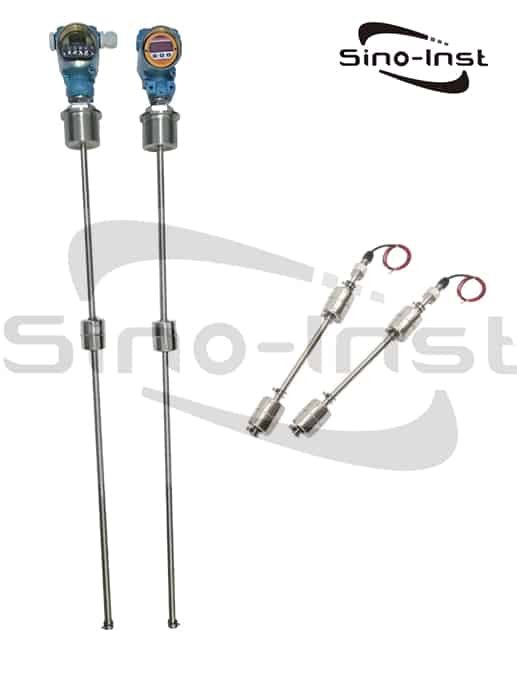
SI-U05 Cable Float Level Sensor & Swtich

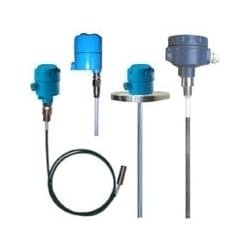
Cable Float Level Sensor (Float level switch) for water/level switch control.

SI-U05 Cable Float Level Sensor & Swtich

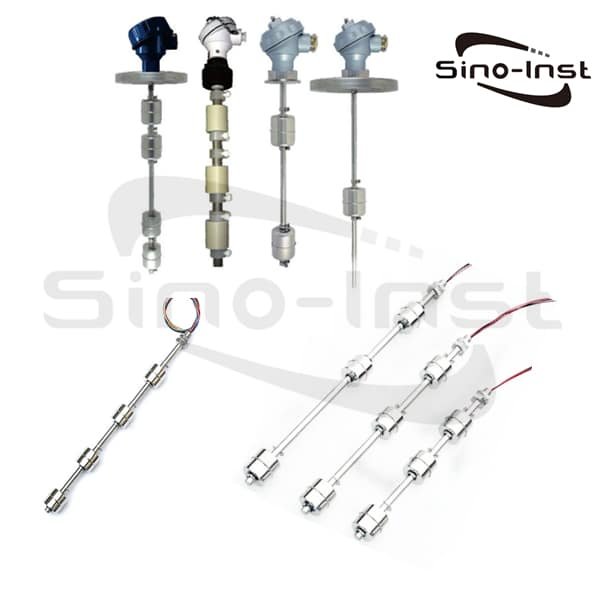
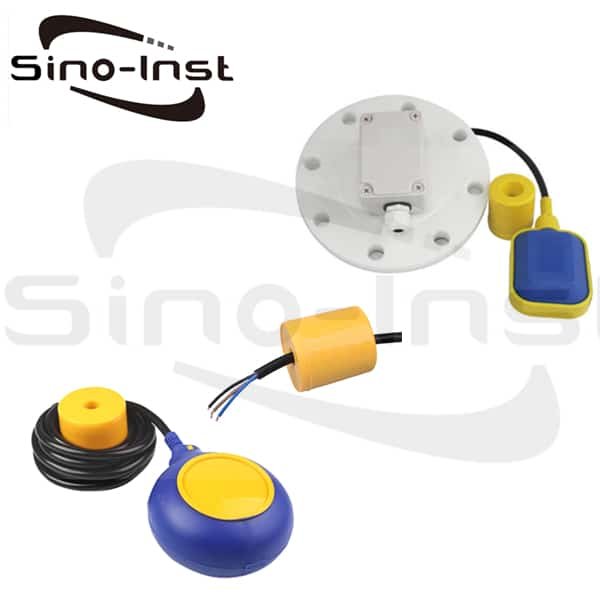
Cable Float Level Sensor (Float level switch) is a high performance level control switch. It can control the work of the liquid pump, adjusting the liquid level. And it can also be installed in the submersible pump to control and protect the motor. High sealing performance is guaranteed by polypropylene injection. It is a switch that can adjust the liquid level in a bucket, tank or well. Cable Float Level Sensor is self-adjusting, easy to operate, easy to install and maintenance-free. It has a resistance to sewage. It is used in mines, oil, irrigation containers, etc.

Please feel free to contact us for Techinical Support, or Request a quote for float level sensors (customization available).

The Cable Float Level Switch is designed using the principles of gravity and buoyancy. Cable Float Level Sensor has a simple and reasonable structure. Including: A floating body. A large-capacity miniature switch set in the floating body.

A driving mechanism capable of turning the switch on and off. And a three-core cable connected to the switch. The outstanding feature of this product is its stable and reliable performance. Cable Float Level Sensor has no malfunction caused by the fluctuation of the liquid surface.

At the same time, it has the characteristics of convenient installation, low price and long service life. This product can be used with various liquid pumps, and automatic control of water levels in water supply, drainage and rotten liquids.

Features of SI-U05 Cable Float Level Sensor

Cable Float Level Sensor can be matched with various liquid pumps. And is widely used for automatic control of water levels in water supply, drainage and corrosive liquids.

  1. Simple construction.
  2. Reliable performance. The product can send switch control signals under normal conditions. Strong reliability.
  3. Durable and long life. 
  4. Easy installation method. Convenient adjustment method. Adjustable water level control range. 
  5. Simple circuit. Economical and practical operating voltage 220v. Current 10A. Simple circuit and low cost.
  6. Resistant to corrosion.

Specifications of SI-U05 Cable Float Level Sensor

Float Materia:PP, SUS304
Contact Capacitance: 10A/250VAC(PP),2A/250VAC(SUS304)
 Contact type: 1A,1B or 1AB(PP),SPDT(SUS304)
 Cable specification: Rubber cable and PVC(PP),Silicone:0.75mm2×3C(SUS304)
 Suitable temperature: Rubber cable: -10℃~80℃,PVC cable:0℃~60℃,Silicone: 0~170℃
 Gravity: >0.6g/cm3(PP),>0.5g/cm3(SUS304)
Lead length: 2m 3m 4m 5m 10m, etc.
Other lengths can be customized
Applicable medium:Clean water, sewage, oils and acid-base liquids below medium concentration

Applicaitons of Cable Float Level Sensor & Swtich

  • Water level monitoring
  • Tank level control
  • High or low level alarm
  • Municipal water control
  • Industrial water control
  • Filling or draining reservoirs and tanks
  • Pump automation
  • General pump control
  • Pump control in wastewater
  • Suitable for low specific gravity materials
  • Can handle high operating temperatures
  • Clean fluids with small process connections
  • Water and wastewater
  • Petrochemical
  • Chemical

Extended reading: Ultrasonic Level Switch-External Mounted

Working Principle of Float Level Sensor

The Cable Float Level Switch is with simple structure of using micro switch or proximity switch or reed switch to control the contact. And it is user friendly design for level measurement. The switches will send out ON or OFF contact signal output. The floating angle is larger than a certain degree. Then the state of the iron ball and reed switch will be changed for actuation. For wastewater and applications at different temperatures, the material of the float can be selected from plastic to stainless steel. Cable float level switch controls long distance and multi-point contact detection. Cable float level switch can be used for transparent liquid and granular liquid industries.

Float Level Sensor Installation

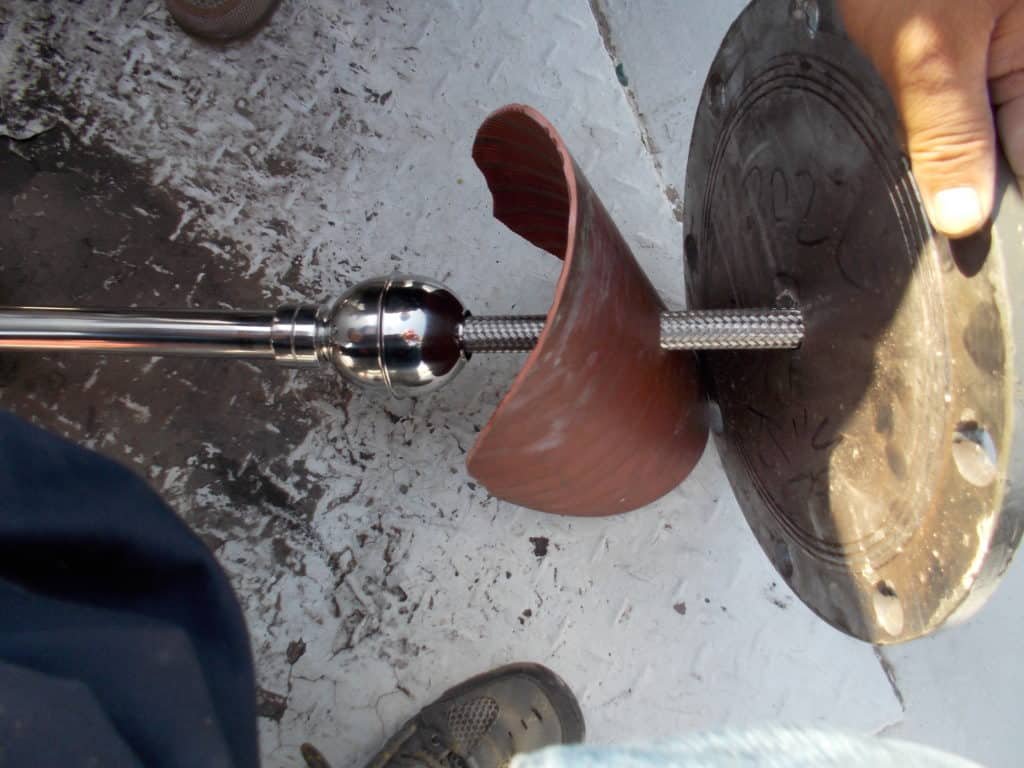
  1. Pass the wire of the float switch from the concave circle of the center of the weight. Push the weight gently to make the plastic ring embedded above the round hole fall off due to the thrust of the wire head. You can also use a screwdriver to remove this plastic ring. Then put the dropped plastic ring on the cable to set the water level by the weight you want.
  2. Gently push the weight to pull out the cable until the center of the weight holds the plastic ring. As long as the heavy hammer is lightly buckled in the plastic ring, it will not slip. If the plastic ring is damaged or lost, it can be replaced with a light bare copper wire into the cable.
  3. Please pull the cable directly to the control box. Avoid using the intermediate connector as much as possible. If there is a connector as a last resort, never immerse the cable connector in the water.
Image source: https://instrumentationtools.com/cable-float-level-switch-working-principle/

Other types of Float Level Switches

SI-U01 Float Level Sensor
SI-U02 Multi-Point Liquid Level Float Switch
SI-U03 Float Switch Water Level Controller
SI-U04 Magnetic Float Level Sensor-Reed Switch

Liquid level float switch is a commonly used liquid level controller. For water Tank & Pump alarm and level control. Can be divided into Continuous Float Level Sensor and Point Level Float Switch. Read more about Guide for Liquid level float switches.

Q&A

The float level switch is based on the principle of buoyancy. The float ball moves a distance with the liquid surface, and this movement plays a limit role. A magnetic floating ball is used to generate a switching action with a reed switch, output a switching signal, and then control the liquid level through wiring.

The float level switch only needs to re-calibrate the water level line before we install it. The switch itself cannot be adjusted. At this time, use a multimeter to measure the switch state, and it will be turned on and off with the water level near the waterline, which means that there is no problem. Just make sure that the water level line of the thermal equipment is consistent during the installation. For example, the liquid level switch of SOR is generally attached to the water level line on the wall of the cylinder. We soak the switch in the water tank and slowly sink, so that the water surface gradually approaches the marking line. When it is closest, we will hear the micro switch action the sound of.
It should be noted that the working temperature of the high-level liquid level switch is high, and the water temperature inside is also high; the density of high-temperature water is less than that of room temperature water. Therefore, the action line of room temperature water is lower than the switch identification line.
Low level alarm is connected to normally closed (NC), high level is connected to normally open (NO). This type of switch is not difficult to install. The liquid level switch itself will have more than two pairs of micro-switches, which respectively output two pairs of normally open and two pairs of normally closed contacts, which are usually “on alarm” when applied.

The liquid level sensor converts the liquid level signal in the container into a switching signal or a voltage and current signal, and then through an external circuit, allows the surveyor to accurately know the liquid level in the container.
There are 7 main types of level transmitters that Sino-Instrument offers. Each type of transmitter works in a different way, and makes it useful for different types of processes.

Liquid level switch, also known as water level switch, liquid level sensor. The liquid level switch is a switch used to control the liquid level. It is mainly divided into contact type and non-contact type. Capacitive liquid level switches are commonly used in non-contact switches. And contact float type liquid level switches are most widely used. Electrode level switches, electronic level switches, and capacitive level switches can also be implemented using contact methods.

There are currently 6 medium level switches:

  1. Float level switch: The magnetic float of the float level switch rises or falls with the liquid level. So that the sensor detects the position of the reed switch chip in the tube, and sends a contact on / off switch signal. Because of its simple structure and economic benefits, it is widely used in the market, mainly for civilian use. But its stability is relatively poor compared to industrial-grade products.
  2. Capacitive liquid level switch: After the probe is wetted, it detects the change in capacitance value and outputs a contact signal, which has certain advantages in the measurement of slightly viscous media.
  3. Electrode type liquid level switch: The electrode type liquid level switch uses the conductivity of the liquid to detect the level of the liquid. Once the measured medium touches the pole, it will conduct electricity and detect the signal. After the signal of the controller is amplified, a contact signal is output to realize the control of the liquid level.
  4. The photoelectric liquid level switch: The photoelectric liquid level switch uses infrared detection, using the principle of refraction and reflection of light. The reflection or refraction of light at the interface between two different media. When the measured liquid is at a high level, the measured liquid forms a kind of interface with the photoelectric switch. When the measured liquid is at a low position, air and the photoelectric switch form another interface. These two interfaces make the intensity of the reflected light received by the light receiving crystal inside the photoelectric switch different. That is, correspond to two different switching states. Generally speaking, compared with other measuring instruments, the applicability of photoelectric switches is poor.
  5. Tuning Fork Liquid Level Switch: It outputs a switch signal by detecting the change in the frequency and amplitude of the fork’s vibration, which is highly versatile. For the viscous working conditions, please consult with the manufacturer to determine the working conditions that are easy to crystallize.
  6. Ultrasonic external liquid level switch: The instrument probe emits ultrasonic waves and detects its residual vibration signal in the container wall. When liquid passes through the probe, the amplitude of this aftershock signal becomes smaller. This change is detected by the meter and outputs a switching signal. It is a non-contact type and is often used in high-risk situations where it is difficult to open holes on the site, but the cost is relatively expensive.

Techinical Support

Sino-Inst is float level sensor manufacturer. On the premise of ensuring product quality, we offer you the best price.


Sino-Instrument
 offers over 10 level transmitters for level measurement.

About 50% of these are liquid level meters,

40% is the tank level sensor.

A wide variety of level meters options are available to you,

such as free samples, paid samples.

Sino-Instrument is a globally recognized supplier and manufacturer of level measurement instrumentation, located in China.

Request a Quote

SI-U04 Magnetic Float Level Sensor-Reed Switch

Magnetic Float Level Switches & Sensors with Magnetic Reed Switches for Continuous Level Measurement.

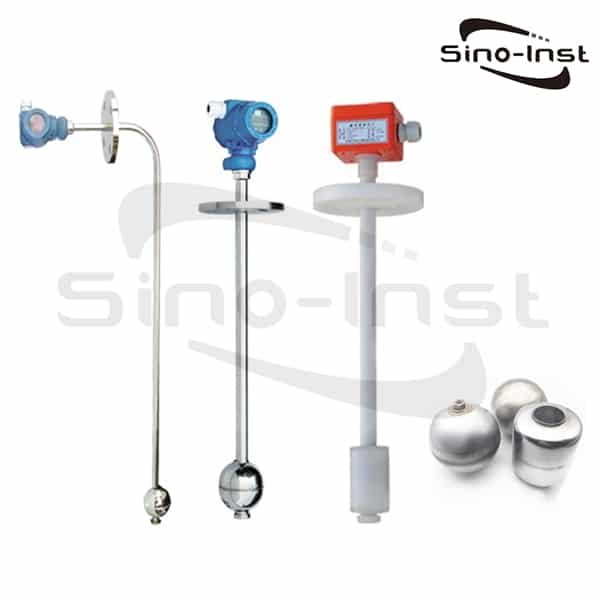
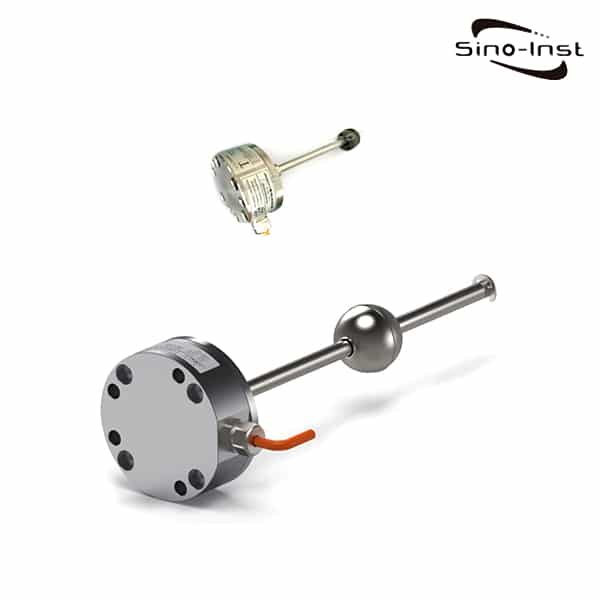
Magnetic Float Level Sensor works with Reed Switch, is a continuous level sensor. SI-U04 Magnetic Float Level Sensor-Reed operatess on a direct, simple principle. As the magnetic float rises and falls as liquid levels change. The magnetic field generated from the inside of the float drives the sealed reed switch installed in the stem. The stem is made of non-magnetic metal or strong engineering plastic. Magnetic Float Level Sensor gets the liquid level signal, transfers it into digital current signal and switching signal. Generally speaking, there are two structures of magnetic floats. Besides, the Magnetic Float Level Sensor supports multiple mounting methods. Such as top-mounted, side-mounted. So SI-U04 Magnetic Float Level Sensor can be applied to a variety of tank level measurements.

Please feel free to contact us for Technical Support, or Request a quote for float level sensors (customization available).

Features of Magnetic Float Level Sensor

  • Simple structure, stable and reliable, good repeatability;
  • Realize the connection measurement of the liquid level
  • Not affected by the physical and chemical state of the measured medium. Such as: the effects of conductivity, dielectric constant, foam, pressure, temperature, evaporation, boiling, and bubbles;
  • Use different materials, which can be used in various strong and weak corrosion, flammable and explosive, toxic, strong radioactive, and foul media environments;
  • Liquid level measurement or interface measurement of two different density media;
  • Explosion-proof structure design, suitable for use in explosive environments.
  • Two-wire 4-20mA current output, with 0.56 “LED digital display, convenient for long-distance observation at night.

Applications of Magnetic Float Level Sensor

Industries:

  • Marine (commercial ships)
  • Petrochemical
  • Food/beverage
  • Water/wastewater
  • Chemical and textile industry
  • Dyeing and finishing
  • Level control in shipping industry

Applications:

Any liquids including water, oil, and chemicals:

  • Diesel or Lube Oils
  • Vegetable Oils
  • Petroleum products
  • Water, Wastewater
  • Acids
  • Caustics
  • Fuels

Specifications of SI-U04 Magnetic Float Level Sensor-Reed Switch

Measuring    range       200~6000mm(>6M customize)
Resolution factor  10mm,5mm,20mm
signal output 4~20mA(two-line)2000/m(1/2″,3/8″)
Loading resistance500Ω
Transmitting   >1000m
Working power supply  16~30VDC
Density      ≥0.5g/cm3
PressurePN2.5~PN160(×0.1MPa)(Max pressure PN320)
Operating temperature  -40 ~ 80 °C, ≤120 °C, ≤150 °C
Float ball diameterΦ30~Φ120(depending on pressure and density)
Flange installationDN40~DN150/RF/PL(HG/T20592~2009) customize2” thread(downward install)1/2” thread (upward install, resistance   signal output) 3/8” thread(upward install, resistance signal output)
Installation angle≤±25°
Electrical connection M20×1.5 female thread three-lines screening cable
IP gradeIP65
Explosion-proof gradeExia II CT6Ga,EXd IICT6Gb

Extended reading: Food grade flow meters for Food & Beverage industry

Operation Principle of Magnetic Float Level Sensor

Magnetic Float Level Sensor is composed of a reed switch, a precision resistor and a single-chip microcomputer circuit. When the magnetic force line of the magnetic float acts on a certain position of the liquid level gauge, the reed switch in that position is closed. The magnetic float follows the level change of the liquid level (interface). Linear 4 ~ 20 mADC signal output and relay contact output. Realize the detection, transmission and alarm control of the liquid (boundary) surface position signal.
The magnetic float level sensor uses imported high-quality sensing elements and signal conversion devices, which has excellent long-term stability and reliability.

Types of Magnetic Float

Magnetic floating ball (column type)
1.фmm (321, 316L stainless steel)
2.ф40mm (4 fluorine on stainless steel)
3.ф50mm (PVC, PP)
Note: The specification is the diameter of the floating ball, and the length depends on the density of the medium.

Magnetic floating ball (through the core)
ф76 × ф21 × 76
ф51 × ф15 × 51
ф28 × ф10 × 28
ф63 × ф25 × L (mm) is made of PVC and PP. L is determined by the density of the medium, and the diameter can be made according to user requirements.

Other types of Continuous magnetic float level switches

Q&A

Float level sensors are continuous level sensors featuring a magnetic float that rises and falls as liquid levels change. The movement of the float creates a magnetic field that actuates a hermetically sealed reed switch located in the stem of the level sensor, triggering the switch to open or close.
Float level sensor is composed of float, plunger and so on. The float level sensor is installed on the top of the container through the connection flange. The float floats on the liquid surface according to the principle of discharging the liquid volume phase and so on. When the liquid level of the container changes, the float also moves up and down. Due to the magnetic effect, the reed of the ball level sensor is magnetically attracted to change the position of the liquid level into an electrical signal. The actual position of the liquid is displayed digitally by a display instrument. The floating ball level gauge achieves long-range detection and control of the liquid level.

Learn more on Wikipedia

A magnetic float switch is a magnet fixed in a floating ball in the middle. Put the magnetic float on a stainless steel rod. Place a magnetic element (usually a reed switch) inside a rusty steel rod. When the levitation ball moves on a stainless steel rod, the magnetic elements will attract and break.

  • The purpose of a float switch is to open or close a circuit as the level of a liquid rises or falls. Most float switches are “normally closed,” meaning the two wires coming from the top of the switch complete a circuit when the float is at its low point, resting on its bottom clip or stop (for example, when a tank is dry).
  • Most float switches utilize a magnetic reed switch to open or close the circuit. The reed is encased in a glass tube, which is cemented into a plastic or stainless steel stem with epoxy. The illustration to the left demonstrates how a magnet can be used to open or close a circuit by moving it closer to or farther away from a reed switch. When the magnet comes close to the two contacts, they draw together and touch, allowing current to pass through. When the magnet is moved away, the contacts demagnetize and separate, breaking the circuit.
  • In a float switch, the magnetic reed switch is hermetically sealed in a stem, most often made from plastic or stainless steel. The float encases a sealed magnet, which moves up and down the length of the stem as a fluid level rises and falls.
  • As the magnet passes by the contacts in the encased reed switch, they draw together and complete a circuit between the two lead wires, as shown in the cutaway to the left.
  • The operation shown can usually be reversed by removing the bottom clip from the switch, inverting the float and replacing the clip. When this change is made, the switch circuit will be open when the float is resting on the bottom clip and closed when the float rises.
  • Properly used, float switches can deliver millions of on/off cycles, for years of dependable operation. Failures are normally due to overloading, frequently caused by spiking voltage.

Liquid level switch, also known as water level switch, liquid level sensor. Liquid level switch is used to control the liquid level switch. It is mainly divided into contact type and non-contact type. Capacitive liquid level switches are commonly used in non-contact switches, and contact float type liquid level switches are most widely used. Electrode level switches, electronic level switches, and capacitive level switches can also be implemented using contact methods.

Technical Support

Magnetic float level sensor manufacturer

The float level sensor is a fully customized product. Different measurement needs will cause price changes. So before determining the price of the float level sensor, we need to confirm:
1. Junction box style

  1. Connection method
  2. Probe diameter
  3. Float distance
  4. Probe length
  5. Material selection

Sino-Instrument is float level sensor manufacturer. On the premise of ensuring product quality, we offer you the best price.


Sino-Instrument
 offers over 10 level transmitters for level measurement.

About 50% of these are liquid level meters, 40% is the tank level sensor.

A wide variety of level meters options are available to you,

such as free samples, paid samples.

Sino-Instrument is a globally recognized supplier and manufacturer of level measurement instrumentation, located in China.

Request a Quote

Please enable JavaScript in your browser to submit the form

SI-U03 Float Switch Water Level Controller

Float Switch Water Level Controller for Continuous Liquid Level (interface) Measurement and Automatic Control. Explosion-proof and water proof.

SI-U03 Float Switch Water Level Controller

Float switches, also known as float level switches. Float Switch Water Level Controller is mechanical water level indicators that depend on moving parts to trigger a switch.

Float switch water level controller can be directly installed on various tank equipment (water tank). Float switch water level controller is especially suitable for hot heavy oil in oil refinery (temperature ≤500 ℃, pressure ≤4.0MPa). Viscous and dirty media, asphalt, grease and other oil products. As well as flammable, explosive, corrosive and other media’s Liquid level (interface) continuous measurement and automatic control.

Please feel free to contact us for Techinical Support, or Request a quote for float level sensors (customization available).

Float Switch Water Level Controller Features

  • It can be installed horizontally on the side wall of the barrel, or vertically on the top of the barrel;
  • The structure is simple and reasonable, the performance is stable and reliable, and the installation is convenient;
  • Both 220VAC and 24VDC circuits can be used;
  • The control part is completely isolated from the measured liquid medium, which can be applied to high temperature and high pressure environment;
  • A variety of materials (SUS304, SUS316, PP), a variety of connection methods can meet environmental needs;
  • Lightweight (compact type) and long working life.
  • Suitable for various tank installations.
  • Suitable for viscous dirty media;
  • Available in explosion proof and non-explosion proof

Specifications of SI-U03 Float Switch Water Level Controller

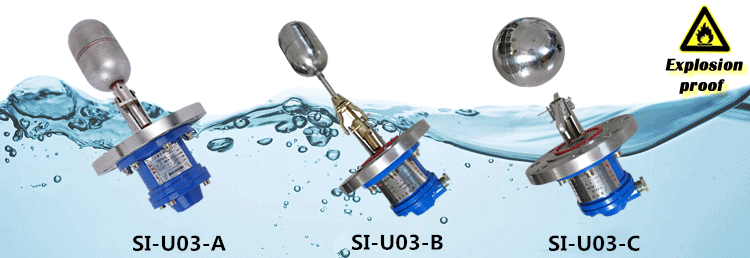
TypeSI-U03-ASI-U03-BSI-U03-C
Protection leveldIIBT4dIIBT4dIIBT4
Pressure1.0 MPa1.0 MPa1.0 MPa
Tenperature(℃)Normal:≤100℃ 
High Temperature:≤350℃
Net weight1.5~2.0Kg
Switching difference(mm)≤825~5508~1000
Setting methodNot adjustable Stepwise adjustableStepless adjustable
Installation formHorizontalHorizontalVertical
Power supply and contact capacity and lifeAC:220V/1.5A、110V/2.5A
DC:24V/2.5A、240V/0.5A 
Life:5×100^2

Know more about: Guide for Liquid level float switches

How to install float switch in water storage tank?

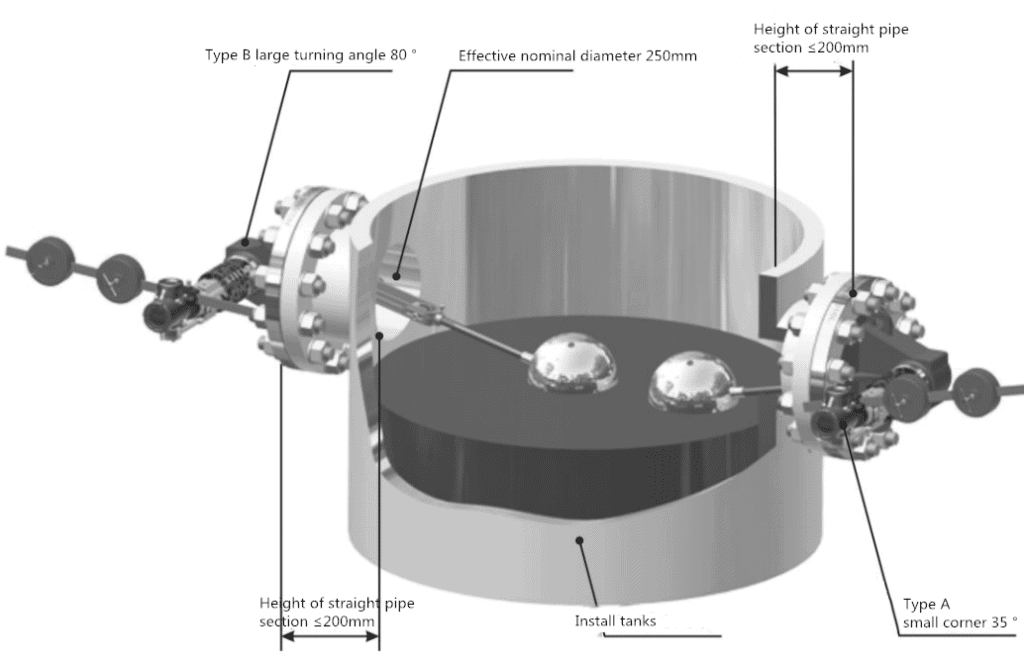
  1. The flange of SI-U03 series electric float liquid level transmitter is installed on the side wall of the medium tank.
  2. Before installation, it should be considered in combination with the structural characteristics of the transmitter. It is convenient to operate, observe and maintain to determine the installation position and direction. If the floating ball transmitter is installed on the left side of the flange, it is installed on the left side, otherwise it is installed on the right side.
  3. Assume that the current state is the right installation. If you want to change to the left installation, use the HART Communicator to move or set the transmitter’s zero position and range.
  4. And (PV range), follow the prompts on the HART communicator display to enter URV (upper range value). LRV (lower range value). And display USL (upper sensor limit)With LSL (Low Sensor Limit). Reset the lower range value corresponding to 4mA and the upper value corresponding to 20mA and send it. If other parameters are not changed, you can change to the left installation.
  5. Floating ball and club installation: First, the floating ball and the club are tightened and welded. For the club installation operation of the new connection structure of SI-U03-A small-angle floating ball liquid level transmitter, the club is installed. Screw into the inner screw hole of the connecting rod at the end of the protective rod sleeve.
  6. Pay attention to tighten the top wires on both sides of the connecting rod into the annular grooves on the club. And then tighten the lock nuts on the top wire. For SI-U03-B large-angle floating ball liquid level transmitter, screw the ball into the inner screw hole at the end of the swing arm. And then tighten the top wire and lock nut on it in the same way.
  7. Note: “If the site conditions are poor, in order to prevent the floating ball, club, swing arm and other connecting parts from loosening. It is recommended to place the top wire and the lock nut on the joint and tighten the float and the club After welding directly to the coupling. “
  8. The transmitter is directly installed on the flange of the side wall of the medium container under test through a flange. The requirements for the straight pipe section of the connection flange are as follows: SI-U03-A L ≤ 160mm;
  9. The transmitter head is connected to the radiator through the connection plate. When installing, insert the spindle head into the coupling hole of the transmitter head, and the coupling should not be distorted. The meter head can be installed on the left or right side.
  10. For correct installation, please refer to the indicator dial on the back of the transmitter case. If the transmitter is installed on the left, turn the end pointer behind the meter head to the “left 0” scale. If the transmitter is installed on the right side, turn the pointer on the back of the meter to the “right 0” scale line. And when the float is moved to the lowest measurement position, tighten the set screw of the coupling and the spindle.
  11. Install the balance rod (mechanism) into the dental insert and square hole. Tighten the top wire to fix the balance rod. Loosen the shaft nut and adjust the dental insert to make the balance rod and the ball in the same plane. And put the axial head nut.
  12. Tighten the position of the balance weight and adjust the balance weight to the optimal state to fix the balance weight. Note: “For liquids of different densities due to the different buoyancy forces experienced by the float, the balance can be adjusted. The position of the hammer on the balance bar to achieve the goal of normal measurement. “
  13. In the process of adjusting the balance weight, when the feel is light, you can adjust the two M10 compression bolts of the waist-shaped compression sleeve inside the radiator to tighten the expansion force of the sealing gasket. Otherwise, you can adjust the waist-shaped compression sleeve when the feel is light Two M10 bolts loosen the expansion of the gasket until it does not leak!

How does a float switch water level controller work?

The float ball level switch structure is mainly designed and produced based on the principles of buoyancy and static magnetic fields. The position of the floating ball with a magnet (floating ball for short) in the measured medium is affected by buoyancy. The change of the liquid level causes the position of the magnetic float to change. The magnet in the float and the sensor (reed switch) function to generate a switching signal.

Similar to the principle of the float level sensor. But the float level sensor outputs a quasi-continuous electrical signal, while the float level switch outputs a discrete switching signal.

Water Tank Level Controller

Water level controller refers to the control of high and low water levels by mechanical or electronic methods. It can control solenoid valves, water pumps, etc., and become water level automatic controllers or water level alarms. To achieve semi-automation or full automation.

Water level control is generally used for high-level tank water supply and sump drainage. The device that converts the water level signal into an electrical signal to control the start and stop of the water pump is called a water (liquid) level controller.

Commonly used water (liquid) level controllers include reed switch water level controllers, float magnetic switch liquid level controllers, electrode type water level controllers, pressure type water level controllers, etc.

Read more about: Types of water level controllers

Water Level Sensors for Water Tanks

Water level transducers are also called Water Level Sensors, or water level transmitters. Water level transducers are used to monitor water usage and quality. The water level signal is output through 4-20mA and other signals, which is convenient for people to monitor the water level.

There are many types of water level transducers. Common ones are input type, ultrasonic, radar and so on.

Sino-Inst offer a wide range of solutions with various pressure ranges, cable lengths and output options.

For remote monitoring and recording of water level data in groundwater pumping and sludge testing, stormwater flood analysis and runoff, and surface water irrigation canals, streams and river measurements.

Read more about: Types Of Water Level Sensors

Water Tank Level Control System

Water level control refers to the control of high and low water levels by mechanical or electronic methods. It can control solenoid valves, water pumps, etc. to become an automatic water level controller or water level alarm, thereby realizing semi-automation or full automation.

Water level control is generally used for high-level tank water supply and sump drainage. The device that converts the water level signal into an electrical signal to control the start and stop of the water pump is called a water (liquid) level controller. Commonly used water (liquid) level controllers include reed switch water level controllers, float magnetic switch liquid level controllers, electrode type water level controllers, pressure type water level controllers, etc.

Read more about: Water tank level sensor system

Generally, we can monitor the liquid level of the water tank remotely. You can choose wired or wireless remote monitoring.

Wired remote transmission, generally the output signal of the liquid level sensor. Such as 4-20mA, RS485 and so on. Through the signal line, the liquid level information can be displayed remotely.

Wireless remote transmission, generally a liquid level sensor through a wireless signal. The use of LORA debugging method and NB-IoT communication method can greatly increase the communication distance. It can be widely used in the field of short-distance Internet of Things wireless communication in various occasions. Real-time monitoring of on-site liquid level data, alarm processing, statistical analysis and other functions.

The appropriate remote water tank level sensor can be configured according to the actual needs of users.

Read more about: Wireless Level Sensor – LoRa

The principles of liquid level sensors may vary, and their applications vary widely. Electronic or mechanical, remote or on-site display, contact or non-contact, it’s dizzying.

In addition to the way of connecting the measured container to visually display the liquid level, the mechanical liquid level gauge is used. Another way to measure is to use the buoyancy of the liquid surface. So that the buoy or float can follow the change of the liquid level, which is converted into the display of the liquid level. These two methods are simple though. But very stable and reliable.

The biggest feature of the mechanical level gauge compared to its electronic level gauge is that the internal structure is very simple and the counting is intuitive. A variety of materials are available, which can achieve anti-corrosion and explosion-proof, and can adapt to various installation environments.

Magnetic flap level gauge, glass tube level gauge, glass plate level gauge, float level gauge, etc. These are the most widely used mechanical liquid level display instruments on the market. They are widely used in petroleum, metallurgy, chemical, paper and other industries.

What about electronic? Generally speaking, the ones that need power supply are basically electronic. Float, capacitive, radar, ultrasonic, remote magnetic flap including liquid level transmitter and so on.

It’s easy to tell them apart, whether it’s powered internally or externally, whether it’s 24V or 220V. In short, the electronic must be powered to work.

Unlike the mechanical type, the working principle of the electronic level gauge is varied. For example, the radar level gauge uses microwaves, the magnetostrictive level gauge uses current pulses, the static pressure type uses the pressure generated at the bottom of the measured medium, and the ultrasonic level gauge uses ultrasonic waves to measure the liquid level.

High precision, easy installation, and adaptability to various installation environments are the characteristics of electronic liquid level display instruments. Compared with the mechanical type, they have a higher level of technology, but at the same time, the price is much higher than the mechanical type.

External Tank Level Indicator refers to an externally mounted level sensor. It is used to install on the outside of the liquid storage tank to measure the liquid level of the tank. When measuring with External Tank Level Indicator, install the ultrasonic probe just below the outer wall (bottom) of the container under test. No need to cut holes, easy to install. Does not affect on-site production. It can realize accurate measurement of various toxic substances and various pure liquids in high temperature and high pressure airtight containers.

Read more about: No Holes – No Damage The Tank – External Tank Level Indicator

Frequently
Asked
Questions

The Float water level sensor uses a float to track the rise and fall of the water level, and directly drives the record in a mechanical way. The use of the float water level sensor requires logging equipment (including the water inlet pipe), which is suitable for the low sandy river section with stable bank slope and little river bed erosion. The float water level sensor is widely used in China.

The price of the water level float switch is mainly determined by some parameters:
structure type;
Wetted material
Pressure Level;
Flange specifications
Explosion-proof type
temperature;
Measuring range;
Insertion length
Medium density
Other contents such as density, operating temperature, operating pressure, electrical interface, etc., must be specified in the specification so that we can use them as reference data when designing the output.

Water level float switch is generally used for high level water tank water supply and sewage tank drainage. The device that converts the water level signal into an electrical signal to control the start and stop of the pump is called a water (liquid) level controller. Common water (liquid) level controllers include:Reed switch water level controllers. Float magnetic switch liquid level controllers. Electrode type water level controllers. Pressure type water level controllers, etc.

Liquid level controller refers to the control of high and low liquid level by mechanical or electronic methods. It can control solenoid valves, water pumps, etc. to achieve semi-automatic or full automation. There are many methods, depending on the choice of different products different.

Extended reading: Capacitive water level sensor

Notes on installation and adjustment of float level switch:

The float level switch only needs to re-calibrate the water level line before we install it. The switch itself cannot be adjusted. At this time, use a multimeter to measure the switch state. It will be turned on and off with the water level near the water line, which means that there is no problem.

Just make sure that the water level line of the thermal equipment is consistent during the installation. For example, the liquid level switch of SOR is usually attached to the water level line on the wall of the cylinder. We soak the switch in the water tank and slowly sink to make the water surface gradually approach the marking line. When you get closest, you will hear the micro switch the sound of.

Note that:
High-temperature liquid level switches, etc. have high operating temperatures and high water temperatures. The density of hot water is lower than the density of room temperature water, so the action line of room temperature water is lower than the switch marking line. Low level alarm is connected to normally closed (NC), high level is connected to normally open (NO). This type of switch is not difficult to install. The liquid level switch itself will have more than two pairs of micro-switches, which respectively output two pairs of normally open and two pairs of normally closed contacts, which are usually “on alarm” when applied.

Control the high and low water levels by mechanical or electronic methods. It can control solenoid valves, water pumps, etc. to become an automatic water level controller or a water level alarm, thereby realizing semi-automation or full automation.

Liquid level switch is a general term. There are many types of level switches. Such as ultrasonic liquid level switch, electrode liquid level switch, capacitive liquid level switch, etc. The float level switch is also one of them.

The float level switch is a controller used to control the detection and control of the water level.

The float level switch is a liquid level control part with a simple structure and convenient use. It has no complicated circuits and will not be disturbed. As long as the material is selected correctly, any liquid, pressure and temperature can be used.

Related Products

Technical Support

Sino-Inst offers over 10 Float Switch Water Level Controllers for level measurement. About 50% of these are liquid Float Switch Water Level Controllers, 40% is the tank level sensor.

A wide variety of Float Switch Water Level Controllers options are available to you, such as free samples, paid samples.

Sino-Inst is a globally recognized supplier and manufacturer of level measurement instrumentation, located in China.

Request a Quote

SI-U02 Multi Level Float Switch

Multi level float switch is also called multi point level switch. Support 1-4 liquid level measurement switch point customization.

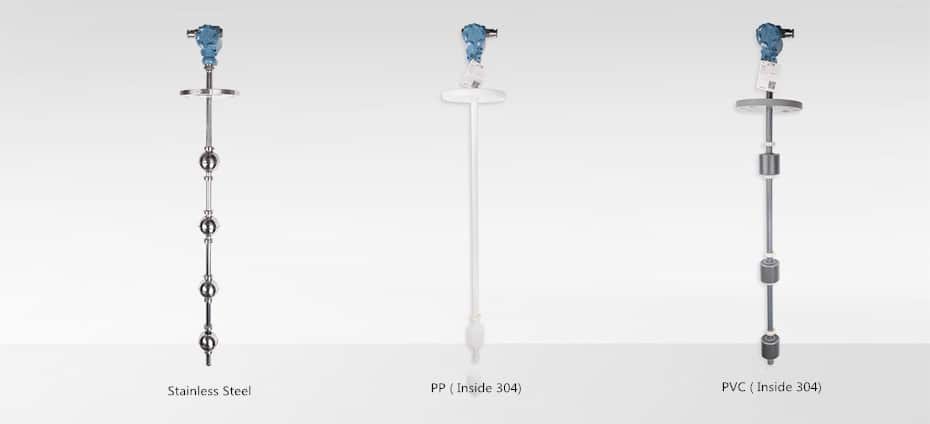
Multi level float switch is a custom multi point float level sensor & switch. These versatile level switches are available in many materials. Like: Stainless Steel, Brass & Buna, PVC, Polypropylene or PTFE and can be ordered with an integrated temperature sensor. Use these multi-level float switches with a tank level alarm or liquid level control relay for a turnkey solution. Explosion-proof available.

Call us now to talk with a sales engineer or fill out our easy to use request for quote form by following the steps below.

Features of SI-U02 Multi Level Float Switch

  • Can be used for multi-point control. The position of the control switch can be customized according to user needs.
  • No power is required to use the reed switch, and the life of the contact can reach 2 million times.
  • All the switch outlets are in the same junction box, and the external construction wiring cost is low.
  • Compared with other types of liquid level switches with multiple switch control points, the RF unit has the lowest unit price.
  • The protection level of the junction box is above IP-65.
  • It is made of PP and SUS316 metal, so regardless of acid and alkali liquid, solvent or various fuels, there are suitable products for use.
  • The magnetic reed switch is completely isolated from the wires and liquid. So it can be used safely on high temperature and high voltage equipment.
  • Connecting rod type float level switch set, suitable for high temperature and high pressure occasions.
  • 60VA dry contact reed switch, can choose normally open or normally closed by floating ball installation position.
  • 316 SS float, conduit and mounting interface, suitable for harsh environment.
  • American standard (NEMA 4X) polypropylene housing with rotatable base for electrical centering adjustment.
  • Customizable catheter length and switch set point size.

Specifications of SI-U02 Multi Level Float Switch

  • PP and PVDF materials are suitable for strong acid and alkali places; SUS304 / 316 metal materials are suitable for high temperature and high pressure tank
  • The most complete specifications of the junction box, including plastic, aluminum alloy, stainless steel explosion-proof type, protection level IP-65 or higher
  • Contact capacity 50W / 250VAC SPST or 40W / 250VAC SPDT
  • Connection flanges have JIS, DIN, ANSI specifications; teeth have NPT, PF, BSP and other specifications
  • Multi-point control, easy installation and cost saving
  • Length: 7.6Cm to 2.4m
  • Accuracy: ± 3mm
  • Repeatability: ± 1mm
  • Specific gravity: minimum 0.55
  • Installation position: vertical installation ± 30 degrees
  • Switch set point: 1-5 (factory setting)
  • Contact type: SPST reed
  • Contact capacity: 240VAC / VDC @ 60VA
  • Electric shock output: normally open
  • Working temperature: -40 degrees to 200 degrees
  • Ambient temperature: -40 degrees to 60 degrees
  • Installation height: 13.2Cm
  • Pressure: 13.8bar
  • Protection level: IP65
  • Housing material: PP.UL94VO
  • Terminal strip: 12 posts, socket
  • Electrical interface: 1/2 ”NPT
  • Installation interface: 2 “NPT
  • Grade: Universal
  • Certification: CE
  • Special specifications can be customized according to customer needs

Extended reading: Ultrasonic Level Switch-External Mounted

SI-U02 Multi Level Float Switch Types

In order to adapt to different measuring liquids, customers can choose different wetted materials.

TypesWetted materialOperating temperatureWorking pressure
Standard typeStainless steel 1Cr18Ni9Ti, 304SS, 316L-30 ~ 120 ℃≤2.5MPa
AnticorrosivePolypropylene PP-30 ~ 80 ℃ ≤0.4MPa
Corrosion-resistantTeflon PTFE/PVC-30 ~ 160 ℃ ≤1.0MPa

How does a float level switch work ?

The Multi-Point Liquid Level Float Switch operates magnetically, without mechanical connections. And it is simple and reliable.

When the floating ball switch measures the floating medium of the test medium, the float moves the main body. And at the same time, the magnet on the other end of the float will control the magnet on the switch operating lever.

Set one or more reed switches in a closed metal or plastic tube. And then pass the tube through one or more, hollow and floating ring with ring magnet inside. And use the fixed ring to control the floating ball and the magnetic spring.

The switch is in the relevant position, which makes the float float up and down within a certain range. The magnet in the float is used to attract the contacts of the reed switch, which generates the opening and closing action.

More about: Float level sensor working principle

Applications of Multi-Point Liquid Level Float Switch

The Multi-Point Liquid Level Float Switch is suitable for:Control the pump operation to maintain the liquid level. Control the automatic loading and unloading of the tank. Control the liquid level or supply signals. Such as oil tanks, automatic cleaning systems, hydraulic tanks, low-pressure boilers, sewage treatment systems.

  • Shipbuilding Industry
  • Generator Facilities
  • Petrochemical Industry
  • Food/Beverage Industry
  • Waste Water/Water Purified Facilities
  • Electronic Industry
  • Dyeing and Finishing Industry
  • Chemical Industry
  • Rubber/ Plastic Industry
  • Hydraulic.

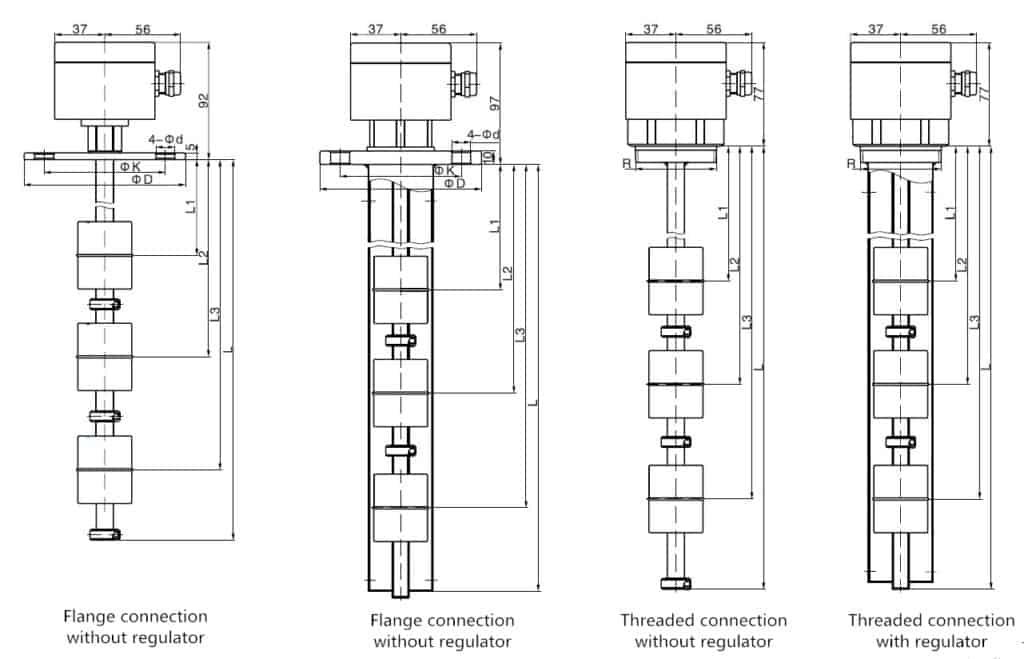
SI-U02 Multi Level Float Switch Dimension

Installation Precautions

  1. Multi-core cables are recommended for wiring. The load of the controlled line must match the contact capacity of the float switch.
  2. The installation position should be far from the water inlet, otherwise the switch will cause malfunction due to the fluctuation of the water inlet.
  3. If the switch device is on the wall of the container, an L-shaped steel bracket can be added.
  4. When the float switch is used in a circuit with an inductive load such as a motor, relay, solenoid coil, etc., it is recommended to protect the circuit in parallel at both ends of the load such as: RC (buffer), rheostat, diode, etc.
  5. After the wiring is completed, please tighten the box cover and fix the connection port to ensure the junction box is waterproof.
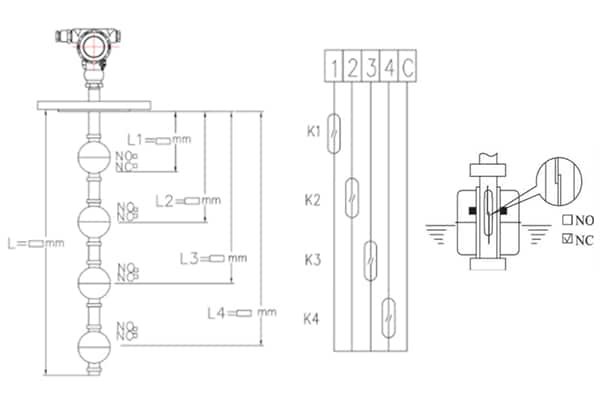
  6. The identification numbers on the terminal block of the terminal board correspond to the contacts of the floating balls from top to bottom.

More Featured liquid Level Sensors and Switches

SI-U01 Float Level Sensor
SI-U03 Float Switch Water Level Controller
SI-U04 Magnetic Float Level Sensor-Reed Switch
SI-U05 Cable Float Level Sensor & Swtich

Sino-Inst offers over 10 level transmitters for level measurement.

About 50% of these are liquid level meters, 40% is the tank level sensor.

A wide variety of level meters options are available to you, such as free samples, paid samples.

Sino-Inst is a globally recognized supplier and manufacturer of level measurement instrumentation, located in China.

Request a Quote

Please enable JavaScript in your browser to submit the form

SI-U01 Float Level Sensor

Float Level Sensors with Magnetic Reed Switches for Continuous Level Measurement.

Float level sensor (float switch) is one type continuous level sensor for industrial level measurement. Float level sensor has a magnetic float that rises and falls as liquid level changes. The percentage of the liquid level, 4 ~ 20mA current and liquid level value, can be displayed on site. Applications like: water tank, fuel tank, level measurement and level control. Vertical, horizontal, and side mounted, all can be satisfied.

Please feel free to contact us for Techinical Support, or Request a quote for float level sensors (customization available).

Description of SI-U01 Float Level Sensor

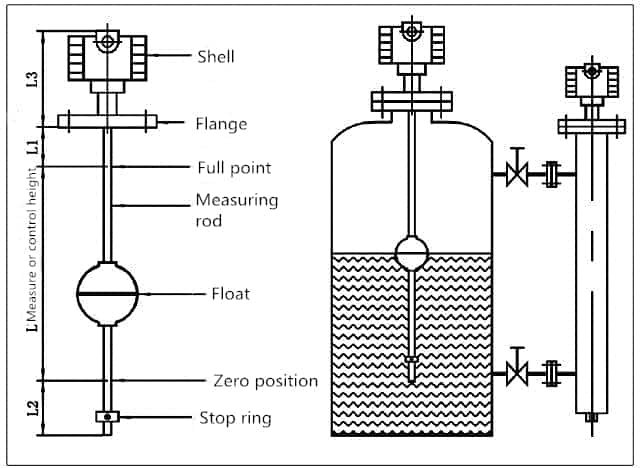
SI-U01 float level meter is composed of three parts: magnetic float, sensor and transmitter. When the magnetic float changes with the liquid level, it floats up and down along the duct. The magnetic steel inside the float attracts the reed switch at the corresponding position in the sensor. So that the total resistance (or voltage) of the sensor changes. The changed resistance (or voltage) signal is converted into a current signal of 4-20mA and output. And the upper and lower limit alarms can be set on the display to achieve the position control of the liquid level.

SI-U01 floating ball liquid level gauge consists of a liquid level sensor and an intelligent HART board (current converter). The floating ball and the liquid level change synchronously, and the reed switch is controlled to open and close. This makes the resistance in the sensor change linearly. The change of resistance is converted by the converter into 4 ~ 20mA standard current signal or superimposed HART digital signal output.

Float level sensor can also be used with paperless recorder.

Features of SI-U01 Continuous Float Level Sensor

  • Intelligent electronic components are composed of a motherboard and an LCD screen;
  • You can adjust the range and zero point by pressing the button on the spot;
  • It can use HART communicator or microcomputer to communicate with this smart meter on both sides without interrupting the output signal.
  • It is suitable for explosion-proof or inconvenient installation and disassembly of the meter. Instrument measurement, process parameters, equipment configuration, calibration, diagnostic information HART protocol access or change;
  • Two-way communication with the host in the distributed control system using the HART protocol;
  • With EEPROM, no data is lost due to power failure.
  • Simple working principle, wide applicability, safe, convenient and maintenance-free
  • Realize the connection measurement of the liquid level without being affected by the physical and chemical properties of the measured medium. Such as: temperature, pressure, conductivity, dielectric constant, etc.
  • The use of different materials can achieve the measurement of highly corrosive media
  • It can be used to measure the interface of two different density liquids.
  • Good repeatability.

Specifications of SI-U01 Float Level Sensor

Max insert depth
L=6m(>6m customize)
Max control scopeL-120mm
Min control scope50mm(<50mm customize)
Medium density>0.5g/cm3
Working pressurePN2.5~ PN160(Max pressure PN320)
Working temperature-40~80 °C, -40~120 °C, -40~150 °C (250°C customize )
Float diameterD28~D120(depending on pressure and density)
Installation typeFlange: DN40~DN150
Flange standard: HG/T20592~2009
(pressure>PN25, Flange>DN125)
G2” thread
Other method (consulting)
Maximum switch frequency<1×10⁵
Inaccuracy±8±2mm
Working power supply220VAC/380VAC
Max voltage of switch<250VAC
Max current of switch5A
Installation angle< ±25°
Wiring boxM20×1.5 female thread
IP gradeIP65
Explosion-proof gradeExd II CT6Gb

Float Level Sensor Operating Principle

Float level meter is an instrument for measuring liquid level. It is widely used in the field of liquid measurement. Many industries will choose to use it for measurement equipment. Such as the petroleum, chemical, and pharmaceutical industries.

Float level sensor is designed and produced based on the principle of buoyancy and static magnetic field. The position of a floating ball with a magnet (floating ball for short) in the measured medium is affected by buoyancy.

The change of the liquid level causes the position of the magnetic float to change. The role of the magnet and sensor (reed switch) in the floating ball changes the number of components (such as fixed resistance) connected in series to the circuit.

Thereby changing the electrical quantity of the instrument circuit system. That is, changes in the position of the magnetic float cause changes in the electrical quantity. The change of the electrical quantity is detected to reflect the liquid level in the container.

The float level sensor is installed on the top of the container through a connection flange. The float ball floats on the liquid surface according to the principle of discharging the liquid volume phase and so on.

When the liquid level of the container changes, the float ball also moves up and down. The reed switch of the ball level gauge is magnetically attracted to change the position of the liquid level into an electrical signal.

The actual position of the liquid is displayed digitally by the display instrument. The floating ball level gauge can achieve long-range detection and control of the liquid level.

Applications of SI-U01 Float Level Sensor

Float level sensors provide reliable readings in a range of operating environments.

Float level sensor can be widely used for continuous measurement of the liquid level (boundary level): High temperature. High pressure. Viscous, dirty media. Asphalt, wax-containing oil products and flammable, explosive, corrosive media.

Float level sensor can be used for industrial level measurement and control of various liquid tanks. Such as: Petroleum, chemical raw material storage. Industrial processes, biochemicals, medicine, food and beverage. Tank farm management and underground storage at gas stations.

The float level sensor is also suitable for dam water level, reservoir water level monitoring and sewage treatment, etc.

Of course, for different applications, you can choose different materials.

Such as:

Plastic materials PP and PVDF, suitable for strong acid and alkali places;

The metal material is SUS304 / 316L, which is suitable for high temperature 200 ℃ and high pressure 64kg/cm2.

Float level sensor Advantages and Disadvantages

Advantages

  • Long life span, stable and reliable operation, easy installation, almost no maintenance
  • None influence of measured medium in physical and chemical state. Eg: medium electrical conductivity, dielectric constants, foam, pressure, temperature, evaporation, boiling, bubbling effect etc, .
  • Choose appropriate material can be used in a variety of bad media environment with densities ≥ 0.5G/CC ;
  • Interface measurement with two media of different density control;
  • Wide range of application. Pressures from vacuum to PN160 (special up to PN320), temperature -40~+150 ° c
  • Design, explosion-proof, suitable for explosive environments;
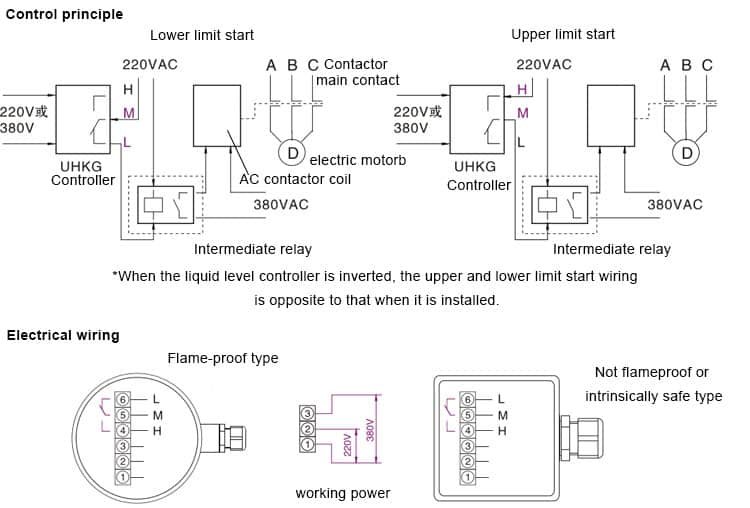
  • Controller can be used to control the upper and lower liquid level.

Disadvantages

  • Low accuracy.
  • The installation position is limited by the shape of the container.
  • Most float level gauges are not suitable for corrosive or hazardous liquid media.

Float level sensor for water tank & fuel tank

In water treatment, the water tank float level switch is directly related to the safety and reliability of the entire process.

In a process, there are different types such as intermediate water tank, backwash water tank, produced water tank and waste liquid tank.

The sizes of these boxes are different. The volume of the produced water and the original water tank may be larger. In these water tanks, the water tank float level switch is used for related control.

Different level switches will have different actions. However, it is not necessary to have several level switches in a large water tank.

In the water tank, there are high and low level switches. The high level switch can detect whether the water tank is full. If it is full, the water production will stop. The low level switch is used to detect the water tank Is the water sufficient? If it is not enough, no more water can be sent out.

Water tank float level switch is a working condition word. If it is a large water tank, other level gauges can also be used to solve it. Like radar level gauges, ultrasonic level gauges, etc.

Of course, our float level sensor can also be used to measure and control the level of the fuel tank.

If it is used in an oil tank, special conditions such as the type of oil and corrosiveness need to be considered.

If you need to measure the level of the fuel tank. Please contact Sino-Inst sales engineers, we will provide you with suitable products and quotations based on your actual measurement situation.

Float Level Sensor for tank liquid volume monitoring

Our Float level sensors can output liquid level signals, such as 4-20mA signal, 0-10V signal, RS485 and so on.

However, the float level transmitter alone cannot calculate the liquid volume of tanks of different sizes. It’s too complicated. A separate recorder is required to calculate it.

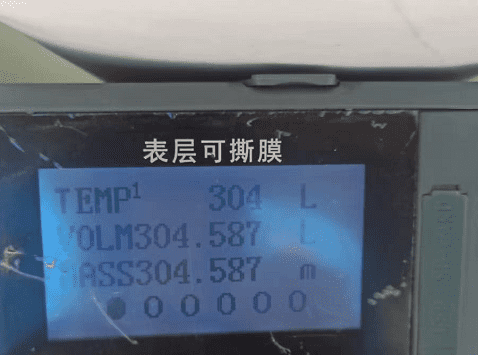
Therefore, the digital display volume meter can collect, display and convert the liquid level of various regular and irregular tanks in the industrial field into the corresponding tank volume. It is suitable for monitoring, controlling and collecting various process parameters.

Read more about: Water Level Monitoring Sensor/System for Sewage-Wastewater

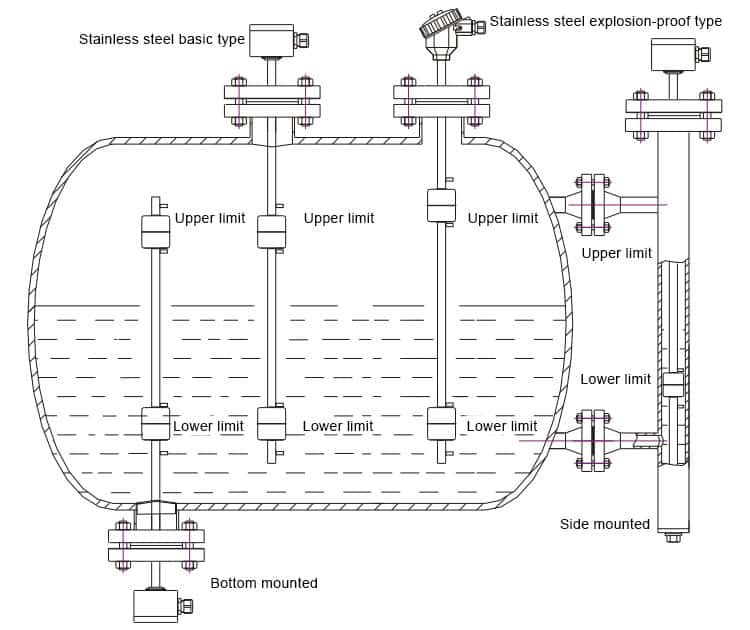
SI-U01 Float Leve Sensor Installation

The main float level sensor installation methods are:

Top mounted; Bottom mounted; Side mounted

SI-U01 Float level sensor installation instructions:

  • The measured medium should not contain ferromagnetic impurities.
  • In order to prevent the floating ball from falling off or hitting the sealing tube at high speed during transportation, which will cause the measuring tape to come out.
  • The meter should be fixed to the bottom of the sealed tube with a clamp and the magnetic steel on top of the sealed tube before the instrument leaves the factory.
  • Before installing and using, the user should remove the clamp. Raise the floating ball to the top of the sealing tube. And then slowly move the floating ball down, and the needle should be rotated accordingly.
  • The indicator of the meter is pointer type, the indicator numbers are arranged in the direction of gel needles during full-scale measurement, and the indicators are arranged in the counter-clockwise direction during emptyness measurement.
  • The instrument is equipped with a mounting flange when it leaves the factory. The user should have a pipeline flange.
  • The installation position of the instrument is generally selected at half of the measuring range.

Float level sensor price

The float level sensor is a fully customized product. Different measurement needs will cause price changes. So before determining the price of the float level sensor, we need to confirm:
1.Junction box style

  1. Connection method
  2. Probe diameter
  3. Float distance
  4. Probe length
  5. Material selection

Sino-Inst is float level sensor manufacturer. On the premise of ensuring product quality, we will offer you the best price.

Frequently Asked Questions

Float level sensor uses magnetic float as the measuring element. Through magnetic coupling, the internal resistance of the sensor changes linearly. The smart converter converts the resistance change into a 4-20mA standard current signal. It can display the percentage of liquid level, the current of 4 ~ 20mA and the value of liquid level. Remote transmission control room can realize automatic detection, control and recording of liquid level. This instrument is suitable for petroleum, chemical, power, light industry and pharmaceutical industries, such as sewage treatment and medium level measurement in various atmospheric and pressure vessels, especially for underground tanks and tanks.

Float level sensor is composed of float, plunger and so on. The float ball level gauge is mounted on the top of the container through a connecting flange. The float floats on the liquid surface according to the principle of discharging the liquid volume phase and so on. When the liquid level of the container changes, the float also moves up and down. Due to the magnetic effect, the reed of the float level gauge is magnetically attracted and changes the liquid level position into an electrical signal. The actual position of the liquid is displayed digitally by the display instrument. The float level gauge thus achieves long-range detection and control of the liquid surface.

Liquid level switch, also known as water level switch, liquid level sensor. As the name suggests, it is a switch used to control the liquid level. It is mainly divided into contact type and non-contact type. Capacitive liquid level switches are commonly used in non-contact switches, and contact float type liquid level switches are most widely used. Electrode level switches, electronic level switches, and capacitive level switches can also be implemented using contact methods.

More about: 

Liquid level float switch technology|continuous-point level

1. Float level switch: The magnetic float of the float level switch rises or falls with the liquid level. So that the sensor detects the position of the reed switch chip in the tube, and sends a contact on / off switch signal. Because of its simple structure and economic benefits, it is widely used in the market, mainly for civilian use. But its stability is relatively poor compared to industrial-grade products.
2. Capacitive liquid level switch: After the probe is wetted, it detects the change in capacitance value and outputs a contact signal. Which has certain advantages in the measurement of slightly viscous media.
3. Electrode type liquid level switch: The electrode type liquid level switch uses the conductivity of the liquid to detect the level of the liquid. Once the measured medium touches the pole, it will conduct electricity and detect the signal. After the signal of the controller is amplified, a contact signal is output to realize the control of the liquid level.
4. The photoelectric liquid level switch: The photoelectric liquid level switch uses infrared detection, using the principle of refraction and reflection of light. The reflection or refraction of light at the interface between two different media. When the measured liquid is at a high level, the measured liquid and the photoelectric switch form an interface. When the measured liquid is at a low level, air and the photoelectric switch form another interface. These two interfaces make the photoelectric switch internal light. The intensity of the reflected light received by the receiving crystal is different, that is, it corresponds to two different switching states. Generally speaking, compared with other measuring instruments, the applicability of photoelectric switches is poor.

5. Tuning Fork Liquid Level Switch: It outputs a switch signal by detecting the change in the frequency and amplitude of the fork’s vibration, which is highly versatile. For the viscous working conditions, please consult with the manufacturer to determine the working conditions that are easy to crystallize.
6. Ultrasonic external liquid level switch: The instrument probe emits ultrasonic waves and detects its residual vibration signal in the container wall. When the liquid passes through the probe, the amplitude of this residual vibration signal will become smaller. This change is detected by the instrument After that, a switching signal is output. It is a non-contact type and is often used in high-risk situations where it is difficult to open holes on the site, but the cost is relatively expensive.
The above is an introduction to the types of common level switches in the market. For more information about level switches (level switch, level switch), level meters (level meter, level meter) and other level measuring instruments, please contact us.

Extended reading: Ultrasonic Level Switch-External Mounted

Float switch is a kind of special switch. Because it does not need power supply to provide power, it is a very simple pressure switch. Its volume is small, the material is stainless steel or plastic, and the working life is very long. It has been widely used in water treatment.
The advantage of the float switch is that it can accurately measure the water level of the liquid. So it is generally used in the liquid detection of normal pressure or pressured storage tanks for signal transmission, such as liquid level alarm. Strong. It can accept multi-point control, and its use position can be left to the customer. It does not need a power supply to ensure its environmental protection. Its life is about 2 million switches. No matter the price of the product itself or the installation cost are very affordable, the price is very high. High degree of protection. It can work under high temperature or high pressure conditions, and has high safety.

If you cannot find an answer to your question in our Float Level Sensor, you can always contact us and we will be with you shortly.

Technical Support

Many people may confuse the float level sensor with the magnetostrictive level sensor. Because they look alike. But the actual working principle is different.

Sino-Ins is a manufacturer of Float Level Sensor. We provide more than 20 types of Float Level Sensors.

Float Level Sensor uses a magnetic floating ball as a measuring element. Through magnetic coupling, the internal resistance of the sensor changes linearly. The resistance change is converted into a 4~20mA standard current signal by an intelligent converter.

Float Level Sensor on-site liquid crystal display can display the percentage of liquid level, 4~20mA current and liquid level value on site. The remote supply control room can realize automatic detection, control and recording of liquid level.

Float Level Sensors can be widely used in the continuous measurement of high temperature, high pressure, viscous, dirty media, oil products such as asphalt, wax, and liquid levels (interfaces) of flammable, explosive, corrosive and other media.

Float Level Sensors can be used for liquid level industrial measurement and control of various liquid tanks such as petroleum, chemical raw material storage, industrial process, biochemical, pharmaceutical, food and beverage, tank farm management and underground storage of gas stations.

Float Level Sensors are also suitable for dam water level, reservoir water level monitoring and sewage treatment, etc.

Sino-Inst’s Float Level Sensors, made in China, have good quality, with better prices. Our Float Level Sensors are widely used in China, India, Pakistan, USA and other countries.

Sino-Inst’s entire team is well trained, so we can ensure that each customer’s needs are met. If you need any help with your product requirements, whether it is a Float Level Sensors, level sensors, or other equipment, please give us a call .

Request a Quote

Please enable JavaScript in your browser to submit the form

LT series Digital Display Magnetostrictive liquid level sensor

Magnetostrictive liquid level sensor can be used as a fuel tank level sensor. With LCD digital display. Perfect choice for Continuous Level measurement of the diesel tank/fuel tank.

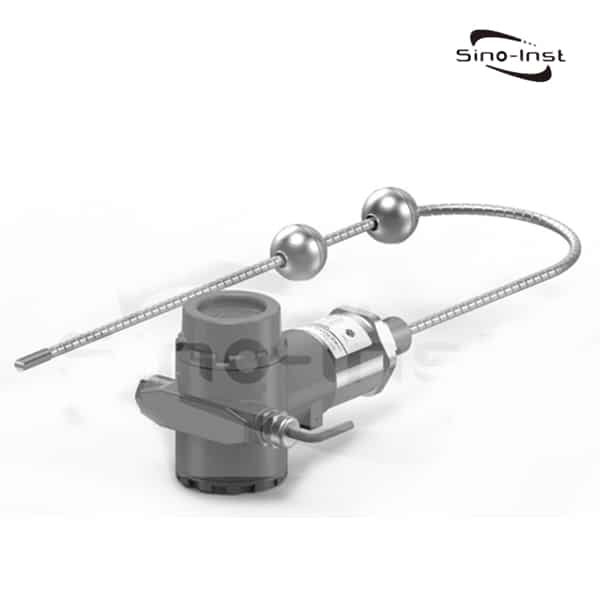
Magnetostrictive liquid level sensor is a Digital display head type liquid level sensor. Specially designed for applications with on-site digital display requirements. Reliable measurement of continuous liquid level and interface are provided in tank level measurement. The LT Level sensors with a magnetostrictive measuring principle support 4-20mA, fieldbus output. Easy installation for storage tank, like Fuel storage tank (explosion proof ).

  • Digital display head, on-site display liquid level.
  • Support: Analog output, Modbus output (optional)
  • Explosion protection: Exd II B T5 (optional)

Sino-Inst offers a variety of magnetostrictive liquid level sensor for industrial level measurement. If you have any questions, please contact our sales engineers.

Need Level Indicator for CO2 tank? Learn more here.

Features of Magnetostrictive liquid level sensor

The LT series digital display head type liquid level sensor is specially designed for the application with on-site digital display requirements. For large-range liquid level measurement (5-22 meters), a flexible measuring rod can be selected. This avoids the difficulties of installation and transportation caused by a large range.

The sensor can be installed on the top of the tank directly (threaded) or through the flange. The flange is equipped with a mounting position adjustment device. The sensor can be adjusted within a certain range.

The flexible measuring rod is equipped with a translucent anti-corrosion sheath on the outside to enhance the product’s resistance in corrosive environments. The product adopts flameproof enclosure (explosion-proof mark: Ex d II B T5). It has more advantages in the detection of liquid level in hazardous environment.

  • Built-in digital display head for easy observation of liquid level data;
  • Absolute output without regular calibration and maintenance;
  • Zero / full-scale point can be adjusted arbitrarily;
  • Low power consumption design, effectively reducing system temperature drift;
  • High precision, maximum 0.1mm level measurement accuracy;
  • Side outlet for easy installation;
  • Optional ultra-long range, up to 22m

Applications of Magnetostrictive liquid level sensor

  • Sensor for continuous level measurement of liquids in bypass level indicators
  • Chemical and petrochemical industries, offshore
  • Shipbuilding, machine building
  • Power generating equipment, power plants
  • Pharmaceutical, food, water treatment, environmental engineering industries
  • Simultaneous Measurement of Multiple Process Conditions:
    • -Product Level
    • -Interface Level
    • -Temperature
    • -Volume

Industries served:

  • Oil and Gas
  • Petrochemical
  • Chemical
  • Power Generation
  • Water and wastewater treatment
  • Pulp and Paper
  • Biotech
  • Marine  
  • Aerospace

Learn more about Diesel fuel tank level gauges & Indicators

TechSpecifications of LT series Magnetostrictive liquid level sensor

Item Parameters
Analog output Current: 4-20mA (minimum / maximum load: 0-500Ω)
Voltage: 0-10V (minimum load> 5KΩ)
Resolution: 16-bit D / A
Modbus Output signal: Modbus RTU
Output Transmission rate: 9600bps by default,
19200 / 4800bps optional
Resolution: 0.01mm
Measurement parameters
Hard measuring rod 100-5000mm
Flexible measuring rod 5000-22000mm
Non-linearity <± 0.05% of full scale F.S.
Repeatability <± 0.02% F.S. of full scale
Update frequency 10 Hz by default, frequency can be customized
Electrical characteristics
Outlet method Straight out of the cable
Input voltage 24VDC (-15 / + 20%)
Working current <60mA (varies with range)
Polarity protection-30VDC
Overpressure protection36VDC
Insulation capacity 500V (between signal ground and case)
Working conditions
Ambient temperature -40 ~ 85 ℃
Humidity / zero 90% humidity, no condensation
Humidity coefficient <50ppm / ℃
Protection class IP68
Explosion-proof ExdIIBT5
Installation & accessories
Installation method M18 * 1.5 thread, matching flange (optional)
Stylus structure Rigid / flexible rod, 304L stainless steel, optional Teflon coating
Electronic warehouse Anodized aluminum alloy
Float 304L stainless steel, optional Teflon coating

Extended reading: Types of Fuel-Diesel Level Sensors

Dimensions

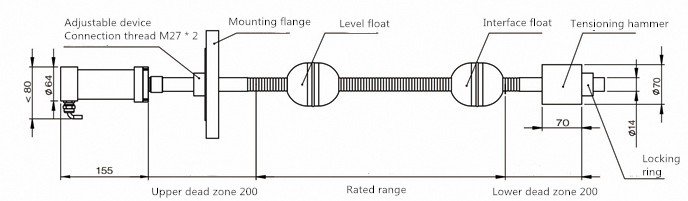
Note 1: Different floats have different measurement blind spots at the first and last measurement ends. Please consult technical support before ordering.

Note 2: The outside diameter of the rod without temperature measurement is 10mm, and the outside diameter of the rod with temperature measurement is 12mm.

Magnetostrictive liquid level sensor Installation on Tank

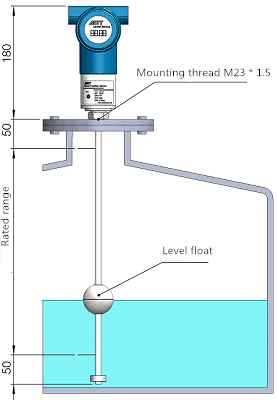
LT series digital display head type liquid level sensor can provide two types of installation: rigid measuring rod and flexible measuring rod. The maximum range can reach 22 meters. There is a Teflon protective sleeve on the outside of the measuring rod. The sensor is mounted on the ceiling through the flange. The flange is equipped with an installation position adjustment device, which can adjust the range of the sensor within a certain range. There are measurement blind areas at the beginning and end of the sensor, which need to be considered during installation.
The sensor uses low-voltage DC power supply, which is more secure in the detection of dangerous goods storage.

Application of Magnetostrictive Liquid Level Senor in Storage Tank

Liquefied petroleum gas is one of the most widely used fuels in civil and industrial production. During the storage and transportation of liquefied petroleum gas, liquid level measurement is an important task of the project. It is required not only to have high accuracy for liquid level measurement. It must also be able to adapt well to the working conditions of closed pressure vessels. At the same time, in order to meet the needs of remote monitoring and management. It must also require the measurement data to have the function of long-distance transmission.

At present, the comparison of the common detection methods for the storage tank liquid level in the tank area is as follows:

Instrument nameAccuracyMeasuring principleLiquid level, interface, temperature measurementRegular maintenanceOn-site installationoverall costsService life
Magnetostrictive liquid level sensor0.5mmMagnetostrictionYes (integrated)Maintenance-freeSimpleLow20 years
Servo level sensor1mm
mechanical
Yes (split)
Regular maintenance
Complicated
High
short
Guided wave radar level senosr 1mm
RadarnoMaintenanceComplicatedHighLonger

Extended reading: Non contact level measurement

Advantages of stainless steel magnetostrictive liquid level sensor for oil level measurement:

  1. High precision: the magnetostrictive liquid level gauge uses waveguide pulse to work. During the work, the measured displacement is determined by measuring the time of the start pulse and the end pulse. Therefore, its measurement accuracy is high. The resolution is better than 0.01% FS. This is an accuracy that is difficult to achieve with other sensors.
  2. Good safety: the magnetostrictive liquid level gauge has high explosion-proof performance. Safer to use. Especially suitable for the measurement of chemical raw materials and flammable liquids. There is no need to open the tank lid during measurement, and there is no insecurity for manual measurement.
  3. Strong reliability: Because the magnetostrictive liquid level gauge uses the waveguide principle. There are no mechanical moving parts, so there is no friction and no wear. The entire converter is enclosed in a stainless steel tube and does not contact the measuring medium. The sensor works more reliably and has a longer life.
  4. Facilitate system automation: The secondary instrument of the magnetostrictive liquid level gauge adopts standard output signal. Help the computer to process the signal. It is easy to work on the Internet. Improve the automation of the entire measurement system.
  5. Simple installation and maintenance: the magnetostrictive liquid level gauge is usually installed through the existing nozzle on the tank top. It is especially suitable for the installation of underground storage tanks and already put into operation. And will not affect normal production during the installation process.

If you need to measure river water level, open channel level, etc. The Ultrasonic Liquid Level Sensor can be used for non-contact continuous level monitoring. Extended reading: Ultrasonic level transmitter for Hazardous Liquids

What is magnetostrictive level transmitter?

Magnetostrictive liquid level transmitter is a kind of liquid level sensor. But it uses the principle of magnetostrictive operation internally. And combines modern electronic technology to measure the time value between pulse waves to achieve the purpose of accurately measuring the liquid level . The magnetostrictive liquid level meter works with waveguide pulses. During the work, the measured displacement is determined by measuring the time of the start pulse and the end pulse, so the measurement accuracy is high.

How does a magnetostrictive sensor work?

  1. The device electronics generates a low energy current pulse at fixed intervals.
  2. The electrical pulses create a magnetic field which travels down a specialized wire inside the sensor tube.
  3. The interaction of the magnetic field around the wire and the magnetic float causes a torsional stress wave to be induced in the wire. This torsion propagates along the wire at a known velocity, from the position of the magnetic float and toward both ends of the wire.
  4. A patented sensing element placed in the transmitter assembly converts the received mechanical torsion into an electrical return pulse.
  5. The microprocessor-based electronics measures the elapsed time between the start and return pulses (Time of Flight). And converts it into a position measure-ment which is proportional to the level of the float.

Extended reading: Radar Level Sensor Working Principle

Magnetostrictive level transmitter price

The price of a magnetostrictive level transmitter is determined based on the measurement conditions. Sino-Instrument is a manufacturer of magnetostrictive level gauges. We offer magnetostrictive level gauges at the right price.

Selection considerations:   

1. The selection of the level gauge should be consistent with the environment of the media on the site. Including ambient temperature, pressure, vibration, shock, compatibility of structural materials and media, etc.   

2. When the temperature of the measured medium is high (100 ~ 200), it is recommended to choose a probe with an outer float type and use a side flange installation. When the temperature is higher (200 ~ 300), it is recommended to choose a probe with a side-bundled type with an outer float, and install it with a side flange.   

3. There are measurement dead zones at the upper and lower ends of the measuring rod of the magnetostrictive level gauge, which should be considered when selecting the range.   

4. The size of the stainless steel magnetic float commonly used for level gauges is Ф45 × 56 × Ф15, and flange connection of DN50 or above is required. For the liquid level gauge with thread connection, users need to install flange or bracket.

Magnetostrictive liquid level sensor can measure liquid level or interface. However, it is not possible to perform on-off control of the liquid level. If you need to control the tank level, you can read Guide for Liquid level float switches.

FAQ

How does a level transmitter work?

The level of the liquid medium in the container is called the liquid level. And the instrument that measures the liquid level is called the liquid level transmitter. Level transmitter is a kind of level instrument. There are two types of level transmitterss, one is continuous and the other is point-off. The continuous level transmitter is a real-time monitor of the height of the liquid in the container. The point type, which generally takes two points, high and low, and outputs an alarm signal when the medium in the container reaches these two points.The types of liquid level transmitters is very wide. Specific include: magnetic flap liquid level gauge, tuning fork vibration type, differential pressure type, pressure type. Ultrasonic, magnetostrictive liquid level gauge, magnetic flap, radar and so on.
Levels of media such as: water, viscous fluids, and fuels, or dry media such as bulk solids and powders can be measured using the transmitter.
Level measurement transmitter are used in a myriad of applications that require level measurement within containers or tanks. These transmitters often find their application in material handling, food and beverage, power, chemical, and water treatment industries.
Learn More

How does a hydrostatic level sensor work?

When considering a new level sensor for level measurement applications,
it is often hard to find information on how the different types of level sensors,
like the hydrostatic level sensors respectively hydrostatic pressure sensors, are working.
Recently, I explained level measurement by using the hydrostatic pressure measurement.
In closed geometries, such as enclosed tanks and vessels,
generally, flush pressure sensors or pressure transmitters are used,
which can be screwed into the vessel from the outside.
Pressure sensors are therefore particularly suitable,
in applications of free-standing tanks and vessels.
submersible pressure transducer
or a flush pressure sensor
measures the height-dependent weight-force of the liquid column,
also known as hydrostatic pressure.
This pressure measurement is directly proportional to the liquid level respectively liquid column,
at the measuring point of the pressure sensor.
It is, therefore, necessary, for the measurement of level,
that the pressure sensor is placed as close as possible to the level of the vessel’s bottom.
The measured hydrostatic pressure then directly corresponds to the height of the liquid column,
from the ground-level measurement point to the surface-level of the medium.
So, the filling height is calculated from the distance of the medium surface,
to the measuring point by the pressure measurement.
The weight force of the liquid column,
thus the hydrostatic pressure, however,
is not only directly proportional to the filling height
but also varies with the specific gravity of the medium and the force of gravity.
More
Extended reading: Hydrostatic Level Measurement

What is DP type level transmitter?

The liquid level (pressure/differential pressure) transmitter is a pressure signal,
measured at the reference side of atmospheric pressure (low pressure side), 
with one or two ports for flange (or other connection) and process pipe connection.
On the basis of common pressure/differential pressure transmitter,
one or two isolation membrane boxes, are added to measure the liquid receiving part.
Mainly used for measuring high temperature, easy to solidify or crystallize, 
containing solid suspended matter, too viscous, 
corrosive or other needs to maintain sanitary conditions, non-polluting media.
More

More Featured Level Senors

Featured Continuous level sensors

SI-U01 Float Level Sensor
SI-U02 Multi-Point Liquid Level Float Switch
SI-U03 Float Switch Water Level Controller
SI-U04 Magnetic Float Level Sensor-Reed Switch

Sino-Instrument offers over 10 level transmitters for level measurement. About 50% of these are liquid level meters, 40% is the tank level sensor.

A wide variety of level meters options are available to you, such as free samples, paid samples.

Sino-Inst is a globally recognized supplier and manufacturer of level measurement instrumentation, located in China.

Request a Quote

Please enable JavaScript in your browser to submit the form

Hydraulic Oil Flow Meters

The hydraulic flow meter is mainly for inline hydraulic system instantaneous flow test and high-pressure test. Industrial Hydraulic oil flow meter, also called hydraulic flow gauge.

Sino-Inst offers Turbine, Mass flow, Oval gear, V-cone, Target, and Orifice flow meters for inline hydraulic oil flow. Features like: bidirectional, high pressure, analog, can be customized as customer need.

Sino-Inst offers a variety of hydraulic oil flow Meters for flow measurement. If you have any questions, please contact our sales engineers.

Hydraulic oil flow meters measure the flow of oil in machines. They are important in many industries. These meters help machines work well, last longer, and avoid breaking down. Industries like car-making, mining, and oil & gas use them. Hydraulic oil flow meters are needed for accurate measurements and to keep machines running smoothly.

Featured Hydraulic Flow Meters for Sale

Sino-Inst offers great prices for hydraulic oil flow meters. For example, a turbine flow meter for hydraulic oil:

  • Size: DN50
  • Max pressure: 16 bar
  • Signal output: 4-20mA
  • FOB Price: USD 585.00/set

Please note, this price is just an example. The actual price depends on the user’s specific measurement needs.

Hydraulic oil is the hydraulic medium.

Hydraulic oil is used in hydraulic systems that utilize fluid pressure energy.

Its role is Energy transfer, anti-wear, system lubrication, Anti-corrosion, anti-rust, cooling, etc.

1. Hydraulic systems for automobiles and construction machinery use hydraulic oil as the working medium. In this type of hydraulic system, the fluid velocity is not large and the pressure is high, so it is called static pressure transmission.

2. Hydraulic oil is widely used, and it is the most used product in industrial oil. Hydraulic components are developing in the direction of small size and high power. The system pressure is getting higher and higher, and some have exceeded 50 MPa.

More:

  1. Hydraulic pressure is a term for the machinery industry and electromechanical industry. Hydraulic power can be powered by hydraulic power. Hydraulic pressure can also be used as a control method, which is called hydraulic pressure control.
  2. Hydraulic principle In certain mechanical and electronic systems, the static pressure of the liquid medium is used to complete the backlog, transfer and amplification of energy. Achieve lightweight, scientific, and maximized mechanical functions.
  3. In the hydraulic system, due to some reason, the liquid pressure suddenly rises suddenly at a certain moment, and a high-pressure peak is formed. This phenomenon is called hydraulic shock.
  4. Select the type of hydraulic oil according to the working environment and working conditions. When selecting the hydraulic oil used in hydraulic equipment. It should be comprehensively considered and judged from several aspects such as working pressure, temperature, working environment, hydraulic system and component structure and material, and economy.

Extended reading: High Temperature Flow Meter

The hydraulic flow meter is a flowmeter that can measure hydraulic oil. The hydraulic flow meter is a name called according to the measurement medium in the industry.

There is no hydraulic oil flow meter in the strict sense. It is not accurate to say which flowmeter is a hydraulic flow meter. Which one to use depends on the specific flow measurement conditions.

For example, the hydraulic oil is also labeled, 40 #, 46 #, or other viscosity properties. Then choose a suitable flow meter according to the relevant information such as flow, pressure, viscosity, and so on.

Read more about: What is a Flow Meter? Types and how does it work?

Here are some common types of hydraulic oil flow meters and what they do:

  • Gear Flow Meters: These meters have gears that rotate to measure oil flow. They work well with thick fluids.
  • Turbine Flow Meters: These meters use a spinning part to measure flow. They work with different flow rates and clean fluids.
  • Variable Area Flow Meters: Also called rotameters, these meters use a tube and a moving float to measure flow. They’re simple and work with many fluid types.
  • Positive Displacement Flow Meters: These meters measure fluid flow by trapping and counting fluid. They’re accurate and good for thick fluids like hydraulic oil.
  • Mass Flow Meters: These meters measure the mass of fluid flowing through a system instead of volume. They are useful in situations where fluid density changes can impact the accuracy of volumetric flow meters.
  • Ultrasonic Flow Meters: These meters use sound waves to measure flow without touching the fluid. They’re good when you want to avoid fluid contamination or pressure loss.

Knowing the different types of hydraulic oil flow meters helps you pick the best one for your needs.

High-Pressure Turbine Flow Meter series of turbine flow meters is ideal when measuring the flow of fluids under high pressure, such as in hydraulic testing. 

It is also perfect for chemical injection systems, as it withstands pressures up to 20,000 psi and is available in a variety of flow ranges (0.08 to 32 gallons/minute).

High Pressure Hydraulic Flow Meter
DiameterDN200~DN3000mm
Accuracy0.5% to 2.0% of reading
Temp. range-20~+150℃
Pressure40 MPa
Flow rate0.5~6m/s
Straight pipe requiredUp stream≥5DN, down stream≥3DN

The wireless flow meter is integrated with the instrument and control part on the basis of accurate measurement. Realize automatic cut-off and connection operation of the pipeline.

The wireless flowmeter avoids the liquid flowing too fast and causing damage to the instrument itself. Prevent dangerous accidents.

Wireless flow meter realizes the operation of automatic two-way flow measurement. Instantaneous flow on site. Total forward and reverse total display. Self-diagnostic fault alarm. Full use of GSM / GPRS data wireless remote transmission and other functions to realize wireless remote transmission of flow data, Storage and other functions.

GSM / GPRS remote monitoring and management software system is matched with wireless remote transmission flowmeter with remote transmission function.

This system can query, statistics, analyze and display the water consumption situation and pipeline pressure of each measurement point in the form of charts or curves.

Users can easily manage water consumption at each measurement point. When abnormal water conditions occur at the measurement point or the battery capacity of the on-site flow meter is insufficient. The system can issue an alarm message.

  • Can display the meter’s flow rate, flow rate, cumulative quantity, pressure, working status, and other data.
  • Can print all the data of the query directly.
  • Can directly export the data of all meters to the computer.
  • Can directly see the flow curve of the query meter. Directly print out the flow curve graph.
  • You can check the working status of the field instrument and whether the instrument has an alarm condition.
  • Can display the annual, monthly, and daily water consumption of all the instruments in the form of a report. You can directly print the report.
  • You can directly export the report to the computer. All meter data can be backed up directly to the computer.

Extended Reading: Insertion Flowmeter Types

You may like: High-Temperature Oval Gear Heating oil Flow Meter

How to use a hydraulic flow meter?

  • A flow meter can be placed in any location of the hydraulic line to detect the flow rate. Flow meters with variable port sizes are available that are suitable for different hydraulic systems.
  • When the hydraulic system operates, the fluid is passed towards the flow meter.
  • A flow meter mainly contains 3 parts; the primary device, a transducer and a transmitter. The transducer senses the hydraulic fluid passing through the primary device.
  • And a usable flow signal is generated by the transmitter when the sensed signal is sent by the transducer.
  • The volume is calculated based on the principle that the volume of fluid passing is directly proportional to the cross-sectional area and the fluid velocity.
  • Also, the mass flow is directly proportional to fluid density and volume.
  • Then, this calculated hydraulic measurement is displayed on the hydraulic flow meter gauge.
  • All standard hydraulic oil flow meters supports unidirectional flow.
  • But, reverse flow by-pass options are also available with some selected flow meters.
  • Selecting a hydraulic flow meter is a difficult procedure. A wrong selection will cause errors in the diagnosed result.
  • The factors that need to be considered while selecting a hydraulic flow meter are:
    • the hydraulic fluid properties.
    • operating condition of the hydraulic system.
    • the need for measuring flow.
    • the level of accuracy required.
    • the effect of fluid on flow meter and vice-versa.
    • and finally the budget.

More about inline oil flow meter

Digital inline oil flow meter

What is an inline flow meter?

The online flow meter is actually a flow meter displayed on the spot. At present, all integrated flow meters are online flow meters. All have local display function.

For example, the split-type flowmeter has no local display function. Its meter head and sensor are connected through conduction, and the online flowmeter is the mainstream measuring instrument in current flow measurement.

What are the advantages of online flow meters in the flow measurement process? In some measurements with a control system, the advantage of the online flowmeter is not great. Because the size of the flow can be monitored through the PLC system. And there is no PLC system in the working condition. The online flowmeter can show its advantages, and it can display the accumulated flow and instantaneous flow online.

Read more about: Find your suitable industrial oil flow meter with best price

Inline hydraulic oil flow meter

Inline hydraulic oil flow meter measures the hydraulic oil flow directly on the pipeline, and then displays the flow on the meter.

Hydraulic oil flowmeter is a flowmeter that can measure hydraulic oil. It is the name given by the industry based on the measurement medium. There is no hydraulic oil flow meter in the strict sense.

It is foolish to say which flowmeter is the hydraulic oil flowmeter.

Which one to use depends on the specific working conditions. For example, hydraulic oil also has a label, is it 40#, 46# or other viscosity properties. It is necessary to see clearly, and then select an appropriate flow meter based on the flow, pressure and other related information.

Extended Reading: Summary Of Crude Oil Flow Measurement Options

Oil Flow Meter Types

At present, the following types of flow meters can be used to measure oil:

Turbine flow meters. Gear flow meter. Vortex flowmeter. Ultrasonic flow meter. Mass flowmeter. Differential pressure flow meters.

Read more: Top 8 petroleum flow meters for Measuring Oil and Gas

Flow Meter Selection Guide 101: Find the Perfect Fit for Your Application

How to Select Hydraulic flow Meter?

When searching for a flow meter for use in a particular hydraulic application, these five questions can help:

  1. What are the fluid properties?
  2. What is the hydraulic system operating condition
  3. Why is flow being measured; how accurately does the flow measurement need to be?
  4. What effect might the flow meter have on the fluid and vice-versa?
  5. How important is it to measure flow;
  6. What is your budget?

Extended Reading: Mechanical oil flow meter

Technical Support

The D represents the diameter of the pipe. For the orifice plate in the orifice plate flowmeter, the minimum requirements for the front and rear straight pipe sections are 10D Upstream and 5D Downstream. If there is a pump or regulating valve in front of the orifice plate, then the requirements for the straight pipe section are greater.

There are many types of flow meters.

According to the different structural principles of the flowmeter, it is divided into:

  1. Differential pressure flowmeter: orifice plate, bar type such as Annubar, V cone, wedge type, elbow, nozzle, target type, etc.
  2. Variable area flowmeter: rotor, open channel, etc.
  3. Velocity flowmeter: electromagnetic, ultrasonic, turbine, vortex street, precession vortex, rotor, etc.
  4. Positive displacement flowmeter: waist wheel, oval gear, piston, scraper, etc.
  5. Mass flowmeter: Coriolis, thermal, etc.

Extended reading: Metal Tube Flow Meter-Variable Area Flow Meters Principle

Flow is the amount of fluid that passes through a pipe or device at a cross-section in a unit of time. This quantity is expressed by mass and is called mass flow. Expressed by volume, called volume flow. Expressed by weight, called weight flow.

Because the density of a fluid changes with changes in the state parameters of the fluid, the volume state must be given while specifying the state of the fluid.

Especially for gas, its density varies significantly with pressure and temperature. In order to facilitate the comparison of the volume flow rate, the volume flow rate in the working state is often converted to the volume flow rate in the standard state (temperature is 20 ° C and absolute pressure is 101325Pa).

Commonly used flow measurement methods include speed-type flow measurement methods, volumetric flow measurement methods, and direct or indirect methods to measure the mass of fluid flowing through the cross section of the pipe per unit time.

In the above method, more speed-type flow measurement method instruments are applied.

Except for the standard throttling device which does not need to be tested for the current flowmeter, almost all other flowmeters need to be calibrated when leaving the factory. During the use of the flowmeter, it should also be calibrated frequently.

The volume method is most commonly used. This is a method of measuring the volume of fluid flowing into a constant volume container within a measurement time to obtain the flow rate.

The mass method is a method of weighing the mass of a fluid flowing into a container within a measurement time to obtain a flow rate.

During calibration, a pump is used to draw the test fluid from the liquid storage container through the calibrated flowmeter and enter the liquid container.

The temperature of the fluid is measured while the weight is weighed to determine the density of the measured fluid at that temperature.

Divide the weight of the measured fluid by the density of the fluid at the measured temperature to obtain the volume of the fluid.

Comparing it with the meter’s volume indication (accumulated pulse number), the meter constant and accuracy of the calibrated flowmeter can be determined. The accuracy of this system can reach 0.1%.

The working principle of the standard volume tube method is based on the volumetric method (standard volumetric method), but it is a dynamic measurement.

The standard flowmeter comparison method is to connect the calibrated flowmeter and the standard flowmeter in series to the pipeline flowing through the test fluid, and compare the two measured values ​​to find the error. The accuracy of the standard flowmeter is 2 to 3 times higher than that of the calibrated flowmeter.

Where are flow meters used? Or, What does a flow meter measure?

At industrial sites, meters that measure fluid flow are referred to as flow meters or flow sensors.

It is one of the most important instruments in industrial measurement.

With the development of industry, the accuracy and range of flow measurement requirements are getting higher and higher.

In order to adapt to various purposes, various types of flowmeters have been successively launched,

widely used in oil and gas, petrochemical, water treatment, food and beverage.

Industries such as pharmaceuticals, energy, metallurgy, pulp and paper, and building materials.

  1. Measurement of gas mass flow in industrial pipelines
  2. Smoke flow rate measurement from the chimney
  3. Calciner flue gas flow measurement
  4. Air flow measurement during gas process
  5. Compressed air flow measurement
  6. Gas flow measurement during semiconductor chip manufacturing process
  7. Gas flow measurement in sewage treatment
  8. Gas flow measurement in heating ventilation and air conditioning systems
  9. Flux recovery system gas flow measurement
  10. Measurement of combustion gas flow in a combustion boiler
  11. Gas flow measurement of natural gas, flare gas, hydrogen, etc.
  12. Measurement of carbon dioxide gas flow during beer production
  13. Measurement of gas mass flow in the production process of cement, cigarette and glass factory
  14. Open channel

Flowmeters are devices that measure the rate of liquid, gas or vapor that passes through them.

Some flowmeters measure flow as the amount of fluid passing through the flowmeter during a time period (such as 100 liters per minute).

Other flowmeters measure the totalized amount of fluid that has passed through the flowmeter (such as 100 liters).

Flow measurement can be described by :
Q = A x v

Q is flow rate, A is the crosssectional area of the pipe, and v is the average fluid velocity in the pipe.

Putting this equation into action, the flow of a fluid traveling at an average velocity of a 1 meter per second,

through a pipe with a 1 square meter cross-sectional area is 1 cubic meter per second.

Note that Q is a volume per unit time, so Q is commonly denoted as the “volumetric” flow rate.

Now consider the following equation:
W = rho x Q

Where W is flow rate (again – read on), and rho is the fluid density.

Putting this equation into action, the flow rate will be 1 kilogram per second,

when 1 cubic meter per second of a fluid with a density of 1 kilogram per cubic meter is flowing.

(The same can be done for the commonly-used “pounds”. Without getting into details — a pound is assumed to be a mass unit.)

Note that W is a mass per unit time, so W is commonly denoted as the “mass” flow rate.

Now — which flow do you want to measure? Not sure? In some applications, measuring the volumetric flow is the thing to do.

Consider filling a tank.

Volumetric flow may be of interest to avoid overflowing a tank,

where liquids of differing densities can be added.

(Then again, a level transmitter and high level switch/shutoff may obviate the need for a flowmeter.)

Consider controlling fluid flow into a process that can only accept a limited volume per unit time.

Volumetric flow measurement would seem applicable.

In other processes, mass flow is important.

Consider chemical reactions,where it is desirable to react substances A, B and C.

Of interest is the number of molecules present (its mass), not its volume.

Similarly, when buying and selling products (custody transfer) the mass is important, not its volume.

In recent years, flow measurement technology has developed rapidly. Most of the steam flow measurement uses differential pressure flowmeters and vortex flowmeters.

In practical applications, the maximum diameter of the high temperature vortex flowmeter can only be 300mm and the maximum temperature is 450℃. Therefore, in the measurement of high temperature and high pressure large-diameter steam flow, the differential pressure flowmeter still has unique advantages. For example, Annubar flowmeter, differential pressure orifice flowmeter, etc.

Differential pressure flowmeter manufacturing technology and national and international standards are quite mature. With the introduction of the multivariable transmitter dynamic full compensation intelligent technology, the accuracy of high temperature pressure and large diameter steam flow measurement has been greatly improved, and the installation and maintenance workload has been reduced.

More Oil Flow Measurement Solutions

Sino-Inst is Manufacturer of Hydraulic Oil Flow Meters. We supply more than 20 kinds of Hydraulic Flow Meters. 50% turbine flowmeters, 20% oval gear flow meters, 20% DP flow meters and other types of flowmeters.

Hydraulic Oil Flow Meters are mainly used for flow measurement of various oils.
It can measure even liquids such as crude oil, lubricating oil, gasoline, diesel etc.

Hydraulic Oil Flow Meters enable stable flow measurement. This greatly meets the measurement needs of many applications. Can be used from small to large tubes.

Sino-Inst’s Hydraulic Oil Flow Meters, made in China, Having good Quality, With better price. Our flow measurement instruments are widely used in China, India, Pakistan, the US, and other countries.

The entire team at Sino-Inst’s has received excellent training, so we can ensure that every client’s needs are met. For assistance with your product requirements, whether it’s a Hydraulic Flow Meters, level sensor, or other device, give us a call.

Request a Quote

Please enable JavaScript in your browser to submit the form

Diesel Fuel Flow Meters

Diesel Fuel flow meters are digital flow meters for liquid fuel consumption measurement.

Most widely used types are mechanical and digital inline fuel meters. Differential flow sensors are avilable. Like: the turbine, positive displacement (oval gear), Coriolis, and differential pressure flow meters.

Sino-Inst offers a variety of fuel flow meters for most fuels. Including diesel, bio-diesel, kerosene, gasonline, oil, heating oil, grease and certain chemicals.Sino-Instrument offers diesel fuel flow measurement solutions and free technical support. If you have any question for diesel fuel flow measurement, please contact us.

Featured Inline Diesel Fuel Flow Meters

Features of Diesel Fuel Flow Meters

Turbine flow meter for Diesel Fuel

  • High performance ±1%R, ±0.5%R, high precision ±0.2%R;
  • Good repeatability, short-term repeatability of 0.05% to 0.2%
  • Output pulse frequency signal
    A very high frequency signal (3~4kHz) can be obtained, and the signal resolution is strong;
  • The medium and large caliber can reach 1:20 and the small diameter is 1:10.
  • Easy installation and maintenance, and large circulation capacity;
  • Suitable for high pressure measurement
  • Can be made into insert type for large diameter measurement
  • Low pressure loss and low price

More

Mass flow meter for Diesel Fuel

  • Double-U or double-C flow tube ensures high accuracy and customer’s requirement. 
  • Provides integrated mass flow, volum flow, density, temperature measurement and relative calculated parameter. 
  • Easy on Installation, do not need rectifier and filter parts. 
  • Fixed parts, maintenace free. High stability, no need for frequent disassembly calibration. 
  • Allow low-range operation, reducing pressure loss and energy consumption waste. 
  • Integrated installation, low installation costs. 
  • Extremely high accuray and long-term stability, could be used for business transaction. 
  • Ultra-wide measure range, could measure gas accurately (gas mass flow meter). 
  • Transmitter can be exchanged, and will not be influenced by area temperature.

More

Annubar Flow Meter for Diesel Fuel

  • Honeycomb hexagonal stable structure,increasing the range ratio.
  • Suitable for square or rectangular pipes.
  • For the unavoidable clogging problem of similar products in measuring dirty media, achieve non-stop production maintenance.
  • Average speed tube + three valve group + temperature pressure compensation + transmitter, form an integrated structure, easy to use.
  • No flow coefficient drift, long-term stability.
  • Exclusively provide intuitive resonance check to ensure long-term stable operation.
  • Low pressure loss, low energy consumption, significant energy saving effect.
  • Easy to install and save labor, low price and fast delivery (1 week)

More

Orifice Flow Meter for Diesel Fuel

  • The Orifice meter is very cheap as compared to other types of flow meters.
  • Less space is required to Install and hence ideal for space-constrained applications
  • The operational response can be designed with perfection.
  • Installation direction possibilities: Vertical / Horizontal / Inclined.

More

Venturi Flow Meter for Diesel Fuel

  • Less head loss than an orifice or nozzle meter, due to the streamlined design
  • Ideal for clear gas, liquid or steam applications
  • Available in many materials and end arrangements
  • Can be equipped with fittings to accept secondary instrumentation packages

More

You may like: Digital Flow Meters Guide| Liquid and Gas

Diesel Fuel Flow Meters Applications

Diesel, bio-diesel, kerosene, gasoline.

Petroleum, organic liquid, inorganic liquid.

Liquefied gas, natural gas, coal gas.

Oil, DEF, heating oil, grease and certain chemicals, low temperature fluid flow measurement.

Extended reading: More Inline Digital Diesel Fuel Flow Meters

Fuel flowmeter refers to the flowmeter used to measure the flow rate of fuel. Commonly referred to as turbine flow meters and oval gear flow meters.

A flow meter is used to measure the quantity of fluid that has been moved during the transfer process. They have a visual display, which can be either mechanical or digital, for the user to read off the measurement. Flow meters are used within a variety of fluid transfer applications. And therefore whilst they are always used to measure the fluid, the ways in which they work are slightly different.
Of course, the fuel flow meter also has some characteristics of its own, such as:
Explosion proof
Pulse output
Unaffected by changes in fluid density, viscosity, temperature, pressure, and conductivity.

If you need more accurate measurement, you can choose a mass flow meterCoriolis mass flowmeters have zero drift but the impact is relatively small. Higher operating costs. Mass flow meters can measure temperature and density online. Oval gears are relatively stable for mechanical flow meters.

Turbine Flow Meters are the most widely used diesel fuel flow meters. Measure your diesel fuel or oil consumption with our fuel flow meter.

Diesel Flow Meter Working Principle

The working principle of the turbine flow meter:

Fluid flows through the sensor housing.Because the blade of the impeller has a certain angle with the flow direction, the impulse of the fluid causes the blade to have a rotating moment.

Blades rotate after overcoming frictional torque and fluid resistance.After the torque is balanced, the speed is stable.Under certain conditions, the speed is directly proportional to the flow rate.

Because the blade is magnetically permeable, it is in the magnetic field of a signal detector (made of permanent magnetic steel and coils).

The rotating blade cuts the magnetic field lines and periodically changes the magnetic flux of the coil.

Thereby, an electric pulse signal is induced at both ends of the coil.This signal is amplified and shaped by the amplifier to form a continuous rectangular pulse wave with a certain amplitude.

Remotely transmitted to the display instrument, show the instantaneous flow rate and cumulative amount of the fluid.In a certain flow range, the pulse frequency f is proportional to the instantaneous flow Q of the fluid flowing through the sensor.

In addition to supplying diesel flowmeters, Sino-Inst also supplies various diesel level sensors.

A flow meter is an instrument that indicates the flow rate to be measured and/or the total amount of fluid in a selected time interval. Simply put, it is a meter used to measure the flow of fluid in a pipe or open channel.

Flowmeters are devices that measure the rate of liquid, gas or vapor that passes through them.

Some flowmeters measure flow as the amount of fluid passing through the flowmeter during a time period (such as 100 liters per minute).

Other flowmeters measure the totalized amount of fluid that has passed through the flowmeter (such as 100 liters).

Flow measurement can be described by :
Q = A x v

Q is flow rate, A is the crosssectional area of the pipe, and v is the average fluid velocity in the pipe.

Putting this equation into action, the flow of a fluid traveling at an average velocity of a 1 meter per second, through a pipe with a 1 square meter cross-sectional area is 1 cubic meter per second.

Note that Q is a volume per unit time, so Q is commonly denoted as the “volumetric” flow rate.

Now consider the following equation:
W = rho x Q

Where W is flow rate (again – read on), and rho is the fluid density.

Putting this equation into action, the flow rate will be 1 kilogram per second, when 1 cubic meter per second of a fluid with a density of 1 kilogram per cubic meter is flowing.

(The same can be done for the commonly-used “pounds”. Without getting into details — a pound is assumed to be a mass unit.)

Note that W is a mass per unit time, so W is commonly denoted as the “mass” flow rate.

Now — which flow do you want to measure? Not sure? In some applications, measuring the volumetric flow is the thing to do.

Consider filling a tank.

Volumetric flow may be of interest to avoid overflowing a tank, where liquids of differing densities can be added.

(Then again, a level transmitter and high level switch/shutoff may obviate the need for a flowmeter.)

Consider controlling fluid flow into a process that can only accept a limited volume per unit time.

Volumetric flow measurement would seem applicable.

In other processes, mass flow is important.

Consider chemical reactions,where it is desirable to react substances A, B and C.

Of interest is the number of molecules present (its mass), not its volume.

Similarly, when buying and selling products (custody transfer) the mass is important, not its volume.

You may like: Industrial flow meters

Extended Reading: Petroleum Flow Meter

Flow Meters Pulse Output

The signal output by the flowmeter is generally a pulse signal or a 4-20mA current signal. Both types of signals output instantaneous flow (also used by relays to output cumulative signals. The principle is the same, and will not be repeated).

Our purpose is to PLC Calculate and display the instantaneous flow value and calculate the cumulative value. When the input signal is a pulse signal. When calculating the instantaneous flow rate, you must follow a strict time interval to ensure the accuracy of the instantaneous flow rate.

So, when calculating the instantaneous flow rate, This must be done using timed interrupts. Moreover, only one interrupt program can be run in a PLC system. No other interrupts are allowed (even low priority interrupts are not allowed to run).

Prevents interference with the accuracy of timed intervals. Calculating the instantaneous flow rate is to convert the accumulated pulse number of this time period into the accumulated flow rate. Divided by time is the instantaneous flow.

For the 4-20mA input, the instantaneous flow rate can be directly obtained by simply converting according to its corresponding range. The cumulative flow is the cumulative flow accumulated in each time period is the cumulative flow.

Flow meters with a pulse output essentially use pulses per litre to measure the amount of fluid being dispensed. And then send a signal to an external piece of equipment to tell them this information.

A fuel pulse meter for example is often connected to a remote display or a fuel management system.

Our range of fuel pulse meters include models suitable for different fluids and are compatible with pumps with differing flow rates. Ensure that when selecting your meter, its flow range meets your pump’s flow capabilities.

Of course, in addition to measuring Diesel Fuel flow meters. Other flow meters can also output pulses or 4-20mA signals.

For example, if you need to measure the waste water flow of a 2-inch pipe, then you can refer to: Magnetic Flow Meters Guides.

How much is a 2 inch water flow meter? Let’s find out.

Fuel Flow Meters for Diesel Engine Fuel Consumption

For generators, boats, trains to hydraulic packs applications. Diesel engines are becoming increasingly popular.

Fuel consumption and efficiency are generally not monitored in Diesel Engines. And the unit’s performance has to be gauged from the manufacturer’s test figures and often never checked again.
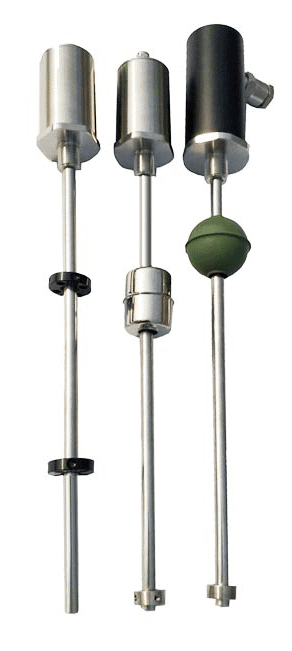
With increases in fuel prices, the possibility of theft from remote installations along with many other factors. So the monitoring the fuel consumption of diesel engines has become increasingly important with the transport industries in particular taking a lot more interest in their vehicles fuel consumption.

This chart approximates the fuel consumption of a diesel generator. Based on the size of the generator and the load at which the generator is operating at. Please note that this table is intended to be used as an estimate of how much fuel a generator uses during operation. And is not an exact representation due to various factors that can increase or decrease the amount of fuel consumed.

Extended reading: Fuel Flow Meter for Boat-Selection & Application

Ddiesel engine fuel consumption chart

Generator Size (kW)2030406075100125135150175200230250300350400500600750100012501500175020002250
1/4 Load (gal/hr)0.61.31.61.82.42.63.13.33.64.14.75.35.76.87.98.91113.216.321.626.932.237.542.848.1
1/2 Load (gal/hr)0.91.82.32.93.44.155.45.96.87.78.89.511.313.114.918.52227.436.445.354.363.272.281.1
3/4 Load (gal/hr)1.32.43.23.84.65.87.17.68.49.71112.513.616.118.721.326.431.539.352.16577.890.7103.5116.4
Full Load (gal/hr)1.62.944.86.17.49.19.810.912.714.416.61821.525.128.635.742.853.471.188.8106.5124.2141.9159.6

Learn more about Diesel fuel tank level gauges & Indicators

Fuel flow meter aircraft

A fuel flowmeter for plane indicates an engine’s fuel use in real time. This can be useful to the pilot for ascertaining engine performance and for flight planning calculations.

The types of fuel flow meter used on an aircraft depends primarily on the powerplant being used and the associated fuel system. Not every plane or associated system uses the same kind of flow meter to get the job done.

In most cases, many flow meters perform tasks related to maintaining a single plane. Some of the more common flow meters in use include:

https://www.aircraftsystemstech.com/2017/06/fuel-system-indicators.html

Every flow meter must be properly maintained and calibrated. All flow meters become inaccurate over time through regular use. Regular re-calibrations and general standards to ensure proper operation.

Flow meters designed for the aviation industry are made of the highest quality materials and to specific industry standards. That way, everyone working in the industry and flying the skies can be in the safest environment possible at all times.

Extended Reading: Fuel Flow Meters for Diesel-Marine fuel-Industrial oil

Marine diesel fuel flow meter

  • How much fuel is consumed onboard a ship, is directly related to the performance. The better the performance, the lower the fuel consumption during operation. In this equation, accuracy is not negligible.
  • An offset of 1% in measurement on a vessel operating 200 days a year consuming an average of 100 tons a day equals an offset of 200 tons a year. Depending on the price of HFO or MGO used, this misread has the potential to range up to USD 100,000.
  • The Coriolis Mass Flow Meters used in our Fuel Consumption System has an accuracy better than 0,2% of nominal flow directly measured in mass. Whereas most volumetric flow meters are in the range 0,5% to 2,0%. And they rely on volumetric conversion which depends on the temperature to calculate a mass flow.
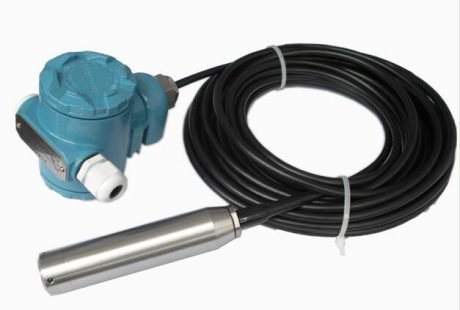
  • By installing one or more mass flow meters (depending on engine supply line layout and desired insight) fuel consumption can be monitored closely in real-time.
  • The main principle is to measure the flow of fuel before and after the engine and/or generators. When you compare the consumption data with measurements of actual speed and position (based on speed log and GPS signals). You are able to directly measure the fuel efficiency.
  • If you require more detailed readings, for example, one set of meters per consumer or one set for the ship’s entire consumption. Additional flow meters can be installed.

Read more about: Large-diameter Oval Gear-Marine Fuel Flow Meter

More Technical Supprots

Fuel Flow Meters for Diesel-Marine fuel-Industrial oil

What is a fuel flow meter? Fuel flow meter is an instrument that can monitor fuel flow. Industrail Fuel is an important energy source. For example, diesel, marine fuel, gasoline, etc.

Industrail Fuel is an important energy source for production and manufacturing. For example, diesel, marine fuel, gasoline, etc. It is very necessary to accurately measure industrial fuel. Commonly used industrial fuel flow meters, such as turbine flow meters, gear flow meters, mass flow meters, ultrasonic flow meters, etc.

Related Blogs

  • PD Flow Meters Selection and Application | Oil-Liquid

    What is PD flow meter? PD flow meters (positive displacement flow meters) are the only flow measurement technology that directly measures the volume of fluid passing through the flow meter.Rotating components within a high precision chamber capture the fluid. The…
  • Guide for Digital Fuel Flow Meter

    Digital Fuel Flow Meter is a flow meter dedicated to measuring fuel, diesel, gasoline, and petroleum. Digital Fuel Flow Meter generally has a digital display or signal output. Such as pulse or 4-20mA. Such as turbine flow meters, gear flow…
  • Mechanical Water Flow Meters

    Mechanical water flow meters refer to a type of flow meter suitable for clean water processes or applications. The working principle of a mechanical water flow meter is to measure the speed of water flowing through a pipe. This causes…
  • Strap on Ultrasonic Flow Meters

    What is Strap on Ultrasonic Flow Meters? Strap on Ultrasonic Flow Meter is also often called Clamp On Type Flow Meter. The unique feature of Strap on Ultrasonic Flow Meter is that the sensor does not need to be in…
  • Ultrasonic Flow Detectors

    Ultrasonic flow detectors are an important part of ultrasonic flow meters. Ultrasonic flow detectors are also called ultrasonic transducers. Ultrasonic flow detectors measure the volumetric flow of liquid within closed conduits. Ultrasonic flow meters use transit-time differences for measuring flow…
  • 4-20ma Flow Meters

    What is 4-20ma Flow Meter? 4-20mA Flow Meters are those flow meters with 4-20mA current signal output function. The signal current of general instruments is 4-20mA. This means that the minimum current is 4mA and the maximum current is 20mA…
  • Flow Transmitter vs Flow Meter

    You may have heard of flow transmitters and flow meters. Are flow transmitter and flow meter the same? What is the difference and relationship between them before? Should you buy a flow meter or a flow transmitter? What kind of…
  • Food Grade Flow Meters for Food & Beverage Industry

    In the food and beverage industry, automation equipment requires food grade. Ensure hygiene and safety. The food grade flow meter can easily sterilize the equipment without disassembly. Many of the flowmeters we provide use accessories such as triple clamps, clover,…
  • Gas Rotameter Tips

    What is Gas Rotameter? Rotameter is also called float flowmeter. It is often called glass tube float flowmeter, glass rotameter, metal rotameter, and metal tube float flowmeter.Rotameter is mainly used to measure the flow of single-phase non-pulsating fluid (gas or…

If you are interested in fuel flow sensor, Sino-Instrument has over 100 flow meters related, so you can compare and shop! Try finding the one that is right for you by choosing the price range, applications, or specifications that meet your needs. You will find a high quality fuel flow sensor at an affordable price from Sino-Instrument.

Request a Quote

Please enable JavaScript in your browser to submit the form