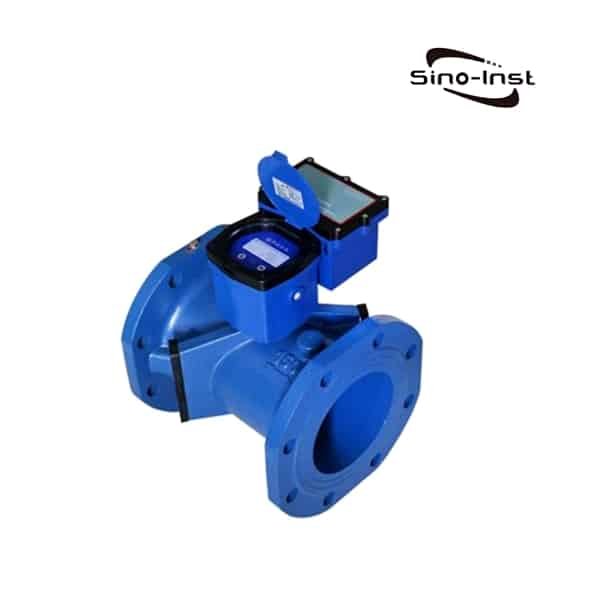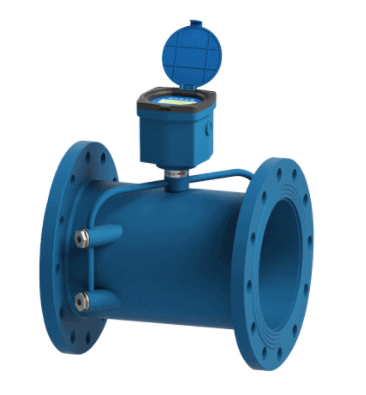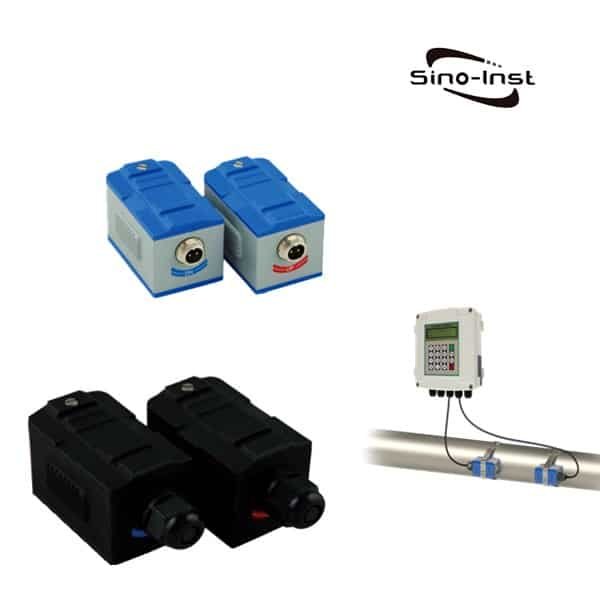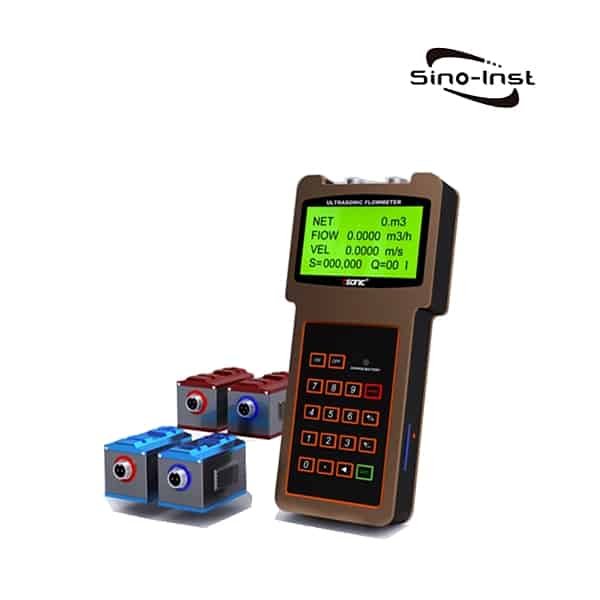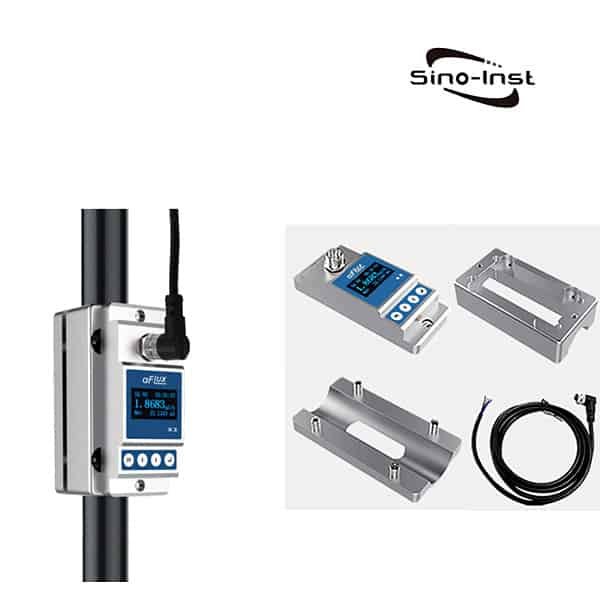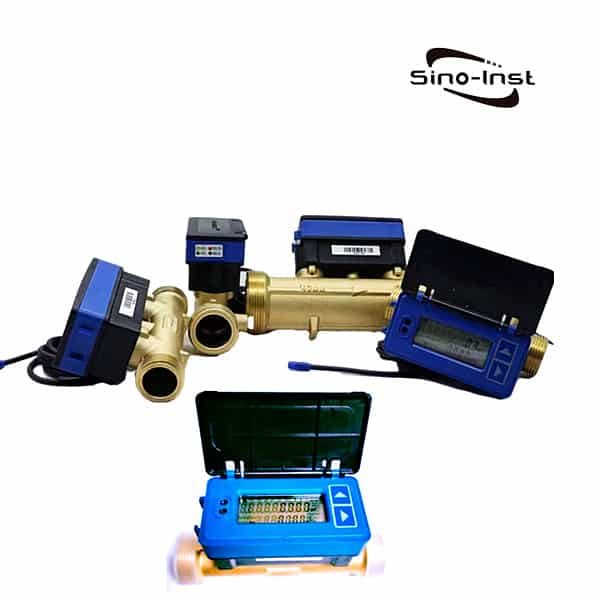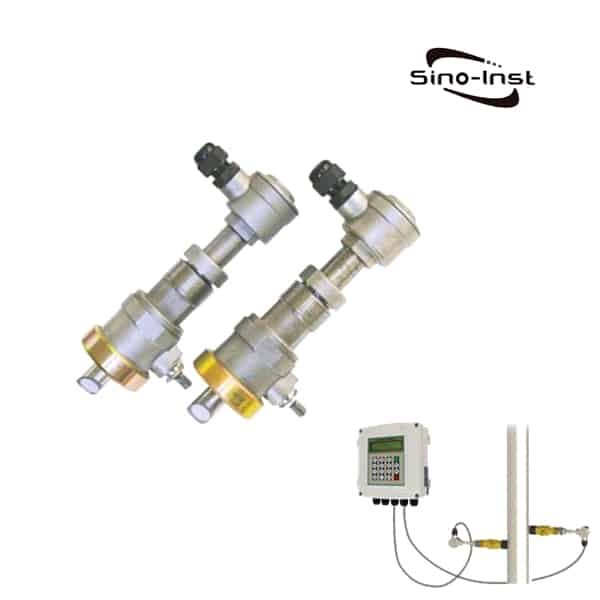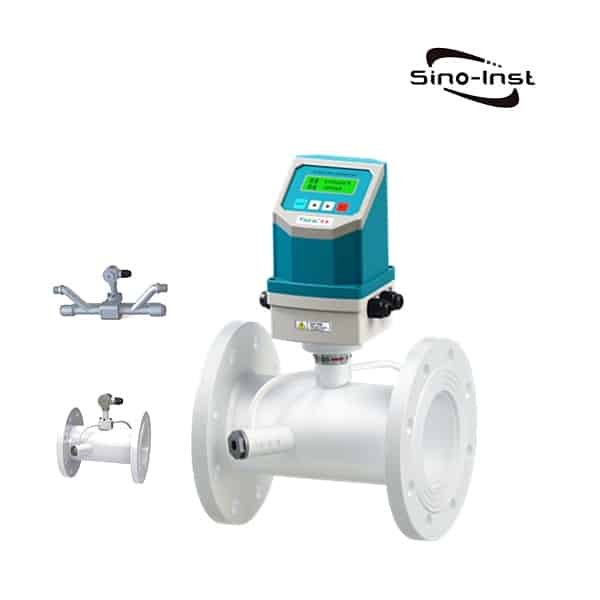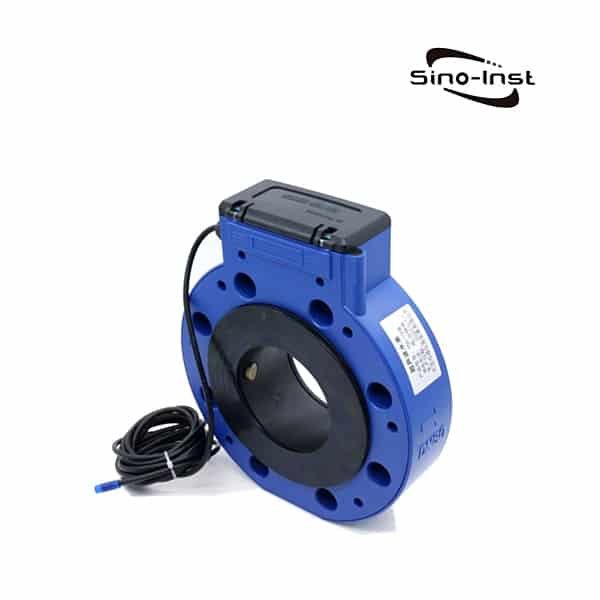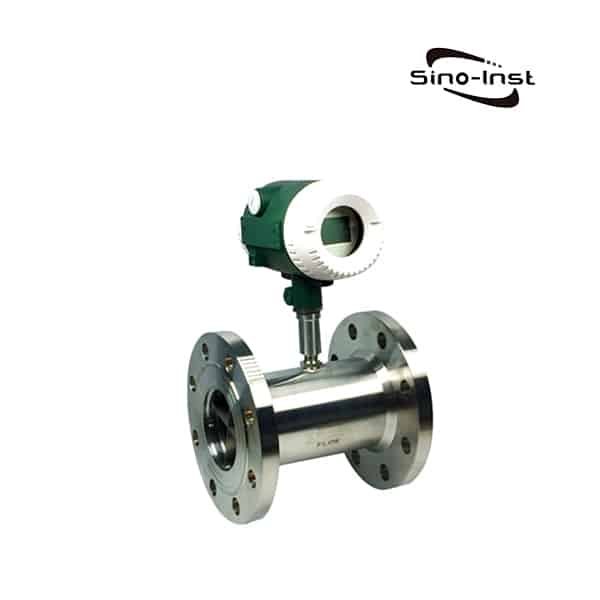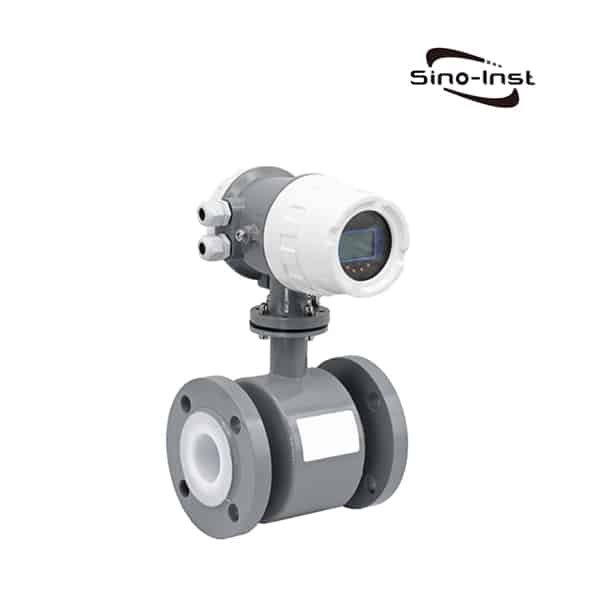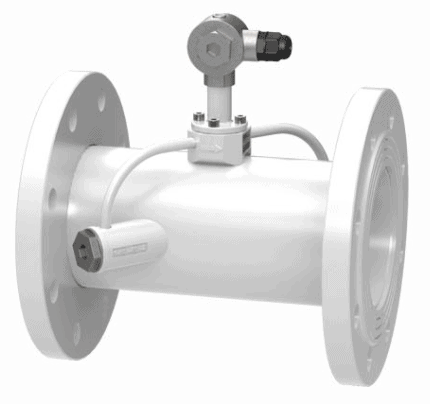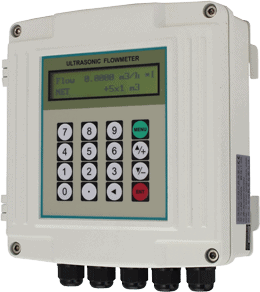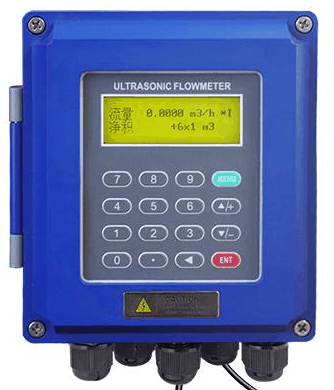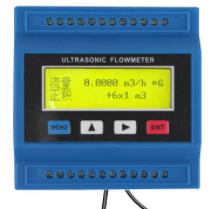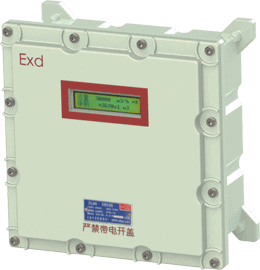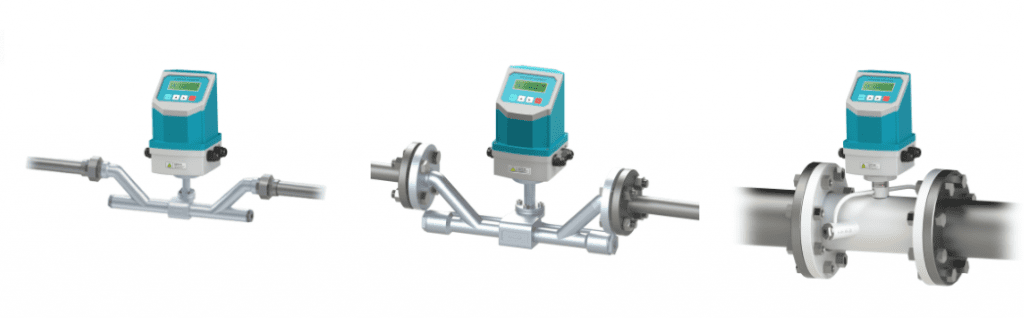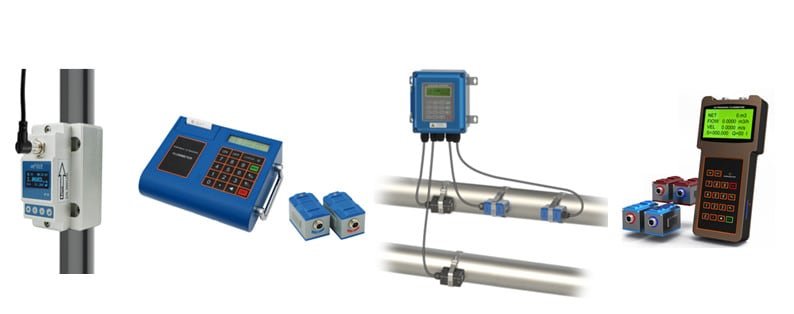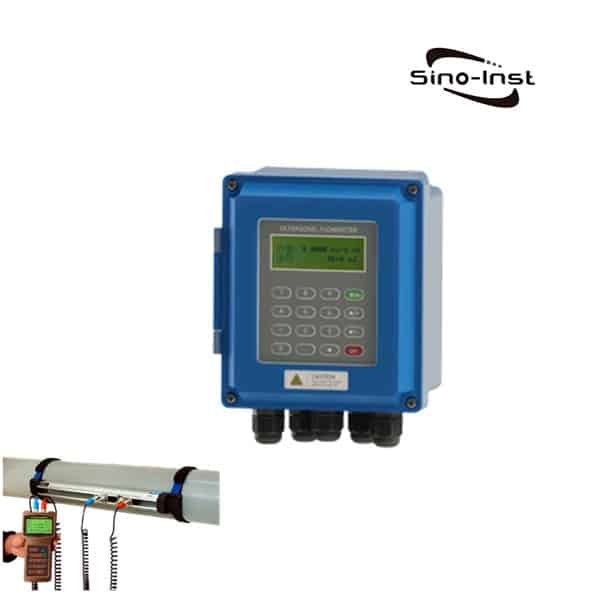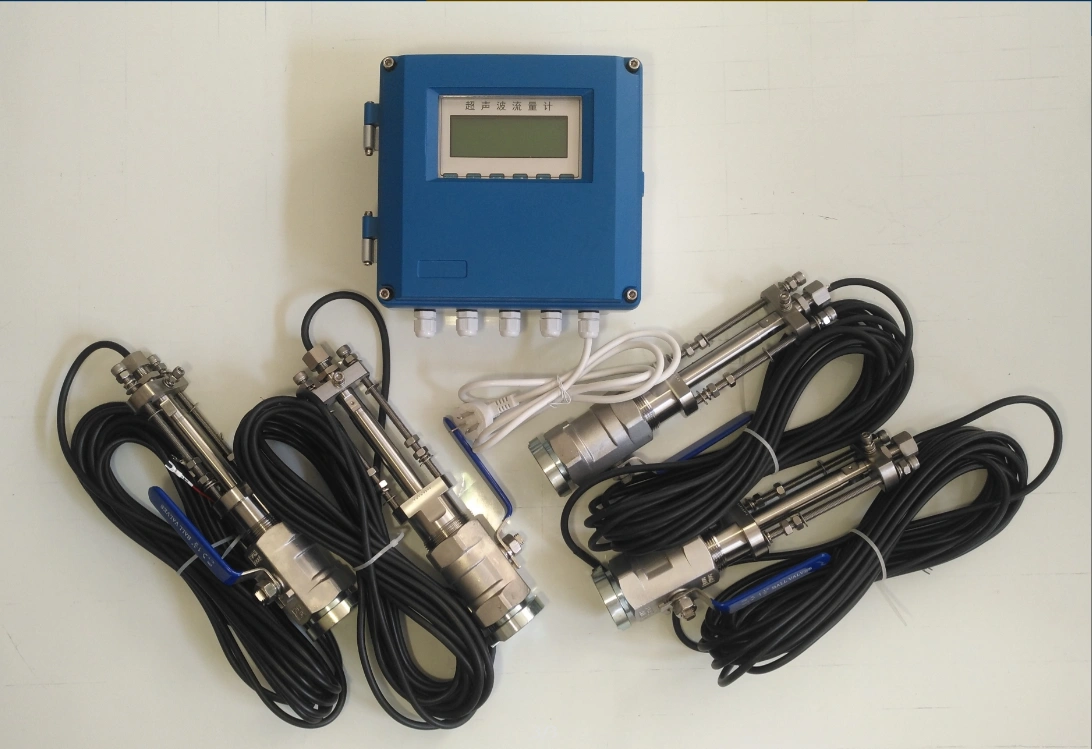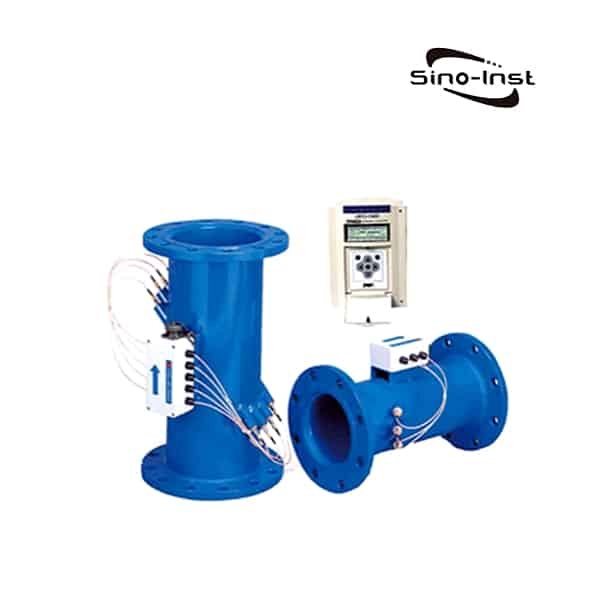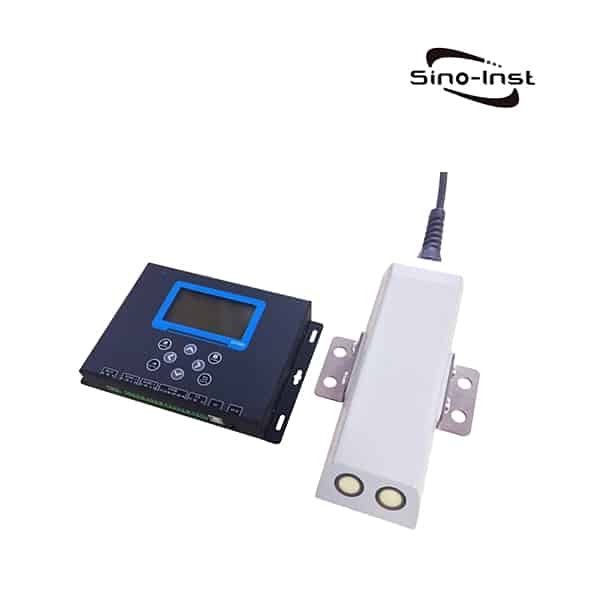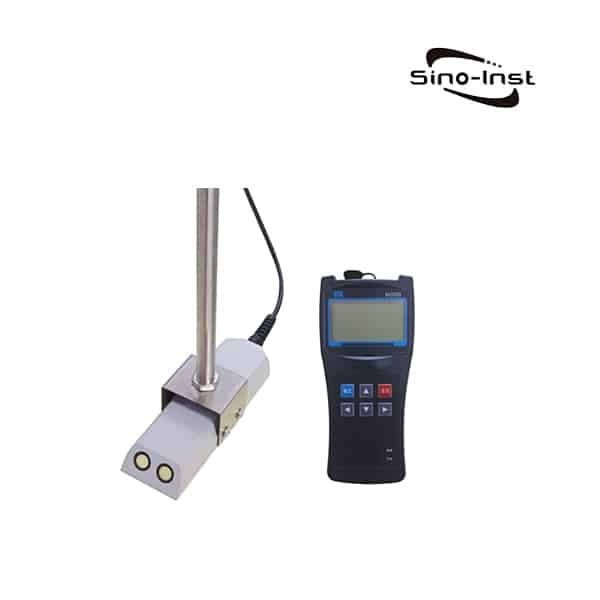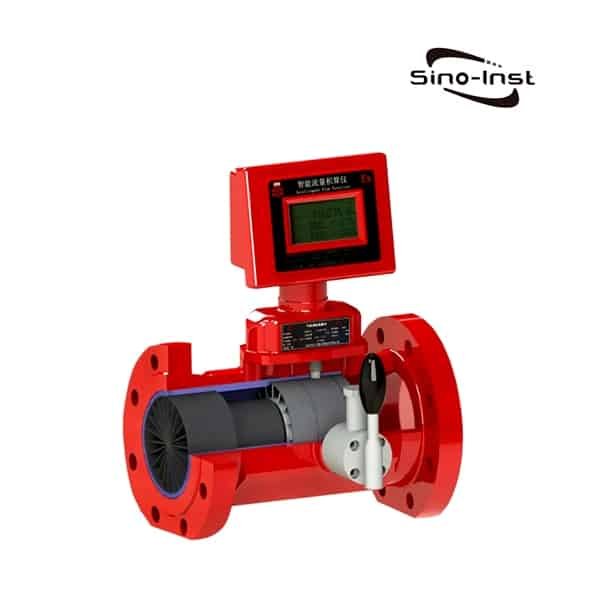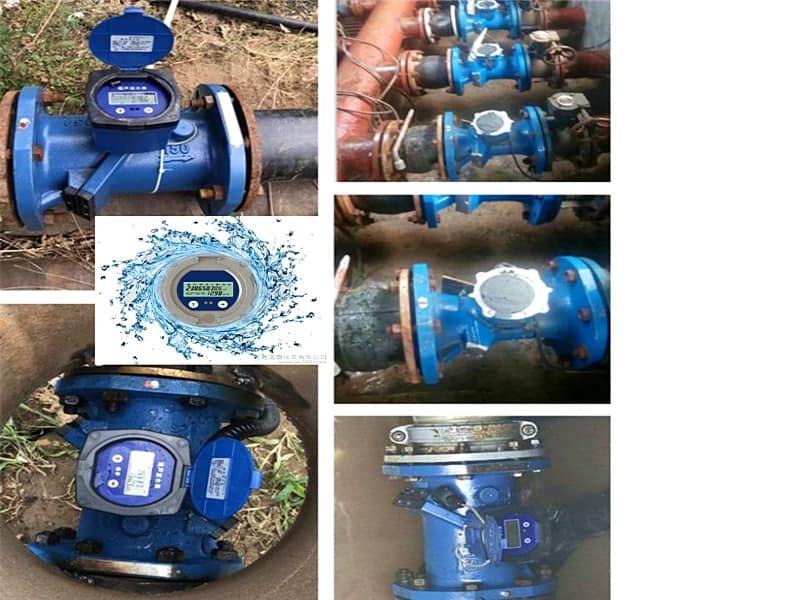
Multipath Transit Time Ultrasonic Flow Meter

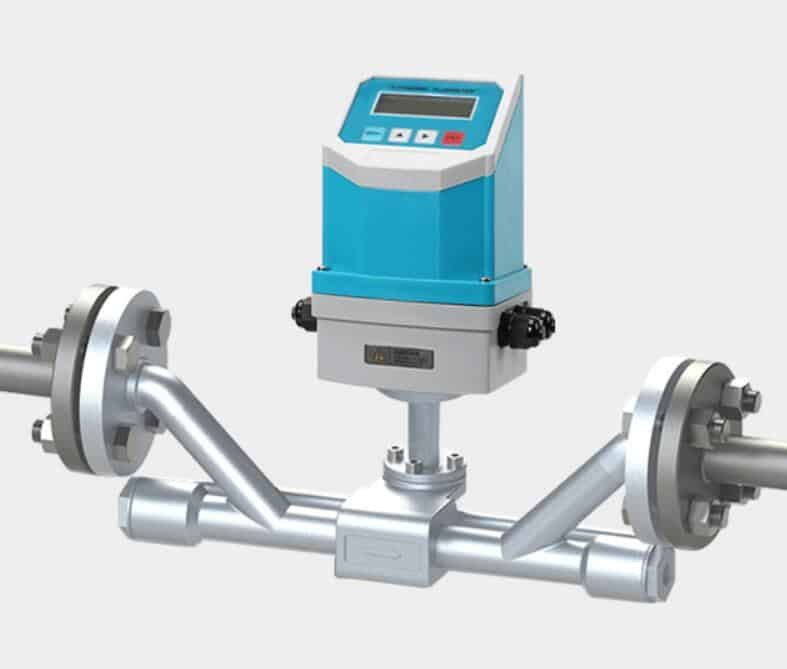
Transit Time Ultrasonic Flow Meter is a multi-channel flow meter. A velocity flow meter that measures the flow rate of the medium using the time difference method.

Multipath Transit Time Ultrasonic Flow Meter

Transit Time Ultrasonic Flow Meter is the flow velocity obtained by measuring the difference in the propagation time of the ultrasonic pulse in the measured medium. When multiple beams of ultrasonic waves propagate in a flowing fluid, they carry information about the fluid velocity. The flow rate of the fluid can be detected by the received ultrasonic wave and converted into flow rate. The use of ultrasonic flowmeter eliminates the need to install measuring elements in the fluid. No additional resistance is generated.

Sino-Inst offers a variety of  Ultrasonic flow meters for flow measurement. If you have any questions, please contact our sales engineers.

Features of Multipath Transit Time Ultrasonic Flow Meter

  • High measurement accuracy:
  • Two-way measurement: It can measure the forward and reverse flow of the measured fluid.
  • Large measuring range: The measuring range of flow velocity can reach 0.03m/s~20m/s.
  • Wide application range:
    • The nominal diameter of the measuring pipe can reach DN25mm~15000mm.
    • The measuring width of the open channel can reach 30 m.
    • The measuring width of the river can reach 150m.
  • Good low flow rate:
    • The multi-channel ultrasonic flowmeter can obtain high accuracy in a more complicated state with low flow rate. The problem of inaccurate measurement in the low flow rate area is solved.
  • Dry-type verification technology:
    • It can realize online verification, which solves the problem that large-diameter flow meters and flow meters in use cannot be verified in real flow. It also reduces the cost of verification.
  • Continuous flow online installation and maintenance:
    • It can be installed and maintained online to avoid the loss caused by the current cut. No need to set up bypass pipelines, reducing construction and maintenance costs.
  • Low pressure loss: no drive, protruding and other obstructive parts, no pressure loss.
  • Short upstream and downstream straight pipe sections required: accuracy can be guaranteed when the upstream 5D and downstream 2D ​​(D is the pipe diameter) are met.
  • Can display and transmit pressure signal:
    • Install a pressure sensor to measure fluid pressure, which can be displayed on the secondary meter and realize communication.
  • With RTU function:
    • Can store positive and negative instantaneous flow, cumulative flow, flow rate, pressure, power failure records and other information.
    • You can download and store data on-site. It can also be remotely transmitted to the upper computer for control and management.

Extended Reading: Inline Ultrasonic Flow Meter

Specifications of Multipath Transit Time Ultrasonic Flow Meter

Number of channels 1 3 5
Nominal diameter (mm) DN50~DN600 DN80~DN600 DN150~DN15000
Average flow velocity (m/s) 1.0~20 0.05~0.5 0.5~20 0.02~0.5 0.5~20
level of accuracy 0.5 1 0.5 0.5 0.25
Repeatability 0.3 0.3 0.2 0.15 0.1
Environment temperature:-20℃~ + 60℃
Relative humidity of environment:≤ 90%
Medium temperature:-20℃~+ 80℃;-40℃~+ 150℃ (optional)
Media status:The measured medium should be a uniform liquid that does not affect the propagation of ultrasonic waves.
Fluid pressure:PN1.0, PN1.6, PN2.5, PN4.0 (other)
Power supply:AC 110V/220V±10% (50/60Hz) DC 24V±10%
Meter power consumption:18w
Measuring tube (one-time meter):IP68
Controller (secondary meter):IP65 (please equip an instrument box if placed outdoors)
Display parametersInstantaneous flow, cumulative flow, flow rate, time, pressure (optional)
Analog signal:4∼20mA
1. In the SOURCE active mode, the maximum load resistance is 500Ω, and the jumpers 2 and 3 on the bottom right of the main board are shorted;
2. In the case of LOOP passive mode, pins 1 and 2 are short-circuited, and an external DC24V power supply is required
Frequency output:  1kHz 10kHz (optional)
Police report:  High value, low value (NPN-TYPE 24VDC)
News:RS232/RS485 (switching)
Store information:Store 2400 sets of cumulative flow/instant flow, 100 sets of switch records/error information codes, more optional.

Guess You’ll Like: Ultrasonic flow meters types & technical guide

Transit Time Ultrasonic Flow Meter Principle

The time difference method is actually based on the vector superposition of the ultrasonic propagation velocity and the liquid velocity. It can be simply compared to the process of ferrying on a river.
Although the speed of the ferry itself is the same when flowing downstream and upstream.

However, due to the influence of the current speed, the time required for the ferry to reach the opposite bank is less when the flow is downstream than when it is upstream. The greater the flow velocity, the faster the downstream speed, and the longer the time required for the upstream flow. The time difference between the forward and reverse flow is proportional to the flow velocity.

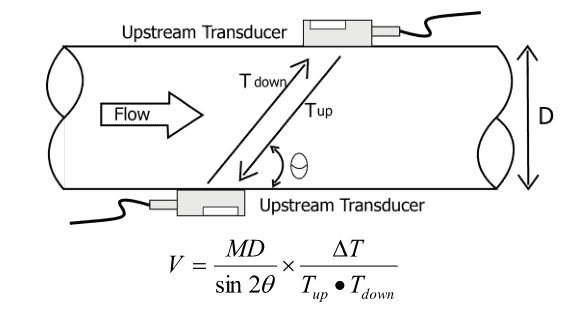
Transit time ultrasonic flow meter equation

The difference in the upstream and downstream measurements taken over the same path is used to calculate the flow through the pipe:

V = K • D/sin2θ • 1/(T0 – t)2 ΔT

Where:

V = Mean velocity of flowing fluid
K = Constant
D = Inner diameter of the pipe
θ = Incident angle of ultrasonic waves
T0 = Zero flow transit time

ΔT = T1 – T2
T1 = Transit time of waves from upstream transmitter to downstream receiver
T2 = Transit time of waves from downstream transmitter to upstream transmitter
t = Transit time of waves through pipe wall and lining

The above equation shows that the flow velocity of the fluid is directly proportional to the difference in the upstream and downstream measurements.

The transit time ultrasonic flow meter has three possible transducer configurations: Z, V and W.

All are recognized as a single measuring path, whereas the ultrasonic beam follows a single path. In all three configurations, the output produced by the transducers is converted to a current, frequency or voltage signal. The preferred configuration is determined by factors such as:

  • Pipe size
  • Space available for mounting the transducers
  • Condition of the internal walls of the pipe
  • Type of lining
  • The characteristics of the flowing liquid

In the “Z” configuration, the transducers are positioned on opposite sides of the pipe with one downstream from the other.

Usually, the distance downstream is approximately D/2, where D equals the diameter of the pipe. The optimum distance is calculated by a converter. This arrangement is only advisable under conditions where there is limited space, high turbidity, a mortar lining or a thick build-up of scale on the interior walls of the pipe. It should be avoided for installations on small pipes, where the accuracy of its measurements tends to degrade.

The “V” configuration is recommended for most installations. This arrangement places the two transducers on the same side of the pipe within approximately a diameter of the pipe from each other. A rail attachment clamps on the pipe and allows the transducers to be slid horizontally to position them the calculated distance apart.

A “W” configuration is most often used for installations on pipes with diameters of ½ inch to 1½ inches. In this arrangement, the ultrasonic signal rebounds from the wall three times; therefore, it must travel a greater distance. High turbidity liquids, and scale or deposit build-up on the interior of the pipe wall can diminish accuracy.

Extended reading: Ultrasonic flow detectors types

More Transit Time Ultrasonic Flow Meter

Sino-Inst, Manufacturer for Transit Time Ultrasonic Flow Meters. It can measure a single sound-conducting liquid medium. It can measure even liquids such as water, seawater, oil, and slurry.

Sino-Inst’s Transit Time Ultrasonic Flow Meter, made in China, Having good Quality, With better price. Our flow measurement instruments are widely used in China, India, Pakistan, the US, and other countries.

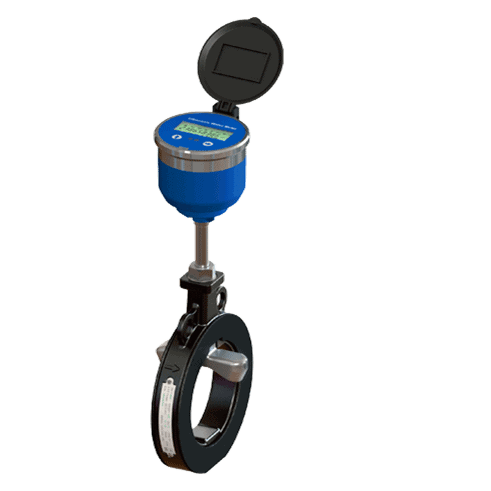
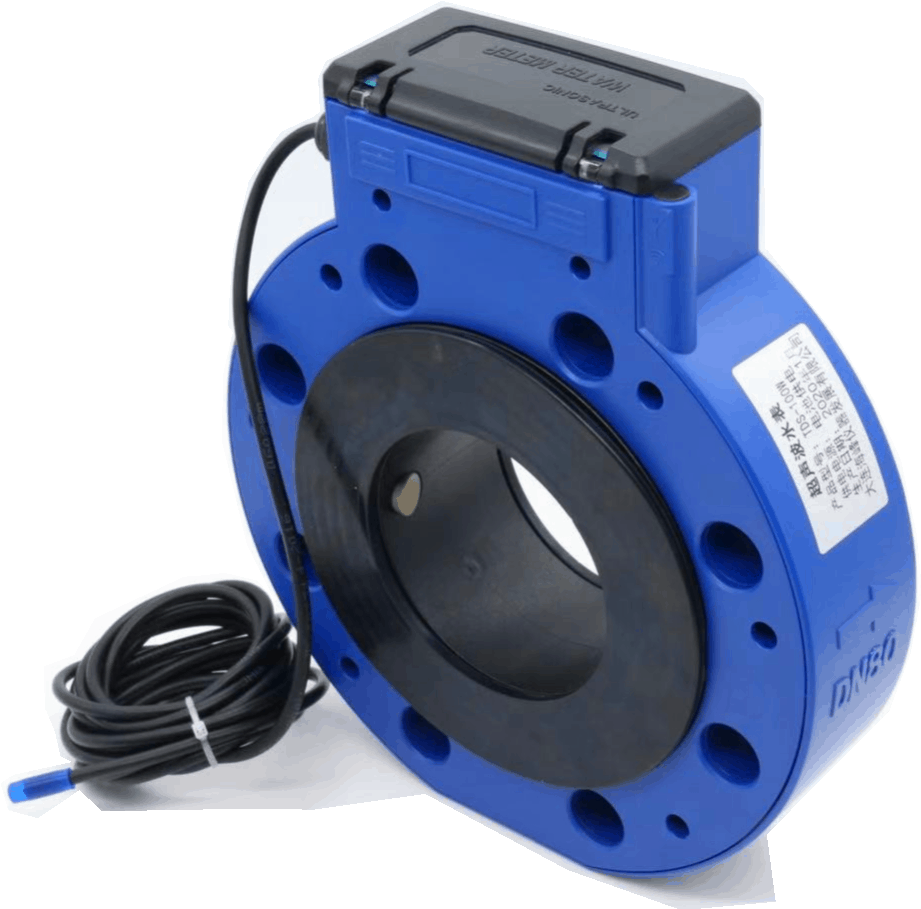
Dual Channel Ultrasonic Water Meter

Digital Ultrasonic water meter works with principle of ultrasonic time difference is used to measure the flow of liquid in the pipe.

Can be battery powered and wireless. For residential water, urban water, industrial water management.

  • High accuracy and reliable operation.
  • Low starting flow rate(Q1)
  • IP68 protection
  • Built-in Lithium battery for 6 years life expectancy.
  • No Rotation, N o Moving Parts
  • Can completely replace other types of water meters.

Sino-Inst offers a variety of  Ultrasonic flow meters for flow measurement. If you have any questions, please contact our sales engineers.

Specifications of Ultrasonic Water Meter

ItemSpecification
Measurement LiquidWater, Sewage, Seawater( Other liquid need to customized), the liquid should be full of the pipeline
Medium Temperature0.1-30℃
Working EnvironmentTemperature:-10~45℃; Humidity≤100%(RH)
Working Pressure1.6MPa(2.5MPa optional)
The sensitivity of upstreamU3
The sensitivity of downstreamD0
Climatic and mechanicalC class
Electromagnetic compatibility classE2 class
Communication InterfaceRS485/USART/Infrared
Output SignalTwo way OCT pulse output/TTL pulse output/One way4-20mA output
Power SupplyBuilt-in Lithium battery(3.6,19AhV)/DC8-36V power supply
Protection ClassIP68, can work 2 meters underwater
Digital DisplayMulti-line 9 digital accumulative flow,4 digital display for instantaneous flow, varies of state prompt and units
Data StorageEEPROM/FLASH, automatically record the accumulative flow of the last 512 days
Measurement CycleMeasuring:1 times/second;Verification:4 times/second
Power Consumption<2.7AH/Year,6 years battery life

Read more about Everything You Need To Know About Electronic Flow Meters

Dual Channel Ultrasonic Water Meter Optional Transducer:

 DN15~DN40Single channel, the copper material, forging technology
 DN50~DN150Dual channel, nodular cast iron (304 stainless steel optional),
integrated casting technology
DN200~DN300Dual channel

Dual Channel Ultrasonic Water Mete Flow range:

Norminal Diameter
(mm)
Range than
R
Flow(m³/h)
Starting
Flowrate
Minimum
Flowrate
Q1
Transitional
Flowrate
Q2
Permanent
Flowrate
Q3
Overload
Flowrate
Q4
DN15 200 0.003 0.0125 0.020 2.500 3.125
DN20 200 0.0035 0.016 0.026 3.200 4.000
DN25 200 0.007 0.020 0.032 4.000 5.000
DN32 200 0.010 0.032 0.050 6.300 7.875
DN40 200 0.015 0.100 0.160 20.000 25.000
DN50 100 0.030 0.400 0.640 40.000 50.000
DN65 100 0.059 0.630 1.008 63.000 78.750
DN80 100 0.064 1.000 1.600 100.000 125.000
DN100 100 0.094 1.600 2.560 160.000 200.000
DN125 100 0.120 2.000 3.200 200.000 250.000
DN150 100 0.270 2.500 4.000 250.000 312.500
DN200 100 0.315 4.000 6.400 400.000 500.000
DN250 100 0.508 4.000 6.400 400.000 500.000
DN300 100 0.770 6.300 10.080 630.000 787.500

Features of Ultrasonic Water Meter

  • Initiating flow lower to millimeter grade 
  • Multi line 9 digital LCD dispaly accumulative flow and 4 digital for instantaneous flow
  • High reliability design, no moving part 
  • Two channel isolated pulse output,pulse equivalent and output pulse can be arbitrary customed
  • Two-wired system 4-20mA output optional 
  • Built-in Lithium battery for 6 years life expectancy
  • It can automatic power saving under empty pipe or the liquid static for a long time
  • Resin vacuum sealed IP68 for long life and high expectancy Chronological cumulative record 
  • Standard RS485 interfaceInfrared communication interface,support CJ-188 communication Support MODBUS, M-BUS communication protocol 
  • TTL levels pulse output and USART interface,convenient to connect the low power consumption equipment 
  • With the two channel PT1000 temperature transducer, which can realize the heat measurement

Ultrasonic Water Meter Working Principle

First of all, let’s start with the measurement principle of the ultrasonic water meter:

Ultrasonic water meters use the difference between the downstream and upstream propagation of sound waves in the water to obtain the flow velocity of the water through a measurement formula, thereby further obtaining the cumulative flow of water per unit time.

Then the component that emits sound waves and receives the return sound waves is called a transducer. An ultrasonic water meter with a pair of transducers is called a mono ultrasonic water meter.

In theory, the measurement accuracy of an ultrasonic water meter with more channels will be higher. Because the more sound channels, the wider the width of the water meter to measure the water flowing through the pipe section. The more the number of measurements, the more reliable the data obtained.

However, the subsequent change is also the substantial increase in cost. If it is not particularly necessary, it is recommended to use dual channels to meet the normal measurement requirements.

Generally speaking, two-channel ultrasonic water meters are only used for DN100 and above.

Ultrasonic water meter is a new type of water meter that detects the time difference caused by the speed change when the ultrasonic sound beam propagates in the water upstream and downstream, and analyzes and processes the water velocity to further accumulate the water flow.

Ultrasonic water meter is a fully electronic water meter manufactured with industrial-grade electronic components using the principle of ultrasonic time difference. Compared with mechanical water meters, it has high precision, good reliability, wide range ratio, long service life and no moving parts. No need to set parameters, installation at any angle, etc.

With excellent small flow detection capabilities, it can solve many problems of traditional water meters. More suitable for gradient charging of water charges. It is more suitable for the conservation and rational use of water resources. It has a broad market and application prospects.

Extended reading: Portable ultrasonic flow meter for water

There are two types of ultrasonic water meter accuracy: Class 1 and Class 2.

Ultrasonic water meters supplied by Sino-Inst are generally Class 1 with an error of 1%.

Read more about: Ultrasonic flow meters types & technical guide

Ultrasonic Clamp on Flow Meter is composed of an integrated host and external clamp on sensors. Clamp on Flow Sensors are available at room temperature and high temperature.

Clamp on flow meter (Model: 2000) is composed of an integrated host and ultrasonic clamp on sensor. Clamp on flow meter is widely used in online flow measurement of various liquids. Just stick the external clamp sensor on the pipe surface. Compared with the traditional flowmeter, it does not need to cut off the pipe and flow. The installation is convenient and quick, and the non-destructive installation is truly realized.

Clamp on Flow Meter Reference price: USD 470.00/pc

Sino-Inst offers a variety of  Ultrasonic flow meters for flow measurement. If you have any questions, please contact our sales engineers.

Extended Reading: Chilled Water Flow Meter

  1. According to the measurement principle

(1) Time difference method ultrasonic flowmeter;
(2) Frequency difference method ultrasonic flowmeter;
(3) Phase difference method ultrasonic flowmeter;
(4) Doppler ultrasonic flowmeter;
(5) Ultrasonic flowmeters for partially full pipes and river channels that combine liquid level measurement and average flow velocity measurement.

  1. According to the way of use

(1) Portable ultrasonic flowmeter;
(2) Fixed (standard pipe section) ultrasonic flowmeter.

  1. According to the installation method of the transducer

(1) Standard pipe section ultrasonic flowmeter;
(2) Clip-on ultrasonic flowmeter;
(3) On-site hole-opening plug-in ultrasonic flowmeter.

  1. According to whether the transducer is in contact with the fluid

(1) Immersion (contact) ultrasonic flowmeter;
(2) Non-invasive (non-contact) ultrasonic flowmeter.

  1. According to the nature of the measured fluid

(1) Liquid ultrasonic flowmeter;
(2) Gas ultrasonic flowmeter.

  1. According to the number of transducer channels

(1) Mono ultrasonic flowmeter;
(2) Two-channel ultrasonic flowmeter;
(3) Multi-channel ultrasonic flowmeter.

Extended reading: Portable ultrasonic flow meter for water

9 points: the difference between electromagnetic water meter-ultrasonic water meter-mechanical water meter

The following are some of the differences between these three tables summarized by Sino-Inst:

  1. Water quality requirements

Electromagnetic water meter: not affected by impurities such as sand, weeds, and chemical substances in the medium, but interfered by magnetic substances;
Ultrasonic water meter: It is not interfered by impurities, chemical substances and magnetic substances in the medium such as sand, weeds, etc.;
Mechanical water meter: The water quality similar to tap water must be used, and the liquid must not contain impurities such as rust, gravel, aquatic plants, etc.

  1. Turndown ratio

Electromagnetic water meter: low flow rate measurement performance is poor, medium and high flow rate measurement performance is stable. The coverage of the turndown ratio does not cover the small flow area;
Ultrasonic water meter: The range is generally better than 100:1, the initial flow velocity is extremely low, which can be lower than 0.01m/s, and the effective measurement range is large, which can avoid running, emitting, dripping, and leaking;
Mechanical water meter: It is more difficult to make high range ratio products, and the range ratio of conventional water meters is generally below 80

  1. Protection level

Electromagnetic water meter: electronic products, the protection level strictly meets IP68 requirements, and the quality must be qualified.
Ultrasonic water meter: electronic products, the protection level strictly meets IP68 requirements, and must be qualified by products;

Mechanical water meter: IP68

  1. Pressure loss

Electromagnetic water meter: meet the minimum level of pressure loss ΔP10;
Ultrasonic water meter: meet the minimum level of pressure loss ΔP10
Mechanical water meter: The force loss is very large, about ΔP63

  1. Wearability

Electromagnetic water meter: no mechanical moving parts, never wear, accuracy has little relationship with the use time, the general verification period is more than 3 years;
Ultrasonic water meter: without any mechanical moving parts, never wear, accuracy has little relationship with the use time, the general verification period is more than 3 years;
Mechanical water meter: Use impeller gears and other mechanical rotating parts to measure, and there is abrasion. The longer the use time, the lower the measurement accuracy.

  1. Installation method

Electromagnetic water meter: horizontal or vertical, the electrodes must be on the same horizontal plane;
Ultrasonic water meter: freely choose the installation method according to the site conditions, horizontal, vertical, or inclined installation;
Mechanical water meter: Single installation, must be installed strictly horizontally or vertically.

  1. Installation requirements (sensitivity level of flow field)

Electromagnetic water meter: U10D5 or U5D3: Upstream requires 10/5 times the pipe section aperture length, and downstream requires 5/3 times the pipe section aperture length;
Ultrasonic water meter: the industry-leading product can be better than U3D0: the upstream requires 3 times the length of the pipe section aperture, and the downstream can be directly connected to the elbow;
Mechanical water meter: U10D5: Upstream requires 10 times the length of the pipe section aperture, and downstream requires 5 times the pipe section aperture length.

  1. Communication network

Electromagnetic water meter: internal circuit initiated, no external electronic device is needed, zero communication error;
Ultrasonic water meter: the internal circuit is initiated, no external electronic device is required, and the communication is zero error;
Mechanical water meter: additional electronic devices are required.

  1. Power supply problem

Electromagnetic water meter: The principle of electromagnetic induction determines that the power consumption is relatively large. Generally, it takes 15s to measure the flow rate once, and the battery life is 3-5 years;
Ultrasonic water meter: Qualified product, can guarantee the battery life of more than 10 years under the current measurement cycle of at least 1S;
Mechanical water meter: The mechanical base meter does not require power supply.

Read more about: How does a residential water meter work?

water meter installation details

Installation and use of ultrasonic water meters and precautions:

  1. The applicable model is determined according to the system flow rather than the system pipe diameter. The diameter and model of the heat meter should be determined according to the commonly used flow.
  2. According to the design requirements of household measurement, a filter must be installed before the water inlet. The filter must be cleaned and maintained regularly.
  3. It must be installed in a horizontal or vertical direction, and the direction of the arrow on the pulse meter (including the filter) must be consistent with the direction of the water flow in the pipeline. Do not allow the water to flow backwards to avoid impurities in the water from damaging the meter. When installed vertically, the water flow direction must be upward .
  4. Before installation, the pipes must be cleaned.
  5. There should be straight pipes of sufficient length at the inlet and outlet of the water meter. The length of the straight pipe at the front end of the inlet should not be less than 10 times the length of the pipe diameter. The length of the straight pipe at the front end of the outlet should not be less than 5 times the length of the pipe diameter:
  6. The water meter calculator (display) shall not be immersed in water.
  7. The water quality of the water supply should meet the relevant regulations.
  8. The water meter is a measuring instrument, and the heat meter must be checked regularly in accordance with national standards, and the battery must be replaced during the check.
  9. To avoid man-made damage to the metering system, a water meter box can be installed.
  10. Without the permission of the company, no one is allowed to disassemble the maintenance watch without permission, otherwise the warranty service will be released by itself.

Read more about: Common River Water Level Measurement Methods

water meter life expectancy

Water meter is an instrument for measuring water flow. Most of them are cumulative flow measurement of water, generally divided into two types: volumetric water meter and speed water meter. Originated in the United Kingdom, the development of water meters has a history of nearly two hundred years.

The service life of the water meter shall not exceed 6 years (caliber of 15-25 mm), 4 years (caliber of > 25-50 mm), and shall be rotated upon expiration. In other words, a water meter with a diameter of 15 to 20 mm can be used for up to 6 years.

More high accuracy liquid flow meters

More Water Flow Measurement Solutions

  • LORA Water Meter

    LORA Water Meter is a commonly used wireless water meter/wireless flowmeter. The wireless remote water meter measures the water flow in the pipeline. The microcomputer in the water meter automatically…
  • Clamp on Water Flow Meter

    What is Clamp on Water Flow Meter? Clamp on Water Flow Meter is also known as the clamp-on ultrasonic flowmeter. Using an ultrasonic flowmeter to measure water flow rate is…
  • Mechanical Water Flow Meters

    Mechanical water flow meters refer to a type of flow meter suitable for clean water processes or applications. The working principle of a mechanical water flow meter is to measure…
  • Water Flow Measurement for Pipes and Open Channels

    Water flow measurement is common in both industry and life. You may often hear about the use of electromagnetic flowmeters to measure wastewater. The clamp-on ultrasonic flowmeter measures large water…
  • Irrigation Flow Meters for Agriculture Water System

    What is an irrigation flow meter? The irrigation flow meter is a flow meter designed for agricultural irrigation water counting. Agriculture, horticulture, etc. require water for irrigation. And water is…
  • How does a residential water meter work?

    What does a residential water meter look like? A residential water meter is a legal meter for measuring water consumption in residential communities, residential buildings, bungalows, and other places. What…
  • 3 inch (3″) Water Meter

    Low cost 3″ Water Meter 3″ water meter is also DN80 water meter. Easy to read. Totalizing water volume. Intelligent large-caliber remote water meter includes wired remote transmission and wireless…
  • 2 inch Water Flow Meter

    2 inch water flow meter is also written as 2″ flow meter. If you are planning to buy a 2 inch water flow meter, please be sure to read this…
  • Hot Water Flow Meters

    Hot Water Flow Meters Improve Heating-Boiler System Hot water flow meters refer to flow meters that can measure and indicate the flow of high temperature water. Hot water is widely…

Frequently
Asked
Questions

Ultrasonic water meters mainly use:

When the ultrasonic wave is transmitted in the water flow, the speed and temperature of the water flow will affect the ultrasonic receiving time. However, the difference between the upstream and downstream measurement times can eliminate the temperature effect. Therefore, if the ultrasonic receiving time is affected at this time, it is only related to the speed of the water flow.

During measurement, both transceivers transmit and receive ultrasonic waves, and the current water velocity can be calculated according to the time difference between upstream and downstream.

Compared with mechanical water meters, it has the characteristics of high precision, good reliability, wide range ratio, long service life, no moving parts, no need to set parameters and installation at any angle.

If the diameter of the water pipe is known when calculating the water loss, the flow rate for a certain period of time can be calculated. The calculation formula is:

Downstream formula: TDown= L / (VS+ Vf)
Upstream formula: TUp= L / (VS– Vf)

L is the distance between the two ultrasonic sensors. VS is the speed of sound in water. Vf is the velocity of the water flow.

It is precisely because the ultrasonic water meter has the above characteristics. The measurement accuracy of the ultrasonic water meter is very high. It is several times or even dozens of times that of ordinary mechanical water meters. It is precisely because of this that more and more people are beginning to use ultrasonic water meters.

Check more Choosing The Right 1 Inch Flow Meter.

The areas with relatively large demand for ultrasonic water meters include agricultural irrigation, township water supply, urban water supply, and smart city construction.

Details as follows:

  1. Agricultural irrigation: no mechanical transmission parts. No flow blocking elements. Ultrasonic water meter measurement is almost unaffected by water quality. It can adapt to the poor water quality of agricultural irrigation and is the most suitable product for the measurement of agricultural irrigation water.​​
  2. Smart city: no pressure loss, reduce the energy consumption of the pump, and achieve the goal of energy saving. The communication interface is complete. It is convenient for network remote monitoring and reflects intelligence. Battery powered, no mechanical transmission parts, long service life.​​
  3. Urban water supply: The initial flow of the ultrasonic water meter is low, which avoids the unmeasured small flow and increases the water fee income. The high measurement accuracy makes the accurate measurement of water bills a reliable guarantee. Wide range ratio, suitable for various users with different water consumption.​​
  4. Township water supply: adapt to various domestic water quality conditions. The communication network is convenient, the output signal is many, and it is convenient for automatic settlement and computer management. Realize centralized management of water resources and improve management efficiency. Remote monitoring, reducing management costs.

Read more: Insertion Type Ultrasonic Flow Meter Applications

The measurement accuracy of the ultrasonic water meter is shown in the figure above.

There are many advantages of using the ULTRASONIC flow meters which include:

  • The electronics in the ultrasonic flow meter includes ultrasonic flowmeter detector which compensates and adapts to the changes in the profile of the flow, type of the liquid and material of the pipe.
  • portable ultrasonic flow meter converter can be used as a direct method to determine the flow rates effectively when compared to the other flow systems.
  • Ultrasonic flow meter converter is inexpensive to use and maintain when compared to the other mechanical flow meters as they are no moving parts in these flow meters.
  • Their design is highly sophisticated and they do not obstruct the liquid flow, so they can be used for sanitary, corrosive and abrasive liquids.

Sino-Inst is Manufacturer of ultrasonic water meters. We supply more than 20 kinds of ultrasonic water meters. 90% of ultrasonic water meters are used in industrial agriculture. The rest are for civilian use.

Due to the measurement of different pipes, the price of ultrasonic water meters is also different. Available from USD 50.00 to USD 1500. So, if you need to purchase ultrasonic water meter. Please contact our sales engineer to confirm the price.

Ultrasonic water meters are mainly used for flow measurement of water. They are mainly used for metering and monitoring the flow of water media, such as domestic water, central air conditioning system water, equipment pipe network water, etc.

Ultrasonic water meters enable stable flow measurement . This greatly meets the measurement needs of many applications. Can be used from small to large tubes.

Sino-Inst’s Ultrasonic water meters, made in China, Having good Quality, With better price. Our flow measurement instruments are widely used in China, India, Pakistan, the US, and other countries.

The entire team at Sino-Inst’s has received excellent training, so we can ensure that every client’s needs are met. For assistance with your product requirements, whether it’s a Ultrasonic water meters, level sensor, or other device, give us a call.

Insertion Ultrasonic Water Flow Meter

Ultrasonic Water Flow Meter is a new type of water meter designed for water resource monitoring. Using ultrasonic time difference measurement technology.

Insertion Ultrasonic Water Flow Meter (Model: 2000K) is a card type digital water meter. Using ultrasonic time difference measurement technology. A new type of water meter designed for agricultural irrigation, garden management, and water pipe monitoring of water resources. The thickness of the water meter is only 50mm to save installation space.

Ultrasonic Water Flow Meter Reference price: USD 270.00/pc

Sino-Inst offers a variety of  Ultrasonic flow meters for flow measurement. If you have any questions, please contact our sales engineers.

Features of Insertion Ultrasonic Water Flow Meter

  • Small and compact all plastic, IP68 protection level
  • High accuracy 100:1 turndown ratio
  • Pipe body probe, not easy to scale
  • Adaptive ultrasonic signal can measure water with impurities
  • Single chip SOC digital time difference processing
  • Multi-line with status display, touch key operation
  • Optional built-in Lora or NB-iot function
  • Dual interface RS485 and MBUS
  • MODBUS, MBUS, CJ188 and other multiple communication protocols
  • Can work with external power supply
  • 10 years working life of built-in battery
  • Reliable and low price suitable for mass application

How much is a 2 inch water flow meter? Let’s find out.

Specifications of Insertion Ultrasonic Water Flow Meter

Perfomance

Specification

Measurement Range Ratio
100 : 1
Working Pressure
<1.6 MPa
Temperature
T30
Working Environment -25°C~55°C,≤100%RH
Display Range Multi-lines show 9-bit cumulative flow, 6-bit instantaneous flow, signal strength flow direction, error, communication status
Unit m³, USG, Liter, cubic foot, Acre Feet
Operating Mode Two capacitive touch keys support sliding operation.
Communication Interface Physically independent RS485 and infrared interface. LORA/ NB-IOT, WIFI, USART are optional.
Output 2 way of OCT output is optional, can simulate dipulse output of mechanical water meter.
Communication Protocol MBUS, MODBUS, ASCII, CJ188
Power Supply 3.6V 4Ah lithium battery (battery life>10 years). It will operate power save functions when there is no water and flow in pipe
Other Data saving time after power failure: 10 years
Protection IP68

Extended reading: What is Modbus Protocol?

Flow Rate:

Nominal
Diameter
(mm)
 
Flow Meter Dimensiom Flange Dimension Weight(Kg)
L H1 H2 W1 W2 Outside Diameter D Diameter of Bolt Circle
D1
Bore Diameter
×Quantity 
φ×n
Ralsed Face
Outside Diameter D2 Height f
DN50 50.8 52 91 58 58 102 125 16.5×2 102 2 0.7
DN65 50.8 60.5 97 63.5 63.5 120 145 16.5×2 120 2 0.7
DN80 50.8 70 132 68 68 135 160 16.5×2 135 2 0.9
DN100 50.8 80 140 79 79 158 180 16.5×2 158 2 1.0
DN125 50.8 95 145 94 94 188 210 16.5×2 188 2 1.2
DN150 50.78 107 157 106 106 212 240 20.5×2 212 2 1.4

Extended Reading: Inline Ultrasonic Flow Meter

Insertion Ultrasonic Water Flow Meter-Old Style
Insertion Ultrasonic Water Flow Meter-New Style

Extended reading: Industrial VS Residential inline water flow meters

Ultrasonic Water Meter Working Principle

The ultrasonic water meter adopts the time difference method to measure the flow. That is to say, an ultrasonic transducer is installed in the upstream and downstream of the measurement channel (pipe section) for mutual transmission and reception of ultrasonic signals.

Because the ultrasonic signal is superimposed with the water flow signal. Make the sound waves travel at different speeds in the forward and reverse flow. Therefore, the ultrasonic signals emitted by different transducers have different running times in water. By measuring the difference in time, the flow rate of the fluid can be calculated. And then converted into flow, so as to achieve flow measurement.

There are two transducers on top of the flow tube. Transducer A transmits an ultrasonic signal (downstream) to transducer B. At the same time, the B transducer transmits an ultrasonic signal (countercurrent) to the A transducer. A certain time difference is formed in the transmission process of the ultrasonic signals in the upstream and downstream.

In the case of calibrated pipe diameter cross-sectional area and standard measuring pipe length. The flow rate of the meter is calculated by the calculation chip on the integrator.

Frequently
Asked
Questions

Non-intrusive flow meters are also known as clamp-on flow meters. The clamp-on ultrasonic flowmeter consists of a host and a clamp-on sensor. With the clamping technology, the ultrasonic sensor can be easily clamped on the outer surface of the pipe. Flow measurement can be performed without cutting the pipe or interrupting the flow.

Just stick the external clamp sensor on the surface of the pipe to complete the flow measurement of various liquids. Compared with the traditional flowmeter, it does not need to cut off the pipe. The installation is convenient and fast. It truly realizes non-destructive installation.

This not only has the advantage of always guaranteeing the sterility and integrity of the system and that personnel are not exposed to any substances harmful to health. It also ensures quick and easy installation of the measuring device.

Read more about: Insertion Type Ultrasonic Flow Meter Applications

Water flow meters are flow meters that can diaplay the flow rate of industrial water pipe.

A water flow meter measures the amount of water flowing through a pipe. We have several kinds to choose from, depending on the application, maintenance needs, and budget.

Extended reading: 2 inch Water Flow Meter

There are four common water flow meter types:

Turbine (also called mechanical), Vortex, Ultrasonic, and Magnetic. We will tell you everything you need to know about them and help you choose one for your application.

Read more about: Digital Water Flow Meters

At present, in the Chinese market, high-precision ultrasonic flowmeters are all multi-channel or tube-segment type. Medium and small-diameter tube-segment ultrasonic flowmeters are usually calibrated in real flow, with an accuracy of 0.5%.

The currently widely used domestic monophonic ultrasonic flow rate has a nominal accuracy of 1%. However, in practical applications, due to the inability to accurately measure the inner diameter, wall thickness, and roundness of the on-site pipeline and many other factors, the measurement accuracy will exceed the nominal accuracy. There are many degrees. For the measurement of the water supply industry, the actual measurement error of the ultrasonic flowmeter can be controlled within 3%, even if the accuracy is high.

Extended reading: What is an irrigation flow meter?

Featured ultrasonic clamp-on water flow meter

Clamp on flow meter (Model: 2000) is composed of an integrated host and ultrasonic clamp on sensor. Clamp on flow meter is widely used in online flow measurement of various liquids. Just stick the external clamp sensor on the pipe surface. Compared with the traditional flowmeter, it does not need to cut off the pipe and flow. The installation is convenient and quick, and the non-destructive installation is truly realized.

Clamp on Ultrasonic Flow Meter ( Model: 3000S) is composed of a host and an external clamp sensor. The flow measurement of various liquids can be completed by simply sticking the external clamp sensor on the surface of the pipeline. Compared with the traditional flowmeter, it does not need to cut off the pipe and flow, the installation is convenient and quick, and it truly realizes the lossless installation. Compared with the common TDC algorithm of other manufacturers, TGA measurement technology is an algorithm for measuring process time with higher speed and higher accuracy.

Read more about: Digital Water Flow Meters

Related Blogs

Guess you like: Insertion Magnetic Flow Meter-Large diameter online install

Sino-Inst, Manufacuturer for Insertion Ultrasonic Water Flow Meters. It can measure a single sound-conducting liquid medium of DN 25—150mm. It can measure even liquids such as water, sea water, oil, and slurry.

Sino-Inst’s Insertion Ultrasonic Water Flow Meter, made in China, Having good Quality, With better price. Our flow measurement instruments are widely used in China, India, Pakistan, US, and other countries.

In-Line Ultrasonic Flow Meter

Inline Ultrasonic Flow Meter is a standard pipe section flow meter. The flow rate is measured by the principle of ultrasonic time difference.

The InLine Ultrasonic Flow Meter ( Model:2000F) uses pipe-segment sensors to measure liquid pipes. It solves the problem of measurement accuracy drop caused by non-standard pipes and human installation errors in the process of clamp-on and Insertion type. The measurement accuracy of one percent is truly achieved.

Inline Ultrasonic Flow Meter Reference price: USD 470.00/pc

Sino-Inst offers a variety of  Ultrasonic flow meters for flow measurement. If you have any questions, please contact our sales engineers.

Features of InLine Ultrasonic Flow Meter

  • High accuracy
    • Better than ±1%
  • Wide measuring range
    • Several types transducer for selection, pipe size from Dn15mm to Dn6000mm
  • High Reliability
    • Adopt low voltage, multi-pulse technology to improve accuracy, useful life and reliability.
  • Strong Anti-interference
    • Dual-balance signal differential receiver/driver circuit to avoid interference of converter, TV tower, high voltage line etc.
  • Powerful Recording Function
    • Automatically record the following data:
    • The totalizer data of the last 512 days/128 months/10 years
    • The time and corresponding flow rate of the last 64 times of power on and off events
    • The working status of the last 32 days
  • Far Transmission Distance, Easy for Networking
    • RS485 support wireless network, connect GPRS module to accomplish wireless transmission .
  • Support Heat Measurement
    • Connect the temperature transducer ,can finish the heat/energy measurement.

Specifications of Inline Ultrasonic Flow Meter

Working Conditions:

  Transmitter Transducer
Protection grade IP68 IP68
Temperature -20~60℃ -30~160℃

Optional Transducer:

π type Pipe Transducer:

Threaded Connection

Norminal Diameter(DN) Pressure Level(P) Length(L) Connecting Thread Thread Effective length Standard
DN15 2.5 320 G3/4B 18 GB/T7307-2001
DN20 2.5 360 G1B 15
DN25 2.5 390 G11/4B 16
DN32 2.5 450 G11/2B 22.5

Flanged Connection

Norminal Diameter
(DN)
Pressure Level
(P)

Length
(L)
 
Flange Dimension Standard
Outer
Diameter
D
 
Diameter of
center hole
in bolts
D1
Diameter of
bolt hole
×Quantity
Φ×n
 Diameter of
Sealing
surface 
D2
Flange
thickness
Bolting
Specification
 
c f
DN
15
2.5 320 95 65 14×4 46 14 2 M12×50
GB/
T9119-2000
DN
20
2.5 360 105 75 14×4 56 16 2 M12×50
DN
25
2.5 390 115 85 14×4 65 16 2 M12×60
DN
32
2.5 450 140 100 18×4 76 18 2 M16×60

Standard Pipe Transducer:

Norminal Diameter
(DN)
Pressure Level
(P)
Length
(L)
Flange Dimension
Standard
 
Outer
Diameter
D
Diameter of
center hole
in bolts
D1
Diameter of
bolt hole
×Quantity
Φ×n
 Diameter of
Sealing
surface 
D2
Flange
thickness
Bolting
Specification
 
c f
40 1.6 300 150 110 18×4 84 18 2 M16×60 GB/T9119-2010
50 1.6 300 165 125 18×4 99 20 2 M16×70
65 1.6 300 185 145 18×4 118 22 2 M16×70
80 1.6 225 200 160 18×8 132 20 2 M16×70
100 1.6 250 220 180 18×8 156 22 2 M16×80
125 1.6 275 250 210 18×8 184 22 2 M16×80
150 1.6 300 285 240 22×8 211 24 2 M20×80
200 1.6 350 340 295 22×12 266 26 2 M20×90
250 1.6 450 405 355 26×12 319 28 2 M22×90
300 1.6 500 460 410 26×12 370 32 2 M22×90
350 1.0 550 500 460 23×16 428 28 4 M20×80
400 1.0 600 565 515 25×16 482 30 4 M22×90
450 1.0 700 615 565 25×20 532 30 4 M22×90
500 1.0 800 670 620 25×20 585 32 4 M22×90
600 1.0 1000 780 725 30×20 685 36 5 M27×110
700 0.6 1100 860 810 25×24 775 32 5 M22×90
800 0.6 1200 975 920 30×24 880 32 5 M27×100
900 0.6 1300 1075 1020 30×24 980 34 5 M27×100
1000 0.6 1400 1175 1120 30×28 1080 36 5 M27×110

Specifications

Accuracy±1%
Flow range0~±10m/s
Pipe SizeDN15~DN6000mm
Fluid temperature  -30~160℃
Fluid typesWater, seawater, sewage, acid, alkali, alcohol, beer, various oils, etc. can conduct ultrasonic waves as a single uniform liquid
Piping materialSteel, stainless steel, cast iron, copper, PVC, aluminum, fiberglass and all other high quality pipes with lining are allowed
Outputs1 channel 4-20ma current output impedance 0-1k, accuracy 0.1% 1 channel OCT pulse output pulse width 6-1000ms 1 channel relay output
Signal input3-channel 4-20ma current input, the data collector can be connected to three-wire PT100 platinum resistance to realize heat measurement
CommunicationRS485, Modbus Protocol
Power supplyDC8~36V or AC10~30V
AC85~264V,Equipped with waterproof power adapter

Extended reading: Magnetic Large Dia. Pipe Flow Meter

InLine Ultrasonic Flow Meter optional hosts:

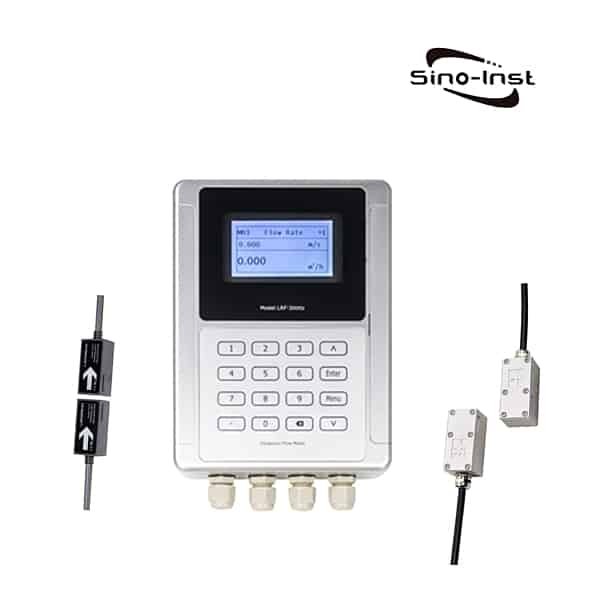
Of course, in addition to integrated installation. In-Line Ultrasonic Flow Meter can do split installation. According to the measurement conditions, different hosts can be selected.

Wall mounted 2000S1
Power supply:DC8~36V or AC85-264V

Wall mounted 2000S2
Power supply:DC8~36V or AC85-264V

Panel mounted 2000U
Power supply:DC 8~36V or AC85-264V

Module mounted 2000M
Power supply:DC 8~36V 

Wall mounted 2000S4
Power supply:DC8~36V or AC85-264V

Inline Ultrasonic Flow Meter Working Principle

Inline Ultrasonic Flow Meter is a meter that measures the flow of liquid in a round tube based on the principle of ” transit Time”. It adopts advanced multi-pulse technology, signal digital processing technology, and error correction technology. The flow meter can be more adapted to the environment of the industrial site, and the measurement is more convenient, economical, and accurate. The products have reached the advanced level at home and abroad and can be widely used in petroleum, chemical, metallurgy, electric power, water supply, and drainage fields.

Ultrasonic flowmeters are the same as electromagnetic flowmeters. Because the flow channel of the instrument is not equipped with any obstructions, it is an unobstructed flowmeter. It is a type of flowmeter suitable for solving difficult problems in flow measurement. Especially in large-diameter flow measurement. The advantages. It is one of the rapidly developing types of flow meters.

Transit Time Ultrasonic Flow Meter adopts the measurement principle of the time difference method. It uses the ultrasonic wave emitted by the sensor to propagate in the flowing fluid. The sound wave propagation speed in the downstream direction will increase, and the backward direction will decrease. In the same propagation distance, there will be different transmission times. According to the difference between the transmission time and the measured The relationship between fluid velocity measures the fluid velocity.

The flow rate of the fluid is different in different positions in the tube. The flow rate in the center of the tube is faster than the flow rate near the wall of the tube. The flow velocity distribution of the fluid in the pipeline can be represented by the flow velocity cross-sectional distribution diagram.

By setting the flowmeter and considering the cross-sectional distribution of the flow velocity, the average flow velocity can be calculated. Then the volume flow of the fluid can be obtained according to the cross-sectional area of the pipe.

Notes:
V measure fluid velocity
M ultrasonic reflection times
D pipe diameter
θ The angle between the ultrasonic signal and the fluid
T up The time when the downstream sensor transmits the signal to the upstream
T down Time from upstream sensor to downstream
ΔT = T up – T down

Guess You’ll Like: Ultrasonic flow meters types & technical guide

Pipe section In-line sensors

Pipe section sensor: The pipe section sensor is a measurement method in which the pipe section sensor is directly connected to the pipeline under test by using a flange or thread. This sensor solves the problem of man-made or measured pipelines during the installation of the external clamps and plug-in sensors. Errors caused by inaccurate parameters. It has the characteristics of high measurement accuracy, good stability, and maintenance-free.

Clamp-on ultrasonic flow meter

Clamp on Ultrasonic Flow Meter ( Model: 3000S) is composed of a host and an external clamp sensor. The flow measurement of various liquids can be completed by simply sticking the external clamp sensor on the surface of the pipeline. Compared with the traditional flowmeter, it does not need to cut off the pipe and flow, the installation is convenient and quick, and it truly realizes the lossless installation. Compared with the common TDC algorithm of other manufacturers, TGA measurement technology is an algorithm for measuring process time with higher speed and higher accuracy.

Extended reading: Ultrasonic flow detectors types

Insertion Ultrasonic Flow Meter

Insertion Flow Meter ( Model:2000S) solves the problem of signal attenuation when ultrasonic Clamp on flow meter works for a long time and the problem of fouling on the inner surface of the pipe without receiving the signal. It can be installed without stopping production. It can be applied to various pipes such as steel pipe, cast iron, FRP, PVC and cement pipe.

Read more about: Ultrasonic flow meters types & technical guide

Frequently
Asked
Questions

An inline flow meter is a flow meter with the function of displaying flow rate on-site. The sensor of the flow meter is installed on the fluid pipe. Digital display or pointer shows the flow rate on the spot.

In-line flowmeters could be digital and mechanical flow meters. Common in-line flowmeters include turbine flowmeters, electromagnetic flowmeters, and ultrasonic flowmeters. With stainless steel material, analog, and 4-20mA output, in-line flow meters can measure and control inline flow.

Read more: Choose the most suitable Inline flow meter

Instruments that measure fluid flow are collectively referred to as flow meters or flow meters. Flowmeter is one of the important instruments in industrial measurement. At present, there are more than 100 types of flow meters in use.

Each product has its specific applicability and its limitations. According to the principle of measurement, there are mechanical principles, thermal principles, acoustic principles, electrical principles, optical principles, and atomic physics principles.

Classified according to the structure principle of the flowmeter. There are positive displacement flowmeters, differential pressure flowmeters, float flowmeters, turbine flowmeters, electromagnetic flowmeters, vortex flowmeters, mass flowmeters, and plug-in flowmeters among fluid oscillating flowmeters.

According to the measurement object, there are two categories: closed pipeline and open channel; according to the measurement purpose, it can be divided into total measurement and flow measurement. The meters are called total meters and flow meters.

The common accuracy of ultrasonic flow meters supplied by Sino-Inst is 1%. It has been able to meet the measurement needs of most customers.

Classification of ultrasonic flowmeters

  1. According to the measurement principle

(1) Time difference method ultrasonic flowmeter;
(2) Frequency difference method ultrasonic flowmeter;
(3) Phase difference method ultrasonic flowmeter;
(4) Doppler ultrasonic flowmeter;
(5) Ultrasonic flowmeters for partially full pipes and river channels that combine liquid level measurement and average flow velocity measurement.

  1. According to the way of use

(1) Portable ultrasonic flowmeter;
(2) Fixed (standard pipe section) ultrasonic flowmeter.

  1. According to the installation method of the transducer

(1) Standard pipe section ultrasonic flowmeter;
(2) Clip-on ultrasonic flowmeter;
(3) On-site hole-opening plug-in ultrasonic flowmeter.

  1. According to whether the transducer is in contact with the fluid

(1) Immersion (contact) ultrasonic flowmeter;
(2) Non-invasive (non-contact) ultrasonic flowmeter.

  1. According to the nature of the measured fluid

(1) Liquid ultrasonic flowmeter;
(2) Gas ultrasonic flowmeter.

  1. According to the number of transducer channels

(1) Mono ultrasonic flowmeter;
(2) Two-channel ultrasonic flowmeter;
(3) Multi-channel ultrasonic flowmeter.

Flow indicator alias The flow indicator is a necessary accessory for observing the flow of the medium in the pipeline. The ability to observe the flow reaction of liquid, gas, steam and other media at any time is an indispensable accessory to ensure normal production. Flow indicators include threaded flow indicators, welded flow indicators, and flanged flow indicators.

Sino-Inst, Manufacturer for InLine Ultrasonic Flow Meters. It can measure a single sound-conducting liquid medium of DN32—6000mm. It can measure even liquids such as water, seawater, oil, and slurry.

Sino-Inst’s InLine Ultrasonic Flow Meter, made in China, Having good Quality, With better price. Our flow measurement instruments are widely used in China, India, Pakistan, the US, and other countries.

You may like:

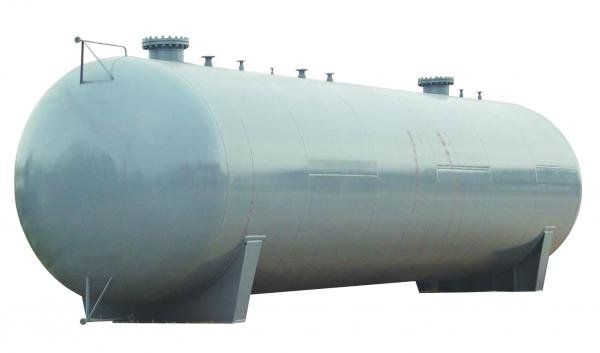
Inaccurate level measurement of liquid ammonia storage tank

The liquid level of the liquid ammonia storage tank is accurately measured, which can eliminate potential safety hazards.

Choosing a suitable monitoring instrument for liquid ammonia storage is a prerequisite for ensuring safe production. The main instruments in the liquid ammonia tank area include liquid level, temperature, pressure, toxic (flammable) gas alarms, etc. For tank farms where the system is rebuilt, and environments where wiring is difficult, wireless instrumentation solutions can be used.

This article analyzes the application problems of several common liquid ammonia storage tank level measuring instruments. So as to provide a basis for the selection of measuring instruments.

About Liquid Ammonia Storage Tank

Liquid ammonia is a common chemical raw material. To facilitate transportation and storage, gaseous ammonia is usually pressurized or cooled to obtain liquid ammonia. When liquid ammonia is dissolved in water, ammonium ion NH4+ and hydroxide ion OH- are formed, and the solution is alkaline. Liquid ammonia is mostly stored in pressure cylinders or steel tanks. Liquid ammonia is widely used in industry, is corrosive and easily volatile, so its chemical accident rate is very high.

Read more about: 7 Level Senors for Tank Level Measurement

Application Analysis of Common liquid Ammonia Storage Tank Level Measuring Instruments

External liquid level sensor

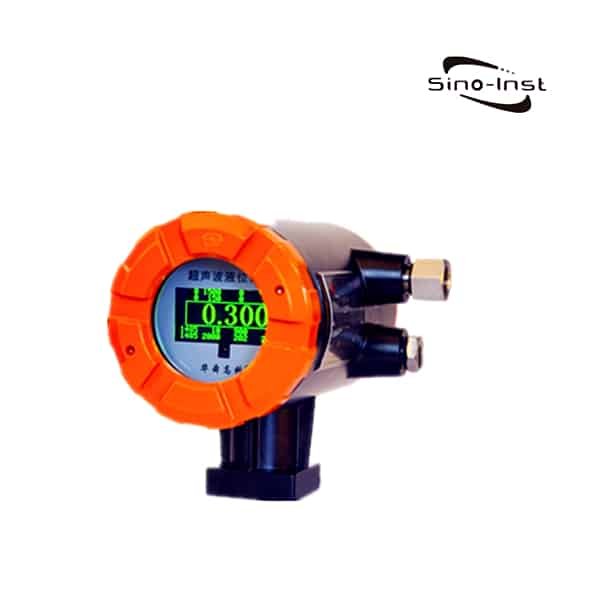
The external level gauge is an instrument that uses the sonar ranging principle and “micro-vibration analysis” technology to measure the level from the outside of the container. No need to make holes on the tank wall, no flanges, no fire, no tank cleaning. Do not touch the liquid and gas in the tank. It can realize online installation and maintenance. It is a completely non-contact isolated instrument.


HS-2000 External Mounted Ultrasonic Tank Level Sensor- (referred to as “external level gauge”). It adopts advanced signal processing technology and high-speed signal processing chip. It breaks through the influence of container wall thickness. Realizes the height of the liquid level in the closed container True non-contact measurement.

The ultrasonic liquid level sensor (probe) is installed directly under the outer wall (bottom) of the container under test. Calibrate the outer wall of the probe. There is no need to open holes for the container to be tested, easy to install, and does not affect production. It can accurately measure the level of various toxic substances, strong acids, strong alkalis and various pure liquids in high-pressure airtight containers. The HS-2000 External Mounted Ultrasonic Tank Level Sensor has no special requirements for the material of the liquid medium and the container. The explosion-proof design is adopted to meet the explosion-proof requirements.


The external liquid level sensor continuously and accurately measures the liquid level in the tank from outside the tank. No contact with the liquid and gas in the tank at all, realizing a true isolation measurement. Therefore, the characteristics are as follows:

  1. Isolated non-contact liquid level measurement technology is very safe.
  2. Installation and debugging, thereby reducing construction and maintenance costs.
  3. It is more reliable and durable. There are no mechanical moving parts in the measuring probe and host, and it is strictly sealed, isolated from the outside world, and will not be worn or corroded.
  4. Pass the “functional safety integrity” level certification.

Differential pressure transmitter

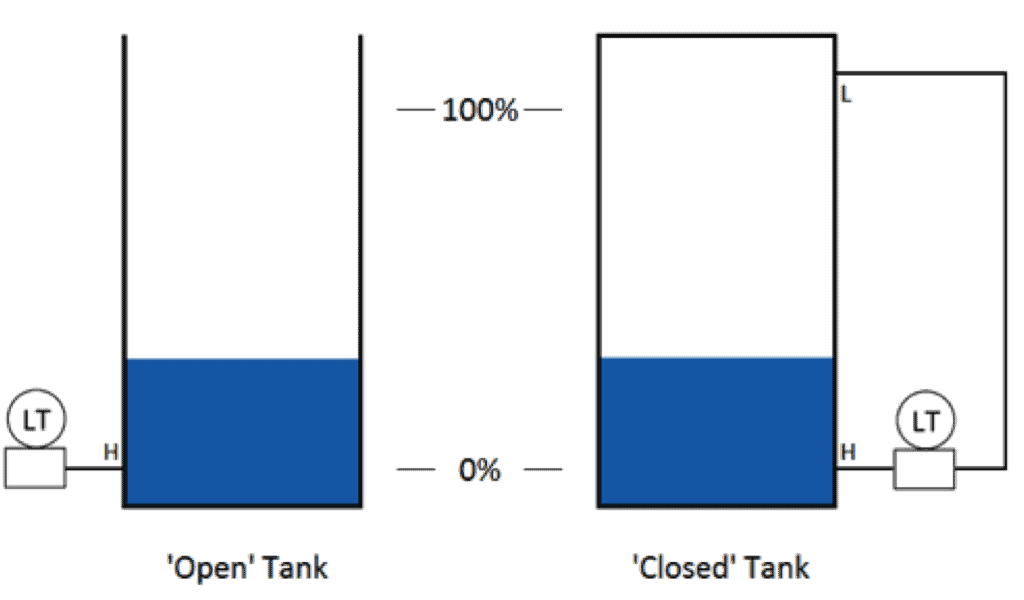
One end of the differential pressure transmitter is connected to the liquid phase, and the other end is connected to the gas phase. The liquid level of the liquid ammonia storage tank can be measured using the principle of hydrostatics.

In the process of applying this instrument and equipment, it is necessary to strictly control the installation height of the equipment.

Generally, it needs to be installed below the lower interface of the liquid level pressure interface of the container under test. And choose easy to maintain and observe. At the same time, it is also close to the pressure taking part.

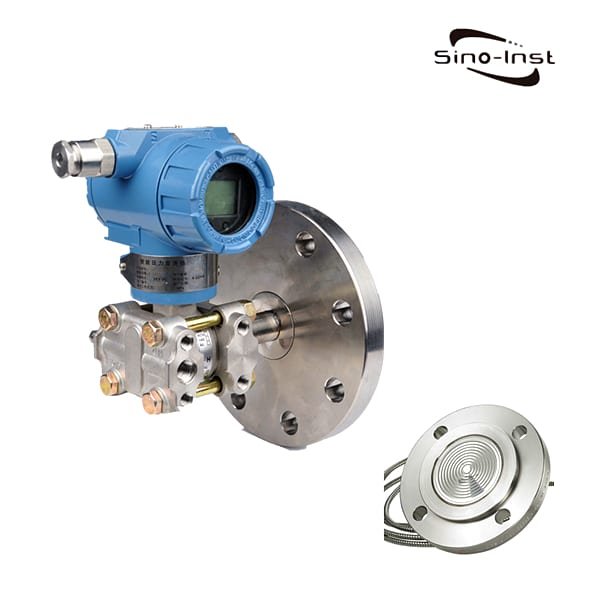
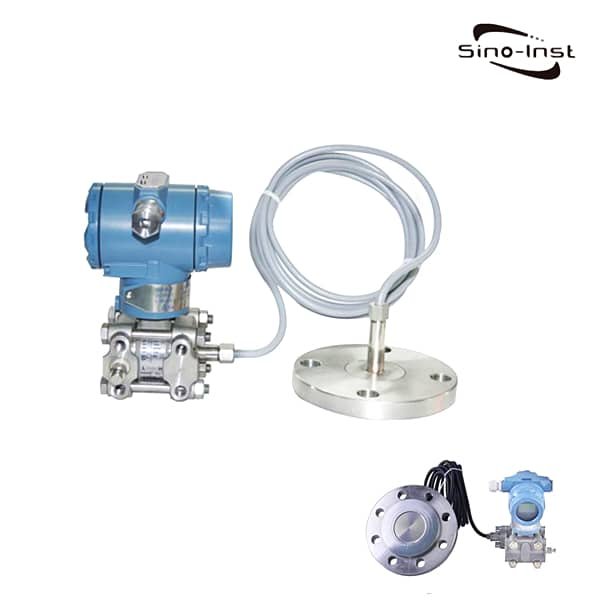
Taking into account the low boiling point and easy vaporization of liquid ammonia, it is necessary to use a double flange differential pressure transmitter to ensure the stability of the measurement signal.

If this device is used, the installation of the device will only be limited by the length of the capillary tube.

Specifically, it is necessary to take corresponding protection and insulation measures, and ensure that the bending radius of the capillary is greater than 50mm. When using this measuring instrument, if the installation elevation changes, the output value of the device will be affected.


Differential pressure(DP) level transmitter is often used as a tank level transmitter. The DP transmitter is connected with a stainless steel flange by capillary. Flange installation. The pressure is sensed by a remote transmission device installed on container. The pressure is transmitted to the body of the transmitter through the capillary. The transmitter convert the pressure or differential pressure to 4 ~ 20mA. The DC signal is output. It can communicate for the setting and monitoring by cooperating with the HART communicator. Explosion proof available.


From the application effect point of view, the differential pressure transmitter has the characteristics of easy calibration and a wide range of popularization. At the same time, the price of this type of equipment is low, and it has a certain cost-effective advantage.

However, when installing the device, it is necessary to reserve mounting holes. At the same time, due to the close relationship between the equipment and the density change of the medium, the measurement operation will cause the material of the instrument diaphragm to be corroded by the corrosive medium. After a long time of operation, the equipment is prone to deformation of the capsule.

In the application process, if there is no indication, the indication is too large or too small and the indication remains unchanged. It is also necessary to check the power supply, safety barriers, circuit boards, diaphragm capillaries and pressure valves. And appropriately replace the equipment components and open the equipment pressure valve in time.

Magnetic flap level gauge

The application of the magnetic flap level gauge follows the law of float and the principle of magnetism, and needs to be connected to the tank through a flange.

During the measurement, the two-color cylindrical magnetic float inside the device will change under the influence of the magnetic field, and the float junction is the actual liquid level of the storage tank.

In the process of installing the equipment, it is necessary to avoid magnetic materials around the equipment, and determine the heating temperature according to the medium condition. In the case of large gas-liquid-phase opening connections, a flange needs to be installed in the middle of the level gauge.

In the process of equipment debugging, a magnetic steel corrector is needed to adjust the magnetic column to white, and then open the gas phase stop valve and the liquid phase stop valve successively, and observe the liquid level rise and fall.

The magnetic flap level gauge can measure the liquid level and interface of any medium, and the equipment itself has the characteristics of convenient and intuitive installation.

However, if there are too many impurities in the medium, the magnetic column will not flip and the measurement will fail.

At the same time, the application of this device is prone to the problem of magnetic column jamming, which will lead to the failure of remote transmission instructions. However, the price of this equipment is low, and installation holes need to be reserved during installation.

The magnetic flap level gauge is prone to problems such as no signal output from the transmitter, no change in the output signal and the range cannot be adjusted to the corresponding value during the application process. In the application process, the power supply voltage, cables, terminal pins and safety barriers need to be checked.

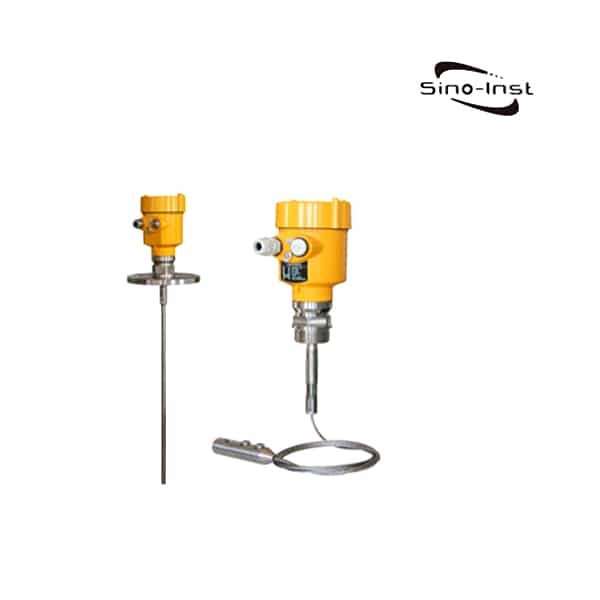
Cable guided wave radar liquid level sensor

The application of the cable guided wave radar level gauge follows the principle of travel time, and it is necessary to measure the distance from the reference point to the surface of the liquid ammonia by transmitting and receiving high-frequency pulse signals.

When installing the equipment, it is necessary to avoid the liquid ammonia inlet to prevent false reflections from the equipment.

When installing the sensor, it cannot be installed in the center of the tank, and the sensor must be kept away from the tank wall.

When installing the cable probe, the distance between the probe and the smooth metal wall should be greater than 50mm, the distance between the end of the probe and the bottom of the container should be greater than 0mm, and the diameter of the short tube should not be greater than 0mm. In addition, depending on the installation position, the offset of the cable probe may increase.


Guided wave radar is a measuring instrument based on the principle of time travel. The radar wave runs at the speed of light. The operating time can be converted into level signals by electronic components. The probe emits high-frequency pulses and propagates along the cable or rod probe. When the pulse meets the surface of the material, it is reflected back and received by the receiver in the instrument. And convert the distance signal into level signal. SIRD-701 Guided Wave Radar Level Sensor is suitable for liquid and Bulk Solids measurement, and complex process conditions.


The cable-type guided wave radar level gauge has the characteristics of direct contact with the medium and small measurement blind area, and the measurement accuracy is high.

However, this equipment is not suitable for measuring pressure vessels, and the price is relatively high. It is necessary to reserve mounting holes on the top of the equipment during installation.

From the point of view of application failures, the equipment may have failures such as incorrect DCS system configuration, cable probe failure, and unstable DCS display value.

In the application process, it is necessary to carry out on-site measurement before calibration, and it is not necessary to check whether the DCS configuration data is consistent with the actual measurement result in order to obtain the real data.

Before measurement, you need to clean the probe and increase the height of the empty tank appropriately to eliminate the effect of echo.

You may like:

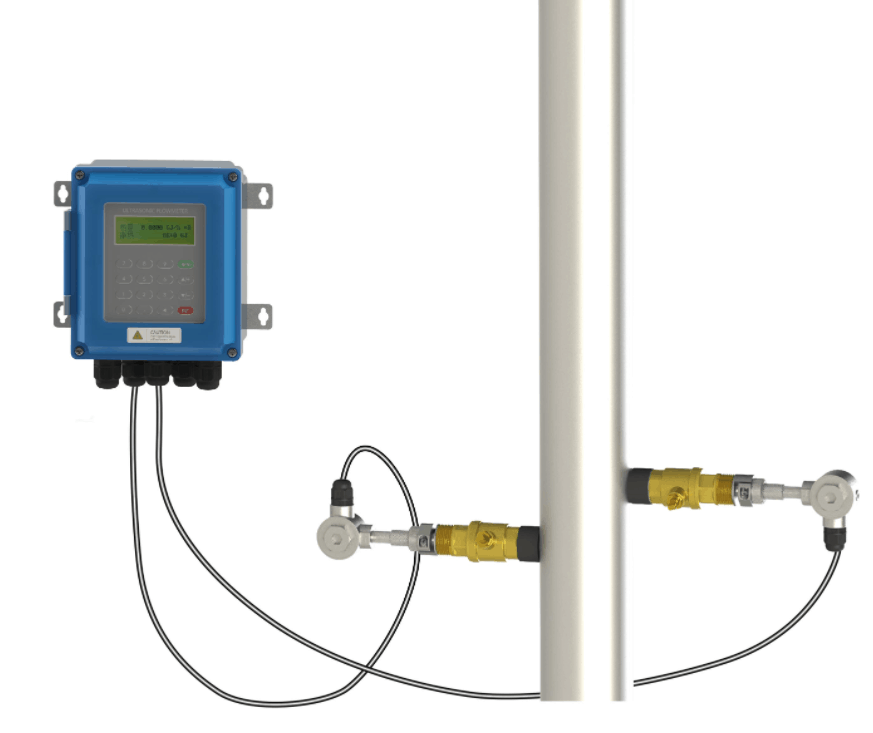
Insertion Type Ultrasonic Flow Meter TUF2000

What is Insertion Type Ultrasonic Flow Meter? Insertion Type Ultrasonic Flow Meter works on the principle of time difference. The transducers are inserted into the surface of the closed pipe.

The insertion type ultrasonic flowmeter is composed of a flowmeter host, a pair of insertion transducers and their accessories.

Insertion Type Ultrasonic Flow Mete can be a replacement for electromagnetic flowmeter on large diameter water flow pipes.

Features Of Insertion Type Ultrasonic Flow Meter

Insertion Type Ultrasonic Flow Meter is a type of ultrasonic flow. The same is the principle of using the time difference method. The form of the transducer has been changed, and the installation method has been changed to the insertion type. The debugging process and use effect are not much different from the clamp-on ultrasonic flowmeter.

Today we mainly introduce the advantages of Insertion Type Ultrasonic Flow Meter! It is divided into the following points:

  1. It can be installed online under pressure. During construction, the production pipeline does not need to be shut down, and there is no need to disconnect the pipe welding flange. Save the time and expense of using the unit;
  2. The product has low power consumption. The power supply is DC24V, and the power is 5W. It is safer to measure tap water, river water, sea water, etc.;
  3. The protection level of the converter is IP65. No screw design on the surface. The appearance is high-end and atmospheric. The service life of the button panel is more than 200,000 times;
  4. Sensor protection grade IP68. Can be immersed in water to work;
  5. 4~20mA current output. RS485 communication, standard MODBUS protocol. It can form a network by itself or connect to a GPRS module to realize remote data transmission;
  6. Independent menu operation, LCD backlight display. Data reading is clear at a glance;
  7. Daily, monthly and annual traffic accumulation functions;

Specifications of Insertion Type Ultrasonic Flow Meter

Item Performance and Parameter
Convertor Principle transit-time ultrasonic flowmeter
Accuracy Flow: over 1%-2%(battery-powered supply over ±2% ),Heat: over ±2%,Repeatability: over 0.2%
Display 2×20 character LCD with backlight, support the language of Chinese, English and Italy Convertor dimension:170*180*56cm
Operation Support 16 key light touch keyboard and the Simulation keyboard software
Signal Output 1 way 4~ 20mA output, electric resistance 0~ 1K,accuracy0. 1%
1 way OCT pulse output( Pulse width 6 ~ 1 0 0 0 ms,default is 2 0 0 ms)
1 way Relay output
Signal Input 3 way 4~ 20mA input, accuracy 0. 1%,acquisition signal such as temperature, press and liquid level
Connect the temperature transducer Pt100, can finish the heat/energy measurement
Data interface Insulate RS485 serial interface, upgrade the flow meter software by computer, support the MODBUS, METER-BUS etc.
Other Function Automatically remember the previous flow/energy data of 512 days,  128 months and 10 years
Automatically remember the previous flow/energy data of 512 days working condition and check it
Automatically remember the previous 32 times power on/off time and flow rate
Special Cable Twisted-pair cable, generally, the length under 50 meters; Select the RS485 communication. The transmission distance can over 1000m.
Pipe Condition Pipe Material Steel, Stainless steel, Cast iron, Copper, Cement pipe, PVC, Aluminum, Glass steel product, liner is allowed.
Pipe Diameter 32mm—6000mm
Straight length pipe Transducer installation should be satisfied: upstream10D, downstream 5D, 30D from the pump.
Measuring Medium Type of Liquid Water (hot water, chilled water, city water, sea water, waste water, etc.);  Sewage with small particle content; Oil (crude oil, lubricating oil, diesel oil, fuel oil, etc.);  Chemicals (alcohol, acids, etc.); Plant effluent; Beverage, liquid food; Ultra-pure liquids; Solvents and other liquids
Temperature Standard Transducer: -30–90℃; High-temperature transducer: -30–160℃
Turbidity No more than 10000ppm and less bubble
Flow rate 0–±12 m/s
Working Environment Temperature Main Unit: -20–60℃
Flow transducer: -40–160℃; 
Temperature transducer: according to the customer’s demands.
Humidity Main Unit: 85% RH; Flow Transducer: Ip67
Power Supply DC  24V or AC  85-264V
Power Consumption 1.5W

Read more about: What Is GPM In Flow Meter?

Optional Host

According to different installation condition, there are many models separated ultrasonic flowmeter for selection:

TUF-2000B Wall-mount-plastic
TUF-2000S Wall-mount-cast aluminum
TUF-2000U Panel-mount
TUF-2000M Modular host
TUF-2000D Explosion-proof
TUF-2000F2 Fixed Mounted

Optional transducer

Types Spec. Model Measurement Range Temperature Dimension
Insertion Standard TC-1 DN50~DN6000 -30~160℃ 190×80×55mm
Lengthen TC-2 DN80~DN6000 -30~160℃ 335×80×55mm

More about: Sewage Flow Meter Selection

Insertion Type Ultrasonic Flow Meter Applications

In terms of the measurement medium, the ultrasonic flowmeter can measure both conductive liquids, such as water, and non-conductive liquids, such as desalted water and pure water. There are also sewage, mud, ore pulp, paper pulp, chemical fiber pulp, corn syrup, fruit juice, alcohol, drugs, blood plasma and many other special media. As long as it is a single uniform and stable ultrasonic transmission liquid, it can be measured.

There are 5 conditions to use Insertion Type Ultrasonic Flow Meter:

  • When the pipe diameter is large, the pipe diameter is generally ≥DN80mm;
  • When there is a tight inner lining;
  • When the scale in the pipe is serious;
  • When the pipe is a poor conductor of ultrasonic;
  • When the external clamped ultrasonic flowmeter probe cannot reach the required signal strength or the measurement is unstable.

In the above cases, the use of Insertion Flow Meter can be considered.

insertion type ultrasonic flow meter installation

Insertion type ultrasonic flow meter installation needs to refer to the user manual we provide for step-by-step operation.

  1. Selection of installation method

    Insertion Type Ultrasonic Flow sensors are suitable for pipes above DN80mm, and are usually installed by Z method.
    Only when the installation space is not enough, the pipe smaller than DN200mm can be installed by V method. For pipes larger than DN200mm, parallel insertion sensors can be selected.

  2. Input the measurement parameters to get the installation distance;

    For parallel insertion sensors, the probe option is PI water meter probe: the included angle of the probe pipe is 0°; the length of the fluid in the static state is 0mm; the linear distance between the probes is optional between 200mm and 300mm, and finally determined by the actual installation results; single The contract delay time is 0μs.
    When using the Z method for standard Insertion sensors, the installation distance = inner diameter – 10mm.

  3. Mounting point positioning

    (1) Positioning of the Z method
    The positioning of the Z method must ensure the following two points:
    Installation distance = the vertical distance between two sensors along the pipe axis.
    Make sure that the two sensors are on the same axis (the connecting line of the two sensors passes through the axis).
    (2) Positioning of the V method
    The positioning of the V method must ensure the following two points:
    Installation distance = the vertical distance between two sensors along the pipe axis.
    Make sure both sensors are on the same level.
    (3) Positioning of parallel insertion sensors
    The positioning of the parallel insertion sensor should ensure the following two points:
    Installation distance = the vertical distance between two sensors along the pipe axis.
    Make sure that the two sensors are on the same level, and the insertion depth is 1/3 of the inner diameter of the pipe.

  4. Welded ball valve base;

    When the installation pipe is made of carbon steel, it can be directly welded and installed.
    For pipes that cannot be directly welded (such as cast iron, cement pipes, etc.), custom-made special pipe clamps (with sealing rubber pads) are required. The base of the ball valve has been welded on the pipe collar in advance, and the pipe collar is directly fastened to the pipe under test.
    Before welding, the surface of the pipeline near the welding spot must be cleaned. Be careful not to include air holes during welding to prevent water leakage or even breakage.

  5. Opening of pipeline under pressure

    Put the sealing gasket into the welded base, and then screw the special ball valve in, pay attention to compress the sealing gasket to prevent water leakage.
    Connect the sealing sheath of the hole opener with the external thread of the ball valve.
    After tightening, open the ball valve, push the drill pipe until it touches the outer wall of the pipe, connect the hand drill and the drill pipe and lock them, turn on the power, and start drilling.
    Keep the electric drill at a low speed during the drilling process, and the speed should not be too fast to avoid sticking the drill or even breaking the drill bit.
    After drilling through, pull out the drill pipe until the front end of the hole saw bit retreats behind the ball valve core. Close the ball valve and remove the hole opener.

  6. Calculation of insertion depth

    The Insertion sensor is precision-cast in a stainless steel mold, and the length of the sensor has been fixed before leaving the factory.
    Therefore, the insertion depth of the sensor probe rod is only related to the thickness of the pipe wall.
    The length of the probe rod of the standard insertion type sensor left outside the pipe is L=25mm-wall thickness, and the length of the probe rod of the extended insertion type sensor left outside the pipe is L=90mm-wall thickness.

  7. Probe Rod Installation

    Screw the sensor probe stem into the special ball valve. When screwing to the ball valve core, lightly tighten the lock nut to prevent water leakage. Open the ball valve and continue to screw in the sensor until the insertion depth of the sensor is L=25mm-wall thickness.

  8. Debugging of Insertion sensors

    When the waterproof joints of the two sensors are relatively inward, the emission angle of the sensor is correct.
    Then use the calculated insertion depth as a reference to rotate the probe slightly clockwise or counterclockwise to find the maximum value of signal strength and signal quality.
    Tighten the lock nut to prevent the probe stem from turning and water leakage.

  9. Check whether the installation is correct

    Check whether the sensor is installed correctly. If the installation requirements are met, the junction box can be potted with silica gel, and then the junction box sealing cover and the cable waterproof joint can be tightened to prevent water leakage.

Large Pipe Flow Meters

The cost of monitoring the flow in a large diameter pipe is very high. Today, modified intrusive and clip-on flowmeter technology can be used to measure flow in large pipelines. Using Insertion flow meters, it is possible to monitor the flow in pipes up to 6000 mm in diameter.

Of course, except for ultrasonic flow meters. There are other flow meters suitable for liquid flow in large-diameter pipes.

When measuring the liquid flow of large-diameter pipes, the following factors should be considered when selecting a flow meter:

  • The pressure loss should be as small as possible;
  • Due to the low flow rate (to reduce operating costs), the inner wall of the pipeline is easy to deposit dirt and sludge;
  • The measuring range of the flowmeter used should be particularly large to adapt to the disparity of browsing in different time periods;
  • The protection level of the flowmeter should also meet the requirements of the environment.

Extended reading: Magnetic Large Dia. Pipe Flow Meter

What is insertion type flow meter?

The insertion flow meter can provide a low-cost alternative to full-caliber flow equipment. Full-caliber flow equipment will take up a lot of space and require a lot of installation work. And there are special difficulties in service or calibration.

Drill a hole of appropriate size in the pipe wall. And a method of fixing the insertion gauge is adopted. This can be a saddle clamp, a welded threaded short tube, or a mating flange.

Then insert the Insertion sensor into the pipe to the depth recommended by the manufacturer. If on-site calibration is possible, the depth can be adjusted to improve accuracy.

Once the meter is fixed, it will only measure the speed at this time. And the volume flow cannot be calculated before considering the pipe diameter and the nature of the medium. Usually in the electronic flow computer/display unit.

More Ultrasonic Flow Measurement Applications and Markets

Ultrasonic Flow Detectors

Ultrasonic flow detectors are an important part of ultrasonic flow meters. Ultrasonic flow detectors are also called ultrasonic transducers. Ultrasonic…

If the insertion type of flowmeter is too troublesome to install. Then you can consider using a clamp-on ultrasonic flow meter. Simple and easy to use.

Sino-Inst, Manufacturer for Insertion Type Ultrasonic Flow Meter TUF2000. It can measure a single sound-conducting liquid medium of DN50 – 6000mm. It can measure even liquids such as water, seawater, oil, and slurry.

Sino-Inst’s Insertion Type Ultrasonic Flow Meter TUF2000, made in China, Having good Quality, With better price. Our flow measurement instruments are widely used in China, India, Pakistan, the US, and other countries.

Ultrasonic Clamp on Flow Meter

Ultrasonic Clamp on Flow Meter is composed of an integrated host and external clamp on sensors. Clamp on Flow Sensors are available at room temperature and high temperature.

Clamp on flow meter (Model: 2000) is composed of an integrated host and ultrasonic clamp on sensor. Clamp on flow meter is widely used in online flow measurement of various liquids. Just stick the external clamp sensor on the pipe surface. Compared with the traditional flowmeter, it does not need to cut off the pipe and flow. The installation is convenient and quick, and the non-destructive installation is truly realized.

Clamp on Flow Meter Reference price: USD 470.00/pc

Sino-Inst offers a variety of  Ultrasonic flow meters for flow measurement. If you have any questions, please contact our sales engineers.

Features Of Ultrasonic Clamp-on Flow Meter

  • High Accuracy measuring 
    • Linearity: better than 0.5%, Repeatability: better than 0.2%, Accuracy: better than ±1% 
  • Wide Measuring Range 
    • Several types transducer for selection, measuring pipe size from DN15mm to DN6000mm
  • English menu
    • Different version UFM can support English display, easy to operate
  • High Reliability
    • Adopt low voltage, multi-pulse technology to improve accuracy, useful life and reliability
  • Strong Anti-interference
    • Dual-balance signal differential receiver/driver circuit to avoid interference of converter, TV tower, high voltage line etc.
  • Powerful Recording Function
    • Automatically record the following data:
    • 1. The totalizer data of the last 512 days/128 months/5 years
    • 2. The time and corresponding flow meter of the last 64 times of power on and off events
    • 3. The working status of the last 32 days

Optional transducers for Ultrasonic Clamp on Flow Meter

Optional Host

According to different installation condition, there are many models separated ultrasonic flowmeter for selection:

Wall-mount-plastic
Wall-mount-cast aluminum
Panel-mount
Modular host
Explosion-proof
Fixed Mounted

Specifications of Ultrasonic Clamp on Flow Meter

Item Performance and Parameter
Convertor Principle transit-time ultrasonic flowmeter
Accuracy

Flow: over 1%-2%(battery-powered supply over ±2% ),Heat: over ±2%,Repeatability: over 0.2%

Display

2×20 character LCD with backlight, support the language of Chinese, English and Italy Convertor dimension:170*180*56cm

Operation Support 16 key light touch keyboard and the Simulation keyboard software
Signal Output

1 way 4~ 20mA output, electric resistance 0~ 1K,accuracy0. 1%

1 way OCT pulse output ( Pulse width 6 ~ 1 0 0 0 ms,default is 2 0 0 ms)

1 way Relay output
Signal Input

3 way 4~ 20mA input, accuracy 0. 1%,acquisition signal such as temperature, press and liquid level

Connect the temperature transducer Pt100, can finish the heat/energy measurement

Data interface

Insulate RS485 serial interface, upgrade the flow meter software by computer, support the MODBUS, METER-BUS etc.

Other Function Automatically remember the previous flow/energy data of 512 days,  128 months and 10 years
Automatically remember the previous flow/energy data of 512 days working condition and check it
Automatically remember the previous 32 times power on/off time and flow rate
Special Cable

Twisted-pair cable, generally, the length under 50 meters; Select the RS485 communication. The transmission distance can over 1000m.

Pipe Installation Condition Pipe Material

Steel, Stainless steel, Cast iron, Copper, Cement pipe, PVC, Aluminum, Glass steel product, liner is allowed.

Pipe Diameter 15mm—6000mm
Straight length pipe

Transducer installation should be satisfied: upstream10D, downstream 5D, 30D from the pump.

Measuring Medium Type of Liquid

Water (hot water, chilled water, city water, sea water, waste water, etc.);  Sewage with small particle content; Oil (crude oil, lubricating oil, diesel oil, fuel oil, etc.);  Chemicals (alcohol, acids, etc.); Plant effluent; Beverage, liquid food;  Ultra-pure liquids; Solvents and other liquids

More about: Sewage Flow Meter Selection

Temperature

Standard Transducer: -30–90℃; High-temperature transducer: -40–160℃

Turbidity No more than 10000ppm and less bubble
Flow rate 0–±12 m/s
Working Environment Temperature Main Unit: -20–60℃
Flow transducer: -40–160℃; 
Temperature transducer: according to the customer’s demands.
Humidity

Main Unit: 85% RH; Flow Transducer: Ip67

Power Supply DC  24V or AC  85-264V
Power Consumption 1.5W

Extended reading: Portable ultrasonic flow meter for water

Ultrasonic clamp on flow meter Pros and Cons

Advantages of Ultrasonic clamp on flow meter

  • The clamp on ultrasonic flowmeter is convenient to carry, easy to operate, intuitive to read data, and can memorize and save the read data;
  • The measurement liquid is relatively wide, including water, sea water, slurry or oil, acid and alkali and other homogeneous liquids;
  • Non-contact measurement method, light weight, small size;
  • The installation of the clamp-on ultrasonic flowmeter probe is simple, and probes of different sizes can detect pipes of different pipe diameters. Under the condition of ensuring accuracy, the clamp-on ultrasonic flowmeter can measure pipes with a minimum of DN15 and a maximum of DN3000. Pipeline
  • The external clamp ultrasonic flowmeter does not need to destroy the pipeline during the flow measurement process, and the probe can directly touch the straight pipe section without pressure loss, and the flow measurement can be performed on the installed pipe;
  • Suitable for measuring pipes of different materials. Common metal pipes (stainless steel, carbon steel, cast iron, etc.), plastic pipes, etc., and some pipes with better sound-transmitting materials.

Disadvantages of Ultrasonic clamp on flow meter

Because the temperature of the measured liquid is limited by the temperature resistance of the coupling material between the ultrasonic probe and the pipe, and the original data of the sound transmission velocity of the measured liquid at high temperature is incomplete. At present, the general ultrasonic flowmeter can only be used to measure the fluid below 200 ℃.

The measurement circuit of ultrasonic flowmeter is more complicated than that of general flowmeter. This is because the flow velocity of liquid in general industrial measurement is often a few meters per second, and the propagation speed of sound waves in the liquid is about 1500 m/s.

Therefore, the change of the measured fluid velocity (flow) has the greatest impact on the change of sound velocity, which is also on the order of 10-3. If the accuracy of measuring the flow velocity is required to be 1%, the accuracy of the measurement of the speed of sound needs to be 10-5~10-6 orders of magnitude. Therefore, a complete measurement circuit can be achieved.

This is the reason why ultrasonic flowmeters can only be applied in practice only under the premise of the rapid development of integrated circuit technology.

The measurement accuracy is not high enough. At present, the accuracy level of our ultrasonic flowmeters is generally level 1 or lower. Ultrasonic flow meters are greatly affected by external conditions. For example, high electric and magnetic fields near the measuring pipeline will affect the measurement of the ultrasonic flowmeter.

Read more about: Non-invasive Ultrasonic Tank Level Sensor Working Principle

Portable clamp on flow meter

The portable ultrasonic flowmeter ( Model: 3000H) uses a non-invasive sensor to measure liquid flow. The installation process is extremely simple. There is no need to destroy the pipeline during the measurement process and no need to stop production. The sensor is not in contact with the measured medium. Battery powered, small size, light weight and easy to carry. Realize the real sense of mobile flow measurement, online detection, is a real sense of portable ultrasonic flowmeter.

Handheld Ultrasonic Flow Meter

Handheld Ultrasonic Flow Meter ( Model:2000H) has been successfully applied to measurement work in various industries. The measuring range is 20-6000mm (0.5-20 inches). A non-contact measurement method is adopted. Flexible operation and easy to carry. Conductive or non-conductive, corrosive or non-corrosive liquids can be measured. Various fluids: water, pure water, sewage, sea water, chemical fluids, river water, fuel Oil etc. can be measured.
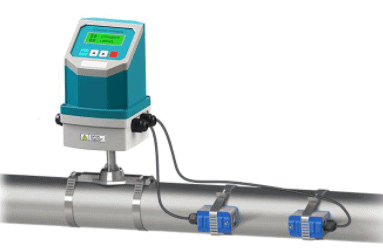
Check more 1 Inch Flow Meters.

Clamp on Ultrasonic Flow Meter

Clamp on Ultrasonic Flow Meter ( Model: 3000S) is composed of a host and an external clamp sensor. The flow measurement of various liquids can be completed by simply sticking the external clamp sensor on the surface of the pipeline. Compared with the traditional flowmeter, it does not need to cut off the pipe and flow, the installation is convenient and quick, and it truly realizes the lossless installation. Compared with the common TDC algorithm of other manufacturers, TGA measurement technology is an algorithm for measuring process time with higher speed and higher accuracy.

Clamp on liquid flow meter

The external clamp ultrasonic flowmeter can measure the flow rate of a single uniform liquid that can conduct ultrasonic waves, such as water, sea water, sewage, acid and alkali, alcohol, beer, various oils, etc.

Read more about Digital Beer Flow Meters for Sale|Brewery-Wine-Craft Beer Brewing Process management system 

Clamp on water flow meter

Clamp on water flow meter refers to the use of external clamp-on ultrasonic flow meters to measure water flow. Especially when other flow meters are not applicable.

For example, the flow measurement of ultrapure water equipment only uses an external clamp-type ultrasonic flowmeter.
why?

Ultra-pure water is non-conductive and has extremely high hygiene requirements, so the clamp-on ultrasonic flowmeter is the first choice. The general contact measurement and conductive medium measurement methods will be excluded. Let’s analyze it in detail below.

First, let’s take a look at the physical characteristics of pure water and ultrapure water. The filter cartridge of the ultra-clean filter device is made of pure polypropylene, and activated carbon is used to remove inorganic and organic trace pollution of ion exchange resin (nuclear grade) and adsorber resin. Dedicated ion exchange resin (nuclear grade) removes inorganic ions. After the adsorber resin removes dissolved organic matter. The pore size of the disinfection filter is 0.2um. The conductivity of pure water and ultrapure water obtained through such purification equipment: 0.055uS/cm. Bacteria content: 1CFU/ml, generally used in fields with high requirements such as biopharmaceuticals.

Secondly, we look at the application conditions of various flow meters.

In addition to measuring the volume flow of general conductive liquids, the electromagnetic flowmeter can also be used to measure the volume flow of strong corrosive liquids such as strong acids and alkalis and uniform liquid-solid two-phase suspension liquids such as mud, mineral pulp, and paper pulp. Since the conductivity of pure water is only 0.055, it cannot be measured.

Look at the turbine flowmeter again. Turbine flowmeter is a contact measurement, and pure water and ultra-pure water have particularly high requirements for materials, so the main material must be 316L when manufacturing, and the use of sanitary clamp joints will increase the production cost immediately.

Clamp on water flow meter is a non-contact meter. It can not only measure the flow of medium with large pipe diameter, but also can be used to measure the medium that is not easy to touch and observe. Its measurement accuracy is very high, and it is almost free from the interference of various parameters of the measured medium. In particular, it can solve the flow measurement problems of strong corrosive, non-conductive, radioactive and flammable and explosive media that other instruments cannot.

In summary, the ultrasonic flowmeter is the best choice for the flow measurement of the purified water equipment in the ultrapure water system.

FAQ

The clamp-on flow meter is a flow meter with an external clamp-on flow sensor. Most flow meters are in-line pipe section mounts. The Clamp-on flow meter is a flow meter that only needs to be clamped on the outside of the pipe to measure the flow rate. This is important for many pipes that cannot be cut and bored.

The installation of the ultrasonic flow meter needs to be done according to the operating instructions of the ultrasonic. Because of different forms of ultrasonic flowmeter, the installation method is also different.

Sino-Inst supplies ultrasonic flow meters with an accuracy of mostly 1%. This accuracy can meet the needs of most users. Of course, there are other flowmeters with higher accuracy. For example, 0.5% electromagnetic flowmeter.

Users can choose according to your measurement requirements.

Sino-Inst, Manufacuturer for Ultrasonic Clamp on Flow Meters. It can measure a single sound-conducting liquid medium of DN 25—1200mm. It can measure even liquids such as water, sea water, oil, and slurry.

Sino-Inst’s Ultrasonic Clamp on Flow Meter, made in China, Having good Quality, With better price. Our flow measurement instruments are widely used in China, India, Pakistan, US, and other countries.
Clamp on Ultrasonic Flow Meter

Clamp on Ultrasonic Flow Meter is a wall-mounted ultrasonic flow meter using TGA time difference technology. TGA is an algorithm for measuring process time with higher speed and accuracy.

Clamp on Ultrasonic Flow Meter ( Model: 3000S) is composed of a host and an external clamp sensor. The flow measurement of various liquids can be completed by simply sticking the external clamp sensor on the surface of the pipeline. Compared with the traditional flowmeter, it does not need to cut off the pipe and flow, the installation is convenient and quick, and it truly realizes the lossless installation. Compared with the common TDC algorithm of other manufacturers, TGA measurement technology is an algorithm for measuring process time with higher speed and higher accuracy.

Clamp on Ultrasonic Flow Meter Reference price: USD 870.00/pc

Sino-Inst offers a variety of  Ultrasonic flow meters for flow measurement. If you have any questions, please contact our sales engineers.
Features of Clamp on Ultrasonic Flow Meter

Compared with other conventional flowmeters, the LRF-3000S ultrasonic flowmeter has the following characteristics in addition to the flexibility of on-site installation, high response speed and better measurement capability under low flow rates:

  1. Use an independent high-performance FPGA chip with 400,000 gate arrays. The measurement rate can be greater than 300 times per second. Compared with other brands, it has a great improvement in the resistance to air bubbles in the measurement pipe diameter. It can withstand continuous bubbles for up to 5 seconds.
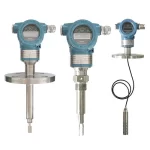
  2. Increased signal strength. It has greater penetrating power to various scales, rust in the pipe and the inner lining of the pipe.
  3. 4-line LED display. Easy to operate.
  4. The sensor adopts our unique manufacturing process and matching technology. The zero point range can be controlled within 0.03m/s. The static time difference between each pair of sensors is less than 2 nanoseconds. This effectively guarantees the authenticity of the measured time difference.

Specifications of Clamp on Ultrasonic Flow Meter

Performance specification
Flow range 0 ~ ±12m /s (0~ 40ft /s)
Accuracy 1.0% of measured value
Repeatability 0.20%
Pipe Size DN25~DN1200mm
Function Specification
Outputs Analog output: 4~20mA, max load 750Ω.
Pulse output: 0~10KHz
Power Supply 10 ~ 36VDC or 10~24VAC
Keypad 16 keys(4X4) touch keys
Display 240*128, 4-line LCD display
Temperature Transmitter: -14℉~140℉(-20℃~60℃)
Transducer:-40℉~176℉(-40℃~80℃,TT01  ,Standard)
Transducer:-40℉~266℉(-40℃~130℃,TT03  ,High Temp)
Physical specification
Transmitter PC+ABS, IP65
Transducer Encapsulated design,IP68
Double-shielded transducer cable
Standard/maximum cable length:30ft/1000ft(9m/300m)
Packaging 20*22*23.5cm, 3.0kg

External clamp sensor:

  1. The signal cable and sensor are manufactured in one piece without wiring;
  2. Hidden tube tie design, more stable and beautiful after installation;
  3. A pair of sensors can achieve DN25-DN1200mm measurement to meet the use of a larger range of pipe diameters;
  4. Protection grade IP68, can work underwater without water ingress.

Clamp on Ultrasonic Flow Meter Working Principle

Clamp on Ultrasonic Flow Meter adopts the measurement principle of time difference method. It uses the ultrasonic wave emitted by the sensor to propagate in the flowing fluid. The sound wave propagation speed in the downstream direction will increase, and the backward direction will decrease. In the same propagation distance, there will be different transmission times. According to the difference between the transmission time and the measured The relationship between fluid velocity measures the fluid velocity.

The flow rate of the fluid is different in different positions in the tube. The flow rate in the center of the tube is faster than the flow rate near the wall of the tube. The flow velocity distribution of the fluid in the pipeline can be represented by the flow velocity cross-sectional distribution diagram.

By setting the flowmeter and considering the cross-sectional distribution of the flow velocity, the average flow velocity can be calculated. Then the volume flow of the fluid can be obtained according to the cross-sectional area of the pipe.

Notes:
V measure fluid velocity
M ultrasonic reflection times
D pipe diameter
θ The angle between the ultrasonic signal and the fluid
T up The time when the downstream sensor transmits the signal to the upstream
T down Time from upstream sensor to downstream
ΔT = T up – T down

Guess You’ll Like: Ultrasonic flow meters types & technical guide

Clamp on water flow meter

Clamp on water flow meter means to measure the water flow rate by clamping the ultrasonic flowmeter sensor outside the pipe. The sensor is non-invasive. Of course, according to the actual requirements of the measurement, it can be fixed or portable.

So, why are we willing to use Clamp on ultrasonic flowmeter to measure the flow rate of water?

There are many types of flow meters for measuring water. Common ones are: V cone flowmeter, electromagnetic flowmeter, metal rotor flowmeter, vortex flowmeter, liquid turbine flowmeter, ultrasonic open channel flowmeter, ultrasonic flowmeter, etc.

There are many types of flow meters for measuring water. Common ones are: V cone flowmeter, electromagnetic flowmeter, metal rotor flowmeter, vortex flowmeter, liquid turbine flowmeter, ultrasonic open channel flowmeter, ultrasonic flowmeter, etc.

Advantages of Clamp on water flow meter for water measurement:

  1. External clamp installation, without damaging the pipeline. easy and convenient.
  2. It is convenient to measure ultra-small and ultra-large pipes. As small as Φ9.5. As large as DN6000.
  3. Electromagnetic flowmeter is used to measure the volume flow of conductive liquid with conductivity greater than 5μS/cm. Then other water flow with conductivity less than 5μS/cm can be measured with ultrasonic clamp on water flow meter. For example, ultrapure water.
  4. For pure water, drinking water, etc., it is necessary to keep clean and hygienic. If contact flow meters such as turbine flow meters and orifice flow meters are used, the material must be strictly required. At least 316SS material is required. Then the cost of the contact flowmeter will be very high.

Read more about: Non-invasive Ultrasonic Tank Level Sensor Working Principle

Portable clamp-on ultrasonic flow meter

The portable ultrasonic flowmeter uses a non-invasive sensor to measure liquid flow. The installation process is extremely simple. There is no need to destroy the pipeline during the measurement process and no need to stop production. The sensor is not in contact with the measured medium. Battery powered, small size, light weight and easy to carry. Realize the real sense of mobile flow measurement, online detection, is a real sense of portable ultrasonic flowmeter.

Handheld Ultrasonic Flow Meter has been successfully applied to measurement work in various industries. The measuring range is 20-6000mm (0.5-20 inches). A non-contact measurement method is adopted. Flexible operation and easy to carry. Conductive or non-conductive, corrosive or non-corrosive liquids can be measured. Various fluids: water, pure water, sewage, sea water, chemical fluids, river water, fuel Oil etc. can be measured.

Sino-Inst, Manufacuturer for Clamp on Ultrasonic Flow Meter. It can measure a single sound-conducting liquid medium of DN 25—1200mm. It can measure even liquids such as water, sea water, oil, and slurry.

Sino-Inst’s Clamp on Ultrasonic Flow Meter, made in China, Having good Quality, With better price. Our flow measurement instruments are widely used in China, India, Pakistan, US, and other countries.

Ultrasonic Flow Meters

The ultrasonic flow meter measures the liquid flow rate quickly and effectively. There are two types of ultrasonic flowmeter technology: Doppler frequency shift and transit time.

Transit time ultrasonic flow meter is most suitable for measuring the flow of cleaning liquid. Therefore, it is the most popular type of ultrasonic meter.

Doppler ultrasonic flow meter can measure the frequency difference of sound waves reflected from bubbles or particles in the airflow. It is suitable for aerated or dirty liquids.

Sino-Inst offers a variety of  Ultrasonic flow meters for flow measurement. If you have any questions, please contact our sales engineers.

Featured Ultrasonic Flow Meters for Liquids

Transit time Ultrasonic Flow Meter Working Principle

Transit time Ultrasonic Flow Meter adopts the measurement principle of time difference method. It uses the ultrasonic wave emitted by the sensor to propagate in the flowing fluid. The sound wave propagation speed in the downstream direction will increase, and the backward direction will decrease. In the same propagation distance, there will be different transmission times. According to the difference between the transmission time and the measured The relationship between fluid velocity measures the fluid velocity.

The flow rate of the fluid is different in different positions in the tube. The flow rate in the center of the tube is faster than the flow rate near the wall of the tube. The flow velocity distribution of the fluid in the pipeline can be represented by the flow velocity cross-sectional distribution diagram.

By setting the flowmeter and considering the cross-sectional distribution of the flow velocity, the average flow velocity can be calculated. Then the volume flow of the fluid can be obtained according to the cross-sectional area of the pipe.

Notes:
V measure fluid velocity
M ultrasonic reflection times
D pipe diameter
θ The angle between the ultrasonic signal and the fluid
T up The time when the downstream sensor transmits the signal to the upstream
T down Time from upstream sensor to downstream
ΔT = T up – T down

Guess You’ll Like: Ultrasonic flow meters types & technical guide

Ultrasonic Doppler Flow Meter Working Principle

Ultrasonic Doppler Flow Meter uses the physical principle of Doppler frequency shift to measure the water flow velocity.

Doppler effect (Doppler frequency shift) principle:
The sound waves emitted by one object are received and reflected by another object. If the object emitting the sound wave is moving relative to the receiving object. The frequency of the sound wave received by the receiving object will be different from the frequency of the emitted sound wave.

If the relative distance between two objects is reduced, the received frequency will increase.
If the relative distance between two objects is increased, the received frequency will decrease.

Such Doppler effects often occur in daily life. For example: when you hear the sirens (sounds) of an oncoming police car. The sound will appear higher in frequency. When the police car is far away from you, the sound it hears will become lower.

Through the difference between the frequency of transmitting ultrasonic waves and the frequency of receiving ultrasonic waves, the specific flow rate can be calculated. Then the water level is measured by the pressure sensor, and the water passing area is calculated from the water level and channel size.
Finally, the velocity and area are integrated to calculate the final instantaneous flow.

Calculation formula:
Velocity × water area × 3600 seconds = instantaneous flow rate (cubic meters/hour)

Ultrasonic Open channel flow meter working principle

The open channel flowmeter is based on the specific shape of the Parshall metering groove/weir plate metering groove. It guarantees a certain liquid level and knows a certain flow rate. The Parshall groove/weir plate metering groove is selected as the specific flow channel. The measurement accuracy is high. Easy to install.

The sensor measures the height of the liquid level, which is processed by 89C52 series single-chip microcomputers to obtain the instantaneous flow and cumulative flow values.

The flow can be expressed by the following formula:
  Q=KHn
  Q: Instantaneous flow rate (t/h)

K: Flow rate constant
  H: height of liquid level n: nth power value

The instantaneous flow is processed by the cumulative accumulation to obtain the cumulative flow.

Read more about: Liquid Flow Meters Guide

Sino-Inst, Manufacturer for Ultrasonic Flow Meters. It can measure a single sound-conducting liquid medium of DN 25—150mm. It can measure even liquids such as water, sea water, oil, and slurry.

Sino-Inst’s Ultrasonic Flow Meter, made in China, Having good Quality, With better price. Our flow measurement instruments are widely used in China, India, Pakistan, US, and other countries.

Precession Vortex Gas Flowmeter

Precession vortex flowmeter is a new type of gas flowmeter. It can be used for the measurement of natural gas, propane, air, nitrogen and other gases.

Precession Vortex Gas Flowmeter, like vortex flowmeter, is a velocity flowmeter. The cost performance of the intelligent precession vortex flowmeter is higher than vortex flowmeter. The intelligent precession vortex flowmeter can only measure gas. Precession Vortex Gas Flowmeter can be made into an integrated temperature and pressure compensation. And can measure various gases. Such as compressed air, oxygen, biogas, natural gas, coal gas, etc.

Precession Vortex Gas Flowmeter reference price: DN50, USD 600.00/pc.

Sino-Inst offers a variety of flow meters for flow measurement. If you have any questions, please contact our sales engineers.

Features of Precession Vortex Gas Flowmeter

  • No mechanical moving parts, not easy to corrosion, stable and reliable, long life, long-term operation without special maintenance;
  • 16 bit computer chip, high integration, small size, good performance, strong function;
  • The intelligent flowmeter integrates flow probe, microprocessor, pressure and temperature sensor into one, and adopts built-in combination to make the structure more compact, which can directly measure the flow, pressure and temperature of the fluid, and automatically real-time tracking compensation and compression factor correction;
  • Double probe detection technology, new sensor processing technology and reasonable installation method are adopted to greatly improve the signal strength, so that the sensor can accurately detect the signal and suppress the interference caused by pipeline vibration.
  • Adopt the domestic leading intelligent anti-seismic technology, effectively restrain the disturbance signal caused by vibration and pressure fluctuation;
  • The Chinese character dot matrix display screen is adopted, which can display the volume flow under working state, volume flow under standard state, total volume, medium pressure, temperature and other parameters directly.
  • The converter can output frequency pulse, 4 ~ 20mA analog signal, and has RS485 interface, can be directly connected to the computer network, transmission distance up to 1.2km;
  • With signal transfer output of several physical parameters, users can choose any of them.
  • Pressure and temperature signals are the input mode of the sensor with strong interchangeability.
  • The power consumption of the whole machine is low, which can be supplied by built-in battery or external power supply.

Specifications of Precession Vortex Gas Flowmeter

Inside nominal
diameter
DN (mm)
Range of
 flow
(m3/h)
Nominal pressure
(Mpa)
Pressure
 loss
(kpa)
Class of
accuracy
Repetitive Shell material
15 0.6~12 1.6
2.5
4.0
6.3
10.0
16.0
25.0
△P=ρ/1.205×PN 1.0
1.5
Less than the base error limit is definitely  worth 1/3 Aluminum alloy 304
stainless  Steel
20 1~15
25 2~40
32 3~70
40 4~80
50 6~130
65 8~400
80 15~500
100 40~1000
125 50~1200
150 100~2000
200 360~3600

Further reading: Industrial LPG/Propane flow meter

Vortex Flowmeter VS. Precession Vortex Flowmeter

The common point of precession vortex flowmeter and vortex flowmeter

  • Both flow meters are velocity flow meters;
  • Both flow meters can be made into a temperature and pressure compensation system, and can measure various gases, such as compressed air, oxygen, biogas, natural gas, coal gas, etc.;
  • Both flowmeters have no mechanical moving parts, are not easy to be corroded, are stable and reliable, have a long life, and do not require special maintenance for long-term operation;
  • The highest accuracy of both flowmeters can reach 1.0%.

Biogas Flow Meters Selection Guide

The difference between precession vortex flowmeter and vortex flowmeter

  • The working principles of the two flow meters are different;
  • The intelligent precession vortex flowmeter can only measure gas, while the intelligent vortex flowmeter can also measure liquid and steam;
  • The maximum caliber of the intelligent precession vortex flowmeter can only achieve 200 caliber, while the maximum caliber of the intelligent vortex flowmeter can achieve 1000 caliber, of which 300-1000 is a plug-in type;
  • The cost performance of the intelligent precession vortex flowmeter is higher than that of the intelligent vortex flowmeter;

Precession Vortex Gas Flowmeter Structure

Flow meter is composed by below parts:

  1. Swirl generation body
    Made by aluminium alloy, with certain angle screw blades, it is fixed in front of the housing contraction, then press the fluid and generate strong swirl flow.
  2. Housing
    It has flange itself, and with certain shape fluid channel, according to different working pressure, the housing could adopt cast aluminium alloy or stainless steel.
  3. Intelligent flow totalizer
    It is combined of temperature, pressure testing analogue channel, flow testing no. Channel and micro processing unit, LCD drive circuit and other assistant circuit, with the extermal output interfernce.
  4. Temperature sensor
    Use the PT100 platinium resistance as the temperature sensitive element, under certain temperaure range, the resistance and temperature is correspond with each other.
  5. Pressure sensor
    Use the diffused silicon piezoresistive type bidge road as the sensitive element, the bridge arm
    resistance will happen some expected change under pressure effect, under certain excitation current, the two output terminal potential difference in proportion to the outer pressure.
  6. Piezocrystal flow sensor
    It is installed at the throat near the housing contraction section, it could test the frequency of swirl.
  7. Clear swirl part
    It is fixed at the housing exit section, the function is clear the swirl and decrease the influence to the downstream instruments performance.

Precession Vortex Gas Flowmeter Working Principle

The flow profile of the Precession Vortex Gas Flowmeter is similar to the profile of a Venturi tube.

A set of spiral guide vanes are placed on the inlet side. When the fluid enters the flow sensor, the guide vane forces the fluid to produce a violent vortex. When the fluid enters the diffusion section, the vortex flow is affected by the backflow and starts to rotate twice. A gyroscopic vortex precession phenomenon is formed.

The precession frequency is proportional to the flow rate and is not affected by the physical properties and density of the fluid. The second rotation precession frequency of the fluid measured by the detecting element can obtain good linearity in a wide flow range.

The signal is amplified, filtered and shaped by a preamplifier and converted into a pulse signal proportional to the flow rate. Then, together with the detection signals of temperature and pressure, they are sent to the microprocessor for integration processing. Finally, the measurement result is displayed on the LCD screen. Including instantaneous flow, cumulative flow and temperature and pressure data.

Precession Vortex Gas Flowmeter Flow Totalizer Working Principle:

Flow totalizer is combined with temperature,pressure testing analogue channel, flow sensor channel and micro processing unit, and with the external output signal interface, with many output signals, the micro processor in the flow meter will carry out the temperature and pressure compensation according to gas state equation, and carry out the compress factor amendment. The gas state equation as below:

In the formula:
QN ——flow volume under standard condition. (m3/h);
QV ——flow volume under working condition. (m3/h);
Pa ——local atmospheric pressure(KPa);
P ——flow meter tapping hole measured meter pressure(KPa);
PN ——atmospheric pressure under standard condition.(101.325 KPa);

TN ——absolute temperature under standard conditions.(293.15K);
T ——the absolute temperature of measured fluid.(K);
ZN ——the gas compression factor under standard condition. ;
Z ——the gas compression factor under working conditions;
Note: when use the bell jar or negative pressure calibrate, use ZN/Z=1, for natural gas (ZN/Z)1/2=FZ is super compression factor, calculated according to the China National Petroleum Corporation standard SY/T6143-1996 formula.

Gas Flow Meter Types

The gas flow meter is a precision instrument used to measure the cumulative flow of gas in the pipeline. There are three main methods for flow measurement:

  • Positive displacement flow meters, such as diaphragm gas meters, Roots flow meters, etc., accurately measure and settle the gas by rotating the volumetric volume.
  • A velocity gas flow meter that measures the volume of fuel gas by the gas flow rate.
  • The way of gas measurement by pressure difference.
  1. Velocity flow meter
    Velocity flow meters are a type of flow meters based on the principle of directly measuring the flow velocity of a full pipe in a closed pipeline.
    Turbine flowmeter
    Vortex flowmeter
    ③ Precession vortex flowmeter
    ④ Time difference ultrasonic flowmeter
  2. Positive displacement flow meter
    Roots flowmeter (gas lumbar flowmeter)
  3. Differential pressure flowmeter
    Orifice flowmeter
    Venturi flowmeter

Read more about: Industrial Gas Measurement with Digital Gas Mass Flow Meters

Gas flow meter calibration

When using a gas flow meter, due to the influence of the error factors caused by the working conditions and environmental changes. After the uncertainty analysis and the verification of the field experiment data, to meet the requirements of the field use, it is necessary to perform the gas flow meter calibration.

How to calibrate the gas flow meter?

Work status check:
According to the requirements of the gas flowmeter instruction manual. First, check to determine whether the gas flowmeter is working properly.

According to the gas flowmeter calibration certificate or factory calibration sheet, check whether the input of the key parameters affecting the measurement accuracy in the converter is correct.

For pipelines with stopped flow conditions, check the zero flow of the flowmeter.

Remote calibration requires that the gas flow meter must be removed and sent to the secondary or primary flow standard for calibration, and then these new calibration factors are input to the existing data acquisition system.

Although remote calibration may provide higher accuracy. However, from a systematic point of view, this method may not be accurate and true, and it is expensive and laborious to operate.

What are the requirements for gas flow meter calibration?

If the flow conditions can be estimated, then the gas flowmeter can be calibrated under conditions different from the operating conditions. The parameter used to estimate the flow conditions is usually a number with respect to the inlet diameter of the gas flowmeter.

First, convert the operating condition range to a number range.

Secondly, the selected calibration equipment must meet the specified number range.

Then, calibrate under different pressure conditions or using different gases.

Within a certain accuracy level, the characteristics of standard differential pressure gas flow meters are well known. Likewise, the characteristics of certain types of turbine gas flow meters are also known.

In some cases, it is necessary to perform several tests before the final calibration to verify whether the gas flowmeter is operating in compliance with the calibration coefficient.

In the future, some work needs to be done to identify the performance of the vortex baffle gas flowmeter, and to determine the performance of the ultrasonic gas flowmeter and the complementary gas flowmeter in the case of high-pressure gas.

Gas flow turbine meter

Gas turbine flow meter is a velocity flow meter that measures gas flow. For natural gas, nitrogen, and gas trade measurement.

The gas turbine flowmeter integrates temperature, pressure, flow sensors and intelligent flow totalizers. The gas turbine flowmeter has high accuracy and good repeatability, so it is suitable for trade measurement and industrial process detection. It is widely used in many kinds of gas in petroleum, chemical, metallurgy, aviation, scientific research and other sectors and industrial fields. Such as natural gas, city gas, propane, butane, air, nitrogen and other gases measurement.

Gas Turbine Flow Meter reference price: USD900-2500/pc

Further reading: Nitrogen(N2) Flow Meter Types

Natural gas flow meter

Natural gas flow meter is mainly used for inline measurement of natural gas flow. Natural gas flow meter is mainly used for industrial production and trade settlement.

At present, the flowmeter products used for natural gas flow measurement roughly include: gas waist wheel flowmeter, gas turbine flowmeter, precession vortex flowmeter, thermal mass flowmeter, vortex flowmeter, ultrasonic flowmeter and orifice flowmeter Wait. Let’s make a simple comparison on the use of these flow meters.

Extended reading: 5 matters to pay attention to when choosing threaded Vortex Nitrogen Gas Flow Meter

LPG gas flow meter

LPG flow meter is used for flow measurement of liquefied petroleum gas. The flow measurement of LPG is very important in industrial production, transportation and trade settlement.

LPG gas (Liquefied petroleum gas) is a kind of hydrocarbon with propane and butane as its main components. LPG is used for heating, motor fuel, industrial applications and in agriculture. LPG can be in a gas or liquefied state. Different type industrial LPG flow meters with accurate and reliable performance. Such as thermal dispersion flow meter, Coriolis flow meter, gas turbine flow meter, vortex flow meters.

💡Industrial Propane Tank Level Indicators for Industrial Tank Level Measurement

Sino-Inst, Manufacuturer for Precession Vortex Gas Flowmeters.

Sino-Inst’s Precession Vortex Gas Flowmeters, made in China, Having good Quality, With better price. Our flow measurement instruments are widely used in China, India, Pakistan, US, and other countries.