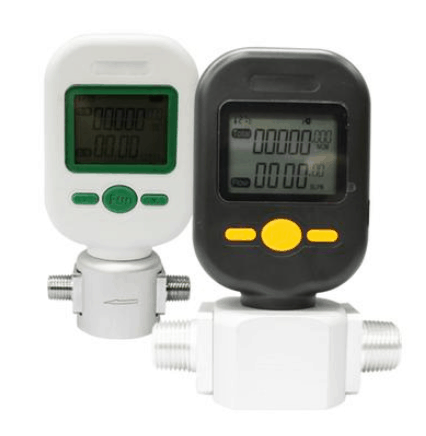
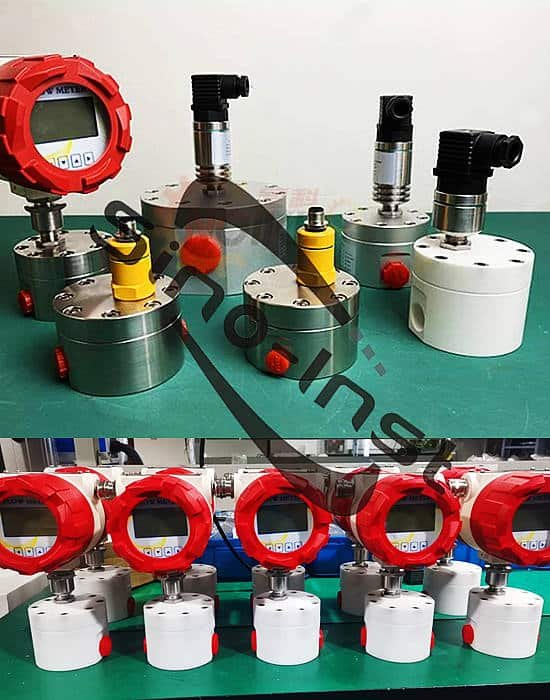
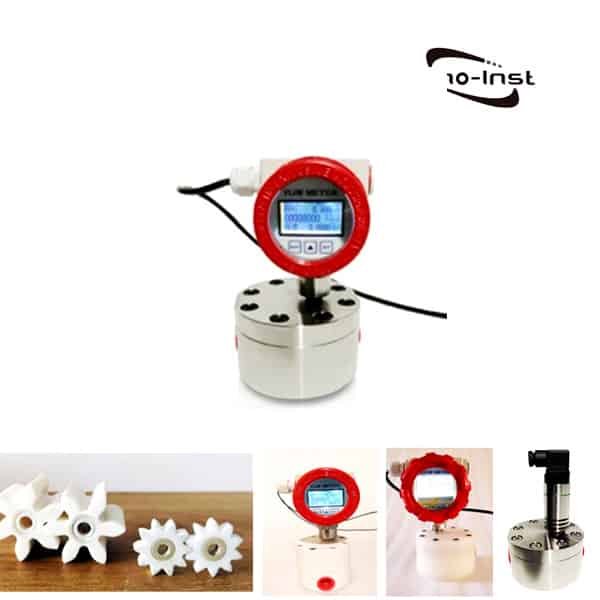
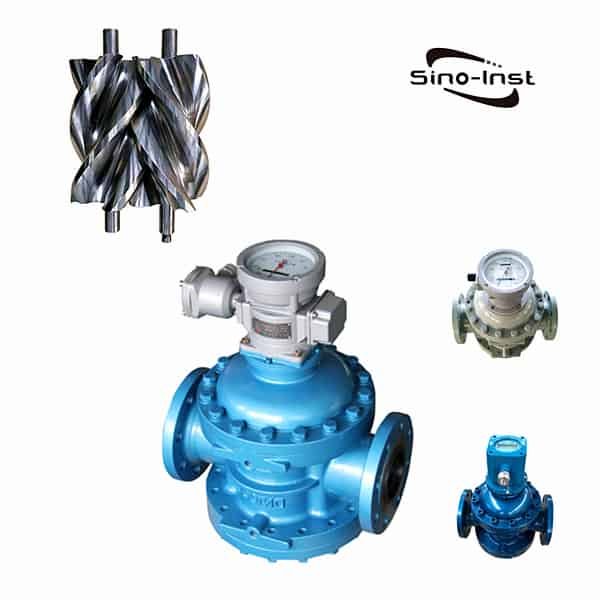
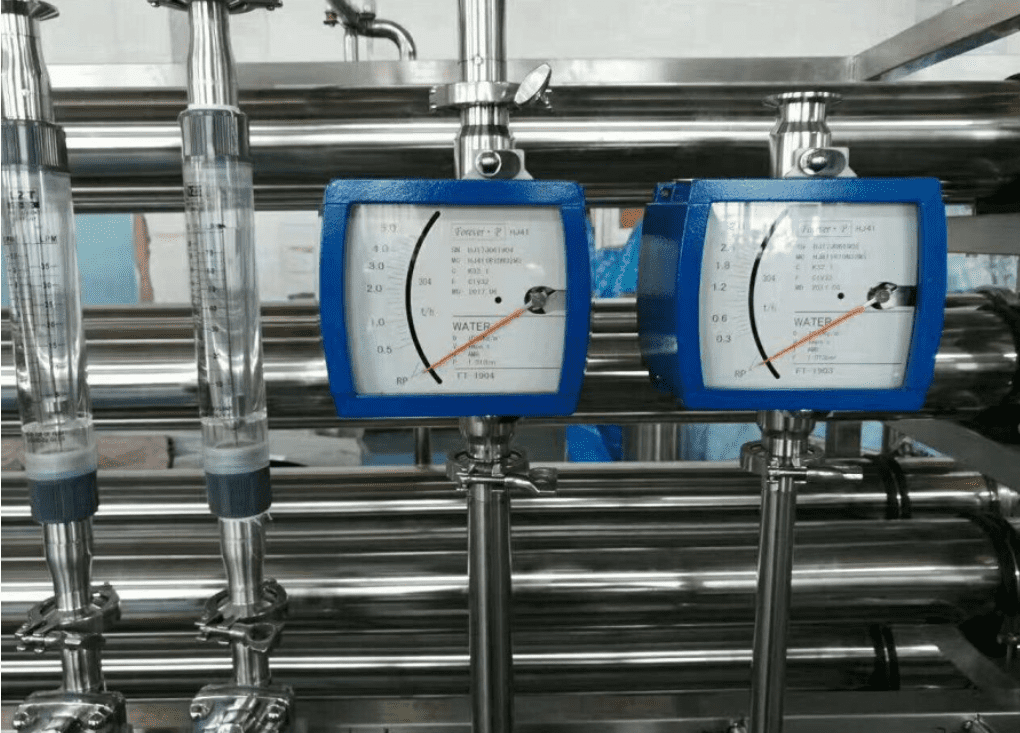
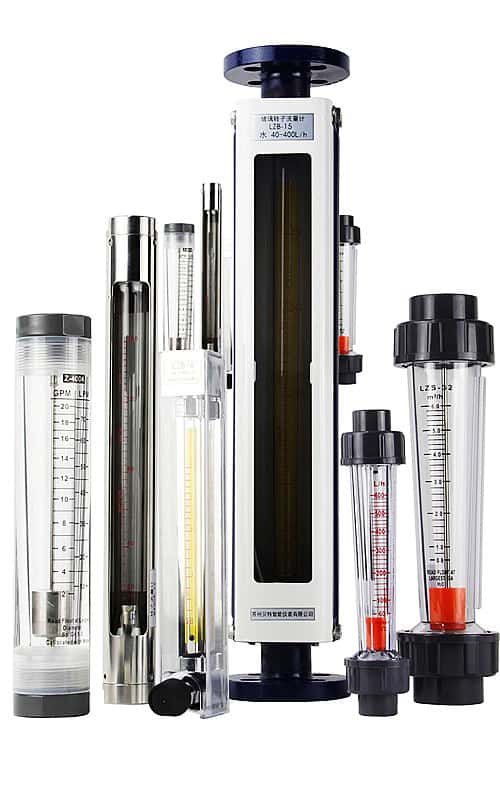
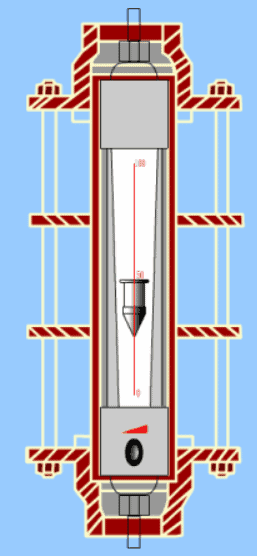
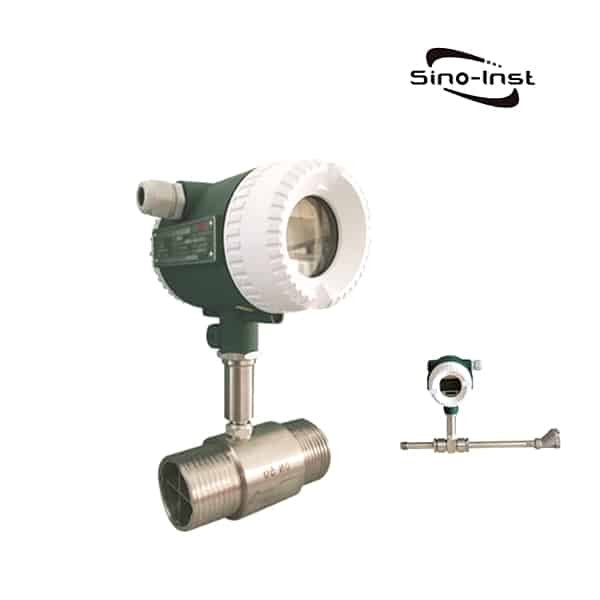
Paddle wheel flow meter technology

What is a Paddle wheel flow meter?

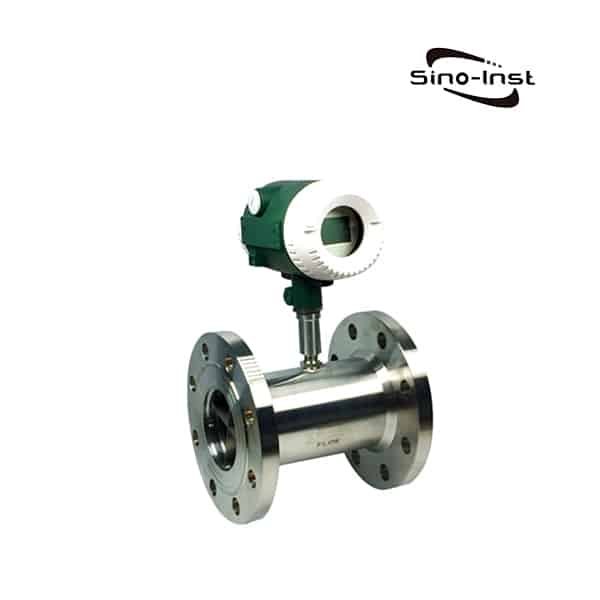
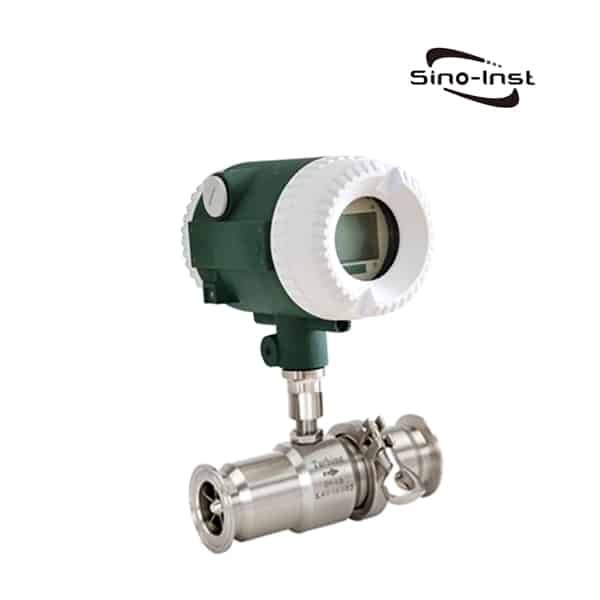
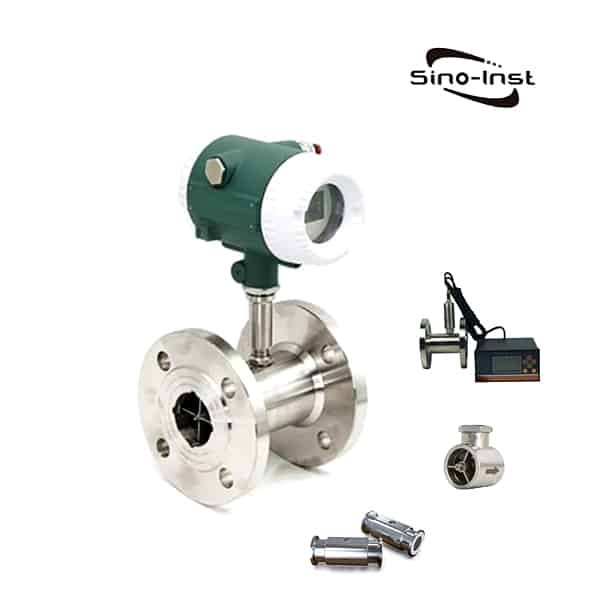
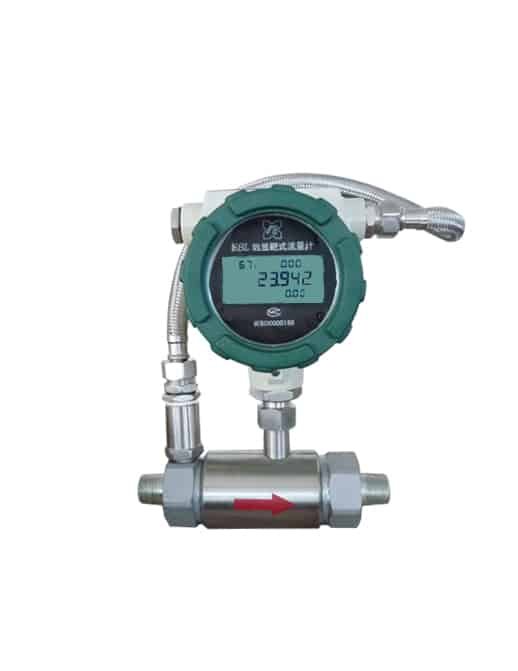
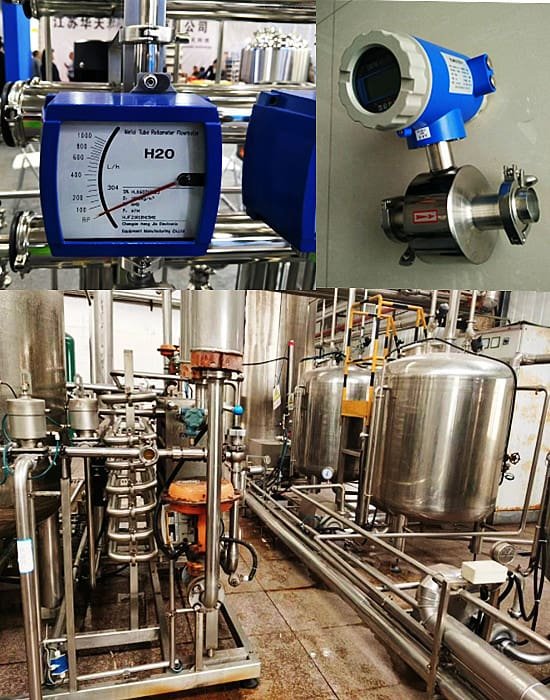
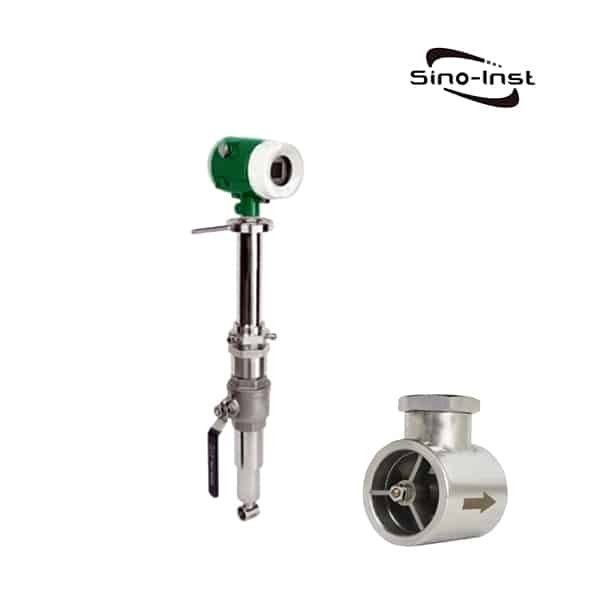
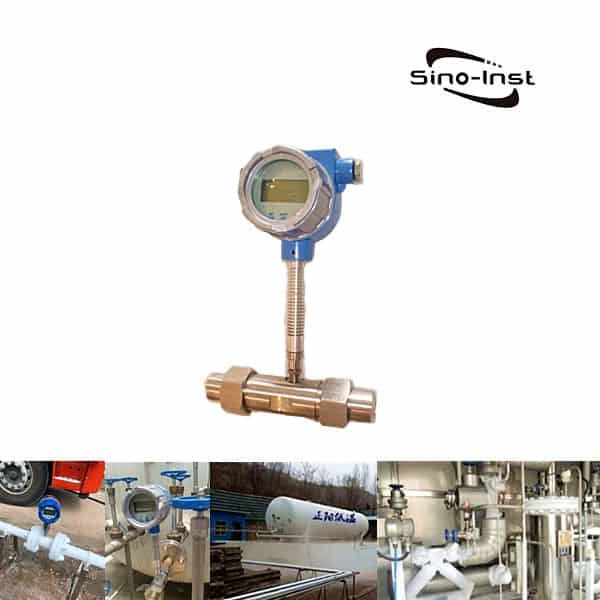
Paddle wheel flow meter is a mechanical flow meter that uses an impeller as a flow sensor component. The impeller-type flow meter is a meter that measures flow according to the principle of fluid momentum moment. Paddle wheel flow meter is also called an impeller flow meter, rotary wheel flow meter, etc. Typical Paddle wheel flow meters are water meters and turbine flow meters. It can be a mechanical transmission output type or an electric pulse output type. It is suitable for the measurement and control of industrial process clean water pipelines or low-concentration acid-base, low-viscosity single-phase fluid non-trade settlement process.

Paddle wheel flow meter technology

Paddle wheel flow meter Features

  1. Has good anti-interference
  2. Strong signal transmission capability (the farthest transmission is 300 meters)
  3. Stable quality and low failure rate
  4. Superior performance-price ratio
  5. Wide range measurement.
  6. All measurement parameters can be adjusted independently.
  7. Output 4-20mA or RS485 communication output, two pairs of alarm output contacts.
  8. Display real-time flow and cumulative flow.
  9. Insertion installation.

Application range of impeller flowmeter

  • Flow monitoring of industrial water treatment process
  • Industrial circulating cooling water and make-up water flow monitoring
  • Reclaimed water flow monitoring
  • Process flow monitoring after wastewater treatment
  • Agricultural irrigation water flow measurement
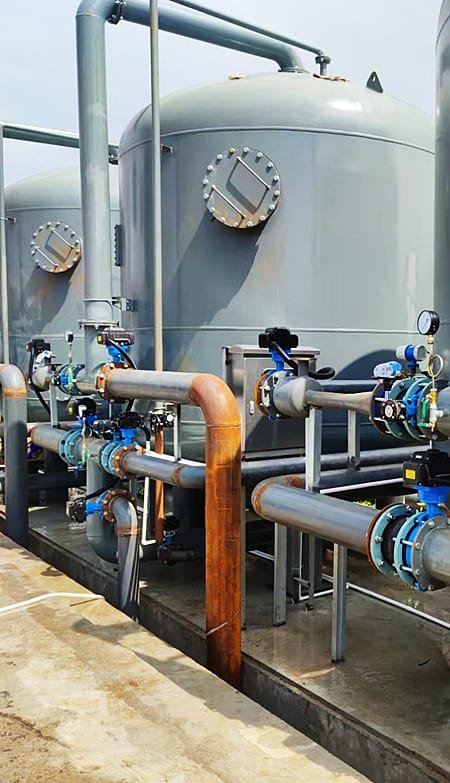
  • Multi-way valve and multi-valve system flow monitoring for softening, filtering, etc.
  • Other water flow detection and control

Extended reading: Insertion Ultrasonic Water Flow Meter – Designed for Agricultural Irrigation, Garden Management

Paddle wheel flow meters parameters

Picture
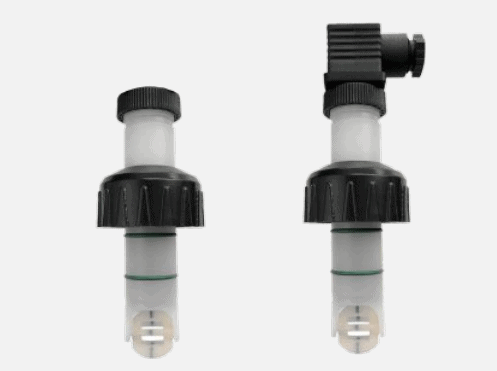
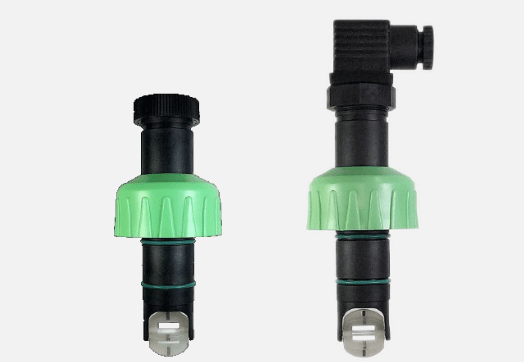
ModelKF11 Corrosion-resistant flow sensorKF11 series impeller flow meter
DescriptionSuitable for highly corrosive fluids, sulfuric acid, nitric acid, hydrofluoric acid, hydrochloric acid, mixed acid, strong alkali and other places;
The flow parts are made of corrosion-resistant materials such as PVDF·PTFE·Hastelloy·Titanium alloy; there is almost no pressure loss and maintenance-free;
Flow velocity range 0.3-6m/s, can measure fluid with flow velocity greater than 0.3m/s;
Not applicable to media containing particles and fibrous impurities;
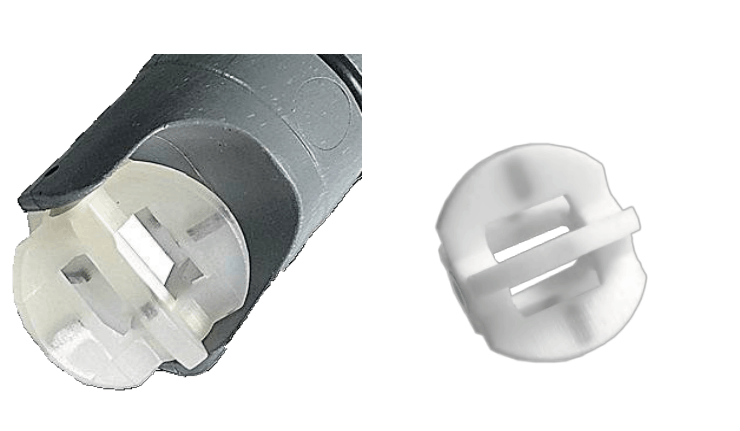
The impeller adopts a five-piece runner design
PP/PVDF/PTFE material
Better guarantee the dynamic balance characteristics, greatly improving the linear accuracy and repeatability accuracy of the sensor;
The minimum flow rate is 0.1m/s; NPN open collector output, which can be directly transmitted to a flow transmitter or PLC, a standard square wave signal and a maximum distance of 300m;
Applicable caliber: DN25-DN600 (1″-24″);
Not suitable for particles and fibrous impurities
The medium;
Caliber rangeDN25-DN600(1″-24″)DN25-DN600(1″-24″)
Flow rate range0.3-5m/s0.1-8m/s
Output signalSquare wave pulse signal: (40-45Hz) nominal flow rate per m/sSquare wave pulse signal: (40-45Hz) nominal flow rate per m/s
Equipped with pulse conversion components can output 4-20mA
CharacteristicHall pulse output, open collector NPN, strong driving ability
Has high chemical resistance
Minimum flow rate 0.3m/s
IP68 protection grade suitable for harsh on-site environment
Hall pulse output, open collector NPN, strong driving ability
Has high chemical resistance
IP68 protection grade suitable for harsh on-site environment
Plug-in type, easy installation, good reliability, almost maintenance-free
Linear accuracy L
Repeatability accuracy R
L=±1%
R=±0.5%
L=±1%
R=±0.5%
OntologyPVDF/PTFEPP plus glass fiber/CPVC
ImpellerPVDF/PTFEPP/PVC/PVDF/PTFE
Shaft and bearingHastelloy C/Titanium Alloy/ZrO2Al2O3/ZrO2/SS316L/Hastelloy C/Titanium Alloy
O-ringfluororubberFPM/EPDM/Fluorine rubber
Temperature and pressurePVDF body: 12.5bar@25℃-2.5bar@100℃
PTFE body: 12.5bar@25℃-2.5bar@100°
PP body: 12.5bar@25℃-1.7bar@80℃
CPVC body: 12.5bar@25℃-1.7bar@80℃
Power supply systemDC 5-24VDC5-24V
Protection levelIP68IP68
Application fieldSulfuric acid ratio and delivery flow monitoring
Copper sulfate monitoring in electroplating bath
Nitric acid mixture
Intermediate
Chemical waste
Pure Water Process/Reverse Osmosis/Ultrafiltration/EDI
Water purification and filtration system
Cooling water and boiler water monitoring
Chemical industry
Agricultural irrigation
Cleaning system and single crystal silicon cleaning
Pump protection

Check more Choosing The Right 1 Inch Flow Meter.

Paddle wheel flow meter working principle

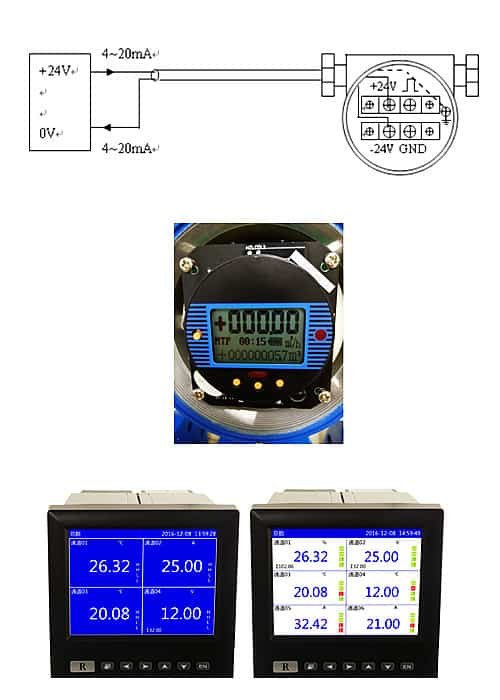
The sensor is divided into two parts: the transmitter and the impeller. The impeller is in direct contact with the fluid, and the transmitter is isolated from the fluid. The liquid flow drives the impeller to rotate, and there are four evenly distributed magnetic blades on the impeller. The rotating magnetic blade induction Hall switch generates a frequency signal proportional to the flow rate, and the transmitter converts the frequency signal into a 4-20mA current signal.

Typical Paddle wheel flow meters are water meters and turbine flow meters. The structure can be a mechanical transmission output type or an electric pulse output type.

The accuracy of water meters with general mechanical transmission output is low, with an error of about ±2%. However, the structure is simple and the cost is low. It has been mass-produced in China, and is standardized, generalized and serialized. The accuracy of the turbine flowmeter output by the electric pulse signal is relatively high, and the general error is ±0.2%-0.5%

The five-piece impeller design is in line with the principle of fluid mechanics, and the uniform force angle produces a better dynamic balance, ensuring better linear accuracy and repeatability accuracy

Various shafts and bearings:
Shaft and bearing: ZrO2, SS316L, Hastelloy C
Impeller material: PTFE, PP, PVDF, ABS
Body material: PP plus glass fiber, ABS, CPVC, PTFE, SS316L, brass

Real flow calibration
Calibration range: DN10-DN1000
Each sensor has undergone strict calibration and quality inspection. When leaving the factory, each sensor guarantees that the K factor is 2% of the standard value, and the repeatability accuracy is 0.5%;

Read more about: What is an inline flow meter?

Paddle wheel flow meter advantages and disadvantages

Advantage

  • Excellent reproducibility and responsiveness.
  • Simple structure and low price.
  • Small size, large-capacity measurement is possible.

Disadvantage

  • Extremely sensitive to foreign objects. (Causing blockage)
  • Due to the high-speed rotation of the impeller, regular maintenance is required to cope with axial wear or to replace the impeller.

Extended reading: How to Select the Right Agriculture Flow Meter

Paddle wheel flow meter installation

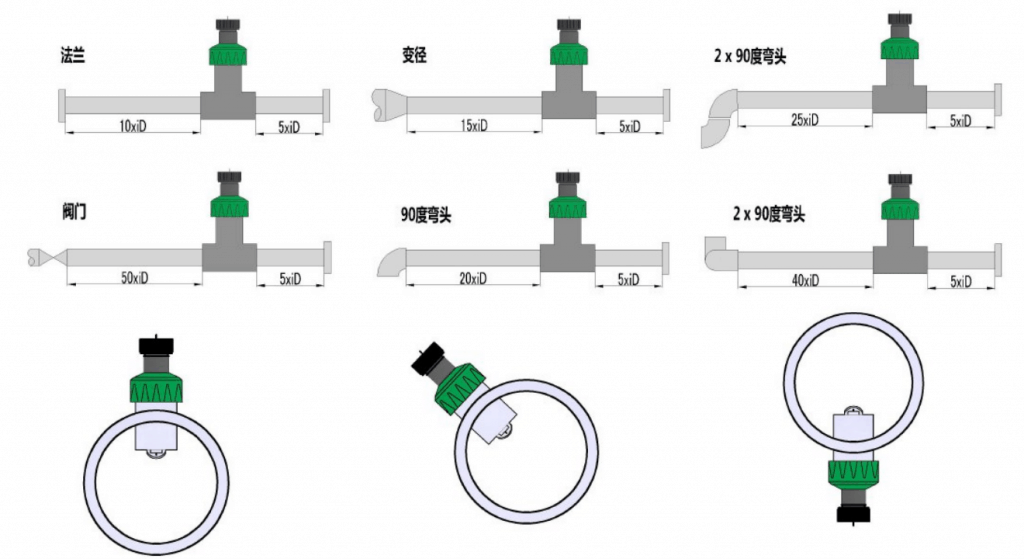
  • The straight section behind the flange must meet the measuring distance of the first 10 and the rear 5 times the pipe diameter;
  • After reducing the diameter (only allowed to change from large to small, but not allowed to change from small to large), the straight line segment needs to meet the measurement distance of the first 15 and the back 5 times the pipe diameter;
  • The straight section behind the first-level equal-diameter elbow needs to meet the measuring distance of the first 20 and 5 times the pipe diameter;
  • The straight section behind the two-stage continuous equal-diameter elbow on the same plane must meet the measurement distance of the first 25 and the rear 5 times the pipe diameter;
  • The straight section behind the non-coplanar two-stage continuous equal-diameter elbow needs to meet the measuring distance of the first 40 and the back 5 times the pipe diameter;
  • The straight section behind the valve must meet the measurement distance of the first 50 and the last 5 times the pipe diameter;
  • The probe is recommended to be installed perpendicular to the pipe, and not at the bottom of the pipe;
  • The probe can be installed on a vertical pipe where the liquid flows upward, but it must also meet the requirements of the above-mentioned straight section;
  • The probe is not allowed to be installed on a vertical pipe where the liquid flows downward;
  • The liquid in the tested pipeline must be full of flow, and no gas and liquid can flow at the same time;
  • The cost of the body must be consistent with the bayonet (open slot) to ensure the correct installation position;
  • The O-ring has a good sealing effect. When the installation is tight, it needs to be wetted with silicone oil or water for installation;
  • The sensor locking cap must be tightened to prevent excessive pressure in the pipeline from leaking or ejecting;
  • When installing outdoors, pay attention to waterproof treatment; keep the cables dry to avoid moisture damage;
  • Do not lay the sensor cable and AC power cable in the same protective tube to avoid electrical interference

Extended reading: Industrial VS Residential inline water flow meters

More Featured Paddlewheel flowmeters

You may like:

Sino-Inst, paddle wheel flow meter manufacturer. It can measure a single sound-conducting liquid medium of Velocity range: 0.1~6m/s; Pipe diameter: DN15 to DN600.

Sino-Inst’s paddle wheel flow meter, made in China, Having good Quality, With a better price. Our flow measurement instruments are widely used in China, India, Pakistan, the US, and other countries.

How Does a Piston Flow Meter Work?

What is a piston flow meter?

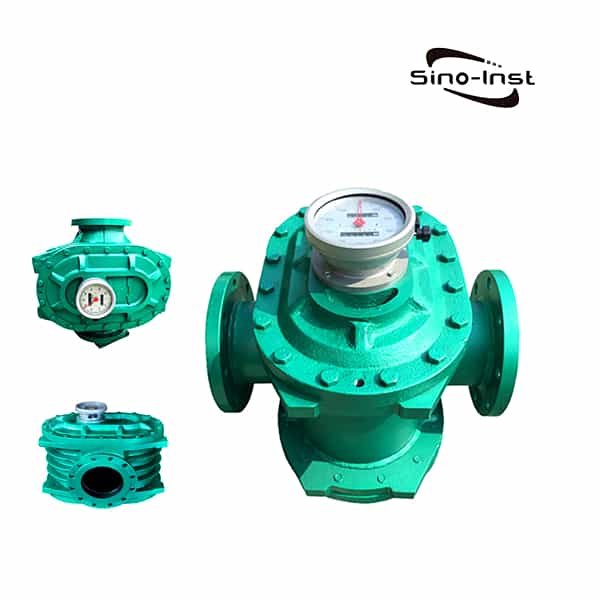
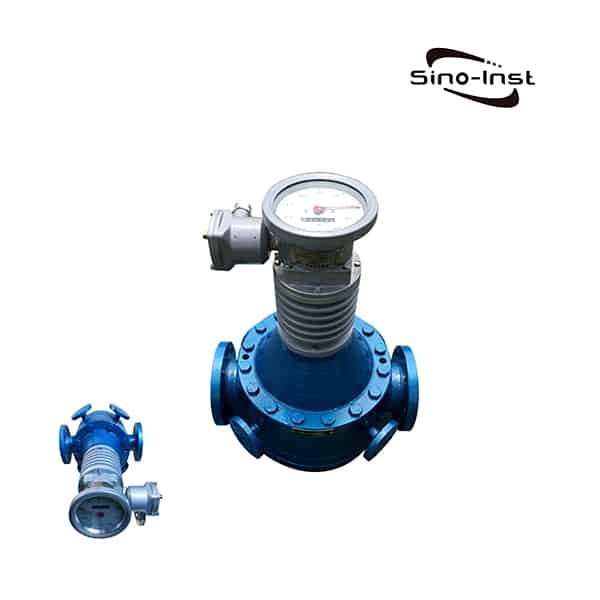
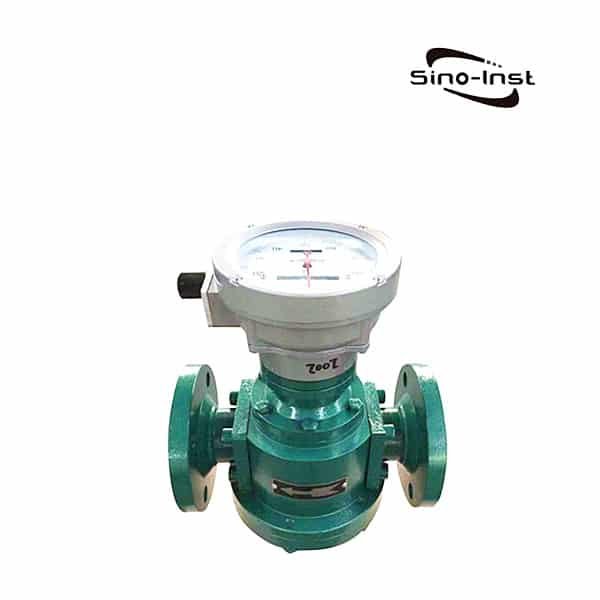
A piston flow meter is a positive displacement flowmeter, which is mainly used to measure liquid flow. The piston flow meter is composed of a shell, piston mechanism, and other parts. The measured fluid fills a space with a certain volume, and these volume increments are counted and accumulated. It has the advantages of simple structure, reliable work, high accuracy, large range ratio, and little influence on viscosity. It is mostly used for measuring non-corrosive liquids, such as heavy oil or other oils, on small-diameter pipelines.

Piston flow meter technology

Piston-type flowmeters are commonly used for flow measurement of fuel dispensers. Its structure includes a housing, an upper cover, a lower cover, a piston, a crankshaft, and a distribution valve. The inner cavity of the housing is equipped with four-piston cylinders that cooperate with the piston dynamic seal. The four-piston cylinders are evenly distributed in the circumferential direction on the vertical plane of the crankshaft rotation centerline.

The piston is connected to the crankshaft by a connecting rod. The piston rodless cavity is connected to the inlet and outlet on the upper cover through the distribution valve. A side cover is installed on the casing outside the piston cylinder. The upper cover is equipped with an output shaft that rotates synchronously with the crankshaft. By right Count the number of revolutions of the output shaft to achieve flow measurement.

  • The main disadvantages are:
  • The outer circular surface of the output shaft of the existing piston flowmeter and the upper cover adopts O-ring dynamic sealing cooperation.
  • The high-speed rotation of the output shaft is likely to cause wear to the sealing ring, resulting in a decrease in sealing performance and even leakage.
  • In addition, there are errors in the machining dimensions of the inner cavity of the piston-cylinder of each product. Lead to the measurement error of the piston flowmeter.

Read more General-purpose Flow Totalizer for Data collection and calculation

Features and applications of Piston flow meter

The piston flow meter has a simple structure, reliable work, and a large measuring range.
The measurement accuracy is high and is not affected by viscosity. It can be changed remotely and other advantages.

However, the main components of the measurement part are not corrosion-resistant. Therefore, it can only measure non-corrosive media, such as heavy oil and other petroleum products.

Extended reading: Cylinder Gear flow meter for micro flow measurement.

Piston flow meter working principle

A piston flow meter is a positive displacement flow meter, which is based on the fact that the piston and the metering chamber have been kept in a tangential sealed state. And there is a fixed eccentric distance metering element piston.

Under the action of the pressure difference, a rotational torque is generated on the piston, which makes the piston perform an eccentric rotation movement.

The number of revolutions of the piston is proportional to the flow rate of the fluid. The piston revolution ratio is recorded by the counting mechanism. Then the total flow of fluid can be measured.

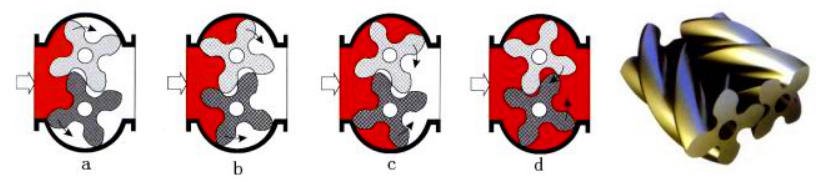
The inlet and outlet of the Piston flow meter are separated by a partition. When the measured fluid enters the metering chamber from the inlet, a pressure difference is formed at the inlet and outlet, forcing the piston to rotate counterclockwise as shown in the figure.

The continuous flow of fluid forces the piston to rotate as shown in the figure, forming two and a half-crescent cavities. The piston is forced to rotate under the action of the pressure difference as shown in the figure. V2 fluid is discharged from the outlet. Rotate under the action of pressure difference. V1 fluid is discharged from the outlet, and the fluid bursting out every revolution of the piston is equal to the sum of V1+V2.

Tool: Volumetric Flow Rate & Pipe Diameter to Flow Speed Calculator

Piston flowmeter output signal, such as 4-20mA. The flow signal can be connected to a paperless recorder. Carry out multi-channel flow signal monitoring. What Is A Paperless Recorder?

Piston flowmeter VS gear type flowmeter

Gear flow meters are a type of positive displacement flow meters, used for precise continuous or intermittent measurement of the flow or instantaneous flow of liquid in the pipeline. It is especially suitable for the flow measurement of heavy oil, polyvinyl alcohol, resin, and other high viscosity media.

Piston type flowmeter is an online installation, mechanical flow switch, used for liquid or gas medium. Very small pressure loss, good repeatability, anti-fouling ability, mechanical part, and electronic part are completely isolated, suitable for small flow economy type.

If the flow rate you want to measure is not large, the piston type is better.
If you want to measure a large flow rate, just use a gear type.
If the gas flow is measured, only the piston type can be used

Extended reading: Positive displacement flow meter working principle.

Guess you like: What is Reynolds number?

A Piston Flow Meter is an innovative device that accurately measures fluid flow in pipelines. Sino-Inst, a well-established manufacturer and supplier of Piston Flow Meters, boasts a wealth of experience in the field.

With our top-notch product line, Sino-Inst is the perfect partner for all your flow measurement needs. If you’re in the market for a reliable and efficient Piston Flow Meter, look no further! Contact Sino-Inst today and let them show you what they can do.

And that’s not all, Sino-Inst also offers a range of other flow meters, including turbine flow meters, magnetic flow meters, and more. Let Sino-Inst help you find the perfect flow meter solution for your specific application!

Bidirectional Flow Measurement

What is bidirectional flow?

Bidirectional flow refers to forward and directional flow. Bi-directional flow lines are not common in most process plants. The measurement of unidirectional flow is easy to understand and is applicable to all types of flow technologies. However, most flow technologies cannot accurately measure two-way flow.
They always cause difficulties for process and instrument designers. For two-way flow, the pipeline scheme uses the same pipeline to achieve the transport and/or control function of the opposite flow (forward or reverse flow) according to the process conditions and goals.

Can the flow meter perform bidirectional measurement?

If the flow direction of the medium in the pipeline is reversed. Does the flow meter need to be installed with a flow meter for forwarding use and a flow meter for reverse use accordingly? Is there a flow meter for normal measurement that does not consider the flow direction?

  1. If you just look at the flow rate, you can. For example, an electromagnetic flowmeter. It doesn’t matter if you measure in the whole direction or in the reverse direction. Change the reverse measurement to allow in the prerequisite electromagnetic flowmeter settings.
  2. It’s hard to say if you still need a cumulative amount. How do you convert the cumulative amount you measured forward and the cumulative amount you measured backward? Whether to subtract or add depends on your actual situation.

Extended reading: Insertion Ultrasonic Water Flow Meter – Designed for Agricultural Irrigation, Garden Management

How does the ultrasonic flowmeter realize bidirectional flow measurement?

The principle of the ultrasonic flowmeter is to calculate the fluid flow rate using the difference in sound velocity. And multiply the fluid velocity by the area to calculate the volume flow.

Usually, there is an incident angle between the probe of the ultrasonic flowmeter, that is, the transducer and the meter body. From 60 degrees to 45 degrees. Ultrasonic waves propagate between a pair of probes if there is no fluid, that is, at zero flow. The travel time back and forth is the same. It is equivalent to a zero flow rate.

Extended reading: Ultrasonic Flow Meters Types & Technical Guide

Once there is fluid, the speed of the ultrasonic flowmeter back and forth between a pair of probes is different. Regardless of the direction of fluid flow, there will be a difference in sound velocity. If one direction is set as the normal flow direction, then the normal sound velocity should be a positive number. If the sound velocity difference is negative, the flow is in the opposite direction. That is reverse measurement. The measurement accuracy of the two directions is the same.

Extended Reading: Inline Ultrasonic Flow Meter

Can a vortex flowmeter measure bidirectional flow?

You cannot measure bidirectional flow with just one vortex flowmeter. But in some applications, you can use two for this.

The vortex flowmeter has a bluff body in front of the sensor, which is used to generate the vortex in the flow. As far as I know, no flowmeter has two bluff bodies to measure bidirectional flow.

If you have a two-way steam application. Then you can install two vortex flowmeters in the same line, as long as you respect the inlet and outlet operation of both. However, depending on the size of the line, this setting may become expensive.

Read more General-purpose Flow Totalizer for Data collection and calculation

Bidirectional orifice flowmeter

The bidirectional orifice flowmeter is a differential pressure flowmeter. Mainly used for flow measurement of liquid and gas. According to the characteristics of the orifice flowmeter, it has the advantage of high temperature and high pressure. Therefore, the orifice flowmeter is widely used in the field of high temperature and high-pressure measurement. The orifice flowmeter has high accuracy and good stability and is unanimously recognized by users.

What kind of measurement conditions will use an orifice flowmeter to measure? It can be used according to the requirements of the site, such as typical boiler steam, the general temperature can be close to about 500 degrees, and general flow meters cannot be used. However, the orifice flowmeter can effectively solve this high-temperature working condition, and the only disadvantage is its high cost of use.

Extended reading: 2 inch Water Flow Meter

You may like:

Extended reading: Integral DP Flow Meter|Gas, liquid, steam|Compact structure

Sino-Inst offers over 50 flow meters for flow measurement. About 50% of these are differential pressure flow meters, 40% are the liquid flow sensor, and 20% are Ultrasonic Level Transmitter and mass flow meters.

A wide variety of flow meters options are available to you, such as free samples, paid samples.

Sino-Instrument is a globally recognized supplier and manufacturer of flow measurement instrumentation, located in China.

What is Modbus Protocol?

What is meant by Modbus protocol?

Modbus Protocol is a serial communication protocol, which was published by Modicon company (now Schneider Electric) in 1979 for the use of programmable logic controller (PLC) communication. Modbus has become the industry standard (De facto) of communication protocols in the industrial field and is now a common connection method between industrial electronic devices.

Modbus Protocol Features

The main reasons why Modbus is more widely used than other communication protocols are:

  • Published publicly and without copyright requirements
  • Easy to deploy and maintain
  • For suppliers, there are not many restrictions on modifying mobile local bits or bytes

Modbus allows multiple (approximately 240) devices to be connected on the same network to communicate. For example, a device that measures temperature and humidity and sends the results to a computer. In the data acquisition and monitoring control system (SCADA), Modbus is usually used to connect the monitoring computer and the remote terminal control system (RTU).

How does a Modbus work?

Modbus is a master/slave communication mode with a single master station. There can only be one master station on the Modbus network, and the master station has no address on the Modbus network. The address range of the slave station is 0-247, where 0 is the broadcast address. The actual address range of the slave station is 1-247. Modbus communication standard protocol can be transmitted through various transmission methods, such as RS232C, RS485, optical fiber, radio, etc.

Modbus has two serial transmission modes, ASCII and RTU. They define different ways of how data is packaged and decoded. Devices that support Modbus protocol generally support the RTU format. Both communication parties must support one of the above modes at the same time.

The above is the official definition, let’s use ordinary words to explain:

This is actually the communication protocol, and any protocol is similar. There are only two communication formats and communication specifications.

If you want, you can also define a communication specification yourself. Use PLC or VB language to process according to this specification defined by yourself. If the reliability exceeds Modbus, then your communication specification is the most popular!

The difference and connection between RS 485 and MODBUS

I often see RS485 and MODBUS written together, and Sino-Inst will talk to you about the difference and connection between RS485 and MODBUS.

RS485 is a physical interface, which is simply hardware.

MODBUS is an international standard communication protocol used to exchange data between devices of different manufacturers (usually for industrial purposes); the so-called protocol can also be understood as the “language” someone said above, or simply software.

Under normal circumstances, two devices transmit data through the MODBUS protocol: RS232C was first used as the hardware interface, (that is, the serial communication port (serial port) on an ordinary computer). There is also RS422, and there is also commonly used RS485. This interface The transmission distance is long, and it is often used in general industrial scenes.

The MODBUS protocol is divided into three modes: MODBUS RTU, MODBUS ASCII and the later developed MODBUS TCP.

The physical hardware interfaces used by the first two (MODBUS RTU, MODBUS ASCII) are serial (Serial) communication ports (RS232, RS422, RS485).

And MODBUS TCP is to conform to the development trend of the world today. Anything can be connected by Ethernet or Internet to transmit data.

The hardware interface of MODBUS TCP mode is the Ethernet (Ethernet) port, which is the network port generally used on our computer.

We categorize industrial networks into three categories: RS485 network, HART network and fieldbus network.

HART network

HART is a transitional bus standard proposed by Emerson. It mainly superimposes a digital signal on top of a 4-20 mA current signal.

The physical layer uses BELL202 frequency shift keying technology. In order to realize the functions of some smart meters. But this agreement is not a truly open standard, and you have to join his foundation to get the agreement. Part of the cost of joining the foundation.

The technology is mainly monopolized by several large foreign companies, and in the past two years, some domestic companies have started to do it again. But it has not yet reached the level of foreign companies.

Nowadays, a large part of smart meters are equipped with HART round cards and all have HART communication function.

But from the domestic point of view, this part of the function has not been really used, at most it is only used to set the parameters of the handheld communicator. The HART intelligent instrument has not played its due function, and it has not been connected to the Internet for equipment monitoring.

In the long run, due to the low communication rate of HART, the networking is difficult and other reasons. The procurement volume of HART instruments will experience a downward trend.

However, because HART instruments have a history of more than ten years, the number of instruments installed is very large. For some system integrators, there is still a lot of room for use.

Fieldbus network

Fieldbus technology is one of the hotspots of technology development in the field of automation today. Known as the computer local area network in the field of automation. Its appearance marks the beginning of a new era of automation control technology.

Fieldbus is a digital, serial, multi-station communication network that connects the instruments installed in the control site and the control equipment installed in the control room. The key symbol is the ability to support bidirectional, multi-node, bus-style all-digital communication.

In recent years, fieldbus technology has become a hot spot in the development of automation and instrumentation in the world. The appearance of the fieldbus network is a revolutionary change in the traditional control system structure. It is the automatic control system that is moving in the direction of intelligence, digitization, informationization, networking, and decentralization. Form a new type of network integrated fully distributed control system-Fieldbus Control System FCS (Fieldbus Control System).

However, various standards of current fieldbus exist in parallel and have their own areas of survival. There has not yet been a truly unified standard. The key is that we cannot see when a unified standard will be formed, and the technology is not mature enough.

In addition, the types of fieldbus instruments are still relatively small, and the room for selection is small, and the price is relatively high. From the perspective of end users, most of them are still on the sidelines. I want to wait until the technology is mature and consider it, but now there are few implementations.

RS485 network

RS485/MODBUS is a popular way of network layout. Its characteristic is simple and convenient to implement. And now there are many instruments that support RS485, especially in the oil industry.

RS485/MODBUS is simply dominating the world. Current instrument vendors have also switched to support RS485/MODBUS. The reason is simple, like the original HART instrument, it is very difficult and expensive to buy a conversion port. The RS485 conversion interface is much cheaper and has a wide variety.

At least in the low-end market, RS485/MODBUS will still be the most important networking method, and it will not change in the past two to three years.

Features of 4-20mA current loop and RS485 communication (Modbus RTU protocol) data acquisition

4-20mA current loop data acquisition characteristics

Use pressure, temperature transmitter and current acquisition module (RTU) or acquisition card on site for data acquisition and then communicate and transmit with the industrial computer. The data acquisition system using 4-20mA current loop instrument has the following characteristics:

  1. The construction is complicated, data cables need to be buried in advance, the number of cables is large, and the construction period is long
  2. The computer terminal needs a current acquisition card or a data acquisition module
  3. Complicated replacement and maintenance operations, troublesome expansion
  4. 4-20mA current loop data acquisition accuracy is low, and the error comes from 4-20mA output instrument and acquisition card (or data acquisition module)

RS485 communication (Modbus protocol) data acquisition characteristics

Use smart meters, transmitters, actuators, etc. with RS485 communication to directly communicate with the serial port of the industrial computer. The use of RS485 communication digital sensor meter network system has the following characteristics:

  1. The construction complexity is reduced, data cables need to be buried in advance, the number of cables is small, and the construction period is reduced
  2. The computer terminal only needs an isolated RS485/RS232 converter
  3. Easy to replace and maintain, and easy to expand
  4. High acquisition accuracy, eliminating the error of RTU, the system error only comes from the transmitter itself
  5. RS485 communication has good transmission stability and less network maintenance
  6. The cost of use is greatly reduced|
  7. The maximum communication distance of RS485 is 1200 meters

RS485 communication transmission of electromagnetic flowmeter Modbus protocol

The RS485 communication data transmission interface of the electromagnetic flowmeter is half-duplex. The standard rate is greater than 250kHz. The communication direction conversion time is 3.5us. Usually 16-way load can be connected. It can also be expanded to 32 channels. Standard shielded twisted pair cable is 1000m. Use master-slave multi-machine communication. When multiple electromagnetic flowmeters are interconnected. It can save signal lines and facilitate high-speed transmission.

RS-485 communication has good anti-noise interference. Long transmission distance and multi-station capability. Will not affect the synchronization of on-site and remote data due to PLC failure.

However, the electromagnetic flowmeter must have a 485 interface and support the MODBUS RTU protocol.

In order to maintain stability, it is better to use electromagnetic flowmeters of the same manufacturer and the same brand when communicating with multiple flowmeters.

RS485 is a kind of industrial data bus. The electromagnetic flowmeter has RS485 serial communication so that digital communication replaces the transmission of PLC analog signals and ordinary switch signals. The PLC simulation calculation is reduced, and the accurate data collection and transmission are realized.

RS485 precession vortex flowmeter

Precession vortex flowmeter is a new type of gas flowmeter. It can be used for the measurement of natural gas, propane, air, nitrogen and other gases.

The converter can output frequency pulse, 4 ~ 20mA analog signal, and has RS485 interface, can be directly connected to the computer network, transmission distance up to 1.2km;

Precession Vortex Gas Flowmeter, like vortex flowmeter, is a velocity flowmeter. The cost performance of the intelligent precession vortex flowmeter is higher than vortex flowmeter. The intelligent precession vortex flowmeter can only measure gas. Precession Vortex Gas Flowmeter can be made into an integrated temperature and pressure compensation. And can measure various gases. Such as compressed air, oxygen, biogas, natural gas, coal gas, etc.

Read more about Everything You Need To Know About Electronic Flow Meters

Guide: Magnetic Flowmeter Installation

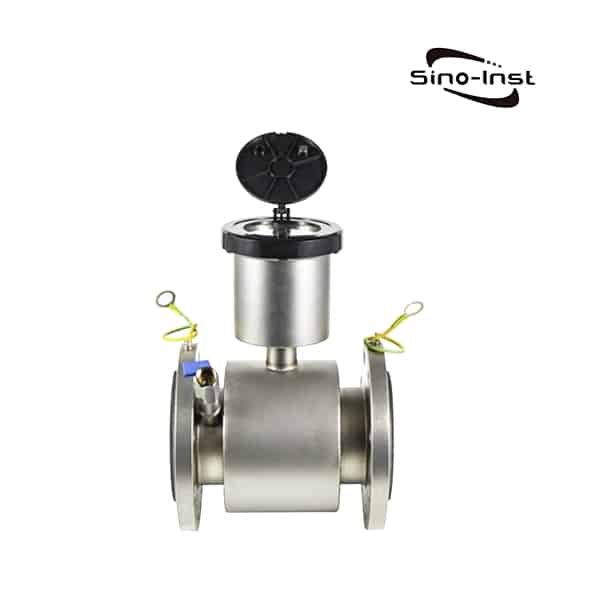
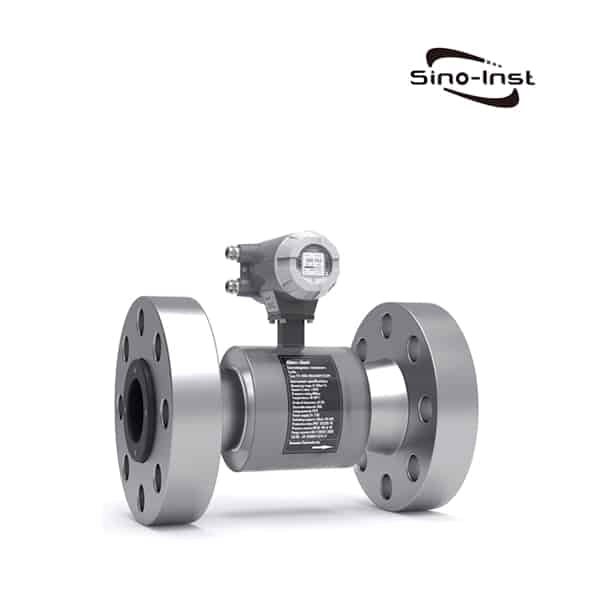
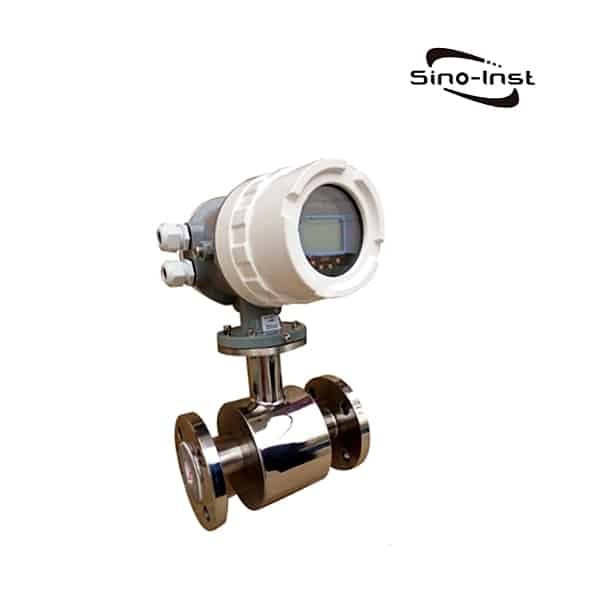
Magnetic flowmeters are mainly used to measure the flow of conductive media with good fluidity. Magnetic flowmeters are divided into insertion type and pipeline type. Pipeline electromagnetic flowmeter and insertion electromagnetic flowmeter has the same requirements for installation. There are also different places. Generally speaking, there are requirements for the external environment and installation methods.

A magnetic Flow Meter is a flow meter that measures the flow of conductive fluids. Abbreviated as EMF, also called Electromagnetic flowmeters. It is a kind of Volumetric flow meter. A magnetic flow meter measures the velocity of conductive liquids moving through a pipe or conduit. In the wastewater treatment industry, a Magnetic Flow Meter is the best flow meter choice.

Electromagnetic flowmeters have been used for more than 50 years and have been widely used worldwide. The fields involve water/sewage, chemical, pharmaceutical, paper, food, and other industries.

  • Water / Wastewater Industry
  • Food and Beverage
  • Metals
  • Brewing, Distilling, and Wine makening
  • HVAC
  • Chemical
  • Pulp and Paper
  • Pharmaceutical
  • Mining, Mineral Processing

Extended reading: How to Select the Right Agriculture Flow Meter

Magnetic flowmeters use the principle of Faraday’s Law of Electromagnetic Induction to measure the flow rate of liquid in a pipe. In the magnetic flowmeter pipe parts, a magnetic field is generated and channeled into the liquid flowing through the pipe. 

Faraday’s Law states that the voltage generated is proportional to the movement of the flowing liquid. A conductor moving through a magnetic field produces an electric signal within the conductor. And the singal is proportional to the velocity of the water moving through the field. 

As fluid flows through the magnetic field, conductive particles in the fluid create changes. This variation is used to measure and calculate the velocity of water flow through the pipe. When the fluid moves faster, more voltage is generated. The electronic transmitter processes the voltage signal to determine the liquid flow.

To learn more about Magnetic Flow Meters, this video by Emerson gives a good explanation.
Video source: https://www.youtube.com/watch?reload=9&v=lRSjYjg9WRo

Read more about Everything You Need To Know About Electronic Flow Meters

The premise of using an electromagnetic flowmeter is that the liquid to be measured must be conductive and cannot be lower than the threshold (ie, the lower limit). If the conductivity is lower than the threshold value, measurement errors will occur until it cannot be used. The threshold value of general-purpose electromagnetic flowmeters is between 10-4~(5×10⁻⁶)S/cm, depending on the model. The general conductivity threshold is 5×10⁻⁶S/cm=5μS/cm. the

The conductivity of industrial water and its aqueous solution is greater than 10-4S/cm. The conductivity of acid, alkali and salt solution is between 10-4 and 10-1S/cm. There is no problem in use, and the low-grade distilled water is 10-5S/cm cm is also not a problem.

Petroleum products and organic solvents cannot be used if their conductivity is too low.

Some pure liquids or aqueous solutions have low conductivity and are considered unusable. However, in the actual work of electromagnetic flowmeters, there will be instances where they can be used because they contain impurities, which are beneficial to increase the conductivity.

For the aqueous solution, the conductivity in the data is measured in the laboratory with pure water. The actual aqueous solution may be mixed with industrial water. The conductivity will be higher than that found. It is also conducive to flow measurement.

Step 1: Magnetic Flowmeter Installation environment requirements

In order to make the electromagnetic flowmeter work stable and reliable, the following requirements should be paid attention to when choosing the installation location:

  1. Try to avoid ferromagnetic objects and equipment with strong electromagnetic fields (large motors, large transformers, etc.). In order to prevent the magnetic field from affecting the working magnetic field and flow signal of the sensor.
  2. Install in a dry and ventilated place as much as possible. Avoid sun and rain. The ambient temperature should be -20 ~ +60 ℃. The relative humidity is less than 85%.
  3. There should be ample space around the flowmeter. Easy to install and maintain.

Extended reading: Ultrasonic Insertion Flow Meter for Lined/Large Pipes

Step 2: Magnetic Flowmeter Installation Location selection

The electromagnetic flowmeter can be installed on a horizontal pipe or a vertical pipe.

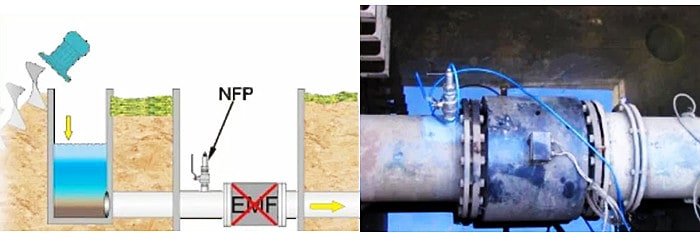
  1. Choose a straight pipe section filled with liquid, such as the vertical section of the pipeline (flow direction from bottom to top is appropriate) or a liquid-filled horizontal pipe (the lowest point in the entire pipeline is appropriate). The position must ensure that the pipeline is always filled with the measured fluid . In the process of installation and measurement, there must be no partial full pipe.
  2. Select the place where the fluid flow pulse is small. That is, it should be far away from pumps, valves, elbows and other local resistance parts.
  3. When measuring two-phase (solid, liquid or gas, liquid) fluids, choose a place that is not easy to cause phase separation.
  4. Avoid negative pressure at the measurement site.
  5. The diameter or circumference of the side pipe is easy to measure, and the ovality should be small.
  6. Straight pipe length: The length of the straight pipe on the upstream side of the sensor installation pipeline should be greater than or equal to 10D, and the downstream side should be no less than 5D.
  7. There are two methods for inserting the insertion point of the plug-in electromagnetic flow sensor: one is to insert it on the central axis of the pipe under test, and the other is to insert it at 0.25D where the inner wall of the pipe is the pipe.
  8. Vertical installation: when the sensor is inserted into the pipe, the angle between the vertical diameter of the pipe section and the pipe section should be less than 5°, which is suitable for measuring clean media with small pipe vibration.
  9. Tilt installation: the angle between the axis of the sensor and the axis of the pipeline being measured is 45°. It is suitable for liquid flow measurement with large pipe diameter and other impurities in the measuring medium. This installation method has low water resistance and is not suitable for entanglement.

Step 3: Mounting flange for Magnetic Flowmeter Installation

A. Select the installation location and select the front and rear straight pipe sections of appropriate length. Cut the pipe section where the flowmeter is installed;
B. Weld a flange on each of the front and rear straight pipe sections. After adding gaskets at both ends of the sensor, connect the sensor to the flange with stud bolts (note that the direction of the arrow on the meter body should be consistent with the direction of fluid flow);
C. Weld the front and rear straight pipe sections of the sensor to the original pipe.

Note:

  1. When welding, ensure that the flange end face is perpendicular to the centerline of the pipeline;
  2. The place where the mounting hole pitch is larger is the meter rod mounting position. And the direction of the mounting holes of the two flanges should be the same;
  3. After the flange is welded, the pipeline should be cleaned up and there should be no welding slag and other sundries.

Extended reading: Magnetic Large Dia. Pipe Flow Meter

Step 4: Converter installation and connection cables

Power and signal wiring. Please refer to the product manual accompanying the goods.

The converter of the split electromagnetic flowmeter should be installed near the sensor where it is convenient for reading and maintenance. It can also be installed in the instrument room, and its environmental conditions can be much better than the sensor.

The distance between the converter and the sensor is limited by the conductivity of the measured medium and the signal of the signal cable. That is, the distributed capacitance of the cable, the cross-section of the wire, and the number of shielding layers. Use the information cable provided with the instrument by the manufacturer.

For liquids with lower conductivity and longer transmission distances, three-layer shielded cables are also specified.

The general instrument “Instruction Manual” gives the corresponding transmission distance range for liquids with different conductivity.

When a single-layer shielded cable is used for industrial water or acid-base liquids, the transmission distance is usually 100m.

In order to avoid signal interference, the signal cable must be worn separately in a well-grounded steel protection tube. Never put the signal cable and the power cord in the same steel pipe.

Guess you like: Insertion Magnetic Flow Meter-Large diameter online install

Special Magnetic Flowmeter Installation situation

For pipelines that do not allow flow interruption in the process, a bypass pipe should be installed and cleaned when the flow meter is installed. As shown in the figure, this device ensures continuous operation of the equipment system when the flow meter is withdrawn from use.

The inner diameter measured by the flowmeter should be consistent with the inner diameter of the pipe. If the inner diameter cannot be the same, the inner diameter of the pipe should be greater than the inner diameter of the flowmeter. And install a tapered tube or expansion tube with a cone angle not greater than 15 between them, as shown in the figure.

When the flowmeter is installed inclined or vertically, the flow direction should be from top to bottom, as shown in the figure.

All Magnetic Flowmeter Installations. It cannot be described in detail here. If you encounter problems with the Magnetic Flowmeter Installation. Please contact our engineers in time. We will guide the Magnetic Flowmeter Installation for you.

Featured Magnetic Flowmeters for Sale

Frequently
Asked
Questions

Generally speaking, there will be an indication of the fluid flow direction on the main body of various flowmeters. When we install the flowmeter, just follow the instructions to install it.

Generally speaking, there are two principles for the installation direction of the flowmeter.

  1. Make sure to measure full of fluid. Because absolutely most of the flowmeters need to be in a full pipe state to ensure the measurement effect.
  2. Install according to the instructions of the flowmeter.

Electromagnetic flowmeters can be installed vertically. However, vertical installation needs to pay attention to the following aspects, whether it is installed at the water inlet or the water outlet. Standard installed in the middle of the vertical position where the water flows upwards. This installation complies with gravity.

If it is installed downstream, it will not be a full pipe, and the water flow from bottom to top is always full. This facilitates accurate measurement of the flow meter. The straight pipe section is required to be 10D in front and 5D in back to ensure the use and accuracy requirements of the electromagnetic flowmeter.

Electromagnetic flowmeter vertical installation requirements:

  1. Installed at the inlet of the pipeline (that is, upstream), so that the pipeline is always full.
  2. The electromagnetic flowmeter should be installed in the lower part of the horizontal pipeline, vertically upward. Avoid installing at high places and vertically downward positions in the pipeline.
  3. Requirements for straight pipe section: inlet/outlet straight pipe section: inlet ≥ 10×DN; water outlet ≥ 5×DN
  4. In order to facilitate the detection of the flowmeter, a bypass channel is set in the measuring pipeline.
  5. Grounding point requirements: In order to make the instrument work reliably, improve the measurement accuracy, and not be disturbed by strong external electromagnetic fields, the sensor should be well grounded, and the grounding resistance should be less than 10 ohms.

Generally speaking, there is no other cost to install a flow meter.
However, the actual situation needs to be determined according to the user’s pipeline situation.

The pump outlet flow meter should be installed after the pump outlet valve. But before regulating the valve. In this way, the regulating valve will not affect the measurement of the flowmeter.

The flowmeter is not allowed to be installed in front of the pump, because there will be negative pressure in front of the pump, which will affect the accuracy of the electromagnetic flowmeter. Therefore, the electromagnetic flowmeter must be installed behind the pump.

The installation distance depends on the length and width of your pipeline, and the flowmeter has certain requirements for the straight pipe sections before and after it. At least the straight pipe section in front of the flowmeter is 10 times the diameter of the flowmeter. The straight pipe section behind the flowmeter is 5 times the diameter of the flowmeter. The farther away from the straight pipe, the better.

More Flow Measurement Solutions

  • Irrigation Flow Meters for Agriculture Water System

    What is an irrigation flow meter? The irrigation flow meter is a flow meter designed for agricultural irrigation water counting. Agriculture, horticulture, etc. require water for irrigation. And water is…
  • How does a residential water meter work?

    What does a residential water meter look like? A residential water meter is a legal meter for measuring water consumption in residential communities, residential buildings, bungalows, and other places. What…
  • Chilled Water Flow Meter

    Application What is a Chilled Water Flow Meter? A chilled water flow meter refers to a flow meter that can be used to measure low-temperature water. Common chilled water flow…
  • 3 inch (3″) Water Meter

    Low cost 3″ Water Meter 3″ water meter is also DN80 water meter. Easy to read. Totalizing water volume. Intelligent large-caliber remote water meter includes wired remote transmission and wireless…
  • 2 inch Water Flow Meter

    2 inch water flow meter is also written as 2″ flow meter. If you are planning to buy a 2 inch water flow meter, please be sure to read this…
  • Hot Water Flow Meters

    Hot Water Flow Meters Improve Heating-Boiler System Hot water flow meters refer to flow meters that can measure and indicate the flow of high temperature water. Hot water is widely…
  • Digital Water Flow Meters

    What is a digital water flow meter? A Digital Water flow meter is a flow meter that can display the water flow rate, and have the output for the flow…

Sino-Inst offer over 50 Magnetic Flow Meters, with Best Price.

A wide variety of Magnetic Flow Meters options are available to you, such as free samples, paid samples.

About 13% of these are magnetic flow meter, 14% are Insertion Magnetic Flow Meter, 25% are Venturi flow meter, 13% are ultrasonic flow meter, and others are Liquid Turbine Flow Meters.

Electromagnetic flowmeters can be divided into insertion electromagnetic flowmeters and pipeline electromagnetic flowmeters. The Magnetic Flowmeter Installation methods of insertion electromagnetic flowmeters and pipeline electromagnetic flowmeters have the same place, but there are also differences.

First of all, what we need is that the shielded wire of the electromagnetic flowmeter cannot be routed together with the cable, because this will cause interference. Under normal circumstances, the parameters of the inner head of the electromagnetic flowmeter are set in advance, so no other adjustments are required.

Magnetic Flowmeter Installation should avoid places where the temperature rises and falls too much, and places where there are magnetic fields and strong vibration sources.

Sino-Inst is Magnetic Flow Meters supplier, located in China. Magnetic Flow Meters products are most popular in North America, Mid East, and Eastern Europe. The United States, and India, which export 99%, 1%, and 1% of Magnetic Flow Meters respectively.

For how to install the electromagnetic flowmeter, the details of Magnetic Flowmeter Installation, if you have any questions and ideas, please feel free to contact us.

Solvent flow meters

The solvent flow meter is a flow meter that can measure solvent volume or mass flow. In the industrial production process, it is very important to accurately measure the amount of solvent. Solvents are divided into organic solvents and inorganic solvents according to their chemical composition. Solvents are commonly used raw materials in various industries such as coatings, paints, and dyes.

Solvent refers to a substance that can dissolve other solids, liquids, gases, and other solutes. The most common solvent in our daily lives is water. Generally, the solvent has a low boiling point and is easy to volatilize, and the solvent cannot produce a chemical reaction to the solute. Solvents are generally colorless and transparent liquids with unique odors.

Solvents play a very important role in adhesives.

Organic solvents are a large class of organic compounds that are widely used in life and production. They have a small molecular weight and are liquid at room temperature. Organic solvents include many types of substances, such as paraffin, alkenes, alcohols, aldehydes, amines, esters, ethers, ketones, aromatic hydrocarbons, hydrogenated hydrocarbons, terpene olefins, halogenated hydrocarbons, heterocyclic compounds, nitrogen-containing compounds, and sulfur-containing compounds, etc. Etc. Most of them are toxic to the human body.

Solvents are generally found in paints, adhesives, lacquers, and cleaners. Commonly used organic solvents include DMF, cyclohexanone, acetonitrile, acetic acid, methyl acetate, ethyl acetate, isopropanol, vinyl acetate, cyclohexane, n-hexane, n-heptane, etc.

Organic solvents are a class of organic compounds that can dissolve some water-insoluble substances (such as grease, wax, resin, rubber, dyes, etc.). Its characteristic is that it is liquid at room temperature and pressure. It has greater volatility. In dissolution During the process, the properties of the solute and solvent are unchanged.

There are many types of organic solvents, which can be divided into 10 categories according to their chemical structure:

①Aromatic hydrocarbons: benzene, toluene, xylene, etc.;
②Aliphatic hydrocarbons: pentane, hexane, octane, etc.;
③ Alicyclic hydrocarbons: cyclohexane, cyclohexanone, toluene cyclohexanone, etc.;
④ Halogenated hydrocarbons: chlorobenzene, dichlorobenzene, dichloromethane, etc.;
⑤Alcohols: methanol, ethanol, isopropanol, etc.;
⑥Ethers: ether, propylene oxide, etc.;
⑦Esters: methyl acetate, ethyl acetate, propyl acetate, etc.;
⑧ Ketones: acetone, methyl butanone, methyl isobutyl ketone, etc.;
⑨Diol derivatives: ethylene glycol monomethyl ether, ethylene glycol monoethyl ether, ethylene glycol monobutyl ether, etc.;
⑩Others: acetonitrile, pyridine, phenol, etc.

Read More about: Chemical Flow Meter Guide

Solvent flow meter – Oval Gear

An Oval Gear flowmeter as a mechanical flow meter is a common type of Volumetric Flow Meter. It can measure the volume flow of high viscosity and corrosive Solvent fluids.

  • High measurement accuracy;
  • The installation pipeline conditions have no influence on the measurement accuracy;
  • Can be used for high-viscosity liquids;
  • Wide range;
  • The direct-reading meter can directly obtain the cumulative and total amount without external energy.
  • Clear and clear, easy to operate.

Extended reading: Mechanical flow meter types

Solvent flow meter – Turbine

Turbine flow meters are velocity flow meters, also called impeller flow meters. Can be used to measure the instantaneous flow and cumulative flow of Solvent liquids.

Turbine flowmeters are widely used in flow measurement: petroleum, organic liquids, inorganic liquids, liquefied gas, natural gas, coal gas and cryogenic fluids. Turbine flowmeter signals can be divided into pulse signals or current signals (4-20mA). It is suitable for use with secondary display, PLC, DCS and other computer control systems.

Turbine Flow Meter reference price: USD 200-1700/pc.

Extended reading: non contact flow meter

Solvent flow meter – Electromagnetic

Magnetic Flow Meter is a flow meter that measures the flow of conductive Solvent fluids. Abbreviated as EMF, also called Electromagnetic flowmeters. It is a kind of Volumetric flow meter. A magnetic flow meter measures the velocity of conductive liquids moving through a pipe or conduit. In the wastewater treatment industry, Magnetic Flow Meter is the best flow meter choice.

  • Measures liquids or liquid slurries that have a minimum conductivity of 5 µS/cm.
  • Sanitary type, PTFE anticorrosive materials are optional.
  • Clamps, flanges, insertion installation are optional.
  • Battery powered optional.
  • Low cost.
  • DN 6 to DN2000
  • High precision: 0.5%, 0.2% optional

Extended reading: How to Select the Right Agriculture Flow Meter

Solvent flow meter – Gear

Gear flow meter is a micro digital positive displacement flow meter. Can measure very small flow rates and quantify small volumes of liquid. High and low-temperature resistance (-196℃-200℃).

The Gear flow meter for Microflow is made of stainless steel and is used for precise continuous or intermittent measurement of the flow or instantaneous flow of liquid. It is especially suitable for the flow measurement of heavy oil, polyvinyl alcohol, grease, and other high-viscosity media. It can measure the viscosity of Fluid up to 10000Pa.s.

Generally speaking, we can choose a suitable flow meter according to the different characteristics of chemical solvents. For example, high-viscosity solvents are recommended to use gear flow meters. For example, for corrosive solvents, electromagnetic flowmeters can be used. If you need to reduce costs, you can choose a turbine flowmeter.

Of course, it needs to be based on our actual measurement conditions, such as the temperature of the medium, the temperature of the pipeline, the pressure, and so on. Select the appropriate flow meter to achieve accurate measurement.

Extended reading: Cylinder Gear flow meter for micro flow measurement.

Guess you like: What is Reynolds number?

Extended Reading: Special Magnetic Flowmeter Installation situation

Sino-Inst, Manufacuturer for Solvent flow meters.

Sino-Inst’s Solvent flow meters, made in China, Having good Quality, With better price. Our flow measurement instruments are widely used in China, India, Pakistan, US, and other countries.

Grease Flow Meters

What is a Grease Flow Meter?

Grease Flow meters are meters dedicated to measuring the volume or mass flow of industrial grease fluids.

The most common Grease Flow meters are elliptical gear flow meters, also called positive displacement flowmeters. There are turbine flow meters, gear flow meters, and so on. Industrial grease can be measured online. Including hydraulic oil, steam turbine oil, refrigeration oil, heat treatment oil and heat transfer oil, etc. In addition, there are greases with lubricating oil as base oil and thickening agent.

Industrial Grease Flow meters are different from grease guns or grease meters. Industrial Grease Flow meters need to deal with more complex conditions. The pipe diameter can range from DN10 to DN200, or even larger. So how to choose the applicable Industrial Grease Flow meters? Let’s analyze it together.

Characteristics of industrial grease

What are the types of industrial grease?

Industrial greases mainly include hydraulic oil, gear oil, turbine oil, compressor oil, refrigeration oil, transformer oil, vacuum pump oil, bearing oil, metal processing oil (liquid), anti-rust grease, cylinder oil, heat treatment oil, and heat transfer oil.

Extended reading: High Temperature Flow Meter

In addition, there are greases with lubricating oil as base oil and thickening agent. The users of industrial lubricants are companies from all walks of life, and they use many varieties and large amounts.

The basic performance and main selection principle of industrial grease is viscosity. GB/T3141-94 is the ISO viscosity classification of industrial liquid lubricants, which is equivalent to the international standard ISO3448-1992 “Industrial Liquid Lubricants-ISO Viscosity Classification”.

So, when we choose an industrial grease flow meter, we first need to consider the viscosity of the grease. Then consider the flow range and temperature. And other special requirements of users.

Our commonly used industrial grease flow meters are oval gear flow meters, turbine flow meters, and gear flow meters. There is also a mass flow meter. Next, let’s discuss separately.

Grease Flow Meters-Oval Gear

Oval gear flowmeter is a volumetric meter for continuous or intermittent measurement and control of liquid flow in a pipeline.

Oval gear flowmeter, also known as positive displacement flowmeter. A positive displacement flowmeter as a mechanical flow meter is a common type of Volumetric Flow Meter. It can measure the volume flow of high viscosity and corrosive fluids.

  • Volumetric Flow Meters
  • High measurement accuracy;
  • The installation pipeline conditions have no influence on the measurement accuracy;
  • Can be used for high-viscosity liquids;
  • Wide range;
  • The direct-reading meter can directly obtain the cumulative and total amount without external energy.
  • Clear and clear, easy to operate.

Therefore, we recommend that when the grease viscosity is high, you can first consider using an oval gear flowmeter.
Viscosity: 0.6—2mPa.s—200mPa.s—1000mPa.s-2000mPa.s.
Temperature: -20~+200℃

Extended reading: Sanitary Positive Displacement Flow Meter

Grease Flow Meters-Turbine

Turbine flow meters are velocity flow meters, also called impeller flow meters. Can be used to measure the instantaneous flow and cumulative flow of liquids and gases.

Turbine flowmeters are widely used in flow measurement: petroleum, organic liquids, inorganic liquids, liquefied gas, natural gas, coal gas, and cryogenic fluids. Turbine flowmeter signals can be divided into pulse signals or current signals (4-20mA). It is suitable for use with secondary display, PLC, DCS, and other computer control systems.

Therefore, when measuring low-viscosity oils, such as diesel, edible oil, etc., we recommend that turbine flowmeters be considered first.

Extended reading: What Is Hydraulic Flow Meter?

Grease Flow Meters-Gear

Gear flow meter is a micro digital positive displacement flow meter. Can measure very small flow rates and quantify small volumes of liquid. High and low-temperature resistance (-196℃-200℃).

The Gear flow meter for Microflow is made of stainless steel and is used for precise continuous or intermittent measurement of the flow or instantaneous flow of liquid. It is especially suitable for the flow measurement of heavy oil, polyvinyl alcohol, grease, and other high-viscosity media. It can measure the viscosity of Fluid up to 10000Pa.s.

  • High pressure resistance (1.0-45MPa)
  • High and low temperature resistance (-196℃-200℃)
  • Can measure various viscous media
  • High precision and repeatability
  • Pulse output/analog output optional
  • Wide range ratio (1:100)
  • Wide measuring range
  • Strong anti-corrosion and anti-fouling ability (acid and alkali)

Therefore, it is recommended to use Gear flow meters, when you need to measure grease in the following situations:High viscosity, low flow rate;Ultra-high temperatureUltra-low temperature;Small caliber;high pressure.

Extended Reading: Types Of Crude Oil Flow Meters

Grease Flow Meters-Mass

Mass flow meter directly measures the mass flow of the medium passing through the flow meter. It can also measure the density, temperature, and viscosity of the medium

Mass flow meter is a flow measuring instrument that measures the mass flow in the pipeline. The volume of a fluid is a function of fluid temperature and pressure and is a dependent variable. The quality of a fluid is a quantity that does not change with time, space temperature, and pressure. More about: What Is Mass Flow Rate?

The mass flow meter has high accuracy. But the price is expensive. Therefore, when you need high-precision measurement, you can choose to use a mass flow meter.

Extended reading: Fuel Flow Meter for Boat-Selection & Application

Tool: Volumetric Flow Rate & Pipe Diameter to Flow Speed Calculator

Find the most appropriate industrial grease flow meter from Sino-Inst for a variety of engineering and industrial purposes. Suitable for various fluids with different pressures and volumes. The choice of these depends on whether the volumetric or mass flow rate is to be measured. Grease flow meters offered on the site have wide minimum and maximum pressure ranges, which is considered to be a desirable quality as they can be used for a wider variety of fluids. These grease flow meters are highly accurate.

Explore Oil and Gas Flow Meters

You may like:

Extended Reading: Guide and Selection for Diesel Fuel Flow Meters

Flow Meter K-Factor: What It Is and How to Calculate It

Updated Apr 9, 2026 — Reviewed by Sino-Inst Engineering Team

The K-factor of a flow meter is the number of pulses the meter generates per unit volume of fluid. It is a calibration constant — determined at the factory or in the field — that converts raw pulse counts into an actual flow volume. Every pulse-output flow meter has a K-factor. Get it wrong, and your flow readings will be off by a fixed percentage regardless of flow rate. This guide explains what K-factor means, how to calculate it, and how to handle multi-point calibration for better accuracy.

Contents

What Is K-Factor in a Flow Meter

K-factor is the ratio of pulse output to volume passed through the meter. If a turbine flow meter generates 100 pulses for every liter of water, its K-factor is 100 pulses/liter. The flow computer or totalizer uses this number to convert accumulated pulses into volume.

K-factor is determined during calibration by passing a known volume of fluid through the meter at a controlled flow rate and counting the pulses generated. A well-calibrated meter will have a K-factor that stays relatively constant across its operating range. No meter is perfect — the K-factor typically varies by 0.5–2% across the meter’s turndown range, which is why some applications require multi-point calibration.

K-factor is specific to each individual meter, not just the meter model. Two turbine meters of the same model and size will have slightly different K-factors due to manufacturing tolerances. Always use the K-factor from the calibration certificate shipped with your specific meter.

K-Factor Formula and Units

The basic formula:

K = N / V

Where K is the K-factor (pulses per unit volume), N is the total number of pulses counted, and V is the total volume of fluid that passed through. Common units include pulses/liter, pulses/gallon, or pulses/m³.

To calculate instantaneous flow rate from frequency:

Q = f / K

Where Q is volumetric flow rate, f is pulse frequency (Hz, i.e., pulses per second), and K is the K-factor in pulses per unit volume. If K = 450 pulses/liter and the meter outputs 75 Hz, then Q = 75/450 = 0.167 liters/second = 10 L/min.

K-Factor for Turbine Flow Meters

Turbine flow meters spin a rotor in the fluid stream. Each rotation passes a blade past a magnetic pickup, generating one pulse per blade. A meter with a 6-blade rotor spinning at 500 RPM produces 3000 pulses per minute (50 Hz). The K-factor ties this pulse rate to the actual volume flowing through.

For liquid turbine meters, K-factor typically ranges from 50 to 2500 pulses/liter depending on meter size. Smaller meters have higher K-factors (more pulses per liter) because the rotor makes more revolutions per unit volume. A DN15 (½”) turbine meter might have K = 2200 pulses/liter. A DN100 (4″) meter might have K = 55 pulses/liter.

Turbine meter K-factor is affected by fluid viscosity. As viscosity increases, bearing friction becomes a larger fraction of the driving torque, and the rotor under-reads. Most turbine meters are calibrated on water. If you use one on a higher-viscosity fluid (glycol, light oil), the K-factor will shift and you need a viscosity correction curve from the manufacturer.

K-Factor for Vortex Flow Meters

Vortex flow meters work on the Kármán vortex street principle. A bluff body placed in the flow sheds vortices alternately from each side. The shedding frequency is proportional to flow velocity, related by the Strouhal number (St ≈ 0.27 for cylindrical bluff bodies in the relevant Reynolds number range).

The relationship: f = St × v / d, where f is vortex shedding frequency, St is the Strouhal number, v is flow velocity, and d is the bluff body width.

Unlike turbine meters, vortex meters have no moving parts. Their K-factor is primarily determined by the geometry of the bluff body and the pipe diameter. This makes the K-factor highly stable over time — it does not degrade with bearing wear. Vortex meter K-factor is also less affected by fluid viscosity and density, making it a good choice for flow measurement across different fluid conditions.

Multi-Point K-Factor Calibration

A single K-factor assumes linearity — that the pulses-per-volume ratio is the same at all flow rates. In practice, most meters have some non-linearity. A turbine meter might read 0.3% high at low flow and 0.2% low at high flow.

Multi-point calibration measures K-factor at 5–10 flow rates across the operating range. The flow computer stores these points and interpolates between them. This can reduce measurement uncertainty from ±1% down to ±0.15% or better.

Typical calibration points for a turbine meter: 10%, 20%, 30%, 50%, 70%, 100% of maximum flow. Each point is run at steady-state for enough time to accumulate at least 10,000 pulses. The calibration certificate will list K-factor values at each point, along with the deviation from the mean K-factor.

For custody-transfer applications (oil & gas, chemical billing), multi-point calibration is mandatory. The flow meter calibration process must follow ISO 4185 or API MPMS Chapter 4 procedures. Recalibration intervals depend on the application — typically every 1–3 years for custody transfer.

Calculation Examples

Example 1: Single K-Factor

A DN25 turbine flow meter has K = 1850 pulses/liter. Over 8 hours, the flow computer records 3,330,000 pulses. What is the total volume?

V = N / K = 3,330,000 / 1850 = 1800 liters (1.8 m³). Average flow rate = 1800 / 8 = 225 L/hr = 3.75 L/min.

Example 2: Frequency to Flow Rate

A vortex meter has K = 12.8 pulses/liter and currently outputs a frequency of 64 Hz. What is the instantaneous flow rate?

Q = f / K = 64 / 12.8 = 5.0 liters/second = 300 L/min = 18 m³/hr.

Example 3: Determining K-Factor from Calibration

During a gravimetric calibration, 500 kg of water (density 998 kg/m³) is passed through a meter, and 278,500 pulses are counted. K = 278,500 / (500/998) = 278,500 / 0.501 = 556 pulses/liter.

Common Mistakes with K-Factor Settings

Using the wrong units. K-factor can be expressed in pulses/liter, pulses/gallon, or pulses/m³. If the calibration certificate says 450 pulses/liter but you enter 450 into a flow computer configured for pulses/gallon, your readings will be off by a factor of 3.785. Always confirm the units match.

Using a generic K-factor. Some installers use the “typical” K-factor from the product datasheet rather than the individual calibration certificate. This can introduce 1–2% additional error right from day one.

Not recalibrating after process changes. If you switch from water to a 30% glycol solution, the viscosity change will shift the K-factor on a turbine meter. The same applies to significant temperature changes that alter fluid properties.

Ignoring the minimum flow rate. Below the manufacturer’s minimum flow rate, K-factor drops sharply. The rotor or vortex shedding becomes erratic. Readings below minimum flow are unreliable regardless of K-factor setting.

Sino-Inst offers pulse-output flow meters with factory-calibrated K-factors and optional multi-point calibration certificates.

Liquid Turbine Flow Meter

DN4–DN200 | ±0.5% accuracy | Pulse & 4-20mA output

Vortex Flow Meter

DN15–DN300 | Steam, gas, liquid | ±1.0% accuracy

Electromagnetic Flow Meter

DN3–DN3000 | ±0.2% accuracy | Pulse & 4-20mA output

Frequently Asked Questions

What is a typical K-factor for a 1-inch turbine flow meter?

For a DN25 (1″) liquid turbine meter measuring water, K-factor is typically between 1500 and 2500 pulses/liter. The exact value depends on the manufacturer and the specific meter. Always use the K-factor from your individual meter’s calibration certificate.

Does K-factor change with temperature?

Indirectly. Temperature changes affect fluid viscosity and density. For turbine meters, higher viscosity (caused by lower temperature in most liquids) increases bearing drag and shifts the K-factor. Vortex meters are less affected because they have no moving parts. For high-accuracy applications, apply a temperature correction to the K-factor or use a multi-point calibration at the operating temperature.

How often should I recalibrate the K-factor?

For custody-transfer applications: every 1–3 years per API or ISO standards. For general process monitoring: every 3–5 years or when you suspect a shift. Turbine meters with bearings should be calibrated more frequently than vortex meters. If you notice a sudden change in K-factor, inspect the meter for damage, debris, or bearing wear.

What is the K-factor for an electromagnetic flow meter?

Mag meters also have a K-factor when configured with pulse output. However, since mag meters are inherently linear across their operating range, a single K-factor provides excellent accuracy. Typical values range from 1 to 10,000 pulses/liter depending on the configured scaling. The K-factor for a mag meter is set during commissioning and is very stable over time.

Can I use K-factor with 4-20mA output flow meters?

K-factor applies only to pulse outputs. For 4-20mA analog outputs, the equivalent concept is the span setting: 4 mA = zero flow, 20 mA = full-scale flow rate. Some flow computers accept both pulse and analog inputs and can calculate totalized volume from either signal, but the K-factor setting is only used for the pulse input.

What happens if I enter the wrong K-factor?

Your flow readings will have a fixed percentage error at all flow rates. If the true K-factor is 1000 pulses/liter but you entered 900, every reading will be 11.1% too high (the computer thinks each pulse represents a larger volume than it actually does). This error is constant and proportional — it does not vary with flow rate.

Need a flow meter with a factory-calibrated K-factor for your specific application? Contact our engineers for sizing assistance, multi-point calibration options, and pricing.

Request a Quote

Please enable JavaScript in your browser to submit the form

How to Select Ultrasonic flow detectors?

What is an ultrasonic flow detector?

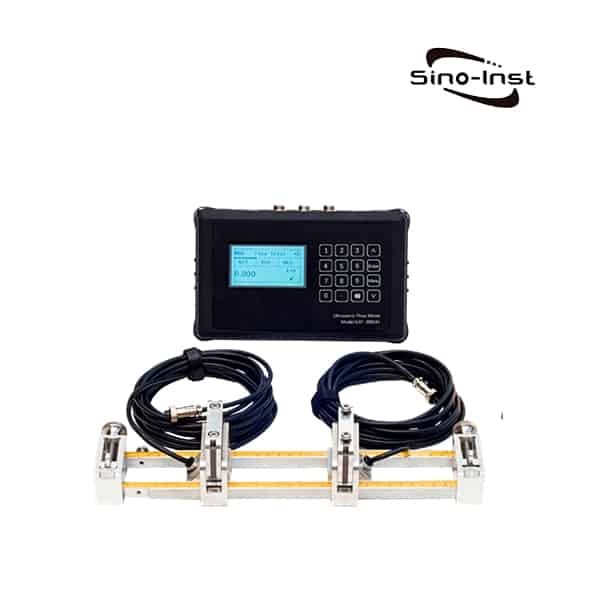
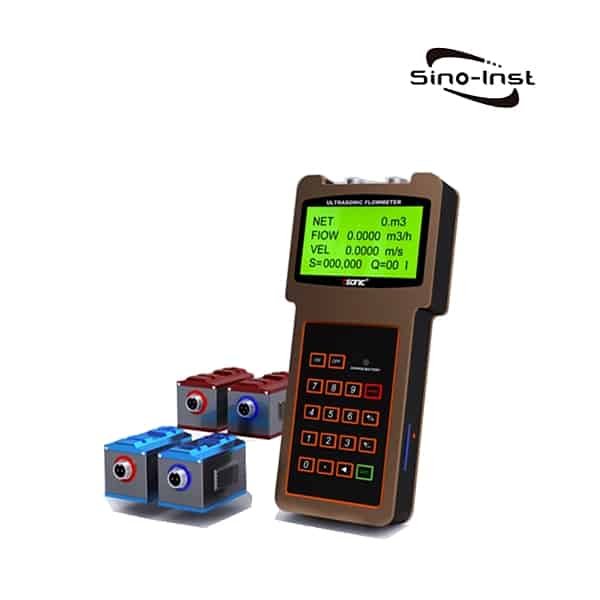
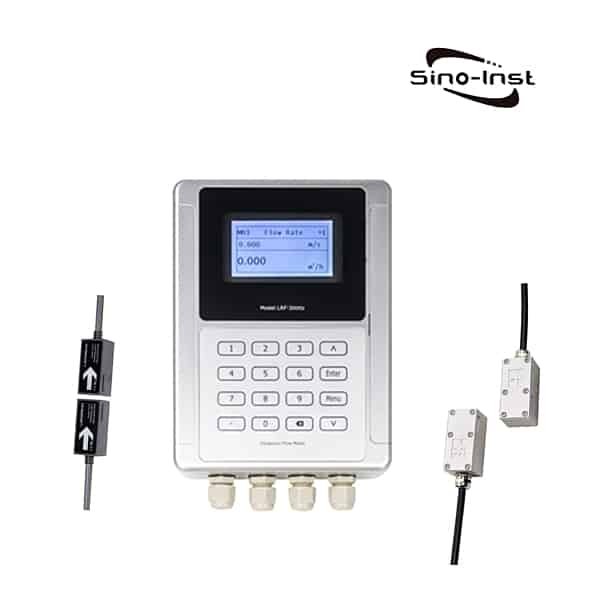
An ultrasonic flow detector is often understood as an ultrasonic flow meter or ultrasonic transducer. In fact, an Ultrasonic flow detector refers to the probe part of the ultrasonic flow meter or sensor part. Ultrasonic flow detectors can be equipped with different ultrasonic flow detectors to meet different measurement needs. For example, a portable ultrasonic flowmeter can be equipped with a clamp Ultrasonic flow detector. commonly used in water, oil, and other single liquid flow rate detection.

Ultrasonic flow detectors types

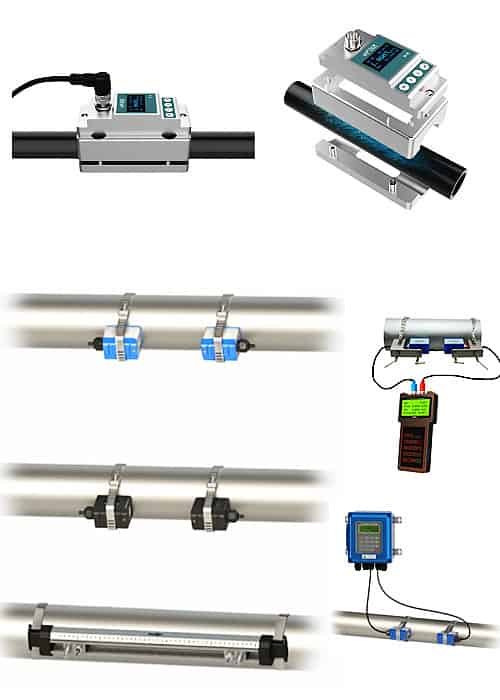
Ultrasonic flow detectors can be divided into external paste type, insertion type, and pipe section type according to the installation method.

A) Clamp-on type

External paste type ultrasonic flowmeter is produced earlier, the user is more familiar with and more widely used ultrasonic flowmeter. Installation of the transducer without pipeline disconnection. That is posted that use, it fully embodies the ultrasonic flowmeter installation is simple, easy to use characteristics.

Extended reading: Portable ultrasonic flow meter for water

B)Pipe section type

Certain pipelines due to material sparse, poor sound conduction, rust and corrosion is serious. Lining and pipeline space with gaps and other reasons. Resulting in serious ultrasonic signal attenuation. Ultrasonic flowmeter with external paste type can not be measured normally. Generated the pipe segment ultrasonic flowmeter.

Pipe segment ultrasonic flowmeter to the converter and measuring tube composition as a whole, to solve the external paste flowmeter measurement in a problem. Measurement accuracy is also higher than other ultrasonic flowmeter. But at the same time also sacrificed the advantages of the external paste type ultrasonic flowmeter non-flow installation. Requires the installation of the transducer to cut the pipe.

Extended Reading: Inline Ultrasonic Flow Meter

C) Insertion type

Insertion type ultrasonic flowmeter in between the above two. Installation can be non-stop flow, the use of special tools have water pipes on the hole, the transducer into the pipe, complete the installation. Transducer pipeline, its signal emission, receiving only the measured medium. Its measurement is not limited by the pipe quality and pipe lining materials.

TM series standard clamp-on Ultrasonic flow detectors

  • With a strong magnet, when measuring steel and cast iron pipes, the sensor only needs to be adsorbed on the outer wall of the pipe.
  • Equipped with a ground terminal, can be used in the occasion of strong electromagnetic interference.
  • Can be fixed by a steel belt, steel wire rope, tensioning belt, special clamps.
  • The upper cover of the sensor is marked with the direction of ultrasonic signal emission.
  • The protection level can reach IP68 after the junction box is filled with glue.
  • Complete specifications, divided into large, medium, and small models, measuring pipe diameter range: DN15~DN6000mm.
  • Temperature range: -40~90℃.
  • According to the different uses, the standard clamp-on sensors are divided into two categories: portable and stationary.

1 Tensioning belt fastening groove
2 Wire rope fastening groove
3 Steel belt fastening slot
4 Top cover fastening screw
5 Signal emission direction indication arrow
6 Sound wedge
7 Powerful magnets
8 Anti-slip groove

9 Upstream and downstream sign sticker
10 Cable interface
11 Installation distance measurement starting and ending points
12 Product information label
13 Positive terminal block
14 Negative terminal block
15 Ground terminal block
16 Junction box

Clamp-on Ultrasonic Flow Meter Working Principle

Clamp on Ultrasonic Flow Meter adopts the measurement principle of time difference method. It uses the ultrasonic wave emitted by the sensor to propagate in the flowing fluid. The sound wave propagation speed in the downstream direction will increase, and the backward direction will decrease. In the same propagation distance, there will be different transmission times. According to the difference between the transmission time and the measured The relationship between fluid velocity measures the fluid velocity.

The flow rate of the fluid is different in different positions in the tube. The flow rate in the center of the tube is faster than the flow rate near the wall of the tube. The flow velocity distribution of the fluid in the pipeline can be represented by the flow velocity cross-sectional distribution diagram.

By setting the flowmeter and considering the cross-sectional distribution of the flow velocity, the average flow velocity can be calculated. Then the volume flow of the fluid can be obtained according to the cross-sectional area of the pipe.

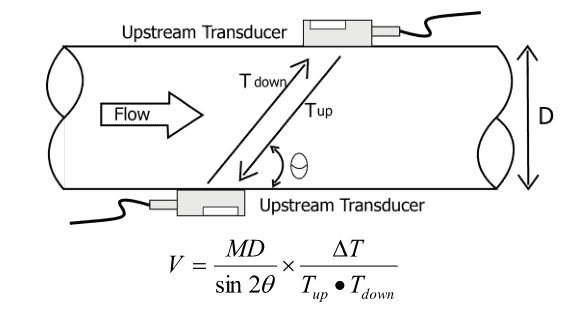
Notes:
V measure fluid velocity
M ultrasonic reflection times
D pipe diameter
θ The angle between the ultrasonic signal and the fluid
T up The time when the downstream sensor transmits the signal to the upstream
T down Time from upstream sensor to downstream
ΔT = T up – T down

Guess You’ll Like: Ultrasonic flow meters types & technical guide

HT series high temperature clamp-on ultrasonic flowmeter sensor

  • With high temperature resistant powerful magnet, when measuring steel and cast iron pipes, the sensor only needs to be adsorbed on the outer wall of the pipe.
  • Equipped with ground terminal, can be used in the occasion of strong electromagnetic interference.
  • Can be fixed by steel belt, steel wire rope, tensioning belt, special clamps.
  • The upper cover of the sensor is marked with the direction of ultrasonic signal emission.
  • The protection level can reach IP68 after the junction box is filled with glue.
  • Complete specifications, divided into large, medium and small specifications, measuring pipe diameter range: DN15~DN6000mm,
  • Temperature range: -40~160℃.
  • According to the different uses, high temperature clamp-on sensors are divided into two categories: portable and fixed.

1 Tensioning belt fastening groove
2 Wire rope fastening groove
3 Steel belt fastening slot
4 Top cover fastening screw
5 Signal emission direction indication arrow
6 Sound wedge
7 Powerful magnets
8 Anti-slip groove

9 Upstream and downstream sign sticker
10 Cable interface
11 Installation distance measurement starting and ending points
12 Product information label
13 Positive terminal block
14 Negative terminal block
15 Ground terminal block
16 Junction box

Extended reading: Flow Totalizer F3000X for Data collection and calculation

Other commonly used ultrasonic flow detectors:

What Does an Ultrasonic Doppler Flow Detector Measure?

From the ultrasonic measurement principle, the time difference method is suitable for measuring pure and less impurity liquids. Such as tap water, river seawater, sewage treatment plant effluent, etc. The Doppler method is suitable for measuring liquids and slurries with a high impurity content. Such as urban drainage, mud, pulp and so on.

Judging from the company’s years of practical experience, the two measurement methods are relatively vague for the quantitative indicators of the impurity content of the measured medium. The main reason is that there is currently no effective instrumentation for measuring the impurity content of liquids.

Doppler ultrasonic flowmeter flow rate measurement is based on the Doppler effect. The probe emits a beam of ultrasonic waves obliquely upward. Ultrasound propagates in fluids. The fluid will contain impurities such as bubbles or particles (it can be considered that the impurities in the fluid are at the same speed as the water flow).

When the ultrasonic wave contacts the impurities in the fluid, the reflected ultrasonic wave will produce a Doppler frequency shift Δf. The Doppler shift Δf is proportional to the flow velocity. The flow velocity of the fluid can be measured by measuring the Doppler frequency shift Δf.

The Dopp ultrasonic flowmeter uses the velocity area method to measure the flow. The flow velocity V is measured using an ultrasonic flow velocity sensor. Use a pressure water level gauge to measure the water level H. The channel parameters set in the controller in advance. The controller can use the water level to automatically convert the flow area S. The formula for the flow rate of the fluid is:

Q= V×S

Wherein V- – – -flow velocity S- – – -flow area Q- – -instantaneous flow

Since the velocity area method is used to measure the flow, it can be applied to any shape of the section.

Related Blogs

Guess you like: Insertion Magnetic Flow Meter-Large diameter online install

FAQ

Ultrasonic flowmeter refers to a flowmeter developed based on the principle that the propagation velocity of ultrasonic waves in the flow medium is equal to the average flow velocity of the measured medium and the vector sum of the velocity of the sound waves in the stationary medium.

According to the principle of signal detection, ultrasonic flowmeter can be divided into propagation speed difference method (direct time difference method, time difference method, phase difference method and frequency difference method), beam shift method, Doppler method, mutual correlation method, spatial filtering method and noise method, etc.

Our time difference ultrasonic flowmeter: measuring the time difference caused by the difference in propagation velocity when propagating downstream and upstream to calculate the measured fluid velocity.

The measurement accuracy of the ultrasonic flowmeter is very high. Almost no interference from various parameters of the measured medium.

Sino-Inst manufactures and supplies ultrasonic flow meters with an accuracy of 1%. This accuracy can meet the measurement needs of most customers.

In particular, it can solve the flow measurement problems of strong corrosive, non-conductive, radioactive and flammable and explosive media that other instruments cannot.

So what causes the inaccurate measurement of the ultrasonic flowmeter?

The following are the reasons for the inaccurate measurement:
The influence of pipeline parameter equipment on the accuracy of ultrasonic flowmeter measurement.
The influence of upstream and downstream straight pipes on the accuracy of ultrasonic flowmeter measurement.
The influence of couplant on measurement accuracy.
The influence of the installation position of the ultrasonic flowmeter transducer on the measurement accuracy.

Sino-Inst produces and supplies ultrasonic flow meters mainly for measuring water, seawater, industrial sewage, acid and alkaline liquids, alcohol, beer, various oils, and other single homogeneous liquids that can conduct ultrasonic waves. Of course, there are also ultrasonic flowmeters that can measure gas.

According to the measurement method can be divided into Doppler ultrasonic flowmeter, time difference ultrasonic flowmeter, hybrid ultrasonic flowmeter.

A)Doppler type ultrasonic flowmeter

B) time difference ultrasonic flowmeter

C)Mixed ultrasonic flowmeter

Related products:

Find more Ultrasonic Flow Meters for Liquids|Clamp-on|Insertion|inline

Sino-Inst, Manufacturer for Ultrasonic flow detectors. It can measure a single sound-conducting liquid medium of DN 15—150mm. It can measure even liquids such as water, seawater, oil, and slurry.

Sino-Inst’s Ultrasonic flow detectors, made in China, Having good Quality, With better price. Our flow measurement instruments are widely used in China, India, Pakistan, the US, and other countries.

Irrigation Flow Meters for Agriculture Water System

What is an irrigation flow meter?

The irrigation flow meter is a flow meter designed for agricultural irrigation water counting. Agriculture, horticulture, etc. require water for irrigation. And water is becoming more and more expensive. The installation of flow measurement devices allows for effective monitoring and management of agriculture water systems.
The old mechanical water meters and today’s ultrasonic flow meters and electromagnetic flowmeters are widely used.

Agricultural irrigation water system

It consists of irrigation canal head project, water transmission and distribution project and field irrigation project.

①Irrigation canal head project has reservoirs, pumping stations, dammed diversion projects, damless diversion projects, wells and other forms. Used to draw irrigation water at the right time and in the right amount.

② water transmission, water distribution projects include channels and canal buildings. Its task is to safely transport and reasonably distribute the water introduced at the head of the canal to all parts of the irrigation area. According to its function and scale, the general fixed channel is divided into dry, branch, bucket, agricultural four levels. Depending on the size of the irrigation area and the terrain, the number of levels of channels can be increased or decreased appropriately. Drainage buildings include diversion buildings, water measuring buildings, restraint buildings, articulation buildings, cross buildings, flood drainage buildings, drainage buildings, etc.

③ Field irrigation project refers to the temporary furrows, water transmission monopoly ditches and field irrigation ditches below the agricultural canals, border fields, and temporary water distribution and water measurement buildings. Used to irrigate the farmland. To meet the needs of normal crop growth or soil improvement.

Extended reading: Industrial VS Residential inline water flow meters

Irrigation flow meters for sale

A magnetic Flow Meter is a flow meter that measures the flow of conductive fluids. Abbreviated as EMF, also called Electromagnetic flowmeters. It is a kind of Volumetric flow meter. A magnetic flow meter measures the velocity of conductive liquids moving through a pipe or conduit. In the wastewater treatment industry, a Magnetic Flow Meter is the best flow meter choice.

Read more about Everything You Need To Know About Electronic Flow Meters

The ultrasonic flow meter measures the liquid flow rate quickly and effectively. There are two types of ultrasonic flowmeter technology: Doppler frequency shift and transit time.

Transit time ultrasonic flow meter is most suitable for measuring the flow of cleaning liquid. Therefore, it is the most popular type of ultrasonic meter.

Doppler ultrasonic flow meter can measure the frequency difference of sound waves reflected from bubbles or particles in the airflow. It is suitable for aerated or dirty liquids.

Insertion Ultrasonic Water Flow Meter-Old Style
Insertion Ultrasonic Water Flow Meter-New Style

Card-type water meter with fixed control function, according to the local climate conditions, crops or green plants growth habits, program control can set up to five timed water supply time per day, in order to achieve water-saving irrigation, scientific irrigation.

The open channel flowmeter uses an ultrasonic sensor with a Parshall groove to measure open channel flow. Ultrasonic open channel flow meter is composed of 3 parts: level sensor, water measuring sink, and flow totalizer.

Ultrasonic open channel flowmeters are used to measure the flow of fluids in non-full tubular open channels and natural flowing water surfaces. It is called open channel flow detection. The measuring flume that is not full is called an open channel. The open channel flowmeter measures the water level in the measuring weir trough and then calculates the flow rate according to the water level flow relationship of the corresponding measuring weir trough.

Extended Reading: Chilled Water Flow Meter

Radar flow meter is a fully automatic flow meter based on microwave technology. It adopts advanced K-band plane radar technology. Through non-contact way to measure the flow rate and water level of the water body. According to the built-in software algorithm, it calculates and outputs the real-time section flow and accumulated flow.

The radar flow meter can be used for non-contact flow measurement in rivers, irrigation channels, underground drainage networks, flood control, and early warning. The product features low power consumption, compact size, high reliability, and easy maintenance. The measurement process is not affected by temperature, sediment, river pollutants, floating objects on the water surface, and other factors.

Extended Reading: Collection of Industrial Insertion Flowmeter Type

Extended reading: 2 inch Water Flow Meter

river flow measurement instruments

The methods of river flow measurement are as follows:

1.Flowmeter method
The flow of the river is measured directly using a flow meter.
There are many types of flowmeters, mainly including differential pressure, electromagnetic, trough and weir flowmeters.
It can be selected and used according to the flow range of the actual flow and the test accuracy requirements.

2.Volume method
Pour river water into a container of known capacity and measure the time it takes to fill the container. Repeat the measurement several times. A method of calculating the amount of water by finding its average value t(s).
The method is simple and easy to implement and has high measurement accuracy. Suitable for rivers with small river flow.
However, there should be an appropriate drop between the overflow port and the receiving water body, or an aqueduct can be used to form an error.

3.Buoy method
Select a straight river reach, and measure the cross-sectional area of ​​the water flow within a 2m interval of the river reach. Find the area of ​​its average cross-section.
Drop buoys in the upper reaches of the river and measure the time it takes for the buoys to flow through the identified reaches (L).
Repeat the measurement several times to obtain the average value (t) of the required time.
The flow rate (L/t) can be calculated.
The flow can then be calculated as follows:

Q=60V*S

where Q is the water flow, and the unit is m^3/min.
v is the average velocity of water flow, and its value is generally 0.7L/t, m/s.
S is the average cross-sectional area of ​​water flow, in m^2.

4.Flow meter method
By measuring the cross-sectional area of ​​the water flow, the river flow rate is measured with a current meter to calculate the river flow.
When measuring, the number of vertical measuring points and the number of horizontal measuring points need to be determined according to the depth and width of the channel.
This method is simple, but it is easily affected by water quality, and it is difficult to achieve continuous determination.

5.Acoustic Doppler flow velocity measurement
Acoustic Doppler flow velocity measurement is developed using the principle of acoustic Doppler. It can simultaneously measure the cross-sectional shape, water depth, flow velocity and flow rate of the river bed at one time, and is suitable for flow monitoring of large rivers.

The flowmeter’s host and transducer are housed in a waterproof container. All immersed in water when working. It is connected with a portable computer through a waterproof cable, and the operation and control of the flowmeter are carried out on the portable computer.
From the initial blind zone of more than 1m, it has been reduced to the so-called “zero blind zone”. The section unit is reduced to the current 0.05~0.25m. Make it possible to apply it on wide and shallow rivers.

Read more about: Common River Water Level Measurement Methods

Battery operated electromagnetic flow meter-GRPS-new irrigation water flow meter

GPRS wireless remote electromagnetic flowmeter inherits the advantages and functions of the original electromagnetic flowmeter and supports GPRS wireless communication.

Only a mobile phone card with GPRS wireless Internet access function is required, and you can easily log in to the Internet and establish a connection with a remote computer without connecting other module devices. Support Kingview.

The battery-powered converter comes standard with a regular lithium battery pack that lasts 3–6 years. If equipped with a high-capacity lithium battery pack, the continuous working time will be longer.

It can easily realize remote monitoring of the electromagnetic flowmeter’s instantaneous flow, instantaneous flow rate, flow percentage, fluid conductance ratio, forward cumulative value, reverse cumulative value, alarm status and other data. With disconnection automatic connection function, support dynamic IP address.

This Battery operated electromagnetic flow meter has become the choice of many users.

How to Select the Right Agriculture Flow Meter

Due to the modernization of agriculture and the realization of precision agriculture, flowmeters are bound to play an increasingly important role in farmland irrigation.
Therefore, on the basis of a comprehensive comparison of the measurement methods and characteristics of various flowmeters on the market. You should choose flow meter products that are more in line with the requirements of farmland water conservancy irrigation, safe, reliable, economical and durable.

The principle of choosing a flowmeter is to have a deep understanding of the structural principles and fluid characteristics of various flowmeters. At the same time, the selection should be made according to the specific situation of the site and the surrounding environmental conditions. Economic factors must also be taken into account.

In general, you should choose from the following five aspects:

① Performance requirements of the flowmeter;

  • Whether to measure flow (instantaneous flow) or total amount (cumulative flow);
  • Accuracy requirements;
  • Repeatability;
  • Linearity;
  • Flow range and range;
  • Pressure loss;
  • Output signal characteristics and flowmeter response time, etc.

② fluid characteristics;

  • Fluid temperature and pressure
  • fluid density
  • Viscosity
  • Chemical corrosion and scaling
  • compression factor

③ Installation requirements;

  • Field piping wiring
  • The flow direction of the fluid
  • The upstream and downstream straight pipe sections of the flowmeter
  • Pipe diameter and pipe vibration
  • The installation position of the valve
  • Protective accessories
  • Electrical connection and electromagnetic interference
  • Pulsating flow and unsteady flow

④ Environmental conditions;

  • Ambient temperature
  • Ambient humidity
  • Security
  • Electrical interference

⑤ The price of the flow meter.

  • Installation fee
  • Running cost
  • Testing fee
  • Maintenance costs and spare parts costs, etc.

Frequently
Asked
Questions

In theory, there are many ways to measure irrigation flow.
However, from a practical application point of view I will tell you:

If it is a closed pipe, use a flowmeter. Electromagnetic flowmeters or ultrasonic flowmeters are both good choices.
If it is an open channel, then an open channel flow meter is used.

If you want to divide the flow meter into three categories. I think it can be divided into volumetric flowmeters, mass flowmeters, and velocity flowmeters.

If you choose a water meter. Then the diameter of the water meter is determined according to the rated flow of the water meter and the user’s water consumption and water use method.

If you choose a flow meter. It is necessary to combine the selection reference parameters mentioned above.

The general measurement is to use an electromagnetic flowmeter.

Magnetic flowmeters use the principle of Faraday’s Law of Electromagnetic Induction to measure the flow rate of liquid in a pipe. In the magnetic flowmeter pipe parts, a magnetic field is generated and channeled into the liquid flowing through the pipe.

As fluid flows through the magnetic field, conductive particles in the fluid create changes. This variation is used to measure and calculate the velocity of water flow through the pipe. When the fluid moves faster, more voltage is generated. The electronic transmitter processes the voltage signal to determine the liquid flow.

Read more about Digital Water Flow Meters

More water flow measurement and control solutions

Sino-Inst is Manufacturer of Irrigation Flow Meters. We supply more than 20 kinds of Irrigation Flow Meters. 60% magnetic flow meter, 20% ultrasonic flowmeters, and other types of flowmeters.

Irrigation Flow Meters are mainly used for flow measurement of Agriculture Water System.
It can measure even liquids such as water, seawater, oil, and slurry.

Irrigation Flow Meters enable stable water measurement and control. This greatly meets the measurement needs of many Farm and irrigation industry applications. Can be used from small to large tubes.

Sino-Inst’s Irrigation Flow Meters, made in China, Having good Quality, With better price. Our flow measurement instruments are widely used in China, India, Pakistan, the US, and other countries.


The entire team at Sino-Inst’s has received excellent training, so we can ensure that every client’s needs are met. For assistance with your product requirements, whether it’s a Irrigation Flow Meters, level sensor, or other device, give us a call.