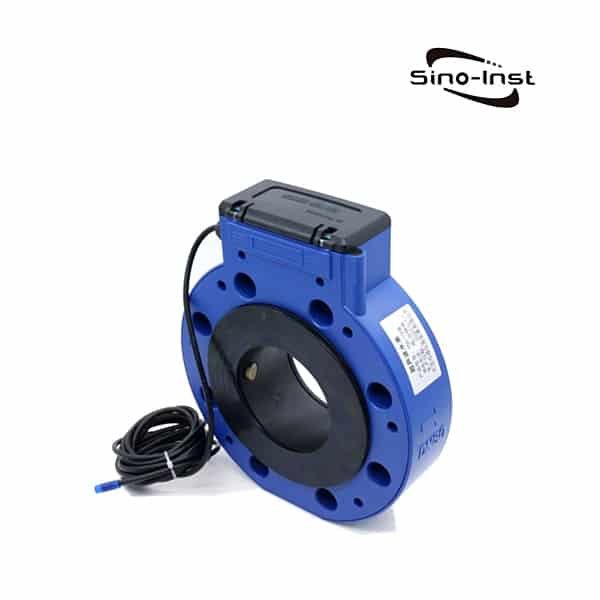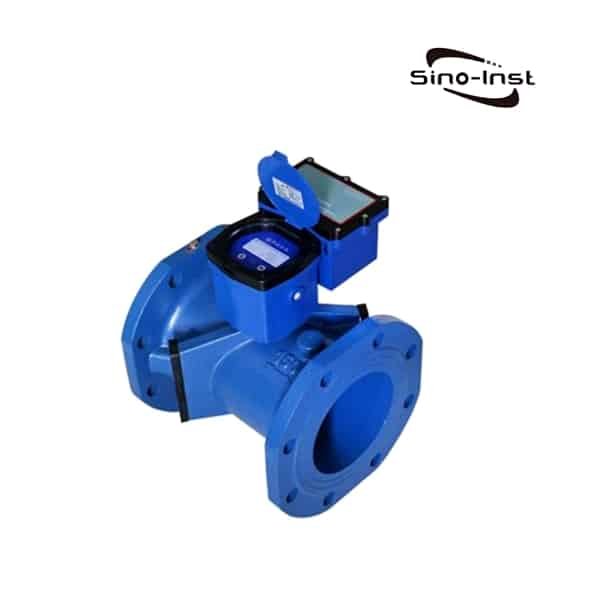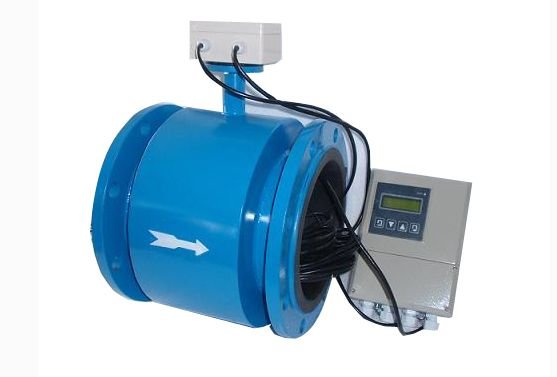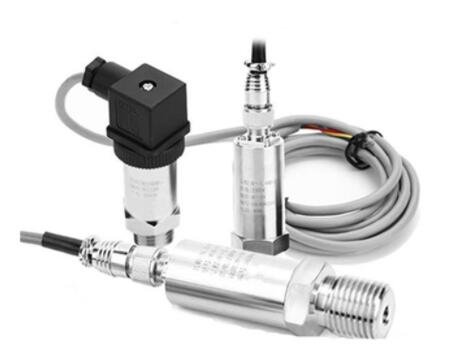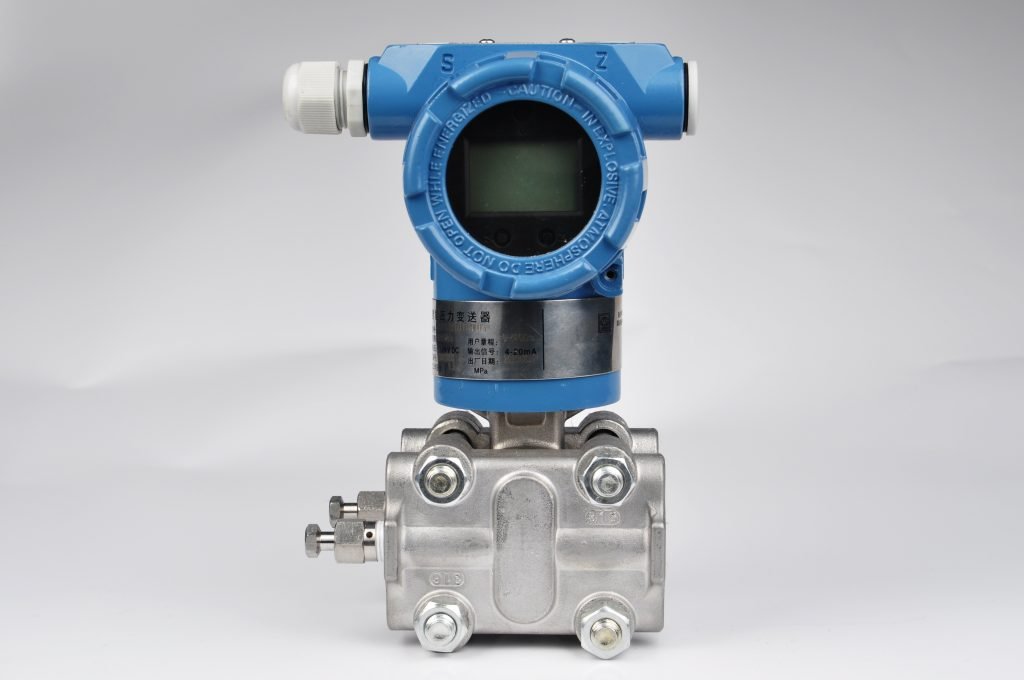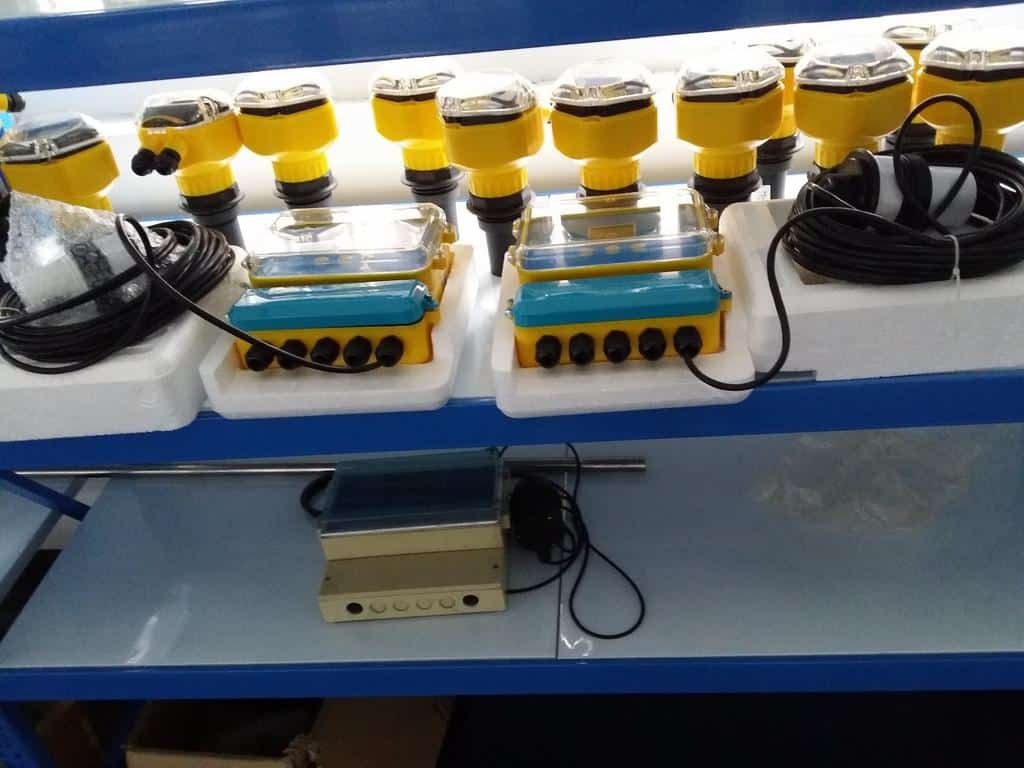
Ultrasonic flow measurement

Ultrasonic flow measurement


Ultrasonic Flow Measurement, Industrial Inline Flow Measurement.

Ultrasonic flow meters, using the ultrasonic principle, measure the velocity of flow.

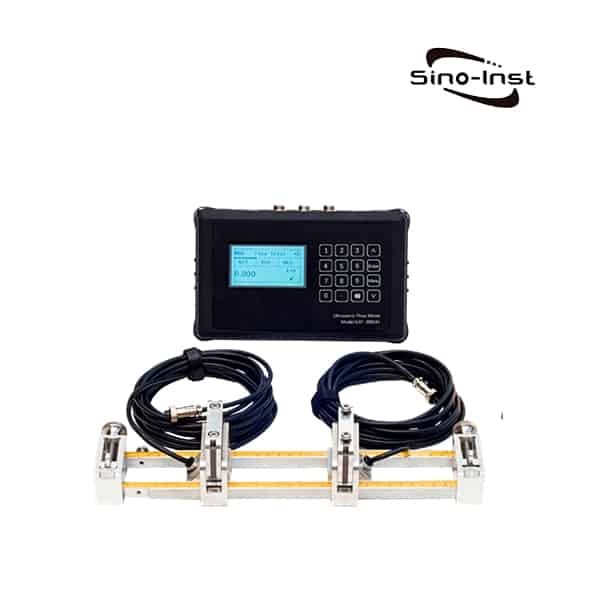
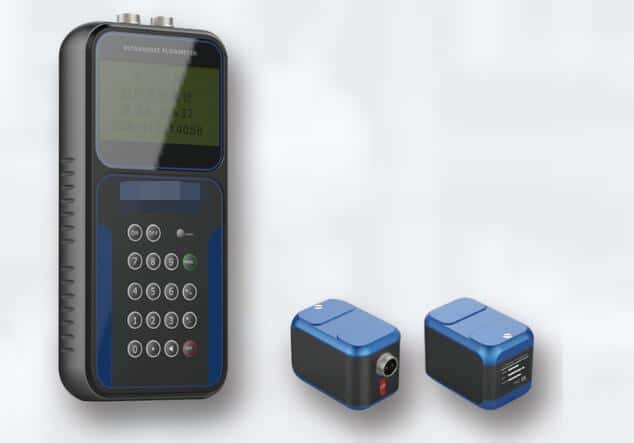
We can use a different type of ultrasonic flow meters, like: Portable ultrasonic flow meter, Handheld ultrasonic flow meter, Clamp-on Ultrasonic Gas Flow Meter.

For airflow, natural gas, water, velocity measurement. There are two types of ultrasonic flow meter technologies: Doppler shift and transit-time. Transit-time measures the time differential between signals sent upstream and downstream.

The differential is directly proportional to the velocity of the water.

Transit-time meters are best used for measuring the flow of clean liquids and, as a result, are the most popular type of ultrasonic meter. 

Doppler shift measures the difference in frequency of the sound wave, reflected off gas bubbles or particles in the flow stream, and is suitable for aerated or dirty liquids.

Products for Ultrasonic Flow Meters solutions

Specifications of Ultrasonic Flowmeters

Item

Principle and parameters

Converter

Principle

Transit-time,4 byte floating-point operation in accordance with IEEE754

Accuracy

Inline type:flow meter:±0.5%; heat meter:±1.0%

Clamp on type:flow meter:±1.0%; heat meter:±2.0%

Insertion type:flow meter:±1.0%; heat meter:±2.0%


Operation

4-key manipulation with magnetic bar touch or figer touch;

simulation keyboard software

Output

One way 4-20mA analog output

One way OCT pulse signal output

One way Relay output

Input

3 way 4-20mA analog input,accuracy:0.1%;

Acquisition signal of temperature,press and liquid level

Achieve heat measurement by connecting 3-wired PT100

Temperature sensor

Data interface

RS485 serial interface,upgraded by computer,support MODBUS communication protocol

Special cable

Twisted-pair shielded cable and cable length should be no more than 50 m.Transmission distance can achieve 1 km if select the RS 485 interface

pipeline

Pipe material

Steel,stainless,copper,cement,PVC,aluminum,glass steel, cast iron

Pipe diameter

DN15mm-DN6000mm

Straight pipeline

Transducers installation points should be:10 diameters’ straight pipeline from upstream transducer ,5 diameters’ 

straight pipeline from the downstream transducer ;30 diameters’ straight pipeline from the pump

Measuring

Medium


Liquid type

Single liquid that can conduct sound wave,such as water,

Seawater, sewage,plant effluent,chemicals,alcohol,beer,oil

etc.

Fluid temperature

-30℃-160

Turbidity

10000ppm,with little bubble

Fluid velocity

0m/s-7m/s

Working

Environment

Temperature

Converter:-20℃-60℃;transducer:-30-160

Humidity

Both of the converter and transducers can work under water,depth underwater ≤2m(After completely sealing)

Power supply

DC8-36V;AC85-264V(optional)

Power consumption

1.5W

ultrasonic flow meter pDF

The Working Principle of Ultrasonic Flow Measurement

Video source: https://www.youtube.com/embed/Bx2RnrfLkQg?start=16

Ultrasonic flowmeters use sound waves to determine the velocity of a fluid flowing in a pipe.

At no flow conditions, the frequencies of an ultrasonic wave transmitted into a pipe, and its reflections from the fluid are the same.

Under flowing conditions, the frequency of the reflected wave is different, due to the Doppler effect.

When the fluid moves faster, the frequency shift increases linearly.

The transmitter processes signals from the transmitted wave, and its reflections to determine the flow rate.

You may like: Digital Flow Meters Guide| Liquid and Gas

Ultrasonic flow meter advantages and disadvantages

Generally, an ultrasonic flow meter is the device, that uses ultrasound to measure the velocity of liquid flow, that helps in determining the volume of liquid flow also.

The ultrasonic flow meters are made using the ultrasonic transducers, which are clamped to the external surface of a pipe, to generate the ultrasonic pulses through the pipe.

When the liquid flows inside the pipe, it creates the time difference in the pulses, and these are examined to calculate the accurate flow velocity of the liquid.

There are many advantages of using the ULTRASONIC flow meters which include:

  • The electronics in the ultrasonic flow meter includes ultrasonic flowmeter detector which compensates and adapts to the changes in the profile of the flow, type of the liquid and material of the pipe.
  • A portable ultrasonic flow meter converter can be used as a direct method to determine the flow rates effectively when compared to the other flow systems.
  • Ultrasonic flow meter converter is inexpensive to use and maintain when compared to the other mechanical flow meters as they are no moving parts in these flow meters.
  • Their design is highly sophisticated and they do not obstruct the liquid flow, so they can be used for sanitary, corrosive and abrasive liquids.

These are the advantages of the ultrasonic flow meters and there are many disadvantages of the Ultrasonic flow meter which include:

  • The main disadvantage of the ultrasonic flow meter is the cost. The cost of the flow meter is very high when compared to the other types of mechanical flow meters.
  • The ultrasonic flow meters are sophisticated when compared to the mechanical flow meters, so it needs experts to repair and maintain the flow meters.

These are the advantages and disadvantages of the ultrasonic flow meters.

Ultrasonic flow meter Types

  1. According to the measurement principle

(1) Time difference method ultrasonic flowmeter;
(2) Frequency difference method ultrasonic flowmeter;
(3) Phase difference method ultrasonic flowmeter;
(4) Doppler ultrasonic flowmeter;
(5) Ultrasonic flowmeters for partially full pipes and river channels that combine liquid level measurement and average velocity measurement.

  1. According to usage

(1) Portable ultrasonic flowmeter;
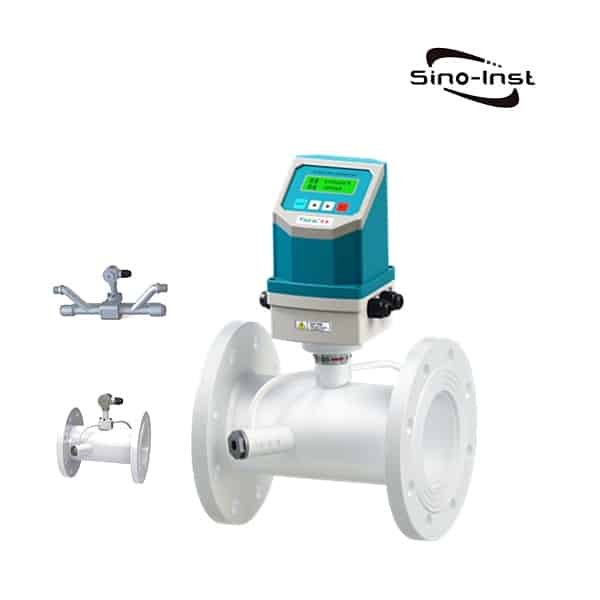
(2) Fixed (standard pipe section) ultrasonic flowmeter.

  1. According to the installation method of the transducer

(1) Standard pipe section ultrasonic flowmeter;
(2) Clip-on ultrasonic flowmeter;
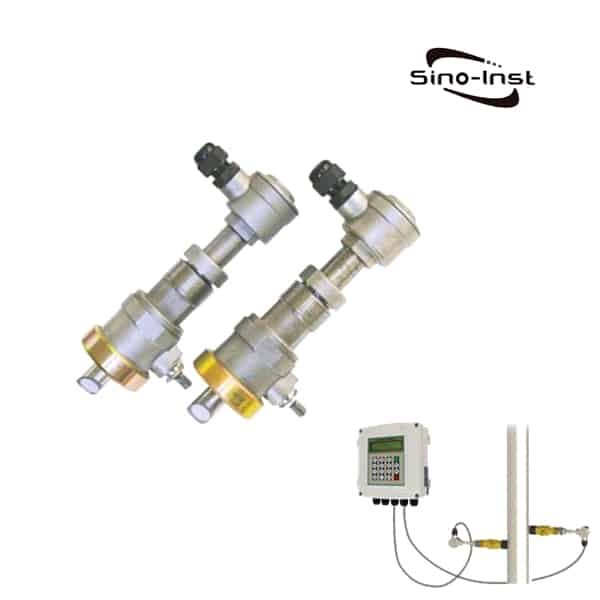
(3) On-site plug-in ultrasonic flowmeter with hole opening.

  1. According to whether the transducer is in contact with the fluid

(1) Immersion (contact) ultrasonic flowmeter;
(2) Non-invasive (non-contact) ultrasonic flowmeter.

  1. According to the nature of the measured fluid

(1) Liquid ultrasonic flowmeter;
(2) Gas ultrasonic flowmeter.

  1. According to the number of transducer channels

(1) Mono ultrasonic flowmeter;
(2) Two-channel ultrasonic flowmeter;
(3) Multi-channel ultrasonic flowmeter.

Extended Reading: Inline Ultrasonic Flow Meter

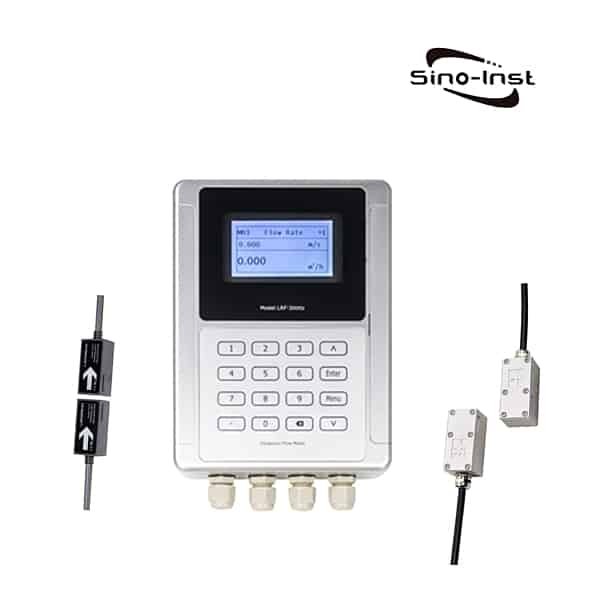
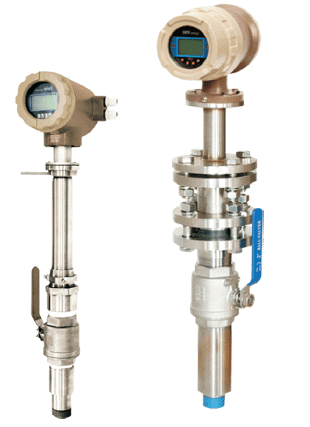
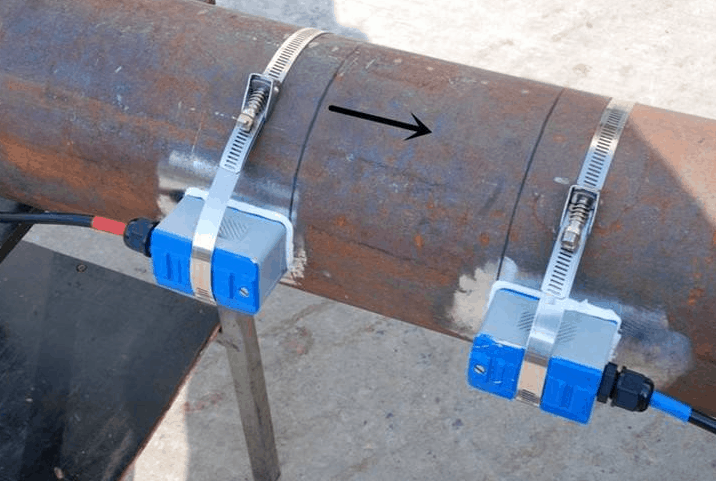
Ultrasonic Clamp on Flow Meter is composed of an integrated host and external clamp on sensors. Clamp on Flow Sensors are available at room temperature and high temperature.

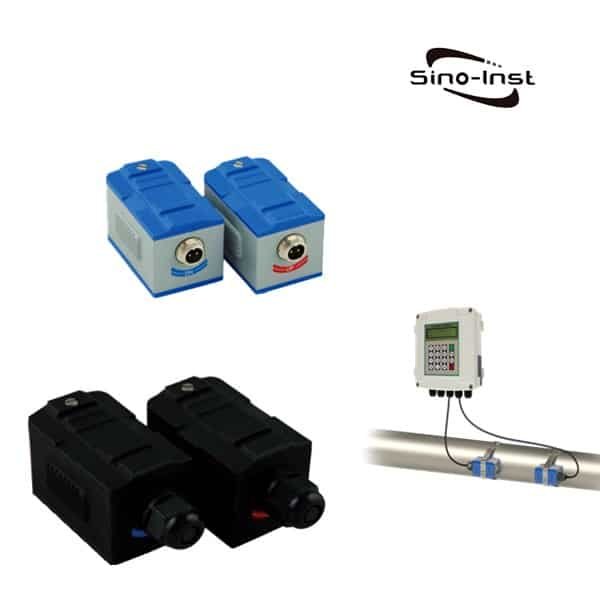
Clamp on flow meter (Model: 2000) is composed of an integrated host and ultrasonic clamp on sensor. Clamp on flow meter is widely used in online flow measurement of various liquids. Just stick the external clamp sensor on the pipe surface. Compared with the traditional flowmeter, it does not need to cut off the pipe and flow. The installation is convenient and quick, and the non-destructive installation is truly realized.

Extended reading: Ultrasonic flow detectors types

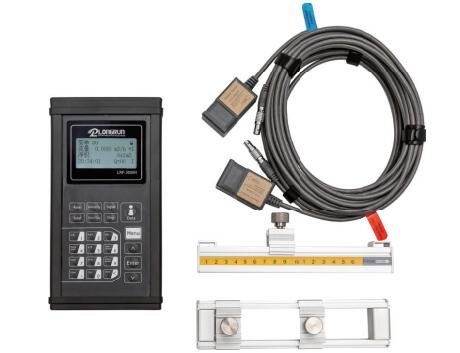
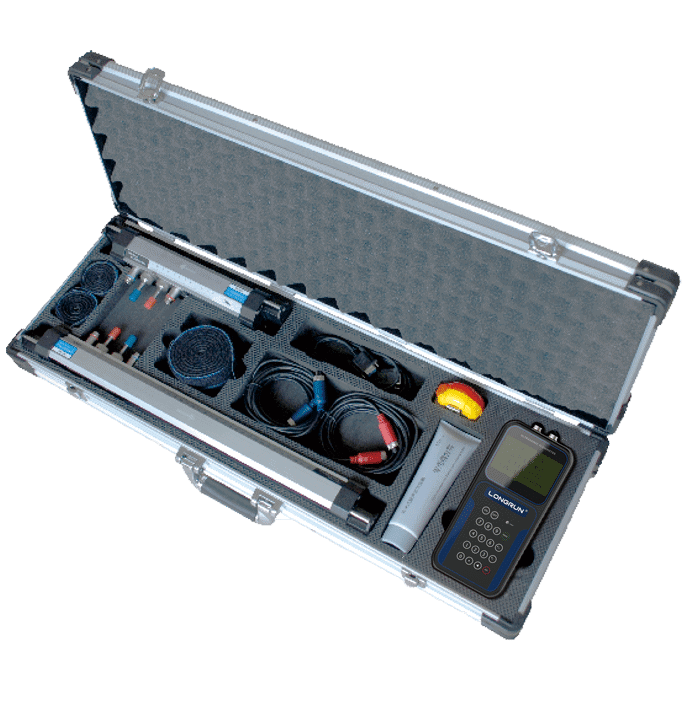
Portable Ultrasonic Flow Meter is a handheld ultrasonic flow meter. The clamp-on sensor is used to measure liquid flow in industrial pipelines.

Handheld ultrasonic flow meter realizes the non-contact measurement of liquid flow. Also often referred to as Portable Clamp-On Ultrasonic Flow Meter for Liquids.
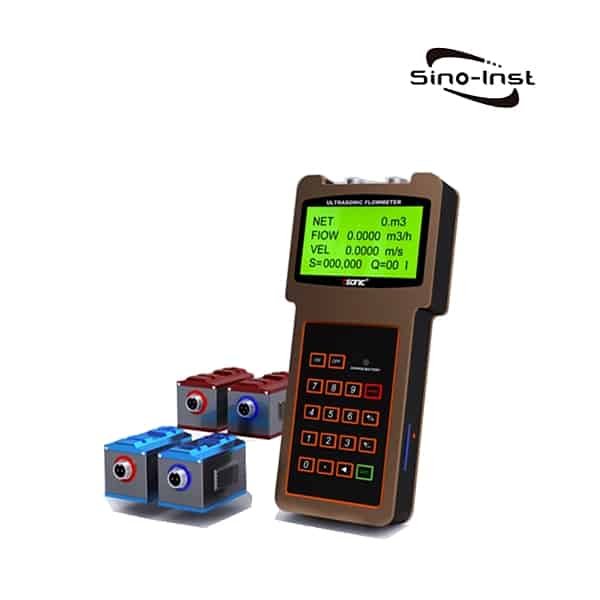
Handheld Ultrasonic Flow Meter ( Model:2000H) has been successfully applied to measurement work in various industries. The measuring range is 20-6000mm (0.5-20 inches). A non-contact measurement method is adopted. Flexible operation and easy to carry. Conductive or non-conductive, corrosive or non-corrosive liquids can be measured. Various fluids: water, pure water, sewage, sea water, chemical fluids, river water, fuel Oil etc. can be measured.

Extended reading: Portable ultrasonic flow meter for water

Ultrasonic flow meter price

Sino-Inst offers Ultrasonic flow meters with the best quality and best price.

The reference price is between USD 150-700.

The price of ultrasonic flow meter is affected by:

  • Types of sensors
  • Materials
  • Cable length

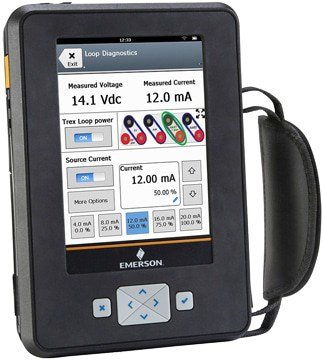
All of our Flow Meters can work with the NEW AMS TREX !

Ultrasonic flow meter manufacturer

Sino-Inst offers 20 Ultrasonic flow meter products, with Best Price.

Sino-Inst is the manufacturer and supplier of ultrasonic flow meters.

About 13% of these are Petroleum& Chemical flow meters, 4% are water treatment flow indicators. The best Reference price is USD 2000-7000.

A wide variety of ultrasonic flow meter options are available to you, such as free samples, paid samples.

Sino-Inst is clamp-on ultrasonic flow meter suppliers, located in China.

Clamp-on ultrasonic flow meter products are most popular in North America, Mid East, and Eastern Europe.

The United States, and India, which export 99%, 1%, and 1% of ultrasonic level transmitter respectively.

You can ensure product safety by selecting from a certified supplier,

with ISO9001, ISO14001 certification.

In addition to measuring flow rate, ultrasonic technology can also be used to measure liquid level.
The ultrasonic liquid level sensor is also an excellent product for measuring the liquid level of the tank.

Procurement Guide: Ultrasonic liquid level sensors

CO2 Cylinder | Portable Liquid Level Gauge

Frequently
Asked
Questions
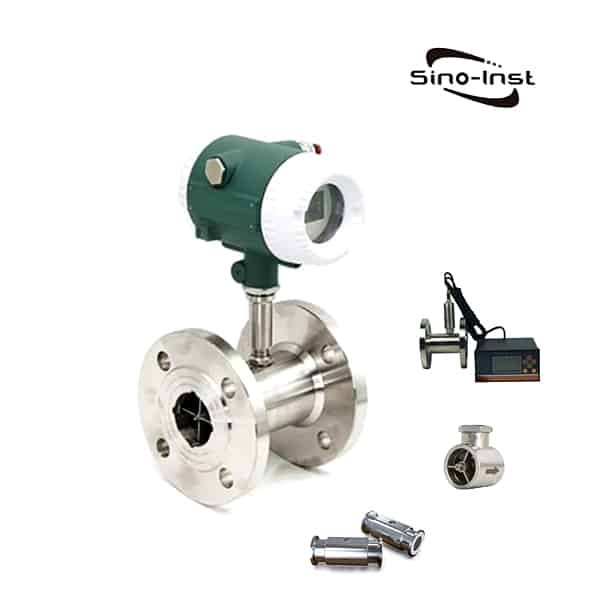
Fuel flow meters, also known as turbine flow meters, are the main types of speed flow meters. A freely rotatable impeller is installed in the fluid flowing pipe. When the fluid passes, its motion can make the impeller rotate. The larger the fluid flow rate, the larger the kinetic energy and the higher the impeller speed.

The fluid flow can be determined by measuring the number of revolutions or the number of revolutions of the impeller.

Ultrasonic flow detector is also an ultrasonic sensor. Or called an ultrasonic flowmeter.
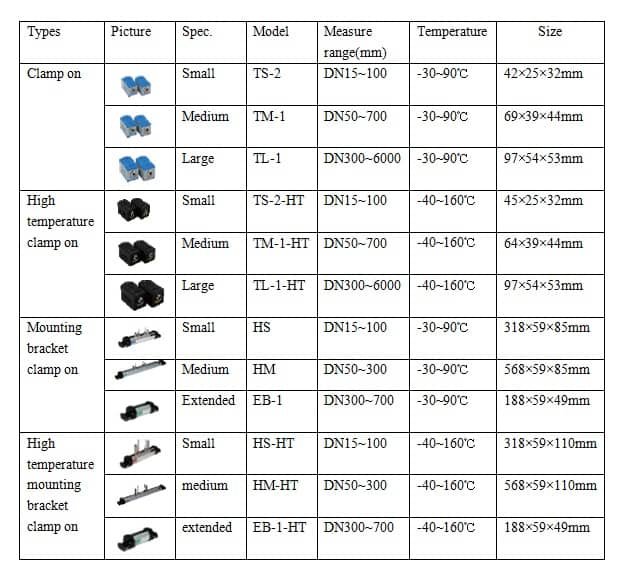
Ultrasonic flow detector is composed of sensor and host. The host has wall-mounted, handheld, portable, etc. Sensors are classified into the following models according to the measuring pipe diameter and measuring temperature. It can help users measure pipeline flow under various working conditions.

Optional Transducer

Ultrasonic flowmeter refers to a flowmeter developed based on the principle that the propagation velocity of ultrasonic waves in a flowing medium is equal to the vector sum of the average velocity of the measured medium and the velocity of sound waves in a stationary medium.

It is mainly composed of transducer and converter, and there are different types such as Doppler method, velocity difference method, beam shifting method, noise method and correlation method.

Clamp-on or tube-segment ultrasonic flow meter is based on the principle of “velocity difference method”. It is an instrument for measuring the liquid flow in a circular tube.

Ultrasonic flow meters for measuring liquid flow. Measurement linearity is better than 0.5%. Repeatability accuracy is better than 0.2%. The time difference measurement resolution of up to 40 picoseconds enables the measurement accuracy to reach ±1%.

When choosing an ultrasonic flowmeter, the following points are mainly considered:

1.Measuring medium. 2. Pipe material. 3. Velocity range. 4. Diameter range. 5. Applicable temperature. 6. Medium turbidity. 7. Pipe lining. 8. Acceptable form of installation.

Related Blogs

Sino-Inst, Manufacturer for Ultrasonic Flow Meters. It can measure a single sound-conducting liquid medium of DN 25—150mm. It can measure even liquids such as water, sea water, oil, and slurry.

Sino-Inst’s Ultrasonic Flow Meter, made in China, Having good Quality, With better price. Our flow measurement instruments are widely used in China, India, Pakistan, US, and other countries.

Clamp-on Ultrasonic Gas Flow Meter

Clamp-on Ultrasonic gas flow meters, also called ultrasonic natural gas flow meters, measure liquids, and gas in industrial flow measurement applications.

Ultrasonic gas flow meters are one of the most reliable solutions,

for challenging gas flow measurement applications. (Kind like the portable ultrasonic)

Because the sensor is clamped on to the outside of the pipe,

it is immune to the process compatibility,

concerns of an in-line flow metering technology (What is a flow meter? ).

​​It is now possible to measure natural gassteamcompressed airhydrogen

compressed air and many more using clamp-on flow meters.

Our transducer technology is also ideal for shale gas,

and coal seam gas wellhead applications.

SI-3128 wall mounted ultrasonic flow meter could be applied to a variety of liquid applications,

including ultra-pure liquids, water, chemicals, raw sewage,

reclaimed water, cooling water, river water, plant effluent, alcohol, beer, etc.

What are the types of flow meter?

Features of Clamp-on Ultrasonic Gas Flow Meter

Ultrasonic Flow Meter SI-3128
  • Accuracy: 1%
  • Ingress protection level: IP67 (transmitter), IP68 (sensor)
  • Wide measurement range, pipe size from DN15mm to DN6000mm.
  • Three installation types: wall mounting, DIN-rail mounting, explosion-proof box mounting
  • Could operate with temperature sensors for heat/energy measurement.
  • Could be installed without shut down equipment operation

Specifications for Clamp-on Ultrasonic Gas Flow Meter

Items

Performance Parameter


      Host


Principle

Transit- time ultrasonic flowmeter

Accuracy

±1%

Display

2X20 character LCD with backlight, support the language of Chinese, English and Italy

Signal

Output

1 way 4~20mA output, electric resistance 0~ 1K, accuracy 0. 1%(optional)

1 way OCT pulse output(Pulse width 6~1000ms, default is 200ms)

1 way Relay output


Signal

Input

3 way 4~20mA input, accuracy 0. 1%, acquisition signal such as temperature, press and liquid level

Connect the temperature transducer Pt100, can finish the heat/energy measurement

Data

Interface

Insulate Rs485 serial interface, upgrade the flowmeter software by computer, support the MODBUS

Special Cable

Twisted-pair cable, generally, the length under 50 meters ; Select the RS485, transmission distance can over 1000m

Pipe

Installation

Condition

Pipe

Material

Steel, Stainless steel, Cast iron, Copper, Cement pipe, PVC, Aluminum, Glass steel product, liner is allowed

Pipe

Diameter

DN32~6000mm

Straight

Pipe

Transducer installation should be satisfied: upstream10D, downstream 5D, 30D from the pump

Measuring

Medium

Medium

water,sea water ,alcohol,Acid and alkali,waste water,beer,all kinds of oil Single liquid can transmit sound wave.

Temperature

-30~160℃

Turbidity

No more than 10000ppm and less bubble

Flowrate

0~±7m/s,Forward and backward measurement

Work environment

Protection grade

Host:IP67;flow sensor:IP68

temperature

Host:-20~60℃;flow sensor:-30~ 160℃

Humidity

Host: 85%RH; Flow sensor:can measure under water, water depth^2m (tansducer sealed glue)

Power Supply

DC8~36V or AC85~264V

Power

Consumption

1.5W

Dimension

132*150*85mm(host)

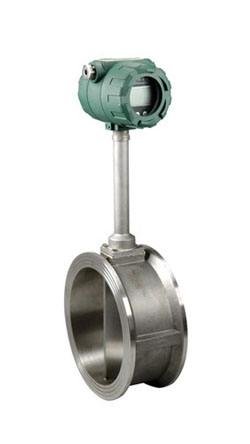
You may like: Vortex shedding flow meter

Gases that can be measured with ultrasonic clamp-on flowmeters include:

Compressed AirHydrogenOxygen
NitrogenSteamNatural Gas
PropaneButaneCorrosive Gases
Erosive GasesHigh Purity GasesSterile Gases
Toxic GasesInert GasesCompressed Air

What is ultrasonic gas meter?

Ultrasonic flowmeters use sound waves to determine the velocity of a fluid flowing in a pipe.

At no flow conditions,

the frequencies of an ultrasonic wave transmitted into a pipe,

and its reflections from the fluid are the same.

Under flowing conditions, the frequency of the reflected wave is different due to the Doppler effect.

When the fluid moves faster, the frequency shift increases linearly.

The transmitter processes signals from the transmitted wave,

and its reflections to determine the flow rate.

Transit time ultrasonic flowmeters send and receive ultrasonic waves,

between transducers in both the upstream and downstream directions in the pipe.

At no flow conditions,

it takes the same time to travel upstream and downstream between the transducers.

Under flowing conditions, the upstream wave will travel slower and take more time than the (faster) downstream wave.

When the fluid moves faster, the difference between the upstream and downstream times increases.

The transmitter processes upstream and downstream times to determine the flow rate.

They represent about 12% of all flowmeters sold.

The ultrasonic principle can also be used to measure water depth. Please refer to Portable Ultrasonic Water Depth Gauge for water depth measurement.

You may like: Nitrogen flow meter

How does a clamp-on flow meter work?

A clamp-on ultrasonic gas flow meter produces signals,

that is five to ten times more powerful,

then those of traditional ultrasonic transducers.

The new clamp-on transducers produce clean, coded signals with very minimal background noise.

The result is that a clamp-on gas flow meter can now provide optimum performance,

even with low-density gas applications.

Today, our ultrasonic clamp-on gas flowmeters such as the SI-3128 can measure the flow of any gas,

and then calculate mass flow using a pressure transmitter connected to the analog input.

Inline ultrasonic flowmeters

The SI-3000H Portable Ultrasonic Flowmeter is a widely used time difference ultrasonic flowmeter,

for on-line calibration and inspection of liquid flow in various industrial sites.

Handheld ultrasonic flow meter, also known as Portable Doppler flow meter, or Inline ultrasonic flow meter.

SI-2000H handheld ultrasonic flow meter is a representative of portable ultrasonic flow meters.

More Gas Flow Meters

Sino-Instrument offers 20 Gas flow meter products, with Best Price.

About 13% of these are Petroleum& Chemical flow meters, 4% are water treatment flow indicators.

The best Reference price is USD 2000-7000.

A wide variety of gas flow meter options are available to you, such as free samples, paid samples.

Sino-Instrument is clamp-on ultrasonic flow meter suppliers, located in China.

clamp-on ultrasonic flow meter products are most popular in North America, Mid East, and Eastern Europe.

The United States, and India, which export 99%, 1%, and 1% of ultrasonic level transmitter respectively.

You can ensure product safety by selecting from a certified supplier,

with ISO9001, ISO14001 certification.

Of course, you can also choose other gas flow measurement instruments, like:

https://www.drurylandetheatre.com/coriolis-mass-flow-meter-si3131/
https://www.drurylandetheatre.com/steam-flow-meter-inline-vortex-flow-meters/
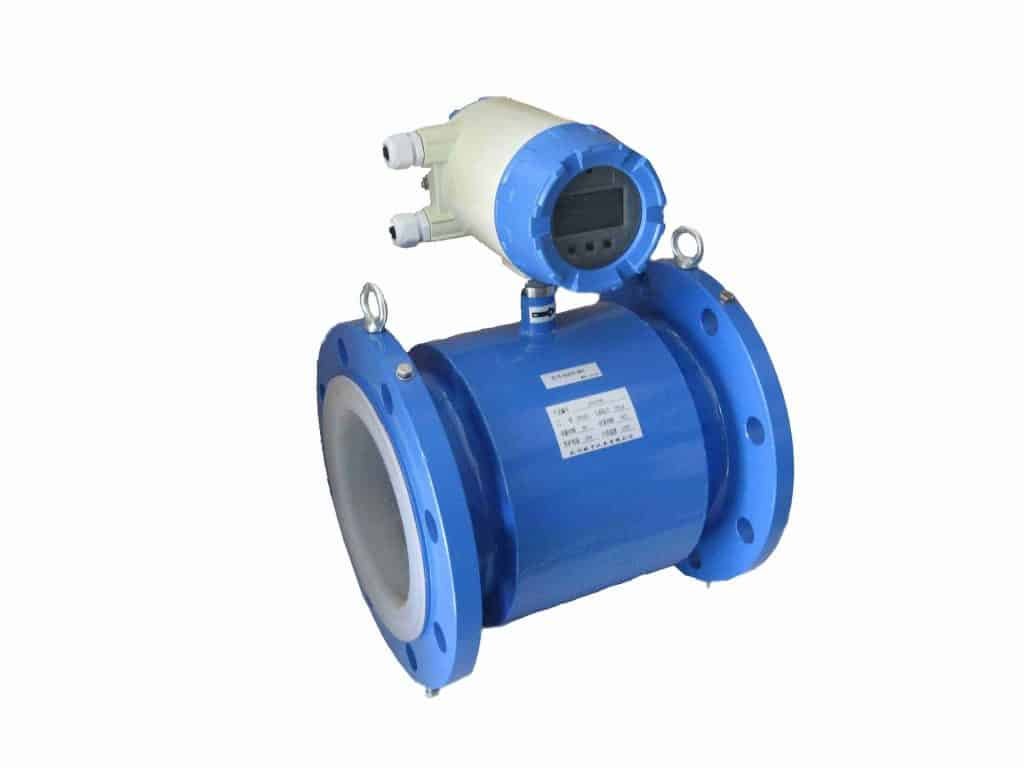
https://www.drurylandetheatre.com/magnetic-flow-meters/
https://www.drurylandetheatre.com/si-rsl-thermal-mass-flowmeters/

Request a Quote

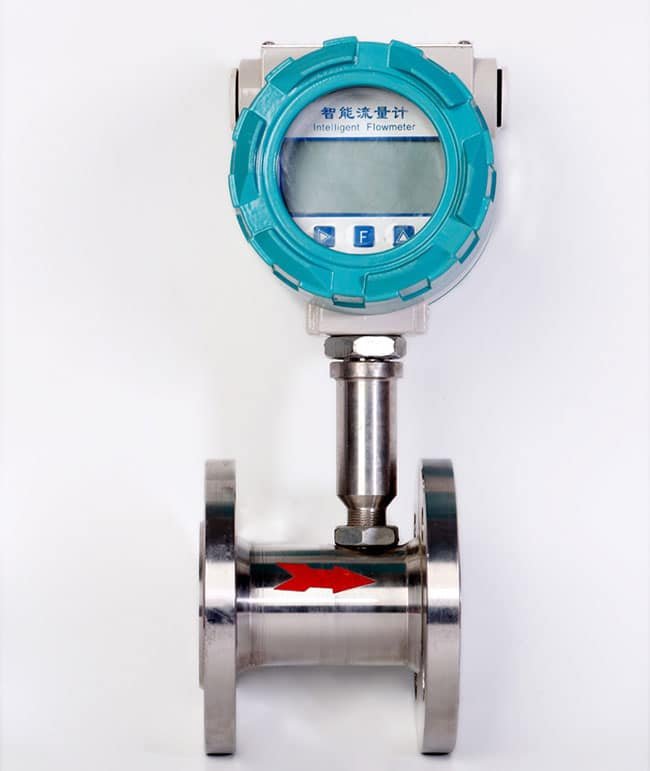
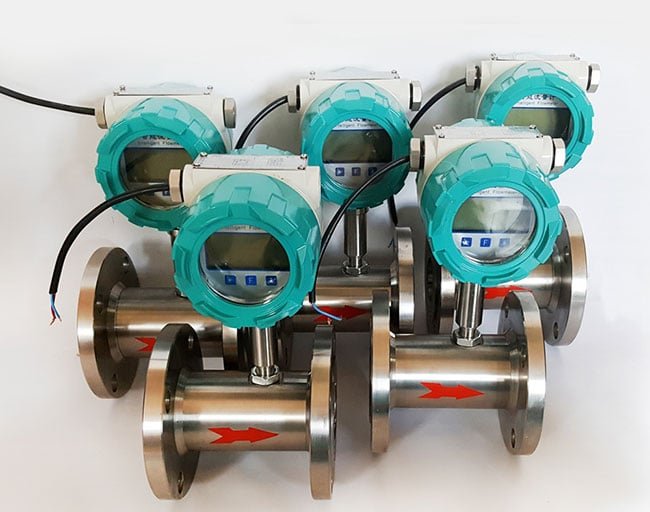
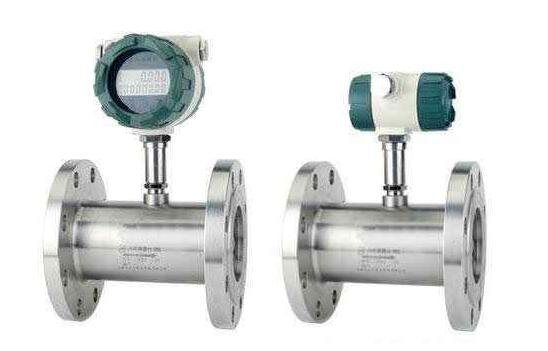
Turbine Flow Meters

Turbine Flow Meters for Liquid

Turbine flow meters are flow sensors work for the inline liquids.

Turbine flow meters are cost-effective and offer reliable,

measurement with minimal flow meter maintenance required.

Turbine flow meters measure the velocity of liquids, gases, and vapors in pipes,

such as hydrocarbons, chemicals, water, cryogenic liquids, air, and industrial gases.

Types of flow meter

Featured Turbine Flow Meters

Gas Turbine Flow Meters

Liquid Turbine Flow Meters

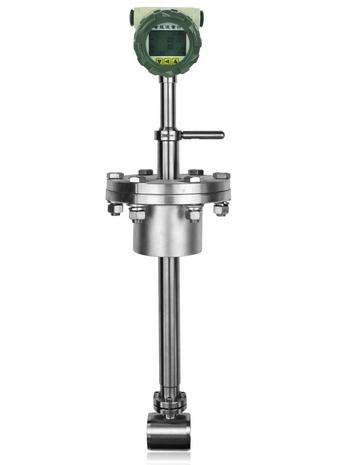
Insertion Turbine Flow Meters

https://www.drurylandetheatre.com/insertion-turbine-flow-meter/

Sanitary flow meter

Turbine Flow Meter Working Principle

Turbine meters are simple to operate and maintain,

and in-service worldwide as a reliable, cost-effective method,

for achieving accurate flow measurement.

Turbine flow meters are designed to maximize throughput,

and minimize pressure drop, maintain high flow rates over an extended flow range,

and offer pulse output that is linear to the flow rate.

The turbine meters also minimize fiscal measurement uncertainty,

by delivering high-frequency pulse resolution,

to account for minute increments of the flow rate.

Turbine flow meters use the mechanical energy of the fluid to rotate a “pinwheel” (rotor) in the flow stream.

Blades on the rotor are angled to transform energy,

from the flow stream into rotational energy.

The rotor shaft spins on bearings.

When the fluid moves faster, the rotor spins proportionally faster.

Turbine flow meters now constitute 7% of the world market.

Shaft rotation can be sensed mechanically or by detecting the movement of the blades.

Blade movement is often detected magnetically,

with each blade or embedded piece of metal generating a pulse.

Turbine flowmeter sensors are typically located external to the flowing stream,

to avoid material of construction constraints that would result,

if wetted sensors were used.

When the fluid moves faster, more pulses are generated.

The transmitter processes the pulse signal to determine the flow of the fluid.

Transmitters and sensing systems are available to sense flow,

in both the forward and reverse flow directions.

You may like: Industrial flow meters

Turbine flow meter equation


The relationship between volumetric flow rate of the turbine flowmeter and the frequency of the pulses generated by the pickup sensor can be expressed in the form of the equation:

f = kQ

Where,
f = Frequency of pulses generated by pickup sensor(Hz, equivalent to pulses per second)
Q = Volumetric flow rate (e.g. litres/min)
k = “K” factor of the turbine meter (e.g. pulses per litre)

Turbine Meter K-Factor
The turbine meter measures volumetric flow, however the pulses produced vary depending on the meter. The variation is accounted for by a K-factor. The K-factor is the number of pulses per unit volume. It is primarily determined by the size and type of the turbine meter. Due to manufacturing tolerances, the actual K-factor can vary between similar models. The K-factor is applicable only to the fluid for which the meter was calibrated in the factory.

You may like Coriolis mass flow meter 

Turbine flow meter advantages and disadvantages

Advantages of Turbine Flow Meters

  1. High precision, generally up to ± 1% R, ± 0.5% R.
  2. Output pulse frequency signal, suitable for total metering and connection with a computer, no zero drift, strong anti-interference ability.
  3. Compact and lightweight, easy installation and maintenance, and large-circulation capacity.
  4. Good repeatability, short-term repeatability of 0.05 ~ 0.2%, due to good repeatability, frequent calibration or online calibration can get very high precision.
  5. A special type of sensor can be designed according to user needs, such as low-temperature type, two-way, downhole type, mixed sand special type.
  6. Pressure compensation can be performed under the pressure state in which the gas to be measured is stable.
  7. The turndown is wide, medium and large caliber up to 1:20, small-caliber is 1:10.

Disadvantages of Turbine Flow Meters

  1. Need to be calibrated regularly, there is no way to maintain accuracy for a long time, can not work continuously for a long time.
  2. The cleaning requirements of the medium are high, but the filter can be installed.
  3. The flowmeter has a large influence on the flow velocity distribution (flow regulator can be installed).
  4. It is not suitable for places where the flow rate is drastically changing.
  5. Not suitable for testing of corrosive media.

You may like:Wastewater Flow Meter

Application Industries

  • Oil & Gas
    • Water injection
    • Test and production separators
    • Disposal wells
    • Hydraulic fracturing
    • Chemical injection
    • Natural gas pipelines
  • Aerospace/Defense
    • Engine Testing
    • Fuel flow measurement
    • Shipboard reverse osmosis systems
    • Monitor fuel supply to ship engines
  • Pharma-Bio Tech, Food & Beverage
    • Sanitary measurement
    • Pill coating
  • Power Generation
    • Custody transfer
  • Industrial & Municipal
    • Building automation
    • HVAC
    • Water metering
  • Cryogenics
    • Liquids measurement for plant applications and truck deliveries

Turbine Flow Meters Price

Sino-Instrument offers all kinds of Turbine flow meters, made in China. Best Quality, and Best Price!

The price of Turbine Flow Meter is around USD400-700/pc,

which will be affected by:

  • Fluid Type
  • Viscosity
  • Connection
  • Pipe Sizing
  • Process Temperature (min & max)
  • Flow Range (min & max)
  • Pressure Range (min & max)
  • Accuracy Range
  • Specific Application

All Flow Meters can work with the NEW AMS TREX, HERE!

Sino-Instrument, Manufacturer for turbine flow meters,

like: gas turbine flow meter,

liquid turbine flow meter, sanitary turbine flow meter,

insertion turbine flow meter, steam turbine flow meter,

and natural gas turbine flow meter.

Sino-Instrument’s turbine flow meters, made in China,

Having good Quality, With better price.

Our flow measurement instruments are widely used in China, India, Pakistan, US, and other countries.

Request a Quote

Differential Pressure Flow Meters


Differential Pressure (DP) Flow Meters Technology –
Reliable Flow Solutions Across Many Applications

Differential Pressure Flow meters, also known as DP flow meters. Differential Pressure (DP) flow meters introduce a constriction in the pipe, that creates a pressure drop across the flow meter.

The calculation of fluid flow rate, by reading the pressure loss across a pipe restriction, is the most used flow measurement technique in industrial applications.

Differential pressure flow meters are suitable for water flow measurement, oil, steam or gas flow measurement.

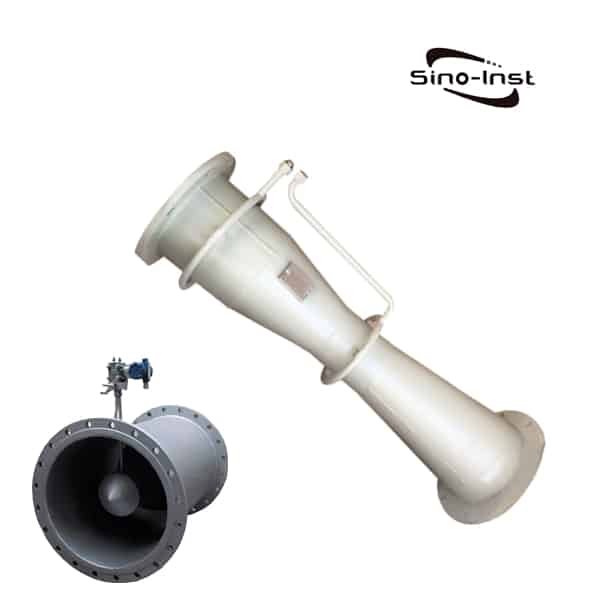
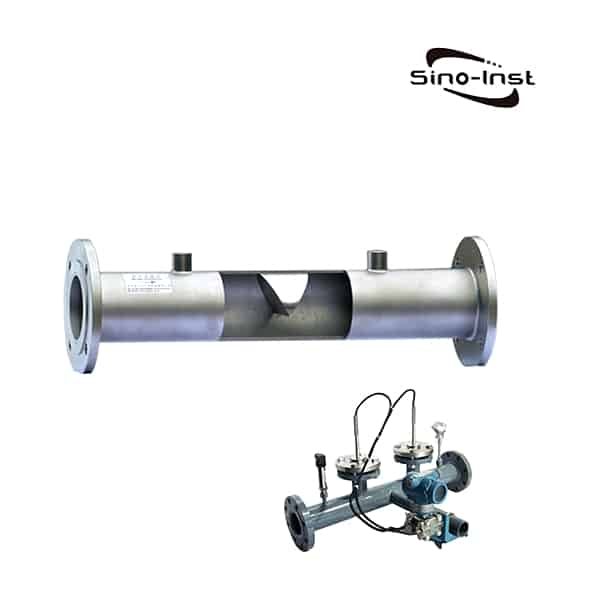
According to different flow senor structures, we have:

  • Orifice Plate Flowmeters;
  • Venturi Flowmeters;
  • Nozzle Flowmeters;
  • Wedge Flowmeters;
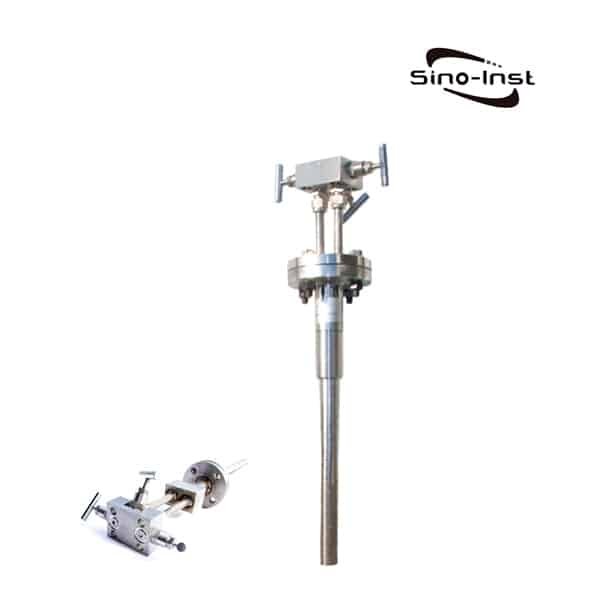
  • Annubar Flowmeter

And more.

What is a differential pressure flow meter?

You can take this as the definition of the differential pressure flow meter.

Differential pressure flow meters, also known as DP flowmeters, create a cross-sectional change in the flow tube, which causes the velocity of the flowing fluid to change.

A change in velocity occurs whenever there is a change in flow cross-section; ie, With a decrease in velocity, an increase in pressure occurs.

Differential pressure flow meters can be used as liquid flowmeters or gas flowmeters; however, a single flow meter may not be configured to measure both liquid and gas phases.

Differential pressure (also known as throttling) Flow meters, are based on the throttling principle of fluid flow. It is one of the most mature and most commonly used methods for measuring flow in production. It is usually composed of a throttling device, which capable of converting the measured flow into a differential pressure signal, and a differential pressure gauge, and a display instrument, capable of converting the differential pressure into a corresponding flow value.

In the unit combination meter, the differential pressure signal generated by the throttling device, is often converted to a corresponding standard signal (electrical or pneumatic), by a differential pressure transmitter for display, recording or control.

The differential pressure flow meter is composed of a primary device (detection member), and a secondary device (a differential pressure converter and a flow display instrument).

Types of flow meter

The differential pressure flow meter is usually classified in the form of a test piece, such as an orifice flowmeter, a venturi flowmeter, a constant velocity tube flowmeter, a pitot tube principle-Pitoba flowmeter, and so on.

The secondary device is a variety of mechanical, electronic, electromechanical integrated differential pressure gauges, differential pressure transmitters and flows display instruments.

It has developed into a large-scale instrument with a high degree of categorization (series, generalization, and standardization) and a wide variety of specifications.

It can measure flow parameters as well as other parameters (such as pressure, level, density, etc.).

You may like the pressure level transmitter.

How does a differential pressure flow meter work?

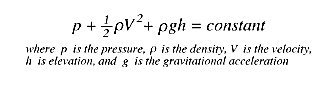
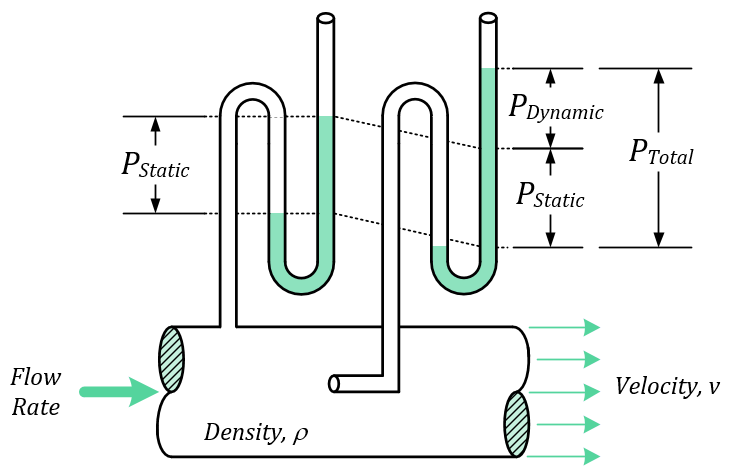
Differential pressure flow meters use Bernoulli’s equation, to measure the flow of fluid in a pipe.

Differential pressure flow meters introduce a constriction in the pipe, that creates a pressure drop across the flowmeter.

When the flow increases, more pressure drop is created. Impulse piping routes the upstream and downstream pressures of the flowmeter to the transmitter, that measures the differential pressure to determine the fluid flow.

This technology accounts for about 21% of the world market for flow meters.

Bernoulli’s equation states that the pressure drop across the constriction is proportional to the square of the flow rate. Using this relationship, 10 percent of full-scale flow produces only 1 percent of the full-scale differential pressure.

At 10 percent of full-scale flow, the differential pressure flowmeter accuracy is dependent upon the transmitter, being accurate over a 100:1 range of differential pressure.

Differential pressure transmitter accuracy is typically degraded, at low differential pressures in its range, so flowmeter accuracy can be similarly degraded.

Therefore, this non-linear relationship can have a detrimental effect on the accuracy, and turn down of differential pressure flow meters.

Remember that of interest is the accuracy of the flow measurement system — not the accuracy of the differential pressure transmitter.

Different geometries are used for different measurements, including the orifice plate, flow nozzle, laminar flow element, low-loss flow tube, segmental wedge, V-cone, and Venturi tube.

Read more about: Shop 101: Key Factors In Selecting A Pipe Flow Meter

Differential pressure flow meter formula:

where

  • points 1 and 2 lie on a streamline,
  • the fluid has constant density,
  • the flow is steady,
  • and there is no friction.

Although these restrictions sound severe, the Bernoulli equation is very useful, partly because it is very simple to use. And partly because it can give great insight into the balance between pressure, velocity, and elevation.

To learn more about DP Flow:

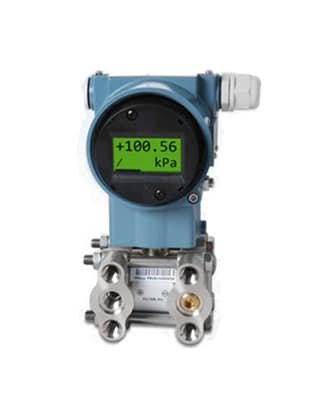
Extended reading: Smart Differential Pressure Transmitter

Advantages and disadvantages of differential pressure flow meter

The upside of this technology is low cost, multiple versions can be optimized for different fluids and goals, are approved for custody transfer (though it is being used less and less for this). It is a well-understood way to measure flow. And it can be paired up with temperature/pressure sensors, to provide mass flow for steam and other gasses.

Negatives are that rangeability is not good due to a non-linear differential pressure signal (laminar flow elements excepted), accuracy is not the best and can deteriorate with wear and clogging.

Advantages and disadvantages of throttling differential pressure flow meter (orifice flowmeter)

Advantages:    

1) The standard orifice plate structure of the throttle piece is easy to copy, simple, firm, stable and reliable in performance, long in service life and low in price;    

2) The throttling application range is extremely wide. All single-phase fluids, including liquid, gas, and steam, can be measured. Some mixed-phase flows, such as gas-solid, gas-liquid, liquid-solid, etc. can also be applied. General production processes and pipe diameters, The working condition (pressure, temperature) has products;    

3) All accessories can be used by all manufacturers if it is an international standard and can be used without calibration.

Disadvantages:    

1) The repeatability and accuracy of the measurement are medium levels;    

2) The range is narrow because the meter signal and the flow rate are squared, the general range can only reach 3:1 ~ 5:1;    

3) The requirements for on-site installation conditions are relatively high. If a long straight pipe section is required, it is difficult to meet;    

4) The pressure piping is a weak link, which is prone to leakage, blockage, freezing and signal distortion;    

5) The pressure loss is large.

Extended reading: Integral DP Flow Meter|Gas, liquid, steam|Compact structure

What is the relationship between flow and differential pressure?

Differential pressure use Bernoulli’s equation to measure the flow of fluid in a pipe.

Differential pressure flow meters introduce a constriction in the pipe, that creates a pressure drop across the flowmeter.

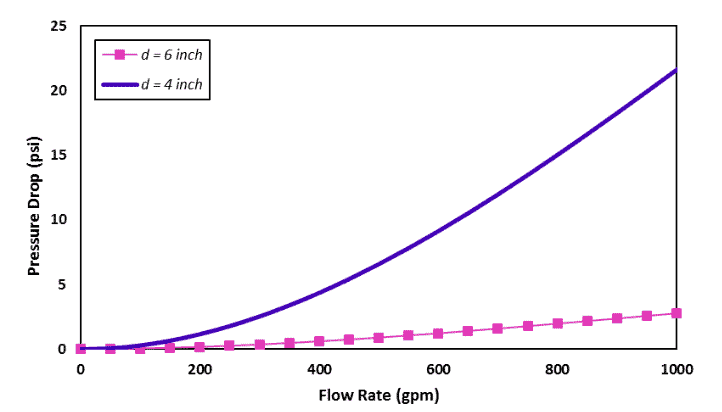
When the flow increases, more pressure drop is created.

y+P(x)y =Q(x)y^n (equation)

is called a Bernoulli differential equation where n is any real number.

The graph below shows the resulting pressure drop for water at 60 F, over a range of flow rates for a 100-foot long pipe, for both 4 inches and 6-inch schedule 40 piping.

the relationship between flow and differential pressure

If you need, you can learn more about Flow Rate And Pressure Relationship.

How to Select a Flow Meter?

The basis of good flow meter selection is a clear understanding of the requirements of the particular application.

Therefore, time should be invested in fully evaluating the nature of the process fluid and of the overall installation.

  1. What is the fluid being measured by the flow meter(s) (air, water, etc…)?
  2. Do you require rate measurement and/or totalization from the flow meter?
  3. If the liquid is not water, what viscosity is the liquid?
  4. Is the fluid clean?
  5. Do you require a local display on the flow meter or do you need an electronic signal output?
  6. What are the minimum and maximum flow rate for the flow meter?
  7. What are the minimum and maximum process pressure?
  8. What are the minimum and maximum process temperature?
  9. Is the fluid chemically compatible with the flow meter wetted parts?
  10. If this is a process application, what is the size of the pipe?

Types of Differential Pressure Flowmeters

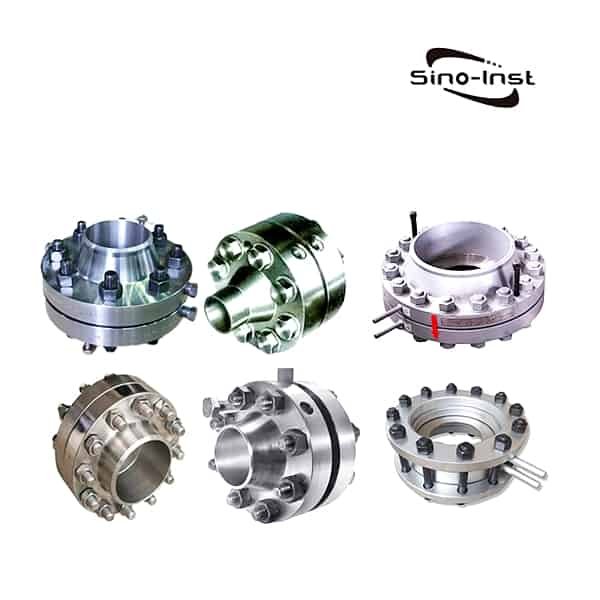
Flat metal plate with an opening in the plate installed perpendicular to the flowing stream in a circular pipe.

As the flowing fluid passes through the orifice, the restriction causes an increase in velocity and a decrease in pressure.

A differential pressure transmitter is used to measure pressure between the orifice and the pipe flow stream. 

There is always a permanent pressure loss. No dirty liquids allowed.

Orifice differential pressure flowmeters can be constructed to measure gas, liquid or steam.

Orifice plates are primary flow elements which measure flow as a function of differential pressure.

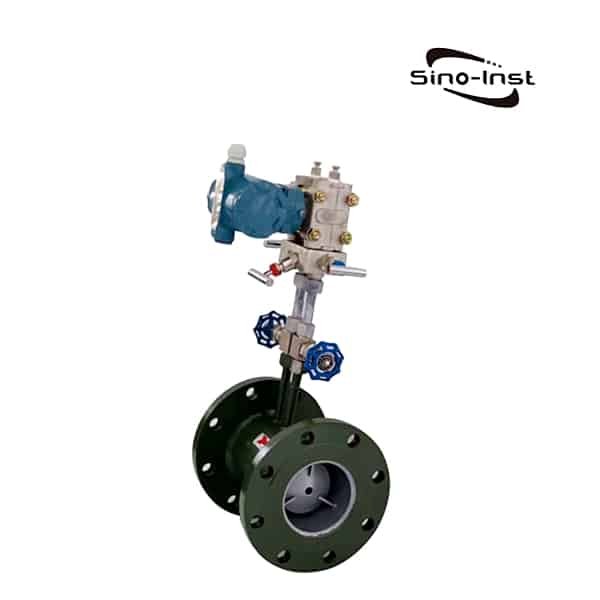
A restriction with a relatively long passage having a smooth entry and exit.

A venturi produces less permanent pressure loss than an orifice but is more expensive.

They are often used in dirty streams because there is no build-up of the foreign material.

Venturi flow meters can be constructed to be either gas flowmeters or liquid flow meters.

Extended reading: What Is A Venturi Flow Meter?

Smooth entry and sharp exit. Permanent pressure loss is on the same level as an orifice, with the added ability to handle dirty and abrasive fluids.

A differential pressure transmitter is used to measure pressure between the nozzle and the pipe flow stream.

This type of differential pressure flowmeter technology can be constructed to measure either gas or liquids.

Extended reading​: What is a flow nozzle?

A device consisting of a Pitot tube and an annubar tube combined with static pressure ports.

The differential pressure between the two ports is the velocity head.

A differential pressure transmitter is used to measure pressure differential between the two ports.

This indication of velocity combined with the cross-sectional area of the pipe provides an indication of flow rate. 

Pitot tube flow meters can measure either liquids or gases.

Differential pressure is caused by centrifugal force between the inside diameter and the outside walls of the pipe elbow.

It does not introduce any additional pressure loss other than that caused by the elbow. 

A differential pressure transmitter is used to measure pressure between the walls.

This type of flow meter technology can be configured as either a gas or a liquid flow meter.

A wedge-shaped element that is perpendicular to the flow at the top of the conduit which means that the bottom part is unrestricted.

Therefore, it is useful in slurry measurement.   

A differential pressure transmitter is used to measure pressure between either side of the wedge.

However, this type of differential pressure flow meter technology can be constructed to work as either a gas or a liquid flow meter.

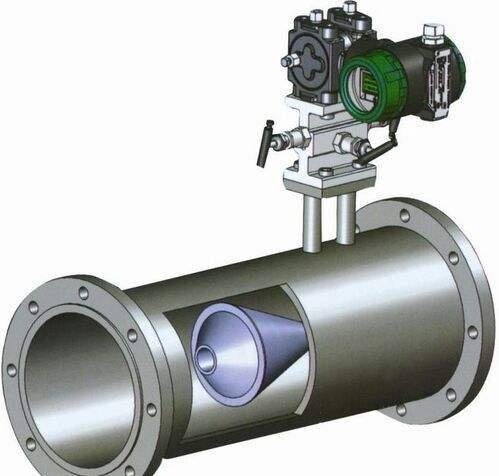
Consists of a V-shaped cone element placed at the center of the pipe which creates an annular space for the passage of fluid.

It has a lower permanent pressure loss than orifice flowmeter.

The cone element conditions the flow at the same time it is creating the pressure differential, providing for smoother and less noisy differential pressure readings vs. the orifice technology.  

A differential pressure transmitter is used to measure pressure before and after the cone. 

This type of differential pressure flow meter can be constructed to measure gases, liquids, or steam.

This type of flow meter relates a change in flow rate to the differential pressure across a spring-loaded cone.

The cone repositions itself to balance the force.  

This, in turn, changes the aperture for the flow.

Flow rate has a relationship with the differential pressure of the flow meter and the position of the spring-loaded cone.

A differential pressure transmitter is used to indicate flow.

This type of differential pressure flow meter technology can be constructed to measure either gas or liquids.

Flow rate is linearly proportional to the differential pressure and inversely proportional to the viscosity of the flowing fluid.  

A flow can be made laminar by passing through a bundle of small diameter tubes.

A differential pressure transmitter is used to measure pressure before and after the tubes.

This type of differential pressure flow meter technology can be constructed to measure either gas or liquids.

Featured DP Flow Meters for Sale

More Flow Measurement Solutions

Sino-Inst is a manufacturer of Differential Pressure Flow Meters. We supply more than 20 types of Differential Pressure Flow Meters. 30% are orifice plate flow meters. 30% are Annubar type flowmeters, and 40% are other differential pressure flowmeters,

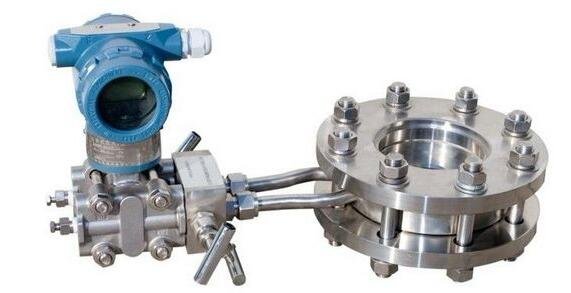
Differential pressure flowmeter is a new type of transmitter integrating differential pressure transmitter, pressure transmitter, temperature transmitter, and flow totalizer. It can display working pressure, temperature, instantaneous and cumulative flow. It can also perform automatic temperature and pressure compensation for gas and steam, and realize the function of directly displaying the standard flow rate and mass flow rate on site. In the case of an external 24V power supply, it can also provide current, frequency, and 485 personnel transmission. And it can work for 2-3 years with one battery, and can be directly matched with differential pressure flowmeters.

There are many types of differential pressure flowmeters, such as orifice flowmeters, uniform velocity tube flowmeters, and Venturi flowmeters are based on flow sensing in pipelines. They calculate the flow according to the differential pressure generated by the flow detection in the pipeline. They have the advantages of firm structure, stable performance and long service life.

Sino-Inst has provided pressure measurement solutions to customers for many years. Our Differential Pressure Flow Meters, made in China. Widely exported to the United States, Britain, Germany, South Africa, Norway and other countries.

If you need Differential Pressure Flow Meterss, but have technical questions, please feel free to contact our sales engineers.
Request a Quote

Please enable JavaScript in your browser to submit the form

Capacitive pressure transducer

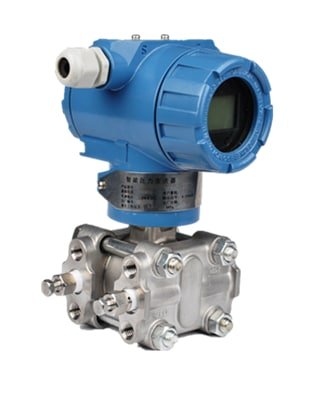
A capacitive pressure transducer also called a Capacitance pressure transmitter or a Capacitance pressure sensor. The capacitive type pressure transmitter is a differential pressure type sensor.

What is the capacitive pressure transducer?

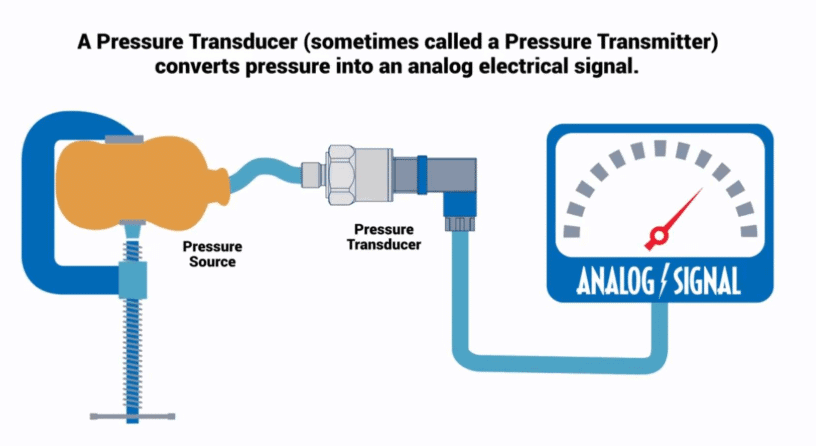
The capacitance pressure transmitter is a pressure measurement device, which converts an applied pressure into a current signal, Like 4-20mA.

A pressure transducer is a device that measures the pressure of a fluid, indicating the force the fluid is exerting on surfaces in contact with it.

Pressure transducers are used in many control and monitoring applications, such as flow, airspeed, level, pump systems, or altitude.

A pressure transducer consists of two main parts: an elastic material that will deform when exposed to a pressurized medium. And an electrical device that detects the deformation and converts it into a usable electrical signal.

The elastic material can be formed into many different shapes and sizes, depending on the sensing principle and range of pressures to be measured.

This often involves a diaphragm combined with an electrical device, that uses a resistive, capacitive, or inductive principle of operation.

Featured Capacitive pressure transducers

How does a capacitance pressure transducer work?

Capacitive Pressure Transducer Working Principle

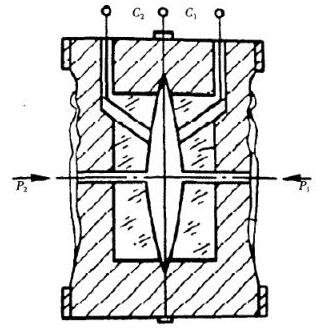
A variable capacitance pressure transducer has a capacitive plate (diaphragm), and another capacitive plate (electrode) fixed to an unpressurized surface. With a gap of a certain distance between the diaphragm and the electrode.

A change in pressure will widen or narrow the gap between the two plates, which varies the capacitance.

This change in capacitance is then converted into a usable signal.

Capacitive Pressure Transducer Working Principle:

– A linear change in capacitance with changes in the physical position of the moving element, may be used to provide an electrical indication of the element’s position.

The capacitance is given by:

C = Aε/d

C – Capacitance between two conductors

A – Area of overlapping between those conductors

d – Distance separating the conductors

ε – Dielectric permittivity of the insulating medium

The permittivity of the medium and the area of overlapping will be constant in this case, the only varying parameter. In this case, is the distance between the conductors which varies when the pressure varies, which changes the capacitance.

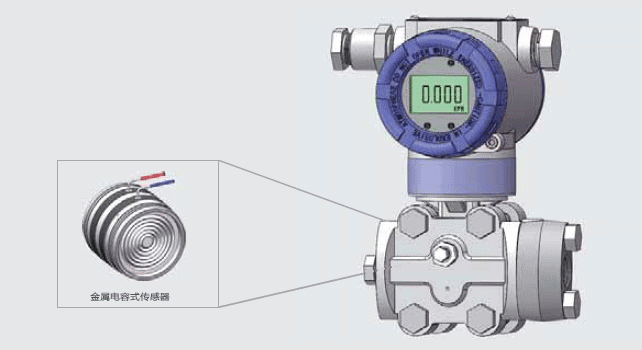
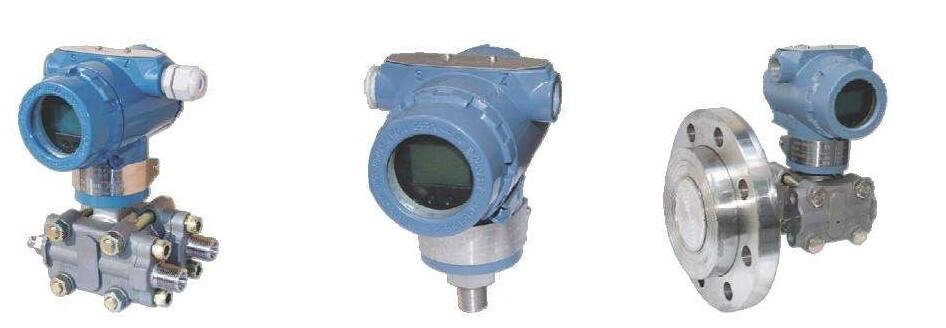
So the pressure variation results in the capacitance variation. Our capacitance pressure sensor is shown below. Just like A Rosemount capacitance pressure sensor:

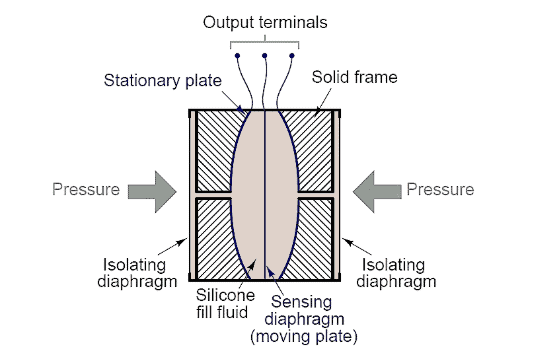
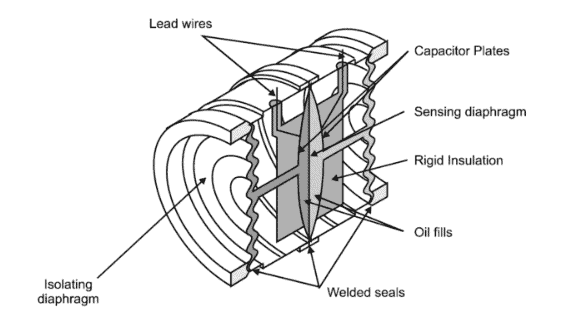
The capacitance chamber is isolated from the process with an isolation chamber.

The pressure applied at one side. As the pressure at the high-pressure side increases the isolating diaphragm gets pushed toward the metal frame. Transferring its motion to the sensing diaphragm via the fill fluid.

The fill fluid will be oil.

A capacitance detector circuit connected to this cell uses a high-frequency AC excitation signal to measure the difference in capacitance between the two halves. Translating that into a DC signal ultimately becomes the signal output by the instrument representing pressure.
The simple capacitance detector connection with the electrical circuit is shown below:

capacitance detector connection

Advantages of Capacitive Pressure Transducer:

  • Inaccuracy 0.01 to 0.2%
  • Linearity
  • Fast response
  • Range of 80Pa to 35MPa

Disadvantages of Capacitive Pressure Transducer:

  • Temperature sensitivity
  • Stray capacitance problem
  • Vibration
  • Limited overpressure capability
  • Cost

Read more What is a diaphragm seal?

What does a pressure transducer do?

A pressure transducer is a measuring device which converts an applied pressure into an electrical signal.

Generally, a pressure transducer consists of two parts, an elastic material that deforms under the application of pressure. And an electrical part which detects this deformation.

Extended Reading: 4-20ma pressure transducer wiring diagram

Capacitive pressure sensor applications

Types of Pressure Sensors:

There are different types of pressure transducers based on their design.

These sensors can come in several shapes and sizes, but the technology inside can also differ. 

There 4 main types of pressure sensor based on this: 

  • Strain Gauge Pressure Transducers
  • Capacitance Pressure Transducers
  • Potentiometric Pressure Transducers
  • Resonant Wire Pressure Transducers

Know more about Industrial Pressure Sensors

Absolute measurements are generally used in applications where you need a repeatable reference pressure; i.e. in an experiment or in a barometric application.

For example, if you are looking to replicate a test that was originally completed by a colleague in Denver, CO and you are at a facility in Boston.

May you may want to use an absolute sensor to minimize variables in your test.

Other applications include weather stations, altimeter calibration equipment, and semiconductor fabs and many more.

However, if you want to measure or control a pressure that is based on current conditions a gauge sensor may be best.

Generally, if you want to measure or control a pressure that is influenced by changes in atmospheric pressure.

This style sensor is used in any application where you want to overcome the atmospheric conditions, to produce a task or pull a vacuum to accomplisher another type of task.

The applications for gauge pressure sensors are quite vast.

Some examples are pump discharge pressure, fire hose discharge pressure, tank level, steam pressure in a commercial boiler and many more.

Extended Reading: strain gauge pressure transducer

A sensor capable of compound pressure measurement is one that can measure both positive and negative (vacuum) pressures.

Often compound pressure ranges are utilized in applications, where different parts of a process may either be higher or lower than the atmosphere.

For example, if you were a manufacturer of a collapsible water bottle, in one part of the process you may pressurize a mold to form the bottle, but they pull a vacuum to release the part.

In this case, you may be able to use only one sensor instead of two to accomplish the same task.

Remember that Differential pressure is the difference in pressure between two points of measurement.

You can measure very low to high pressures in all kinds of different media including liquids, gases, water, refrigerants, and air.

Thus, if you want to measure the difference in pressure across a filter (see below), you could use a differential pressure transducer like 3151DP to tell you when it was time to change the filter.

So you can maintain the Indoor Air Quality (IAQ) of your building.

Differential applications can be quite varied, some examples supply and return pressure in a chiller, airflow stations, leak detection systems, pressurized tank level, hospital isolation or protection rooms, and many more.

Extended reading: Smart Differential Pressure Transmitter

How much does it cost a pressure transducer?

There are a number of factors that will impact the price of a pressure transducer.

The biggest differentiator is whether you can use a standard, off-the-shelf pressure transducer, or if you need a custom pressure transducer.

For an off-the-shelf pressure transducer, pressure transducer prices will be most affected by the level of accuracy required for your application.

The more accurate, typically the more expensive the pressure transducer.

To learn more about the pricing of custom pressure sensors click here.

Related Products

SI-303 Low-Pressure Transducer
Low pressure transducers for air and non-corrosive gases low pressure measurement. 0 ~ 2.5kPa to 0 ~ 30kPa measurable.
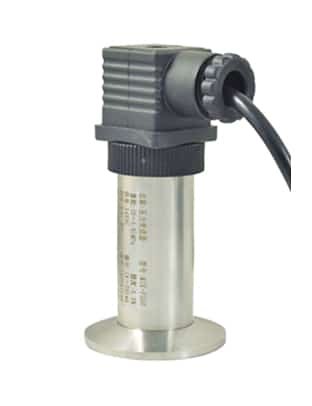
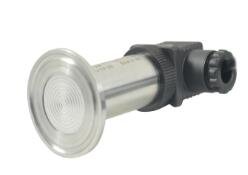
SI-350 Sanitary Pressure Transmitter
Sanitary Pressure Transmitter, also called tri clamp pressure transmitter,
is the pressure transducer with the flush diaphragm (flat membrane) as the pressure sensor.
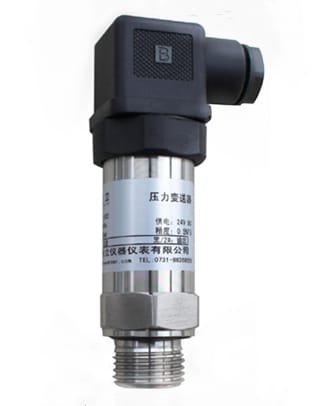
SI-300 Pressure Transducer 4-20mA/Voltage
The 4-20mA/ Voltage Pressure Transducer,
also called pressure transmitter 4-20mA,
is a pressure sensor with4-20ma/Voltage output.
SI-512H High Temperature Pressure Sensor
High Temperature Pressure Sensor for pressure measurement of high temperature gas or liquid. Such as steam pressure. High temperature up to 800 ℃.
SI-706 Combined Pressure and Temperature Sensor-Dual function
Combined pressure and temperature sensor for Simultaneous measurement.
Thermocouple types: J, K, E type or PT100 platinum resistance. 
Absolute Pressure Transmitter
Absolute pressure transmitter with 4-20mA output for measuring pressure with absolute type reference. Absolute pressure (AP) transmitter is a measure of the ideal (complete) vacuum pressure.
Hydrostatic pressure transmitter
Hydrostatic pressure transmitter is used for fluid hydrostatic pressure measurement. With working static pressure up to 32Mpa, for liquid, gas or steam .
Diffused silicon Gauge Pressure Transmitter
A gauge pressure (GP) transmitter compares a process pressure against local ambient air pressure. Gauge pressure transmitters have ports to sample the ambient air pressure in real-time.
Capacitive Gauge Pressure Transmitter
Gauge pressure (GP) transmitters compare process pressure with local ambient air pressure. Gauge pressure transmitters have ports for real-time sampling of ambient air pressure.
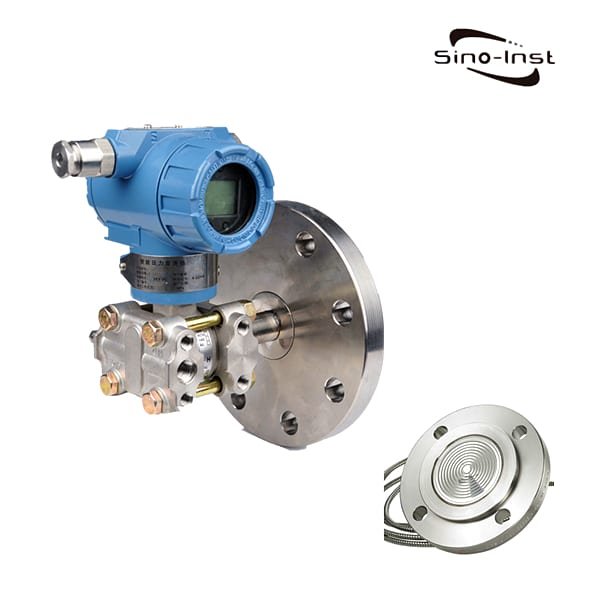
Extended Diaphragm Seal DP Level Transmitter Extended Diaphragm Seal DP Transmitter is a level transmitter direct mounted on pipe or tank. The isolation diaphragm is in direct contact with the liquid medium.

In addition to pressure measurement, capacitive technology is also used in liquid level measurement. Read more about: Capacitive Level Measurement Principle.

Sino-Instrument offers over 50 Capacitive pressure transducers.

About 50% of these are 4-20ma Low-Pressure Transducers, 40% are Differential Pressure Gauge.

And 20% are Diaphragm Seal Pressure transmitters, 20% are 4-20ma differential pressure transmitters.

A wide variety of  Capacitive pressure transducers options are available to you, such as free samples, paid samples. 

Sino-Instrument is a globally recognized supplier and manufacturer of  Low-Pressure Transducers, located in China.

The top supplying country is China (Mainland), which supply 100% of  Capacitive pressure transducers respectively. 

Capacitive pressure transducers products are most popular in Domestic Market, Southeast Asia, and Mid East. 

You can ensure product safety by selecting from certified suppliers, with ISO9001, ISO14001 certification.

Request a Quote

Please enable JavaScript in your browser to submit the form

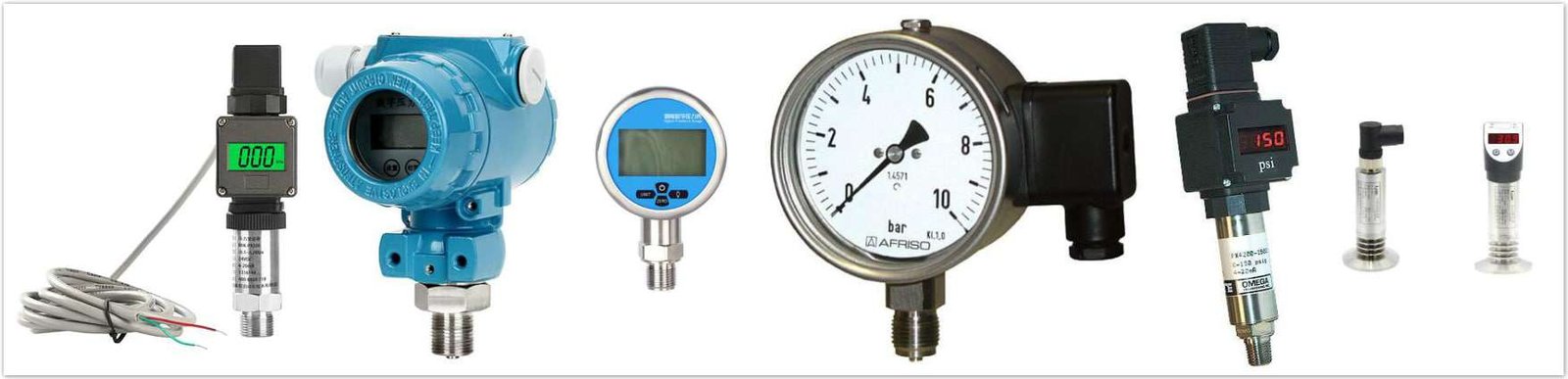
Pressure indicator transmitters


Pressure transmitters and transducers with industry-leading performance help improve operations in a wide range of industries

What is a pressure indicator transmitter?

Pressure indicator transmitters are industrial instruments,
which has a digital display for providing a local indication of pressure indicating,
and a 4-20 mA output pressure transmitter (which is also called the smart pressure gauge),
for sending an analog signal to control & monitor instrumentation.
The built-in digital indicators can be scaled via push buttons or change pots,
to any pressure unit or a 0-100% full scaling.
No additional external supply is required,
since the digital indicator is powered by the 4-20mA current loop,
from the pressure transmitter.

Sino-Instrument can offer pressure indicator transmitters for differential pressure measurement,

pressure level measurement, and water pressure measurement.

Pressure indicator transmitters can work with manifold, diaphragm seal, hart, orifice plate,

to measure different types of flow or level.

Pressure indicator transmitter

Pressure Indicators

by Sino-Instrument

  • More Reliable
  • Better Price
  • Many Years of experience in development and production

Contact us

Email: huahengxa@gmail.com
WhatsApp: +86-180 4861 3163
WeChat: +86-180 4861 3163
Mob: +86-18048613163

Types of the pressure indicator transmitters

The basis for an electronic pressure indicator is formed by the pressure sensor.

It converts the measurement parameter of pressure into an electronic signal.

The advantage of electronic pressure indicator lies

in the excellent dynamic performance and low material stress.

This gives them a high load resistance and long-term stability.

They are available in very small sizes.

Sino-Instrument develops and produces all leading sensor technologies:

The ceramic thick film, metal thin film and piezoresistive.

Electronic assemblies or components are integrated into a mechanical pressure indicator.

The measured pressure is displayed locally, however,

besides, the pressure indicator offers an electrical signal,

or includes an electrical switching function.

With these instruments, the measured value can also be read reliably on site,

if the power supply fails or the measuring signal is disrupted.

With the combination of mechanical pressure indicators with different signals and switches,

this results in a comprehensive range of mechatronic pressure indicators.

For our pressure indicators, we use the latest sensor technologies,

tested millions of times over in automotive applications.

They work without any kind of mechanical contact,

consequently, they are wear-resistant,

and there’s absolutely no influence on the pressure indicator.

Because of their robustness and simple handling,

indicating pressure indicators are widely used.

Their elastic pressure elements deform under the influence of pressure.

The measuring system is made from a capsule element,

diaphragm element or Bourdon tube.

The measuring systems are made from copper alloys, alloyed steels or,

if required for specific measuring tasks, from special materials.

Sino-Instrument manufactures mechanical pressure indicators,

with scale ranges from 0 … 0.007 psi up to 0 … 100,000 psi with indication accuracies of up to 0.1 %.

For pressure measurement with high dynamic pressure loads or vibration,

you will find mechanical pressure indicators with liquid filling in the Sino-Instrument portfolio.

Through their damping, they are optimally protected against destruction.

Even for the most demanding measuring requirements,

you’ll find the right solution with Sino-Instrument.

Diaphragm seals enable pressure measurement with harsh conditions such as,

for example, corrosive, highly viscous or fibrous media, very high temperatures,

awkwardly placed measuring points,

hygienic regulations or also toxic media or media harmful to the environment.

You may like:

Differential Pressure Flowmeters

Orifice flow meter

verabar flow meter

venturi flow meter

What is the function of a pressure transmitter?

The main function of the pressure transmitter is to transmit the pressure signal to the electronic device,

which in turn displays the pressure on the computer.

The pressure transmitter amplifies the weak electrical signal collected by the pressure sensor,

to transfer or activate the control element.

Or a signal source that converts the non-electricity of the sensor input,

into an electrical signal while amplifying it for remote measurement and control.

The analog quantity can also be converted to a digital quantity as needed.

The pressure sensor converts the mechanical pressure value into a proportional electrical signal.

The pressure sensor typically consists of a stable main body and a (thin) diaphragm.

The diaphragm is the most important element for the measurement of the pressure,

and is equipped with strain-sensitive and compression-sensitive resistance structures,

so-called strain gauges (DMS).

The diaphragm is deflected under the influence of pressure.

Thus, the strain gauges attached to it are elongated or compressed,

and its electrical resistance changes.

This change in resistance is directly proportional to the pressure.

For example, if the resistors are wired to a Wheatstone measuring bridge,

the resulting electrical signal can be measured and transferred to an indicator.

You may like the pressure level transmitter

What is the difference between the pressure gauge and pressure indicator?

A pressure Indicator is an instrument that indicates pressure.

A pressure Gauge is also a type of pressure Indicator.

It is a mechanical device.

Pressure indicators can work on mechanical deflection (in case of pressure gauge) or Piezoelectric effect,

change in capacitance, change in inductance, etc.

These are generally digital type instruments.

What is the difference between the pressure switch and pressure transmitter?

A pressure switch is an active electromechanical device,

which measures the pressure in a system,

and when the pressure reaches too high or too low of a given setpoint,

the device will “switch” meaning it will open or close a circuit,

that powers a certain device (like an alarm system or a shutdown valve).

A pressure transmitter or pressure transducer, on the other hand,

is also an electromechanical device,

which measures pressure but instead of signaling a switch,

it merely sends a read-out signal of what the specific pressure value is to a remote location.

Usually, a pressure switch, rather than a transmitter,

will be used in pressure-system applications,

where safety is of paramount importance.

An oil wellhead, for example, can see some very high-pressure spikes,

and if the pressure reaches too high, a possible well blowout can occur.

A pressure switch in this application makes sense so that when the pressure reaches too high,

the switch can trigger a blowout preventer,

which can actuate to reduce pressure in the system.

In contrast, the pressure transmitter has no inherent mechanical switching element.

However, transmitters prove to be much more versatile in that,

via third-party software that interprets the given pressure reading,

they can be extremely useful for measuring efficiencies of pressure systems,

and can control many industrial functions,

such as inlets and outlets, chemical or fuel mixtures,

or can even act as a safety switch itself depending on how the software is set up to control the system.

Extended reading: Smart Differential Pressure Transmitter

Sino-Instrument is pressure transmitters manufacturer in China.

We offer all types of Pressure indicator transmitters.

Like Direct Mounted, flange-mounted, single flange, double flange,

Remote Diaphragm SealsHigh Static, Digital Remote.

Most of our pressure transmitters are used in oil, liquids,

DP transmitterflow measurementlevel measurement (like the ultrasonic level measurement),

density, and other process variables.

Pressure transducers are generally available with three types of electrical output;

millivolt, amplified voltage, and 4-20mA.

You can ensure product safety by selecting from certified suppliers,

with ISO9001, ISO14001 certification.

We will share more about instrument calibration, like the flow transmitter calibration.

Request a Quote

Guide to Ultrasonic Level Transmitters-for Continuous Non Contact Level Measurement of Liquid & Solids.

What is an Ultrasonic level transmitter?

Ultrasonic Level Transmitters & Ultrasonic Level Sensors are designed to provide accurate and reliable level sensing for difficult to monitor fluids, where contact with media is not desirable from the extremes of sending: ultrapure to corrosive or even dirty where coating or scaling is possible. Ultrasonic level transmitters have no moving parts, are easy to install and simple to use.

Ultrasonic level measurement provides continuous, non-contact and maintenance-free level measurement of fluids, pastes, sludges and powdery to coarse bulk materials. The measurement is unaffected by dielectric constant, density or humidity and also unaffected by build-up due to the self-cleaning effect of the sensors.

The basics of ultrasonic level transmitters – how they work and what they’re used for

Ultrasonic Level Transmitters working principle

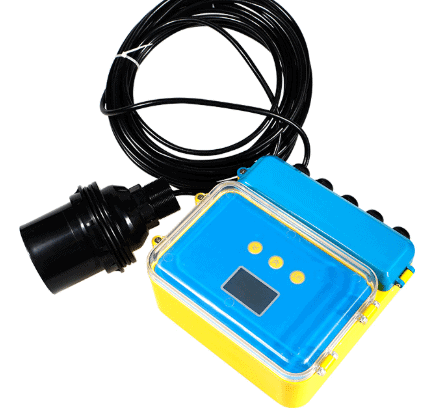
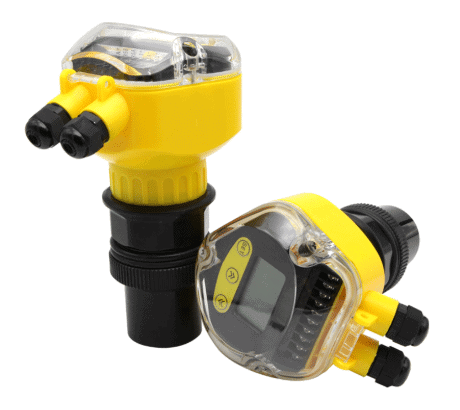
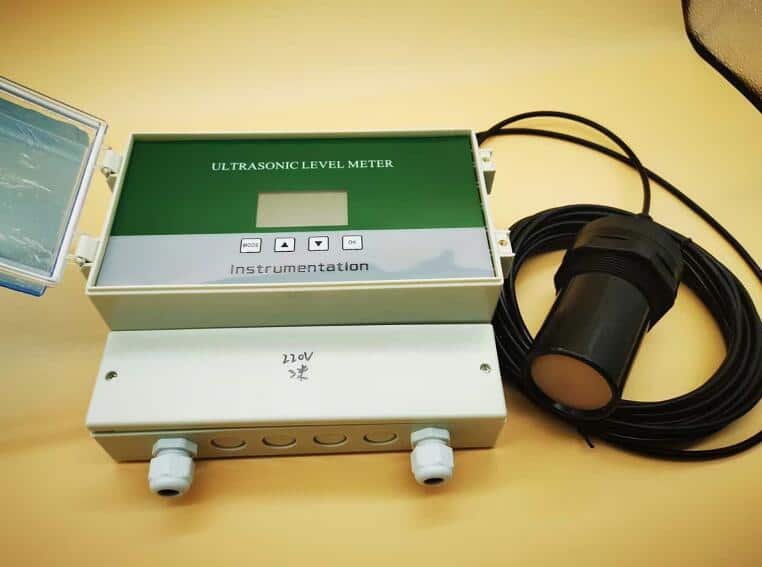
The Ultrasonic Level Transmitter consists of three parts: ultrasonic transducer (probe), drive circuit (module), and electronic display module.

The Ultrasonic Sensor is installed on the storage tank or process vessel. The sensor sends out a sound wave, which ricochets off the surface of the liquid and returns to the sensor. The time it takes for the sound wave to travel from the sensor to the liquid surface and return to the sensor is measured. This time delay is proportional to the level of the liquid.

The drive circuit processes the signal from the Ultrasonic Sensor, compensates for adverse conditions (temperature, pressure, etc) and converts it into a standard 4-20mA or 0-5/10 Vdc signal that can be read by a PLC, DCS or Display/Transmitter.

The Display/Transmitter converts the 4-20mA or 0-5/10 Vdc signal into a display reading in the unit of measure required (feet, inches, meters, centimeters, etc). Ultrasonic level transmitters can be outfitted with local displays and push button controls for easy configuration without the need of a laptop or other computer.

Applications

Ultrasonic level transmitters are used for inventory management and process automation in a wide range of industries. Applications include:

  • Food & Beverage
  • Water & Waste Water
  • Chemical
  • Petroleum
  • Pharmaceutical

Read more about: Ultrasonic Level Sensor Applications

Featured Ultrasonic level transmitters

ModelIntegrated ModelSplit model
Pictures
Measuring range5m、10m、15m、20m、30m5m、10m、15m、20m、30m
Accuracy0.5%~1.0%0.5%~1.0%
Resolution3mm or 0.1% (choose the bigger)3mm or 0.1% (choose the bigger)
DisplayLCD LCD
Analog output4 wire system 4~20mA/510Q loading
2 wire system 4~20mA/250Q loading
4~20mA/510Q loading
Relay output2 sets of AC 250V/ 8A or DC 30V/ 5A are optional, state is programmable2 sets of single-channel are (optional), the double channel is 4 sets of AC 250V/ 8A or DC 30V/ 5A, the state is programmable
Power supplyStandard: 24VDC 
Optional: 220VAC + 15% 50Hz
Standard: 220V AC + 15% 50Hz
Optional: 24VDC 120m
Customized 12VDC or battery-powered
Environmental temperatureMeter display -20 ~ +60°C 
Probe -20~+80°C
Meter display -20~ +60°C 
Probe-20~+80°C
CommunicationOptional 485,232 communication (manufacturer agreement)Optional 485, 232 communication (manufacturer agreement)
Protection classDisplay meter IP65, Probe Ip68Display meter IP65, Probe Ip68
Probe cableNo100m reachable, standard 10m
Probe installationSelection based on measuring range and probeSelection based on measuring range and probe

Ultrasonic level transmitter data sheet

Extended reading: liquid nitrogen level sensor

The benefits of using an ultrasonic level transmitter

– Ultrasonic level transmitters are easy to install and simple to use.

Ultrasonic level measurement provides continuous, non-contact and maintenance-free level measurement of fluids, pastes, sludges and powdery to coarse bulk materials.

– Ultrasonic level transmitters are unaffected by dielectric constant, density or humidity and also unaffected by build-up due to the self-cleaning effect of the sensors.

Sino-Inst offers a wide range of Ultrasonic Level Transmitters that can be used in various industries for inventory management and process automation. If you have any questions about which Ultrasonic Level Transmitter is right for your application, please contact us and we will be happy to assist you.

Read more about 7 Level Senors for Tank Level Measurement

How to choose the right ultrasonic level transmitter for your needs

1. The ultrasonic level meter can only be used for the medium that can fully reflect sound waves and propagate sound waves. For the sound wave adsorption ability of the medium, it is not suitable to use ultrasonic level meter.

2. The ultrasonic level meter can not be applied to vacuum occasions, and not for negative pressure occasions. Because the propagation of ultrasonic waves need air medium. And the thin air environment is very unfavorable to ultrasonic propagation. Plus the sound attenuation will therefore increase. Ultimately, it will lead to serious errors in measurement or even can not be measured.

3. If the measured medium is a volatile liquid, or contains a large amount of water vapor, dust, bubbles, suspended particles and other media, the ultrasonic level meter should not be used.
This is due to the fact that when the sound waves from the probe of the ultrasonic level meter encounter the above medium, irregular reflection and scattering will occur. The probe will not be able to receive the normal signal. And these media will absorb the sound waves. This causes the attenuation of sound waves and affects the measurement results.

4. If there are obstacles or equipment that affect the propagation of sound waves inside the vessel. Then the ultrasonic level meter is not recommended.

5. Ultrasonic level meter can generally only be applied in the normal temperature and pressure range. If the pressure is too high, it will have a strong inhibiting effect on the sound speed of the acoustic wave. Eventually, it will affect the measurement accuracy, or even impossible to measure. And the temperature generally cannot exceed 100℃.

Tips for ultrasonic level transmitter installation

Before installing the ultrasonic level Transmitters, please read the instruction manual of the ultrasonic level Transmitters carefully. Work according to the instructions.

At the same time, it should be reconfirmed whether the model of the instrument matches the environmental requirements of the site such as process pressure, process temperature, and chemical properties of the medium. To ensure that the instrument can be used normally after installation.

To install the ultrasonic level meter, please observe the following operating rules:

  1. Try to avoid in-tank facilities such as ladders, heating equipment, limit switch brackets, etc. for installation.
  2. The ultrasonic beam must not intersect the feed stream. At the same time, pay attention to ensure that the highest material level does not enter the measurement blind area during installation. The ultrasonic level Transmitters must not be installed above the feed stream.
  3. When installing the ultrasonic level Transmitters, it should keep a certain distance from the tank wall. And keep the transducer perpendicular to the liquid surface as much as possible.
  4. When installed outdoors, the ultrasonic level Transmitters should take sunshade and rainproof measures. To avoid direct sunlight and reduce measurement errors caused by temperature changes. At the same time should also pay attention to moisture.
  5. The ultrasonic level Transmitters installed in the hazardous area must comply with the installation regulations of the national explosion-proof hazardous area. The intrinsically safe ultrasonic liquid level Transmitter is installed in the occasion with explosion-proof requirements, and the ultrasonic liquid level Transmitter must be grounded.
  6. When there is stirring in the container. The ultrasonic level Transmitters should be kept away from the agitator. In order to eliminate the false echo effect produced by the stirring blade. If foam or waves are created due to agitation, the still-pipe installation method should be used.
  7. When there is foam in the container. When feeding, stirring or doing other processing in the container, foam will be formed on the surface of some media, which will attenuate the signal of the ultrasonic level Transmitter. The sensor should be installed in a still-pipe or a guided-wave radar level Transmitters should be used. Guided wave radar level Transmitters measurements are not affected by foam and are ideal for this application.
  8. When there is airflow in the container. If there is a strong airflow or air vortex in the container, or if it is installed outdoors and in a very windy place. The sensor should be installed in a still-pipe or a guided-wave radar level Transmitters should be used.

Depending on the shape of the tank top of the container, the installation position of the ultrasonic level transmitter should be selected to avoid multiple reflection echoes between the liquid level and the top wall. In order to reduce interference, reduce noise signal and ensure the accuracy of detection.

Installation position of ultrasonic level transmitters

The reasonable installation position of the ultrasonic level transmitter should be determined according to the different top and internal structure shapes of the liquid container:

A. Grooved container:

  1. The support frame should be firm and reliable;
  2. The height of the intersection line of the beam emitted by the probe and the tank wall must be less than or equal to the minimum height of the liquid level to be measured;
  3. The installation height should be within the required range.

B. Arched container:

Meters cannot be installed on vaulted ceilings. It should be installed at 1/2 or 1/3 of the radius of the empowerment.

C. Conical container:

For conical containers with flat tops. The best place to install the meter is in the center of the top of the vessel. This ensures that you measure to the bottom of the container.

ultrasonic level sensor alternative products

More Level Measurement Solutions

Frequently
Asked
Questions

Ultrasonic level transmitters use sound waves to measure the level of a liquid in a tank. The transmitter sends out a sound wave and measures the time it takes for the sound wave to bounce back. The transmitter then calculates the distance from the sensor to the liquid surface and displays the level on a digital display.

An ultrasonic level sensor is a device that uses sound waves to measure the level of liquids, pastes, sludges, and other similar substances. Ultrasonic sensors are unaffected by dielectric constant, density or humidity, and also have a self-cleaning effect that prevents build-up.

Ultrasonic level measurement works by sending out a sound wave from the sensor and measuring the time it takes for the sound wave to bounce back. The time it takes for the sound wave to bounce back is directly proportional to the level of the liquid. Ultrasonic sensors are very accurate and can be used in a wide range of applications.

Radar level transmitters use microwave energy to measure the level of liquids, while ultrasonic level transmitters use sound waves. Both technologies have their own advantages and disadvantages. Radar is more accurate than ultrasonic, but it is also more expensive. Ultrasonic is less accurate than radar, but it is less expensive and easier to install.

Sino-Ins offers 20 ultrasonic level transmitters products.

About 13% of these are ultrasonic level transducers, 4% are ultrasonic level indicators.

A wide variety of ultrasonic level transmitters options is available to you, such as free samples, paid samples.

Sino-Inst is an ultrasonic level transmitter supplier, located in China.

Ultrasonic level transmitter products are most popular in North America, Mid East, and Eastern Europe.

The United States, and India, which export 99%, 1%, and 1% of ultrasonic level transmitters respectively.

You can ensure product safety by selecting from a certified supplier, with ISO9001, ISO14001 certification.

Request a Quote

Please enable JavaScript in your browser to submit the form

How Does a Pressure Transmitter Work?

What is a pressure transmitter?

A pressure transmitter also often called a pressure transducer. A pressure transmitter is a device used to measure the pressure of liquids or gases in pipes or containers. It works by converting the pressure readings into an electrical signal that can be easily transmitted to a control system for monitoring and analysis.

These devices are commonly used in industrial settings, such as in manufacturing plants and refineries. Where it’s important to monitor the pressure of gases and liquids flowing through pipes and containers to ensure that they’re at safe levels.

Pressure transmitters can measure pressure in gases, liquids, air or oil. Widely used in various industrial processes. Such as pharmaceutical industry, chemical feed, waste water industry, food industry, farms, etc.

Overall, pressure transmitters are essential tools for measuring and monitoring pressure levels in various settings, helping to keep people and equipment safe and functioning properly.

In order to choose a suitable pressure transmitter, we must understand what types of pressure transmitters are there, what are the functions of pressure transmitters, and how do pressure transmitters work? Read on to find out the answers below.

Types of Pressure Transmitters

According to different measurement media, pressure transmitters can be divided into liquid pressure transmitters and gas pressure transmitters.
According to the measurement conditions, the pressure transmitter can have a high temperature type, a very low temperature type, and a high pressure type.
Here we divide by the type of pressure measured.

Type of Pressure TransmitterCharacteristics/Principles
Absolute Pressure Transmitter– Measures pressure relative to atmospheric pressure
– Can only measure positive pressures
Gauge Pressure Transmitter– Measures pressure relative to atmospheric pressure
– Can only measure positive pressures
Differential Pressure Transmitter– Measures the difference between two pressures
– Can measure both positive and negative pressures<br>- Used to measure flow rates
Vacuum Pressure Transmitter– Measures pressure below atmospheric pressure
– Can only measure negative pressures
– Used to maintain vacuum in a process
Hydrostatic pressure transmitters– Often called level transmitters. Because of their working principle and ability to measure level.
– Hydrostatic pressure transmitters work on the basis that the amount of pressure increases with depth.
– These devices are submersible and can be used for liquids and gases.

Featured Pressure Transmitters

Pressure Transmitter Working Principle

A pressure transmitter is a device that measures the pressure of fluids or gases in a process and converts it into an electrical signal that can be used for monitoring or control purposes. There are several different working principles that pressure transmitters use to accomplish this:

One of the main components of piezoresistive pressure transmitters is the resistance strain gauge. It is a sensitive device that converts the strain change on the DUT into an electrical signal.

Usually, the strain gauges are closely bonded to the substrate that generates mechanical strain with a special adhesive. When the stress of the substrate changes, the resistance strain gauge also deforms together. Change the resistance value of the strain gauge, so that the voltage applied to the resistance changes. The transmitter has extremely low price and high accuracy and good linearity characteristics.

Diffused silicon pressure transmitters were introduced in the mid-1990s. It utilizes the piezoresistive effect of elastic elements. When the pressure of the measured medium directly acts on the diaphragm of the sensor, the diaphragm produces a micro-displacement proportional to the pressure of the medium, which changes the resistance value of the sensor. This change is detected electronically. And convert and output a unified standard signal.

Compared with traditional products, this transmitter has the advantages of advanced technology, reliable performance, convenient installation, high accuracy and small size.

Corrosion-resistant ceramic pressure transmitters have no liquid transfer. When the pressure acts on the ceramic diaphragm, the diaphragm will produce a slight deformation. Make the thick film resistor printed on the back of the ceramic diaphragm pass through the Wheatstone bridge (closed bridge) connected to it. Output a voltage signal proportional to the excitation voltage.

The pressure physical quantity is measured through the built-in circuit of the transmitter and converted into a unified standard signal.

The transmitter can introduce various media (corrosive and non-corrosive gases, liquids) directly to the ceramic diaphragm.

The thermal stability of the ceramic and its thick-film resistance allow it to operate over a temperature range as high as -40°C to 135°C.

Therefore, it has high measurement accuracy, good stability, strong output signal and low price.

Piezoelectric pressure transmitters work on the piezoelectric effect.

The crystal is anisotropic, and when a force is applied along a certain direction, the crystal can produce an electric effect. When the mechanical force is removed, it will return to the uncharged state again. The piezoelectric materials mainly used in sensors are quartz, sodium potassium tartrate and ammonium dihydrogen phosphate.

The transmitter is mainly used in the measurement of acceleration and pressure. It has the characteristics of simple structure, small size, light weight and long service life. But it can only be used to measure dynamic stress.

The capacitive pressure transmitter is composed of a measuring diaphragm and electrodes on both sides of the insulating sheet to form a capacitance.

When the pressure on both sides is inconsistent, the displacement of the measuring diaphragm is proportional to the pressure difference. Therefore, the capacitance on both sides is not equal.

Through the oscillation and demodulation link, it is converted into a signal proportional to the pressure. Then the pressure physical quantity is measured and converted into a unified standard signal through the transmission circuit.

It has high precision, corrosion resistance, pollution resistance and good stability. It is recognized as an ideal instrument for detecting low vacuum pressure at home and abroad. It is mainly used in various fields of civil industry, and plays a unique role in military industries such as aerospace industry and nuclear industry.

Extended Reading: Smart pressure transmitter

Capacitive pressure transducer

Video source: https://www.youtube.com/embed/QrT8VWxdxwk?rel=0

Read more about: How does a differential pressure transmitter work

Remote Seal Differential Pressure Transmitter
Differential pressure(DP) level transmitter

Pressure transmitter signal output

There are three common signal outputs that pressure transmitters provide: millivolt, amplified voltage, and 4-20mA.

Below is a summary of the outputs and when they are best used.

Millivolt Output:

This type of output signal is a low-level voltage signal that is proportional to the pressure being measured. The signal typically ranges from 0-50mV or 0-100mV, depending on the specific pressure range being measured.

This type of output signal is usually used in applications where the signal needs to be amplified or converted to a different format before it can be used by the control system.

Amplified Voltage Output:

This type of output signal is a higher-level voltage signal that has been amplified to a specific range, such as 0-5V or 0-10V.

The voltage signal is proportional to the pressure being measured and can be used directly by the control system without the need for additional signal conditioning.

Amplified voltage output signals are commonly used in applications where the control system requires a voltage input signal.

4-20mA Output:

This type of output signal is a current signal that ranges from 4mA at zero pressure to 20mA at the maximum pressure being measured.

This type of signal output is popular because it is immune to electrical noise and can be transmitted over long distances without signal degradation.

4-20mA output signals are commonly used in industrial applications where the control system requires a current input signal.

The choice of signal output will depend on the specific requirements of the application, such as the distance between the pressure transmitter and the control system, the required accuracy and resolution, and the environmental conditions.

Extended reading: Pressure indicator transmitters

Read more about: What is industrial pressure transmitter?

How to Choose Pressure Transducer

There are multiple types of pressure transducers for a variety of applications.

Each pressure transducer has different aspects, that will impact how it works and the applications the pressure transducer works best for.

When selecting a pressure transducer, keep these 6 criteria in mind:

  1. Application and measurement type
  2. Pressure range
  3. Process media
  4. Temperature range and installation environment
  5. Accuracy
  6. Output

If you still don’t know how to choose the pressure transmitter, please contact our sales engineers.

how to use a pressure transducer?

Once you receive the pressure transmitter you ordered, you are ready to use it. First, please check the instruction manual configured by the manufacturer. Based on our many years of experience at Sino-Inst, you can start using a pressure transmitter by following these steps:

  1. Confirm parameters: Before use, please confirm whether the model, range, output type (generally 4-20 mA current output or 0-10 V voltage output) and working voltage of the pressure transmitter meet your application requirements.
  2. Check the appearance: Carefully check whether the transmitter is physically damaged and whether the interface is clean.
  3. Installation location: Install the pressure transmitter on the pipe or container that needs to be measured, ensuring that it is installed securely. Usually the pressure interface should be vertical to the ground.
  4. Connect the power supply and output: According to the instructions of the pressure transmitter, connect the power cord and output cord. Current-type transmitters need to be connected in series in the control loop, and voltage-type transmitters need to be connected in parallel on the measuring equipment.
  5. Zero point calibration: Perform zero point calibration in a no-pressure state to ensure that the output of the transmitter is 4 mA or 0 V when there is no load.
  6. Testing and debugging: Turn on the power and gradually increase the pressure. Observe whether the output signal changes linearly with pressure. Adjust settings until the transmitter’s output meets operating requirements.
  7. Record data: Record the output current or voltage value under different pressures. To ensure that the pressure transmitter can accurately reflect pressure changes throughout the entire working range.
  8. Periodic calibration: Check and calibrate the pressure transmitter regularly to ensure its accuracy and stability in long-term operation.

Can a pressure transducer be used to measure volume?

Pressure transducer cannot be used to directly measure volume. Pressure transmitters are used to measure medium pressure.

However, we can also calculate the volume indirectly through measurements from a pressure transmitter. But this requires other parameters.

For example, in a closed tank, if the temperature of the gas can be kept constant. Then measuring the pressure of the gas can be used to calculate the volume of the gas. This is based on Boyle’s law, which states that the pressure of a gas is inversely proportional to its volume.

Or, in some liquid tanks, if the tank is regular, then we can calculate the cross-sectional area of the tank. Then by measuring the pressure at the bottom of the container, we can calculate the volume of the liquid. Our volumetric recorders also enable this conversion.

Our Pressure Transmitter Markets and Applications

Pressure Transducer Price

There are a number of factors, that will impact the price of a pressure transducer.

The biggest differentiator is whether you can use a standard, off-the-shelf pressure transducer or if you need a custom pressure transducer.

For an off-the shelf pressure transducer, pressure transducer prices will be most affected, by the level of accuracy required for your application.

The more accurate, typically the more expensive the pressure transducer.

Extended reading: What is a pressure sensor?

Choose the right pressure transducer for your application

Sino-Inst offers over 20 Pressure Transmitters. A wide variety of  Pressure sensors options are available to you. Such as free samples, paid samples. Sino-Inst is a globally recognized manufacturer of Pressure sensors, located in China.

Sino-Inst sells through a mature distribution network that reaches all 30 countries worldwide. Pressure sensors products are most popular in Europe, Southeast Asia, and Mid East. You can ensure product safety by selecting from certified suppliers. With ISO9001, ISO14001 certification.

Request a Quote

Please enable JavaScript in your browser to submit the form

Pressure Transmitter Calibration

Pressure transmitter calibration is what you need to do before you install the pressure transmitters. Also called pressure transducer calibration, or pressure sensor calibration.

In this article, we will share pressure transmitter calibration using hart communicator.

Pressure transmitters used in the process industries are very durable and reliable instruments.

Even so, they still require periodic maintenance and calibration to ensure optimal performance.

Before we start to calibrate the pressure transmitter, we should know:

What is span in pressure transmitter?


Fig. showing span and zero adjustment

Span value:
The difference between two minimum value and maximum value of readings is known as a span value.

As shown in fig. below span = 20mA – 4mA

Zero Value:
The value of readings at zero lines (Y-axis) is known as zero value as shown in the figure.

How Often Should You Calibrate a Pressure Transmitter?

Pressure transmitters require regular maintenance and calibration to ensure optimum performance.

There are no specific rules for the calibration of pressure transmitters. However, this depends on the regulations the company must comply with and the purpose of the calibration. Examples include safety specifications, application requirements, process conditions or as part of standard maintenance.

General industry practice is to calibrate pressure transmitters every 1 to 3 years based on the above conditions.

If it is found that there are obvious errors, or it is more important, the calibration cycle can be shortened.

Extended reading: Pressure Sensor Applications-Featured Industry Applications

how to calibrate a 4-20mA pressure transmitter

Once you have established the calibration interval and MPE, you are ready to perform the actual calibration procedure on your pressure transmitter.

The best-practice recommendation is:

  1. Mount the transmitter in a stable fixture free from vibration or movement.

  2. Exercise the sensor or membrane before performing the calibration.

    This means applying pressure and raising the level to approximately 90 percent of the maximum range.
    For a 150 psi cell that means pressurizing it to 130–135 psig. Hold this pressure for 30 seconds, and then vent.
    Your overall results will be much better than if you calibrate “cold.” cent of the maximum range.
    For a 150 psi cell that means pressurizing it to 130–135 psig.
    Hold this pressure for 30 seconds, and then vent.
    Your overall results will be much better than if you calibrate “cold.”

  3. Perform a position zero adjustment (zero the transmitter).

    This is important because the orientation of the fixture used for calibration may be different than the way the transmitter is mounted in the process.
    Failing to correct for this by skipping this step can result in nonconformance.
    You may like:
    Magnetostrictive level transmitters
    Magnetostrictive level sensor

  4. Begin the Pressure Transmitter Calibration procedure.

    Typically this means three points up (0 percent/50 percent/100 percent) and then three points down.
    The 4–20 mA output should be 4 mA, 12 mA, and 20 mA at the three points (or the correct digital values for a smart transmitter).
    Each test point should be held and allowed to stabilize before proceeding to the next.
    Normally that should take no more than 30 seconds.
    You can use more points if you require higher confidence in the performance of the instrument.

  5. Compare the results of your pressure transmitter to your reference device.

  6. Document the results for your records.

Pressure transmitter calibration formula

There is a formula that we can easily use to convert most (or all) units utilizing 4 to 20 mA signal to mA units.

There are others out there but this is the simplest I know.

Below is a simple formula for pressure to current conversion. 

For example:

the range is :  0 to 10 Bar

Full range = 10 Bar

Displayed or measured value:  7 Bar

15.2 mA is the equivalent current value of a 7 Bar pressure.

(Read more about: Common Units Of Pressure

For Value or range which is not starting with zero ( with a vacuum range), use below linear interpolation formula. 

You can also encode this to excel for easier conversion.

If you want to know and calculate the error,

Just subtract the True value with your computed value.

Error = Measured Value – True Value.

If the Pressure Transmitter has an accuracy of 0.5% of the range,

then 0.005 x 7= +/-0.035 Bar,

you can use this as the tolerance to determine a pass or fail result.

Or you can ask the user for their respective tolerances.

Read more about: What Is 0-10V Signal Output?

How to calibrate pressure transmitter with hart communicator

Equipment required for Pressure Transmitter Calibration

Pressure transmitter, multimeter, HART communicator

The basic procedure for Pressure Transmitter Calibration

  1. Isolate the Pressure Transmitter from the Process.
  2. Slowly open the vent plug and the vent valve to release the pressure.
  3. Connect the multimeter with the transmitter and ensure that output is 4ma when 0 pressures are applied.
  4. Connect the handheld test pump (pressure source) to the transmitter.
  5. Ensure there is no leak.
  6. Apply pressure range at 0%, 25%, 50%, 75%, 100% and check there is any error.
  7. If there is any error calibration should be done.

Read more about HART Pressure Transmitter

If the transmitter is the analog transmitter

  1. Apply 0% pressure as per LRV with handheld test pump and check multimeter if it is not 4ma adjust the zero pot in the transmitter and correct transmitter output to 4ma
  2. Apply 100%pressure as per the URV and correct 20ma in multimeter by adjusting span pot in the transmitter
  3. Repeat these steps to rectify the error.

In case of SMART Transmitter

  1. We have to use HART communicator, connect the communicator with the transmitter select the HART Communicator Menu for lower range value trim and upper range value trim.
  2. Basic Set up – Calibration – Zero Trim/Sensor Trim —Lower/Upper range value trims.
  3. HART communicator will automatically calibrate the transmitter.
  4. Restore the process connection
  5. Take the transmitter on line. Ensure there is no leak  

a small example of five-point calibration is given below

Low range value=0psi

upper range value=200psi

This calibration can work for Rosemount 3051 calibration.

Preparing for Field Calibration of Differential Pressure Transmitters

The usual practice is to disassemble the joint of the pressure guiding tube and the differential pressure transmitter, and then connect to the pressure source for calibration. It is troublesome and labor-intensive. The most worry is that there will be leakage or the pressure guiding pipe will be broken when disassembling and assembling the joint.

No matter what type of differential pressure transmitter, the positive and negative pressure chambers have exhaust, drain valves or cocks. This provides convenience for on-site calibration of the differential pressure transmitter, so that it can be calibrated without removing the pressure guiding tube. Differential pressure transmitter.

But make a fitting with the same thread as the vent, drain valve or cock.

When the differential pressure transmitter is calibrated, first close the positive and negative valves of the three-valve group. Open the balance valve, and then loosen the exhaust and drain valves to vent.

Then use a self-made connector to replace the vent, drain valve or cock connected to the positive pressure chamber.
The negative pressure chamber is kept unscrewed, allowing it to vent to the atmosphere.

The pressure source is connected with the self-made joint through the rubber tube. Close the balance valve. And check the air circuit sealing.

Then connect the ammeter (voltmeter) and the hand-operated communicator into the differential pressure transmitter circuit, and start the calibration after power-on and preheating.

Field Calibration of Conventional Differential Pressure Transmitters

First adjust the damping to zero state, first adjust the zero point. Then add full pressure to adjust the full scale, so that the output is 20mA. The adjustment should be fast in the field. Here is a quick adjustment method for zero point and span.

When the zero point is adjusted, it has almost no effect on the full scale, but when the full scale is adjusted, it has an effect on the zero point. When there is no migration, the effect is about 1/5 of the range adjustment amount, that is, the range is adjusted upward by 1mA. The zero point will move upward by about 0.2mA ,vice versa.

E.g:
The input full scale pressure is 100kPa, the reading is 19.900mA.
The range-adjusting potentiometer makes the output 19.900+(20.000-19.900)×1.25=20.025mA, and the range increases by 0.125mA. Then the zero point increases by 1/5×0.125=0.025, and the zero-point potentiometer makes the output 20.000mA.

After the zero point and full scale adjustment are normal, check the middle scales, and make fine adjustments if they are out of tolerance. Then carry out the adjustment work of migration, linearity and damping.

Smart Differential Pressure Transmitter Field Calibration

The intelligent differential pressure transmitter is between the input pressure source and the output 4-20mA signal. In addition to machinery and circuits, there is also a microprocessor chip that operates on the input data.

Therefore, the field calibration method of intelligent differential pressure transmitter is different from that of conventional differential pressure transmitter.

Read more about: Static Pressure Vs Dynamic Pressure Vs Total Pressure

The differential pressure liquid level transmitter has been calibrated according to customer requirements in terms of range, accuracy, linearity and other parameters. And mark the range, accuracy, etc. on the nameplate of the differential pressure liquid level transmitter. As long as the parameters such as the density of the measured medium meet the requirements of the nameplate, there is usually no need to adjust.

If the customer needs to adjust the span or zero position, please adjust according to the following methods. Assuming that the range of the differential pressure liquid level transmitter is 0~10 meters:

  1. Unscrew the back cover of the differential pressure liquid level transmitter, connect an external standard 24VDC power supply and an ammeter (requires an accuracy of 0.2% or higher) to adjust.
  2. When there is no liquid in the differential pressure liquid level transmitter. Adjust the zero point potentiometer so that the output current is 4mA.
  3. Pressurize the differential pressure liquid level transmitter to the full scale (10 meters). Adjust the full-scale resistor so that the output current is 20mA.
  4. Repeat the above steps two or three times until the signal is normal.
  5. Please input 25%, 50% and 75% respectively to check the deviation of the differential pressure liquid level transmitter.
  6. For non-water media, when the differential pressure liquid level transmitter is calibrated with water, it should be converted according to the pressure generated by the actual use of the medium density. For example, when the density of the medium is 1.3, the 1.3m water level should be used to calibrate the 1m range.
  7. After adjustment, tighten the back cover.
  8. The calibration cycle of the differential pressure liquid level transmitter is once a year.
  9. The HART intelligent differential pressure liquid level transmitter of Sino-Inst can be selected, which is convenient to adjust the range of the differential pressure liquid level transmitter.

Learn more about Pressure Transmitter Calibration

When you buy a pressure transmitter, for example, you have the instrument range, which is the pressure range the device can support.

This range covers the overpressure that might occur in the device.

The measuring range covers the values where the transmitter works properly, omitting the overpressure zone.

The lower range limit (LRL) and upper range limit (URL) define this range.

Inside the measuring range, you’ll find the calibration span, the range in which your device will be working, depending on your application.

The calibration span covers the difference between your upper range value (URV), the maximum value your transmitter can read, and the lower range value (LRV), the minimum value the device can read.

So there you go!

You should also know that each instrument has a minimum and maximum calibration span it can support.

If you go below or over these limits, you’ll lose accuracy in your readings.

Make sense? Let me give you an example, just to make it clearer.

Let’s say you want a pressure transmitter with a measurement range of -100 to 200 kilopascals (kPa).

This device can measure pressures as low as -100 and as high as 200 kPa.

If your application just requires pressure between -20 to 50 kpa, then this will be your calibration range.

Your calibration span is the URV-LRV.

By the numbers: 50 – (-20) = 70 kPa.

Therefore, you get a calibration span of 70 kPa, which falls inside the span range (10 to 200 kPa).

A pressure transmitter or pressure sensor is a device that measures pressure in a liquid, fluid, or gas. 

Pressure transmitters are commonly used to measure the pressure inside of industrial machinery, in order to alert the user before a catastrophe occurs.

Extended reading: Pressure Sensor Applications-Featured Industry Applications

Yes, pressure transducers require calibration.
Pressure transducers are used in many applications to provide accurate, real-time data on how systems work. Calibration is critical to maintaining the accuracy of pressure sensors. And it’s not a one-time process.

If the sensor deviates from its specified pressure range, it may cause erroneous pressure readings. This results in degraded device performance and possible security issues.

Calibration allows users to be completely confident that their pressure transducers are performing correctly and accurately measuring the desired pressure range.

If you cannot find an answer to your question in our Pressure Transmitter Calibration you can always contact us and we will be with you shortly.

More Pressure Measurement Solutions

  • What Is a Smart Pressure Transmitter?

    What Is a Smart Pressure Transmitter? Smart pressure transmitter is also called Smart pressure sensor or Smart pressure transducer. Smart pressure transmitter is the best pressure measuring instrument. It is…
  • High Temperature Pressure Transducer with Best Price

    High Temperature Pressure Transducer is also called High Temperature Pressure Sensor, or High Temperature Pressure Transmitter. The High Temperature Pressure Transducer is used for applications where the medium temperature exceeds…
  • What is Static Water Pressure?

    What Is Static Water Pressure? Definition of Static Water Pressure: Static Water Pressure refers to the pressure on water when it is stationary or moving in a straight line at…
  • The Myth of Ceramic Pressure Sensor

    What is a ceramic pressure sensor? Ceramic pressure sensors are sensor diaphragms made of ceramic alumina (Al2O3). Ceramic is a material with high elasticity, corrosion resistance, wear resistance, impact, and…
  • Static Pressure/Hydrostatic Pressure Transmitter

    The Hydrostatic Pressure Transmitter measures the hydrostatic pressure exerted by a hydrostatic head. Use these hydrostatic pressure transmitters to measure the liquid level in storage tanks, processing vessels, collection tanks,…
  • What does intrinsically safe mean?

    Intrinsically safe type is an explosion-proof type of electrical equipment. When purchasing electrical equipment, do you often hear about intrinsic safety? For example, when ordering pressure transmitters or flow meters…
  • How to convert a 4-20mA to 0-10V /1-5V signal?

    4-20mA to 0-10v voltage, this is I/V conversion. That is current-voltage conversion, usually used for long-distance signal transmission in the industry. How to convert a 4-20mA to 0-10V /1-5V signal?…
  • What is a PID controller?

    What is a PID controller? A PID controller is an instrument used in industrial control applications to regulate temperature, flow, pressure, speed, and other process variables. PID is the abbreviation…
  • What Is an Air Pressure Transducer?

    An Air pressure transducer is a sensor that converts the mechanical signal of air pressure into a current signal. Pressure has a linear relationship with voltage or current, and it…
  • Cryogenic Pressure Transducers

    Cryogenic pressure transducer for low temperature pressure measurement.  -196℃~+125℃、-260℃/-350c(especial). Sino-Inst offers a variety of Pressure Sensors for pressure measure and control. If you have any questions, please contact our sales…
  • Steam Pressure Transmitter

    Steam pressure transmitters are widely used in the measurement and control of various high-temperature steam piping systems. The monitoring of steam pipes is very important. To measure the pressure of…

Conclusion:

It is normal for the pressure transmitter to have a certain error. But if the error is too large, it needs to be calibrated. There are two types of Pressure Transmitter Calibrations: conventional method and intelligent calibration. no matter where
Kinds of preparations must be done before calibration, and then calibrate and debug through the handheld operator.

There are no mandatory fixed requirements for Pressure Transmitter Calibration. Generally, enterprises can formulate them by themselves. Normally, they can be calibrated once a year. Crucially, the calibration cycle can be shortened.

About how to calibrate the pressure transmitter, and what needs to be paid attention to during the process of Pressure Transmitter Calibration. If you still have questions, please feel free to contact our engineers.

Request a Quote

Please enable JavaScript in your browser to submit the form

Beginner’s Guide for HART Protocol

The HART protocol is the most trusted communication protocol in recent years. It combines the characteristics of analog systems and digital control systems.

Field instruments in process plants are beginning to be subject to more complex metrology regulations. Most new field instruments are now smart digital instruments. HART is widely used in process and instrumentation systems, such as smart HART pressure transmitters.

What is the HART protocol?

The full name of HART protocol is Highway Addressable Remote Transducer Protocol. This open standard for fieldbus communication was introduced by Fisher-Rosemount in the 1980s.

In order to solve the communication problem between industrial field intelligent instruments and control systems. The FSK (Frequency Shift Keying) frequency shift keying signal based on the Bell202 standard is used to superimpose an audio digital signal with an amplitude of 0.5mA on the traditional 4-20mA analog signal for two-way digital communication.

HART communication will not interfere with the analog signal transmitted to the control system. It ensures compatibility with existing analog systems. It is a transitional product in the process of transforming from analog systems to digital systems.

Benefits of HART protocol

Compatibility: HART protocol can be used to connect all types of field instruments, including temperature, liquid level, pressure, flow, analyzer, etc.

Reliability: HART protocol has full-duplex communication capability. The device can send and receive at the same time, ensuring the reliability of communication.

Ease of use: HART protocol can be transmitted through the existing 4-20mA signal. No additional hardware and cables are required, which is easy to use.

Working principle of HART protocol

HART protocol usually uses 4-20mA signal for two types of communication: analog signal and digital signal.

In analog signal, 4mA corresponds to the minimum value of instrument signal. 20mA corresponds to the maximum value of instrument signal.

In digital signal, the device can send digital instructions to the instrument. The instrument can also send complete measurement data and fault diagnosis information.

Digital signals can be separated and analyzed through HART system, which improves the performance of the system and reduces the cost of field instruments.

Application examples of HART protocol

  • Equipment adjustment: Through HART protocol, the parameters of field instruments can be adjusted remotely to achieve rapid adjustment of equipment.
  • Fault detection and diagnosis: HART protocol allows equipment to obtain the measurement data and fault diagnosis information of the instrument, which helps to find and solve equipment faults in time.
  • Valve control: According to the measurement data, the state of the inlet (outlet) valve can be controlled through HART protocol to achieve precise flow control.

If this article still can not explain the HART PROTOCOL for you, you can learn more about Highway Addressable Remote Transducer Protocol

HART protocol specification

As an open, compatible, stable and reliable communication protocol, HART protocol has been widely recognized and applied in the industrial field.

After decades of continuous evolution, multiple versions have been updated and improved. Each revision brings new technologies and functions while being compatible with previous versions to meet the ever-changing development needs of industrial automation.

The main functions and differences of the current mainstream versions HART 5, HART 6 and HART 7 are as follows:

①Protocols before HART 5:
Physical layer: RS485;
Link layer: Token master-slave question and answer mode;
Application layer: define some simple general commands.

②HART 5 version protocol:
Physical layer: analog current + FSK, 1200bps;
Link layer: token master-slave question and answer mode, adding a second master device and a slave device burst mode;
Application layer: further enriches general commands, ordinary commands, special commands, and short address range 0 to 15.

③HART 6 version protocol:
Physical layer: Added current C8PSK, 9600bps specification;
Application layer: Expanded command content, used extended user identification, added device cluster command, short address range 0~63.

④HART 7 version protocol:
Physical layer: Added 2.4G DSSS O-QPSK 10dBm 250kbps specification;
Link layer: Added time division multiple access (TDMA) link control mode;
Network layer: Added self-organization, multipath, mesh network specifications;
Application layer: Expanded device cluster command, added mesh network maintenance command.

Version567
Analog loop check
Tag (8 characters)
Device calibration
Device configuration
Broadcast message (burst)
Multivariable communication (4)
Primary variable with status
Device status
Long tag (32 characters)
Locate device
Digital loop check
HART software lock
Multivariable status
Wireless
Extended manufacturer ID
Time stamp
Trending
Synchronous sampling
Enhanced broadcast message – exception reporting
Enhanced broadcast message – event notification

Featured HART Communicators and Smart Meters

hART protocol vs modbus

Modbus protocol and HART protocol are two different industrial communication protocols, which have the following differences:

Modbus protocol is a request/response protocol. That is, a master device can send request information or write data to multiple slave devices. The slave device will reply or execute only when it receives the request from the master device. HART protocol is a hybrid protocol that combines analog and data signals. That is, a digital signal is superimposed on the 4-20mA analog signal to achieve two-way data transmission and remote control.

Modbus protocol supports multiple physical layers and transmission modes, such as RS232/RS485/RS422, TCP/IP, wireless, etc. HART protocol mainly uses RS485 physical layer, and can also use wireless physical layer, but does not support TCP/IP transmission mode.

Modbus protocol can transmit multiple variables and information. The data type is limited and the number of nodes is limited. HART protocol can only transmit one primary variable and some secondary variables, device status and configuration data, with rich data types and unlimited number of nodes.

Modbus protocol is an open, compatible, flexible, easy-to-use protocol with no security guarantee. The HART protocol is an open, compatible, stable and reliable protocol with certain security guarantees.

More Measurement Solutions

HART is one of the most widely used bus protocols for industrial field devices. In addition, there are also common modbust protocols, Profibus protocols, FF Foundation bus protocols, etc.

Our simple introduction here cannot fully summarize such a protocol. There are still many details that are not included. For example, variable management, diagnostic definitions, etc. Please refer to the HART standard for specific development.

We Sino-Inst supply various process instruments with HART protocol. Including HART pressure transmitters, flow meters, level meters, etc. If you need to purchase, or have related technical questions, please feel free to contact our sales engineers!

Request a Quote

Please enable JavaScript in your browser to submit the form