
Updated May 30, 2026
A laser level transmitter is not a universal replacement for radar. It wins in the specific spots where radar struggles — low-dielectric media, narrow nozzles and stilling wells, steep solid heaps, and vapor spaces that scatter microwave energy. The right way to choose it is by the failure mode of the alternative technology, not by range on a spec sheet. Also called a laser level sensor or laser distance meter, it is used for both tank liquid level and solid level. This guide explains how the laser works, where it beats radar and ultrasonic, and — just as important — where it does not.
Contents
- How does a laser level transmitter work?
- Laser vs radar vs ultrasonic: which wins where?
- When a laser level transmitter beats radar
- The honest limits of laser level measurement
- Range, beam, accuracy, and blocking distance
- Installation and keeping the lens clean
- Related level products
- Frequently asked questions
How does a laser level transmitter work?
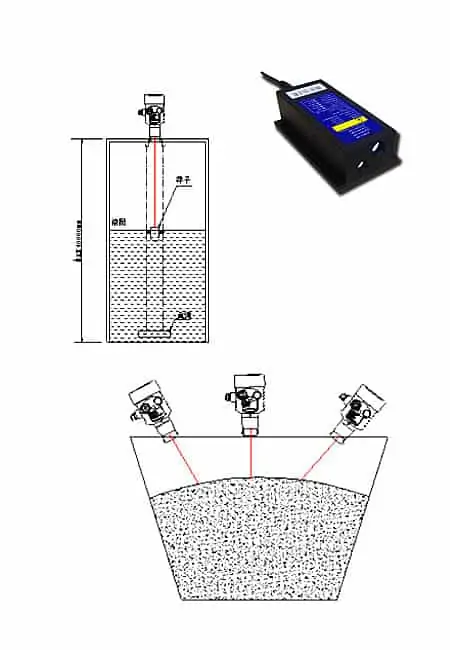
A laser level transmitter measures distance by time of flight: it fires a short pulse of light at the surface, times how long the reflection takes to return, and converts that to a level reading. Because it uses a tightly collimated beam of light rather than a spreading cone of microwave or sound, the measuring spot stays small all the way down the vessel. That narrow beam is the whole point — it ignores nozzle walls, agitator blades, and tank internals that confuse wider-beam devices.
One property matters more than any other: a laser does not care about the dielectric constant of the medium. Radar reflects off the boundary between two materials, and when the product has a low dielectric constant the echo is weak. Light reflects off almost any diffuse surface regardless of its electrical properties, so a laser reads low-DK liquids and dry solids that radar finds difficult. For the contrast in approach, our guide to level measurement technology walks through the full set of methods.
Laser vs radar vs ultrasonic: which wins where?
Each non-contact technology fails in a different way, and the failure mode is what should drive the choice. Match the device to the thing your process does that breaks the others.
| Condition | Laser | Radar (80GHz) | Ultrasonic |
|---|---|---|---|
| Low dielectric constant (DK < 2) | Unaffected | Weak echo | Unaffected |
| Narrow nozzle / stilling well | Best (narrow beam) | Good (80GHz) | Poor (wide cone) |
| Steep solid heap / dust | Good if dust is light | Good | Poor |
| Heavy vapor / steam | Poor (scatter) | Good | Poor |
| Transparent / mirror-like liquid | Poor (no diffuse return) | Good | Fair |
| Cost | Mid–high | Mid | Low |
If your tank space is clean and clear, an 80GHz radar level sensor is usually the simplest answer. Where the surface is hard to see down a long pipe, compare against a radar level gauge selection first, and reserve ultrasonic level for low-cost, clean-air, short-range duty.
When a laser level transmitter beats radar
Reach for the laser in three situations. First, low-dielectric liquids and powders: solvents, oils, plastic pellets, and grain give radar a thin echo, while the laser reads the diffuse surface directly. Second, tight geometry: a narrow stilling well, a small flange, or a tank crowded with internals, where the laser’s pencil beam goes straight down without catching the walls — the same problem a stilling well is built to manage. Third, steep solid heaps: the small footprint lets you aim at a chosen point on an uneven pile instead of averaging a wide cone across peaks and valleys.
On one 12-metre intermediate tank with a condensing vapor headspace, a 26GHz radar lost its echo to attenuation and read erratically. A laser transmitter, immune to dielectric constant and using a narrow beam, held a stable reading once a small air purge kept the lens clear. That combination — narrow beam plus DK-independence — is the laser’s signature win. For multi-tank oversight after you pick the sensor, see our tank level measurement guide.
The honest limits of laser level measurement
A laser is not a cure-all, and treating it as one is the most common selection mistake. It needs a diffuse reflection, so transparent liquids and mirror-bright surfaces give too little return and the reading drops out. Heavy vapor, smoke, or dense dust scatters the beam before it reaches the surface, which is exactly where radar pulls ahead. And the lens is an optical window: any coating, condensation, or dust film on it weakens the signal over time, so dirty service demands routine cleaning or an air purge.
Put plainly: if the headspace is full of steam or the liquid is clear, do not force a laser — choose radar. If the medium has a very low dielectric constant and the geometry is tight, the laser earns its place. When the surface is a conductive liquid you can contact, a guided wave radar level meter sidesteps both vapor and DK problems entirely.
Range, beam, accuracy, and blocking distance
Four numbers decide whether a laser suits your vessel. Range runs from a few metres to several tens of metres depending on surface reflectivity, so always rate range against your actual product, not a mirror target. Accuracy is typically a few millimetres at short range, tightening as the surface reflects better. Beam divergence is small — that is the laser’s advantage — which keeps the spot tight even in deep tanks. Blocking distance, the dead zone just below the sensor, sets how close to full the tank can read; check it against your high-level alarm point. To turn a level reading into stored volume in a horizontal tank, our tank volume calculator handles the geometry. Purpose-built industrial laser level transmitters — the class defined by units such as the ABB LLT100 — pair these specs with a rugged optical head and a purge port; match range, blocking distance, and beam divergence to your vessel rather than to the headline maximum.
Installation and keeping the lens clean
Mount the transmitter so the beam hits the surface perpendicularly and clears all internals on the way down — agitators, ladders, and inlet streams all create false echoes if they sit in the path. Aim at a representative point on a solid heap rather than the slope. In any service with dust or condensation, fit an air purge across the lens; it is the single change that most extends reliable service. Keep the optical window accessible for inspection, and verify the blocking distance and empty-tank calibration during commissioning so the dead zone never masks a real high level.
Related level products
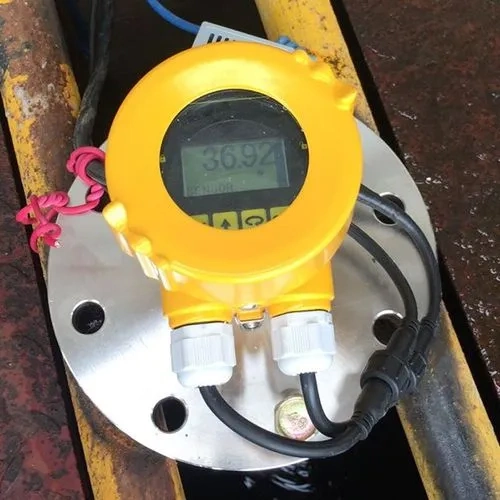
Radar Level Gauge
80GHz and 26GHz non-contact radar for liquids and solids, including vapor and dusty headspaces where a laser struggles. Selection guide with decision tree.
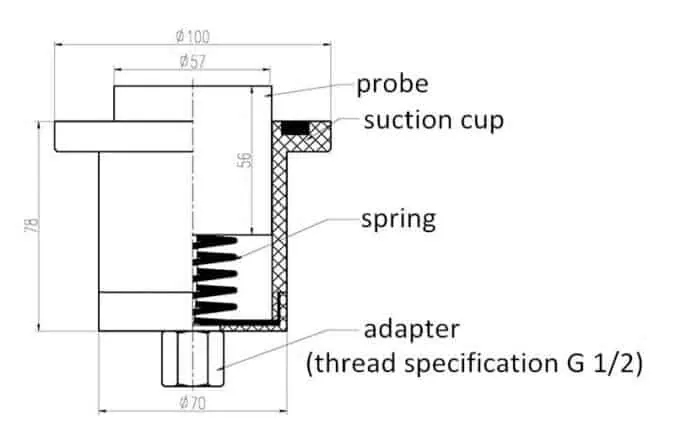
Ultrasonic Level Transmitter
Low-cost non-contact level for clean-air, short-range tanks and open channels. Best where budget matters and vapor and dust are minimal.
Guided Wave Radar Level
Contact probe immune to vapor and low dielectric constant. The fallback when both laser and non-contact radar are defeated by the headspace.
Frequently asked questions
How does a laser level transmitter work?
It measures distance by time of flight — firing a light pulse at the surface and timing the reflection. The narrow beam keeps the measuring spot small, and the reading is independent of the medium’s dielectric constant.
What is the difference between a radar and a laser level sensor?
Radar uses microwave and depends on the medium’s dielectric constant; it handles vapor well. Laser uses light, ignores dielectric constant, and has a much narrower beam, but it is defeated by heavy vapor and transparent surfaces.
What are the disadvantages of laser level measurement?
It needs a diffuse reflection, so transparent or mirror-like liquids read poorly; heavy vapor, smoke, or dust scatters the beam; and the lens must be kept clean, often with an air purge, in dirty service.
Can a laser measure liquid level?
Yes, as long as the liquid surface scatters some light back. It excels on low-dielectric liquids and in narrow shafts, but a clear or highly reflective liquid surface may not return enough signal.
When should I choose laser instead of radar?
Choose laser for low-dielectric media, tight geometry such as stilling wells, and steep solid heaps. Stay with radar when the headspace has heavy vapor or the surface is transparent.
Does a laser level transmitter need maintenance?
The main task is keeping the optical lens clean. In dusty or condensing service, fit an air purge and inspect the window periodically; otherwise the signal weakens as the lens fouls.
About this article
Written and technically reviewed by the Sino-Inst engineering team — last reviewed 2026-05-30 (AI-assisted drafting). Based on time-of-flight level measurement principles and field experience with non-contact level in vapor and low-dielectric service. Questions? reach our application engineers.
Get help choosing a non-contact level transmitter
Tell us your medium, tank height, headspace conditions, and dielectric constant, and our engineers will recommend laser, radar, or guided wave. Request a quote below.
Request a Quote

Wu Peng, born in 1980, is a highly respected and accomplished male engineer with extensive experience in the field of automation. With over 20 years of industry experience, Wu has made significant contributions to both academia and engineering projects.
Throughout his career, Wu Peng has participated in numerous national and international engineering projects. Some of his most notable projects include the development of an intelligent control system for oil refineries, the design of a cutting-edge distributed control system for petrochemical plants, and the optimization of control algorithms for natural gas pipelines.